
SLIDE 1
STOVESAFE
ALERT AND RESPOND
A
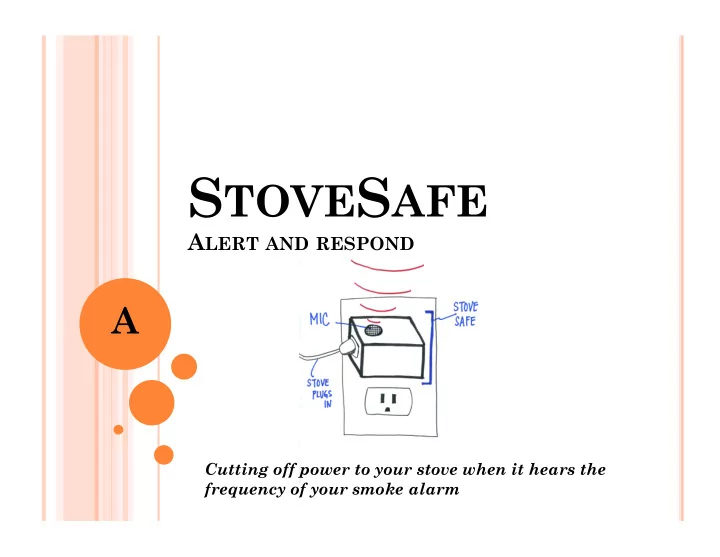
Cutting off power to your stove when it hears the frequency of your smoke alarm
S MOKE D ETECTOR V ARIABILITY Key Challenges Smoke alarm frequency - - PowerPoint PPT Presentation
S TOVE S AFE A LERT AND RESPOND A Cutting off power to your stove when it hears the frequency of your smoke alarm S MOKE A LARM S ENSING S HUTOFF D EVICE Key Problem 108,900 cooking related fires in 2006 Smoke detectors only alert, no
ALERT AND RESPOND
Cutting off power to your stove when it hears the frequency of your smoke alarm
Key Problem
108,900 cooking related fires in 2006 Smoke detectors only alert, no response 4 Stage of Fire: Incipient stage -- Little heat, develops slowly. Smouldering stage – Smoke Flame stage -- Visible flame Heat stage -- Heat, flame, smoke and toxic gases
STOVESAFE
Key Concept
Key Challenges
Smoke alarm frequency is consistently 3.5kHz-4.5kHz
Control Behind Stove, 30 ft.
Distance does not effect frequency
Key Challenges
Loud noise shuts off LED Microphone Micro-Controller Arduino Circuit Board Audio signal can cut power Food smokes before burning, Stove shutoff effective
Special thanks to: Elaine Yang, Dr. Barbara Hughey, Shane Colton, Michael Price, Prof. Joel Voldman, and Prof. David Wallace
Every house is required to have a smoke detector 64% stoves shipped in US in 2008 were electric
(5 million units)
Competition:
Key Challenges
STOVESAFE! Power Strip Smoke Alarm Activation Indicator StoveGuard
No Action Not for stoves Complex, Expensive
Product, Customer, and Market
Product Description: Smoke Alarm Sensing Shutoff Device Intended Customer: Residential Electric Stove Users Market: Kitchen Safety/Fire Safety
Customer Needs Product Attributes Engineering Specifications Easy to install by user Time < 1 hour Compact enough to fit behind stove Thickness < 2.5” Easy to learn how to use Time < 5 min Fast response to smoke alarm Time < 5 sec Few false positives (Accidental stove shut off) % < 5% Few failures (Does not respond to smoke alarm) % < 1% Cost $ < $100
Future Steps
Future Challenges Sensitivity Reset Future Steps Respond to frequency Calibration Components that handle higher currents