Rules vs. Responsibilities Rule: Scientific Misconduct Policy - - PowerPoint PPT Presentation

rules vs responsibilities
SMART_READER_LITE
LIVE PREVIEW

Rules vs. Responsibilities Rule: Scientific Misconduct Policy - - PowerPoint PPT Presentation

Rules vs. Responsibilities Rule: Scientific Misconduct Policy Responsibility: Professional Conduct Principles to communicate Statements to define specific expectations, aspirations and requirements or prohibitions and


slide-1
SLIDE 1

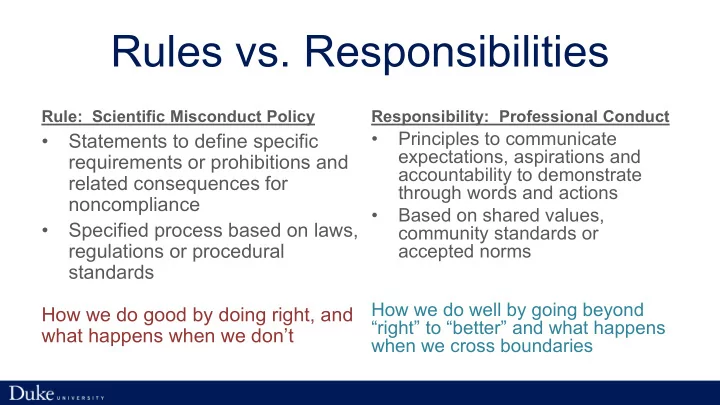
Rules vs. Responsibilities

Rule: Scientific Misconduct Policy

  • Statements to define specific

requirements or prohibitions and related consequences for noncompliance

  • Specified process based on laws,

regulations or procedural standards How we do good by doing right, and what happens when we don’t

Responsibility: Professional Conduct

  • Principles to communicate

expectations, aspirations and accountability to demonstrate through words and actions

  • Based on shared values,

community standards or accepted norms How we do well by going beyond “right” to “better” and what happens when we cross boundaries

slide-2
SLIDE 2

Codified Expectations

Faculty Handbook

5.2.2.7 Misconduct in Research Misconduct in research is defined as fabrication, falsification, or plagiarism. In addition, other practices that seriously deviate from those that are commonly accepted within the research community for proposing, conducting, or reporting research may also constitute misconduct in research. These practices are covered by the Duke University Policy and Procedures Governing Misconduct in Research (in Appendix P). As noted in that policy, "misconduct" does not include honest error or differences of opinion.

Institutional Code of Conduct

This document serves as a statement of responsibilities for all members of the Duke community to adhere to institutional values and policies, and to abide by all applicable legal and compliance requirements…. Research and Scientific Integrity: Research at Duke is integral to its mission and must always be conducted to the highest ethical standards and in compliance with all applicable laws, regulations, policies and contractual

  • bligations.
slide-3
SLIDE 3

Culture and Values

Respect • Trust • Inclusion • Discovery • Excellence

Shared values - along with codified professional standards, codes of conduct and personal beliefs – influence institutional culture through:

  • individual behaviors and actions
  • commitment to integrity
  • accountability to self, colleagues, students, peers and community
slide-4
SLIDE 4

Case Examples

Research Misconduct

  • Background elements

– Access to data – Authorship dispute – Academic productivity

  • Investigation approach
  • Outcomes and recommendations

Research Bias

  • Background elements:

– Dual financial interest – Public disclosure expectations – Position of influence

  • Investigation approach
  • Outcomes and recommendations
slide-5
SLIDE 5

A Culture of Research Integrity

Normative Ethics Right versus wrong Compliance Within bounds

  • f laws,

regulations, policies Rigor and Reproducibility Doing “good science” Social Value Doing science that society values Workplace relationships Environment to conduct sound work Five Dimensions of Research Ethics. Academic Medicine.93;550-555.

slide-6
SLIDE 6

Stakeholders Need to ACT to Move Beyond Good Intentions

slide-7
SLIDE 7

Inclusive

  • All

stakeholders need to participate Comprehensive

  • Education,
  • versight and

accountability Multifaceted

  • Holistic

approach across all dimensions of research integrity Pragmatic

  • Provide

resources and tools to make it “easy” to do the right thing Empowering

  • Empower

community and stakeholders to speak up

Key Principles of Duke Research Integrity Culture

slide-8
SLIDE 8

Key DOSI Initiatives

Education and Training

  • Faculty and Staff Responsible Conduct of Research (RCR) Training Program
  • RCR training for Administrators
  • Research Town Hall

Best Practices

  • Scientific Accountability and Culture Plans (SCAPs)
  • Data Management Documentation
  • Electronic Research Notebook
  • Core and Shared Resource Reviews

Accountability

  • Policy Attestation systems

Measuring Effectiveness

  • SOURCE Survey
slide-9
SLIDE 9

Appendix

Examples of DOSI Initiatives

slide-10
SLIDE 10

Research Town Hall

Whose Paper is it Anyway? A Discussion on Authorship

January 07, 2019

1:30 - 3:00pm • Great Hall, Trent Semans Center

Geeta S Swamy, Vice Dean and Associate Vice Provost for Scientific Integrity Mich chael C

  • C. Fitzgerald

Professor and Dir. of Graduate Studies, Department of Chemistry Cathleen een C Colon-Emeric, c, Professor of Medicine and Office of Research Mentoring Raphael V l Vald ldiv ivia ia, Professor, Department of Molecular Genetics and Microbiology Eli lise S Smith, Fellow, National Institute of Environmental Health Sciences Jennifer A Ahern-Dodson, Assistant Professor of the Practice in the Thompson Writing Program

Join u n us f for a an interactive d discus ussion n on a autho horshi hip p allocation, n, o

  • rderi

ring ng a and d disput pute r resolut ution.

http://duke.is/JGLUKp

*Fulfills the faculty and staff RCR training requirement.

slide-11
SLIDE 11

Whose Paper is it Anyway? A Discussion on Authorship

  • Estimated Attendance: 200 ppl

– Offered as RCR credit

  • Post-Event Survey: 76 ppl

70% 24% 6% Did you learn something that will help your research?

Yes Maybe No

0% 10% 20% 30% 40% 50% 60% 70% 80% 90% 100% Research town hall topic Discussion with panelists

Event rating

Excellent Good Average Poor Terrible

slide-12
SLIDE 12

Research Town Hall

Plagiarism and Intellectual Credit

February 06, 2019

1:00 - 2:30pm • Great Hall, Trent Semans Center

Chr Chris S Simon, Associate Professor in Population Health Sciences, Moderator Paneli lists: Cary Mo Moskovit itz, Professor of the Practice in the Thompson Writing Program David id Ha Hansen, Associate University Librarian for Research, Collections and Scholarly Communication Donna K Kessle ler, Research Misconduct Review Officer John Klin ingensmit ith, , Associate Dean for Academic Affairs, Graduate School

Join u n us f for a an interactive d discus ussion n on p plagiari rism a and nd intell ellectual c l cred edit – the i issues es, the s stakehold lder ers, and the n need ed f for actio ion.

http://duke.is/H3QPgW

*Fulfills the faculty and staff RCR training requirement.

slide-13
SLIDE 13

Plagiarism and Intellectual Credit

  • Estimated Attendance: 190 ppl

– Offered as RCR credit

  • Post-Event Survey: 59 ppl

81% 14% 5% Did you learn something that will help your research?

Yes Maybe No

10 20 30 40 50 60 Research town hall topic Discussion with panelists

Event Rating

Excellent Good Average Poor Terrible

slide-14
SLIDE 14

Scientific Culture and Accountability Plan (SCAP)

Goal

  • Ensure Departments, Centers and Institutes communicate clear expectations about localized

research integrity culture

Approach

  • All SOM Departments, Centers and Institutes required to develop a SCAP and post it on their

website

Intended Audience

  • For all within a specific Department, Center and Institute

Key Features

  • DOSI available for consultation and reviews, as well as provides guidance documents
slide-15
SLIDE 15

Data Management Plan

Goal

  • Promote good data management practices across the Data Life Cycle

Approach

  • All SOM wet labs required to document their data management practices

Intended Audience

  • Individuals within a laboratory or research unit

Key Features

  • ASIST available for consultation and reviews, as well as provides template
slide-16
SLIDE 16

Data Management Plans Next steps

  • OARC completed review of SOM DMPs Fall 2018;

draft report provided

  • Based on OARC report, working to implement

policy changes to improve effectiveness of DMPs

– New DMP format developed with Duke University Libraries – New policies (i.e., review, attestation, quality assurance)

  • Expand DMPs to all Duke Schools
slide-17
SLIDE 17

Research Town Hall

Caring for Your Data:

Data Management Resources at Duke

Wednesday, April 10, 2019

1:00 - 3:00 pm

Great Hall, Trent Semans Center

1:00 - 2:15 pm Resource Presentations 2:15 - 3:00 pm Resource Fair Participating Groups

  • Duke Clinical Research Institute
  • Duke Health Technology Solutions
  • Duke Office of Clinical Research
  • Duke University Libraries
  • IT Security Office
  • Medical Center Library
  • Office of Information Technology
  • Office of Scientific Integrity
  • Research Data Security

http://duke.is/EHebi M

Come l e learn a about d data m managem ement nt resources at D Duke to hel elp c care f e for your d data t throughout t the e data l life c e cycle!

*Fulfills the faculty and staff RCR training requirement.

slide-18
SLIDE 18

Supporting Data Life Cycle

  • Electronic Research Notebooks (ERNs) are used to

electronically capture laboratory information

  • Multiple benefits:

– Data are searchable and accessible anywhere – Less/no paper notebooks – Secure storage in central location – Allows signing, file versioning, and activity tracking in support of data provenance – Data easily shared with PI and/or collaborators

  • Duke has purchased an institutional license

– Soft launch January 2019 with full roll-out April 1, 2019 – Over 300 users as of this week

slide-19
SLIDE 19

Measuring Effectiveness: SOURCE Survey

  • Survey of Organizational Research Climate (SOURCE) is a validated

instrument to assess the climate of research integrity with academic institutions

  • Key domains assessed:

– Responsible Conduct of Research – Regulatory Quality – Integrity Socialization – Integrity Norms – Advisor-Advisee Relations – Lack of Integrity Inhibitors – Departmental Expectations

  • Nearly 1,500 Duke SOM researchers completed baseline survey in 2017
  • Plan to repeat in 2020 to assess any changes and consider University-wide

distribution