RSA Parameter Generation Bob needs to: - find 2 large primes p,q - - - PowerPoint PPT Presentation

rsa parameter generation
SMART_READER_LITE
LIVE PREVIEW

RSA Parameter Generation Bob needs to: - find 2 large primes p,q - - - PowerPoint PPT Presentation

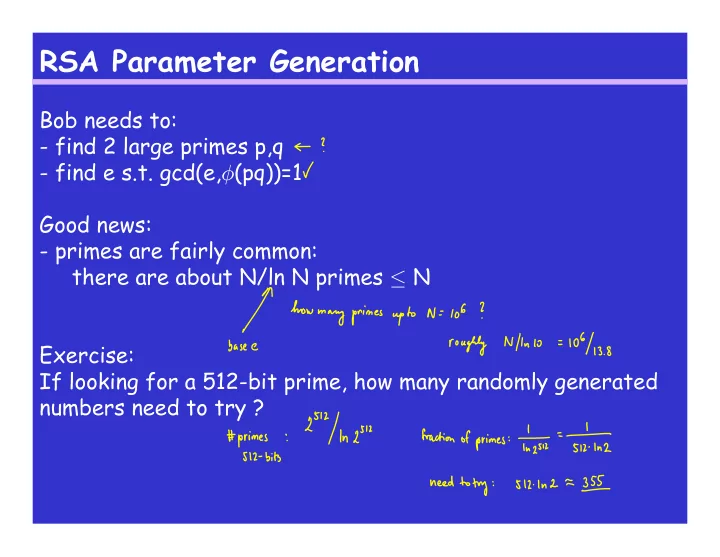
RSA Parameter Generation Bob needs to: - find 2 large primes p,q - find e s.t. gcd(e, (pq))=1 Good news: - primes are fairly common: there are about N/ln N primes N Exercise: If looking for a 512-bit prime, how many randomly generated

slide-1
SLIDE 1

RSA Parameter Generation

Bob needs to:

  • find 2 large primes p,q
  • find e s.t. gcd(e,φ(pq))=1

Good news:

  • primes are fairly common:

there are about N/ln N primes ≤ N Exercise: If looking for a 512-bit prime, how many randomly generated numbers need to try ?

slide-2
SLIDE 2

RSA Parameter Generation

We need to decide: Given a number x, how to determine if x is a prime ? What is the running time ?

slide-3
SLIDE 3

Primality Testing

Until recently, no (deterministic) poly-time algorithm for primality testing. In 2002, Agrawal, Kayal, and Saxena: Primality testing is in P !!!

slide-4
SLIDE 4

Primality Testing

Good news: there is a faster approach using randomization First, some terminology: A yes-biased Monte Carlo algorithm is a randomized algorithm that:

  • if the algo says YES, then the answer is correct
  • if the algo says NO, then the answer might be incorrect, but

this happens with a small probability More precisely, there is a (small) error probability ²>0 s.t. for any “yes” instance, the algo says NO with probability ≤² (considering all possible random choices of the algo).

slide-5
SLIDE 5

Primality Testing

Good news: there is a faster approach using randomization (yes-biased Monte Carlo algorithm to determine if an input number is composite) First, some terminology: A yes-biased Monte Carlo algorithm is a randomized algorithm that:

  • if the algo says YES, then the answer is correct
  • if the algo says NO, then the answer might be incorrect, but

this happens with a small probability More precisely, there is a (small) error probability ²>0 s.t. for any “yes” instance, the algo says NO with probability ≤² (considering all possible random choices of the algo).

slide-6
SLIDE 6

Primality Testing – randomized attempt 1

Fermat’s Little Theorem (pg 79): If p is a prime, then ap-1 ≡ 1 (mod p) for all a∈Zp-{0} PseudoPrime(x):

  • 1. Choose random a, 1 ≤ a ≤ x − 1.
  • 2. if ax−1 ≡ 1 (mod x):
  • 3. return prime
  • 4. else

5. return composite Is this a yes-biased Monte Carlo algorithm ? For primes ? For composites ? Polynomial-time ?

slide-7
SLIDE 7

Primality Testing – randomized attempt 1

Problem: There are composite numbers for which the Fermat’s Little Theorem holds. (A composite number x is a Carmichael number if ax-1 ≡ 1 (mod x), for every a∈Zx-{0}) Good news: Carmichael numbers are very rare: only 255 Carmichael numbers smaller than 109 (the first three are 561, 1105, and 1729). Bad news: What is ² for our algo from the previous slide ?

slide-8
SLIDE 8

Miller-Rabin

Miller-Rabin(x):

  • 1. Find k,m such that x−1 = 2km, where m is odd
  • 2. Choose random a, 1 ≤ a ≤ x−1
  • 3. Let b = am mod x
  • 4. if b ≡ 1 (mod x): return prime
  • 5. for i=0 to k−1:
  • 6. if b ≡ −1 (mod x): return prime
  • 7. else: b = b2 mod x
  • 8. return composite

This is a polynomial-time yes-biased Monte Carlo algorithm that tests whether x is composite. Why ? Note: ² ≤ ¼ (we will not prove this)

slide-9
SLIDE 9

Miller-Rabin

Miller-Rabin(x):

  • 1. Find k,m such that x−1 = 2km, where m is odd
  • 2. Choose random a, 1 ≤ a ≤ x−1
  • 3. Let b = am mod x
  • 4. if b ≡ 1 (mod x): return prime
  • 5. for i=0 to k−1:
  • 6. if b ≡ −1 (mod x): return prime
  • 7. else: b = b2 mod x
  • 8. return composite

This is a polynomial-time yes-biased Monte Carlo algorithm that tests whether x is composite. Why ? Note: ² ≤ ¼ (we will not prove this)

slide-10
SLIDE 10

RSA Questions

  • Eve can compute the e-th root modulo n to decrypt…

The catch: computing roots mod n as hard as factoring !

  • If Bob chooses p,q but one of them will not be a prime,

will RSA still work ?

  • Can Eve precompute all products of 512-bit primes, to have a

table (and factorization) of all possible n ?