ROYAL DUTCH SHELL PLC THIRD QUARTER 2019 RESULTS OCTOBER 31 ST 2019 - - PDF document

royal dutch shell plc third quarter 2019 results
SMART_READER_LITE
LIVE PREVIEW

ROYAL DUTCH SHELL PLC THIRD QUARTER 2019 RESULTS OCTOBER 31 ST 2019 - - PDF document

ROYAL DUTCH SHELL PLC THIRD QUARTER 2019 RESULTS OCTOBER 31 ST 2019 THIRD QUARTER 2019 RESULTS WEBCAST TO MEDIA AND ANALYSTS BY JESSICA UHL, CHIEF FINANCIAL OFFICER OF ROYAL DUTCH SHELL PLC Ladies and gentlemen, Welcome to Shells third quarter


slide-1
SLIDE 1

ROYAL DUTCH SHELL PLC THIRD QUARTER 2019 RESULTS

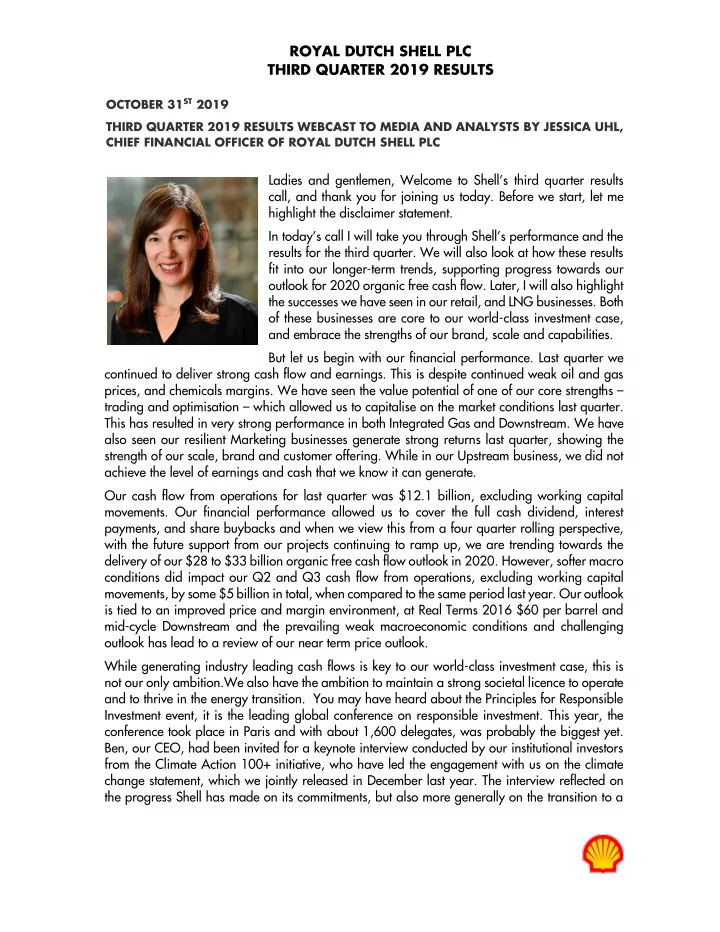
OCTOBER 31ST 2019 THIRD QUARTER 2019 RESULTS WEBCAST TO MEDIA AND ANALYSTS BY JESSICA UHL, CHIEF FINANCIAL OFFICER OF ROYAL DUTCH SHELL PLC

Ladies and gentlemen, Welcome to Shell’s third quarter results call, and thank you for joining us today. Before we start, let me highlight the disclaimer statement. In today’s call I will take you through Shell’s performance and the results for the third quarter. We will also look at how these results fit into our longer-term trends, supporting progress towards our

  • utlook for 2020 organic free cash flow. Later, I will also highlight

the successes we have seen in our retail, and LNG businesses. Both

  • f these businesses are core to our world-class investment case,

and embrace the strengths of our brand, scale and capabilities. But let us begin with our financial performance. Last quarter we continued to deliver strong cash flow and earnings. This is despite continued weak oil and gas prices, and chemicals margins. We have seen the value potential of one of our core strengths – trading and optimisation – which allowed us to capitalise on the market conditions last quarter. This has resulted in very strong performance in both Integrated Gas and Downstream. We have also seen our resilient Marketing businesses generate strong returns last quarter, showing the strength of our scale, brand and customer offering. While in our Upstream business, we did not achieve the level of earnings and cash that we know it can generate. Our cash flow from operations for last quarter was $12.1 billion, excluding working capital

  • movements. Our financial performance allowed us to cover the full cash dividend, interest

payments, and share buybacks and when we view this from a four quarter rolling perspective, with the future support from our projects continuing to ramp up, we are trending towards the delivery of our $28 to $33 billion organic free cash flow outlook in 2020. However, softer macro conditions did impact our Q2 and Q3 cash flow from operations, excluding working capital movements, by some $5 billion in total, when compared to the same period last year. Our outlook is tied to an improved price and margin environment, at Real Terms 2016 $60 per barrel and mid-cycle Downstream and the prevailing weak macroeconomic conditions and challenging

  • utlook has lead to a review of our near term price outlook.

While generating industry leading cash flows is key to our world-class investment case, this is not our only ambition.We also have the ambition to maintain a strong societal licence to operate and to thrive in the energy transition. You may have heard about the Principles for Responsible Investment event, it is the leading global conference on responsible investment. This year, the conference took place in Paris and with about 1,600 delegates, was probably the biggest yet. Ben, our CEO, had been invited for a keynote interview conducted by our institutional investors from the Climate Action 100+ initiative, who have led the engagement with us on the climate change statement, which we jointly released in December last year. The interview reflected on the progress Shell has made on its commitments, but also more generally on the transition to a

slide-2
SLIDE 2

ROYAL DUTCH SHELL PLC THIRD QUARTER 2019 RESULTS

net-zero emissions environment. Importantly our investors highlighted Shell as leading in addressing climate change in our sector and we continue to work actively with investors across sectors to accelerate action. We believe we are taking meaningful steps to provide solutions and reshape our business models to thrive through the energy transition. I would now like to move on to some of our recent portfolio highlights. In Q3, active portfolio shaping continued. We achieved 2 FIDs, 4 start-ups, 3 new opportunities for growth and 3 divestments. In the third quarter, we saw the start-up of two projects in Nigeria: the Forcados Yokri Integrated Project and the Southern Swamp Associated Gas Gathering

  • Project. In Nigeria, the levels of hydrocarbons flared from the SPDC joint-venture facilities have

fallen by close to 90% between 2002 and 2017. SPDC remains committed to eliminating associated gas flaring with reductions already realised from gas gathering initiatives while it continues to invest in facilities that capture the associated gas and commercialise it through domestic and export markets. These two projects add to these efforts and show the JV’s commitment to the development of the Delta State and Nigeria through its strong relationships to support business growth and our societal license to operate. In October we announced our final investment decision on the Pierce Depressurisation Project in the UK Continental Shelf building on our significant presence in the North Sea. The development work will take place between 2020 and 2021, and once complete, the Pierce gas field is expected to produce more than 30,000 barrels of oil equivalent per day at peak production. In September, we announced the completion of the Gumusut-Kakap Phase 2 project, in Malaysia. At peak production, the four additional wells that we have drilled will add 50,000 barrels of oil equivalent per day to the semi-floating production system. This will achieve the rated production capacity of this project of 165,000 barrels of oil equivalent per day. Each of these are great examples of how we are unlocking opportunities and future value, and through the combination of brownfield and greenfield projects, we will support our next phase

  • f growth.

Now let us turn to our financials for the quarter. For Q3, cash flow from operations excluding working capital movements was $12.1 billion. As I have also highlighted, we continue to see pressure on prices and margins for oil, gas, and

  • chemicals. Oil and gas price softened further while there was some recovery in refining margins,

with overall realized prices and margins lower when compared with Q3 last year. In the third quarter, Brent was at an average price of $62 per barrel and our organic free cash flow was $6.6 billion. Earnings amounted to $4.8 billion and our return on average capital employed was 8.1%. For Q3 2019, our gearing was 27.9%, or 23.5% on an IAS 17 basis. Our cash capital expenditure in the quarter was $6.1 billion. And for the full year 2019, we will keep our spend around the lower end of the $24 to $29 billion cash capital range. Our share buyback programme is progressing with some $12 billion in shares purchased to date, since the start of the programme in July 2018. And the next tranche of up to $2.75 billion begins today. During the last quarter, we bought back $2.9 billion of shares. We have now offset all scrip dividends issued post the BG Group combination. While our intention to buyback $25

slide-3
SLIDE 3

ROYAL DUTCH SHELL PLC THIRD QUARTER 2019 RESULTS

billion of shares remains unchanged, the pace of the programme is subject to our progress on debt reduction and macro conditions. We are conscious of the risks to the economy and the outlook for the Upstream and Downstream macro environments, while acting in line with our commitment to preserve our Financial

  • Framework. With the prevailing weak macroeconomic conditions and challenging outlook,

including refining and chemical margins at below mid-cycle levels, the ability to reduce gearing to 25% and completing the share buyback programme may take additional time. We review the share buyback amount on a quarter by quarter basis. Now let us look at our earnings in more detail. Q3 2019 earnings were down largely due to lower prices and margins. Earnings in the third quarter were $4.8 billion, some 15% lower than in Q3 2018. In our Integrated Gas business, total production was 4% higher compared with the third quarter

  • f 2018. This was a result of new fields ramping up in Australia and Trinidad and Tobago. LNG

liquefaction volumes increased by 9% compared with the third quarter 2018. LNG liquefaction volumes increased mainly as a result of new LNG capacity from Prelude as well as increased feed gas availability compared with the third quarter 2018. Integrated Gas earnings were $2.7 billion, reflecting higher volumes and significantly stronger contributions from LNG trading and

  • ptimisation. These earnings were partly offset by lower realised LNG, oil and gas prices.

In Upstream, earnings were some $900 million, reflecting lower oil and gas prices, lower gas production, and increased well write-offs mainly in Kazakhstan. These well write-offs are a result

  • f the decision not to progress the Kalamkas and Khazar projects. These projects were not

deemed competitive versus other opportunities in Shell’s global portfolio. Shell is one of the largest investors in Kazakhstan and looks forward to continuing its co-operation with the Republic

  • f Kazakhstan on future projects in the country. Third-quarter Upstream production decreased

by 2% compared with the same quarter a year ago. This was caused by portfolio effects and weaker operational performance in the Gulf of Mexico and Norway. Excluding divestments and

  • ther portfolio effects, production was up 2% over the same period.

In Downstream, earnings were $2.2 billion in the third quarter, up from $2.0 billion in the same quarter last year. This reflects higher Marketing returns, and also includes stronger contributions from oil products trading and optimisation, as we realised opportunities from our well-positioned and integrated portfolio in the lead up to the International Maritime Organisations’ stricter environmental rules for shipping fuel, which will start on the 1st of January 2020. Our Downstream earnings were partly offset by lower realised margins for refining, base chemicals and intermediates. In the Corporate segment, our underlying earnings excluding identified items were aligned with the latest outlook where we also highlighted a weakening of the Brazilian real, generating a negative earnings impact. Now that we have covered our earnings, let me turn to cash flow. Our cash flow from operations, excluding working capital movements, amounted to $12.1

  • billion. This is $2.6 billion lower than in Q3 last year. In our Integrated Gas business, cash flow
slide-4
SLIDE 4

ROYAL DUTCH SHELL PLC THIRD QUARTER 2019 RESULTS

from operations in Q3 2019 was $4.2 billion, some $900 million or 27% higher than Q3 2018. In Upstream, our cash flow from operations was $4.4 billion, around $2.3 billion lower than in the same quarter last year. In our Downstream business, our cash flow from operations was $3.2 billion, some $2.2 billion higher in Q3 2019 when compared with Q3 2018. This largely reflects the negative impact on working capital in Q3 2018, resulting from higher inventory price and volume movements. Now let us review how we have delivered over a longer period. On this slide, you can see our financial trends across an extended period and as I have said in previous quarters, they are moving in the right direction, particularly given the softer macro in Q3. Looking at our gearing, this was 27.9% at the end of Q3 2019, more or less at the same level as Q2 2019. There are a number of factors effecting our gearing calculation, such as additional leases being brought onto our balance sheet, and movements in equity through revaluation of

  • ur pension liabilities. For example, last quarter, we brought the lease for the Elba LNG terminal

in the US onto our balance sheet, adding $1.4 billion to our net debt. And with the current

  • utlook on macro, equity movements and lease recognition, gearing is likely to stay above 25%

during 2020, on an IFRS 16 basis. Our net debt at the end of Q3 2019 was around $75 billion on an IFRS 16 basis. This is some $7 billion lower than at the end of 2017. It is important to note that we have been deleveraging

  • ur balance sheet and our priority remains to reduce net debt in 2020. We remain committed

to maintaining AA equivalent credit metrics. Now you have seen the quarterly results and how these fit into our four quarter rolling financials, let us look at how this supports our 2020 organic free cash flow outlook. This outlook is based on Real Terms 2016 $60 and mid-cycle Downstream and prices in the second and third quarters have been below this level. On a normalised four quarter rolling basis, we have generated some $21 billion of organic free cash flow. Our growth in cash flows, towards 2020 from key operating assets, is supported by the ramp-up at Prelude and Appomattox. Since start-up, Prelude has delivered a total of 8 LNG cargoes, as well as condensate and LPG. Our focus remains on safe and reliable operations as we continue the production ramp-up. Appomattox is also ramping up, producing around 45 thousand barrels of oil equivalent per day over the last month from three wells with fifteen more wells in the total drilling program yet to come online. This means production from Appomattox will continue to increase in a phased manner as we bring more wells online in 2020. With these assets safely ramping up, and after adding back the impact from IFRS 16, you can see that we are progressing towards the range

  • f $28 to $33 billion organic free cash flow by the end of 2020.

Last quarter we saw strong cash flow and earnings, despite continued weak margins and lower

  • il and gas prices. This shows our resilience through the cycle.

Before I wrap-up, I wanted to talk in more detail about two of our businesses that have delivered competitive and resilient returns during the third quarter: LNG and Retail.

slide-5
SLIDE 5

ROYAL DUTCH SHELL PLC THIRD QUARTER 2019 RESULTS

We are a market leader in LNG and our portfolio is unmatched, with diverse supply and demand positions across the world. In 2018, we sold some 71 million tonnes of LNG, a 22% share of worldwide sales. The majority of our volumes, some 58 million tonnes last year, is sourced on a long-term basis. And this is largely matched by long-term sales agreements. The pricing of more than 80% of these term contracts is linked to the oil price, typically with three to six months’ time

  • lag. In addition to our term volumes, we choose to purchase or sell additional LNG on the spot
  • market. These transactions are discretionary and we only pursue them if they are value-accretive.

While the value we generate from spot and optimisation opportunities might vary from quarter to quarter, our world-class trading and optimisation capabilities allow us to deliver material and resilient cash flows from our leading portfolio. The performance last quarter demonstrates our strength in trading and optimisation, and it also shows how the current weak spot LNG prices have little impact on profitability in our business, with the oil price remaining the main macro driver for the Integrated Gas results. Now, let me touch upon another topic that is of interest to market observers and investors: LNG contract price reviews. Price reviews are a normal feature of long-term contracting and can differ from contract to contract. Contracts typically include terms detailing the timing of contract amendments and how revised pricing will be established. For example, while a contractual price formula may change, it would be extremely unusual for the underlying price indexation to

  • change. From the price reviews that are currently ongoing in our portfolio, we do not expect a

significant impact on this or next year’s results. Our 2025 cash flow outlook already takes into account anticipated changes from price reviews, where required. And let’s not lose sight of the longer-term fundamentals of the LNG market. Natural gas plays a key role in the transition to a cleaner energy system and as we said at our Management Day earlier this year, we expect LNG demand to grow at 4% per year. We are planning to grow with it, keeping our leading position. Not only do we expect growing demand, we also see a supply gap emerging in the mid-2020s, once the current wave of new liquefaction capacity has been

  • absorbed. Consequently, we are seeing continued interest in long-term contracts from LNG
  • buyers. In Hong Kong, for example, we recently signed a long-term agreement for the supply of

LNG for its first LNG Terminal. This secures a new market in Asia. You can see why we believe in LNG as a fuel and as a strong business and why we are committed to continue investing in

  • ur LNG portfolio to grow cash and returns.

Another part of the business that did particularly well during Q3 was Retail. I thought it would be useful to share some of the progress we have made with the Retail growth strategy we presented at the Downstream Open House, in March last year. Our Retail business currently serves more than 30 million customers every day with more than 45,000 sites in almost 80 countries, enabling Downstream to generate $3.2 billion in cash flow from operations in Q3. And there is more to come. We are on track to deliver on our 2025 growth targets and reach 55,000 service stations in more than 90 countries, serving more than 40 million customers every day. We will do this by extending our leading position through three key strengths: our scale, our brand recognition with differentiated product and service offerings, and our excellent customer focus.

slide-6
SLIDE 6

ROYAL DUTCH SHELL PLC THIRD QUARTER 2019 RESULTS

Let me start with the scale of our facilities. We aim to expand in key growth markets like China, India, Indonesia, Mexico and Russia through adding 5,000 new sites across these markets by

  • 2025. Since 2017, in addition to optimising our existing portfolio position, we have added

around 1,000. China is significant for our growth ambitions. We have been investing materially to strengthen our brand there, now reaching the third position overall in this market and

  • ccupying the leading position among international energy companies. Apart from growing in

new markets, we are also increasing our existing markets by adding 5,000 new sites compared to 2017 by 2025. So far, in addition to optimising our existing portfolio position, we have added

  • ver 1,500. Another area for expansion is our convenience stores. We want to add 5,000 stores

across our network by the end of 2025, compared to 2017. To date, we have added more than 1,500. Our convenience stores bring me to the second and third way to extend our leading position with

  • ur brand recognition through our products and services. Like our premium fuel Shell V-Power,

which currently constitutes one in every five litres of fuel we sell in the world. And like our non- fuel retail offerings such as coffee and lubricants. Non-fuel retail margins have increased by 10% compared to last year. Lubricants play an important role in this result. To meet growing demand, this year we have opened 400 additional Shell lubricant servicing outlets, where people can have the oil in their vehicle changed and have minor check-up or repairs done. Another successful service we want to keep growing is Shell Fleet Solutions, which now has more than 8 million

  • customers. We support our customers by playing a leading role in the handling of electronic tolls

for transport companies. The driver uses one Shell card to pay for tolls and fuels and the company receives one periodic invoice, making the administration experience easier. In addition to our facilities and products, another way to extend our leading position in Retail is through our customer focus. We have 500,000 service employees working for us around the

  • world. And they make sure Shell meets the needs of our customers today, and in the future. This

means we keep evolving to meet the changing needs of our customers. Across our Retail portfolio, for example, we continue to expand our presence in electric battery car charging. Shell Recharge,

  • ur fast charging brand is now present in 300 forecourts across our global network. Also, in

Q2, we introduced carbon-neutral driving in the Netherlands. This means Shell will offset customer’s emissions by purchasing carbon credits generated from projects that plant and protect nature like forests, wetlands and other natural eco-systems. Earlier this month, results showed that 1 in every 5 customers are choosing to drive carbon neutral when fuelling at Shell. And, since the 10th of October, customers in the UK can also drive carbon-neutral through our loyalty app GO+. We aim to expand the offer for carbon-neutral driving into more countries. While the Retail business is supporting our ambitions of being a world-class investment case and helping Shell thrive through the Energy Transition, we are also committed to building a business that has a strong license to operate. There are several initiatives Retail is undertaking to support this, for example, how we connect with larger initiatives like playing an active role in finding lasting solutions to end plastic waste. Shell’s retail business is helping its service stations and customers reduce, reuse and repurpose waste across its operations and supply chain, with initiatives from incentivizing reusable cups and bags, to converting plastic waste into eco-bricks.

slide-7
SLIDE 7

ROYAL DUTCH SHELL PLC THIRD QUARTER 2019 RESULTS

As you can see, Retail is delivering strong results for Shell. And by offering more and cleaner choices to motorists around the world, Retail will continue to grow. In summary, Shell showed its competitiveness and resilience in Q3, delivering strong cash flow and earnings, despite a challenging macro environment and some operational shortfalls. Our Upstream, Refining and Chemicals businesses certainly have the potential to generate more cash. You saw our Marketing business generate resilient returns and our trading and optimisation teams, in Downstream and Integrated Gas clearly did very well last quarter. Looking forward, especially with projects like Appomattox and Prelude ramping up, and continued focus on improving asset performance, we will further strengthen and grow the cash flows from our businesses to continue to progress towards our 2020 outlook and the ambition we expressed to strengthen our balance sheet and grow shareholder distributions sustainably. In summary, there are two key messages for the third quarter: the first is we continue to demonstrate delivery of our strategy and therefore achieve competitive and resilient cash flow

  • delivery. The second is weaker macro conditions today and outlook matters to us, today’s

performance and our trajectory. Given the relationship of the macro to our outlook, we thought it would be good to hear directly from Ben, so Ben has joined me for the Q&A session today. With that, let’s go for your questions. Please, could we have just one or two each, so everyone has the opportunity to ask a question. Thank you for your questions and for joining the call today. The fourth quarter results are scheduled to be announced on the 30th of January 2020, it will be a webcast call rather than a face-to-face event. Both Ben and I will talk to you all then.

ROYAL DUTCH SHELL PLC OCTOBER 31ST 2019 WWW.SHELL.COM/IR

slide-8
SLIDE 8

ROYAL DUTCH SHELL PLC THIRD QUARTER 2019 RESULTS

DEFINITIONS AND CAUTIONARY NOTE

NOT FOR RELEASE, PRESENTATION, PUBLICATION OR DISTRIBUTION IN WHOLE OR IN PART IN, INTO OR FROM ANY JURISIDICTION WHERE TO DO SO WOULD CONSTITUTE A VIOLATION OF THE RELEVANT LAWS OF SUCH JURISDICTION. Gearing is defined as net debt (current and non-current debt less cash and cash equivalents, adjusted for the fair value

  • f derivative financial instruments used to hedge foreign exchange and interest rate risks relating to debt, and

associated collateral balances) as a percentage of total capital (net debt plus total equity). Free Cash Flow is defined as the sum of “Cash flow from operating activities” and “Cash flow from investing activities”. Organic free cash flow is defined as free cash flow excluding inorganic capital investment and divestment proceeds. Cash flow from operating activities excluding working capital movements is defined as “Cash flow from operating activities” less the sum of the following items in the Consolidated Statement of Cash Flows: (i) (increase)/decrease in inventories, (ii) (increase)/decrease in current receivables, and (iii) increase/(decrease) in current payables. ROACE on a CCS basis excluding identified items is defined as the sum of CCS earnings excluding identified items for the current and previous three quarters, adjusted for after-tax interest expense, expressed as a percentage of the average capital employed for the same period. The after-tax interest expense is calculated using the effective tax rate for the same period. Capital employed consists of total equity, current debt and non-current debt. Presented ROACE (return on average capital employed) is ROACE on a CCS basis excluding identified items unless stated otherwise. Historical ROACE for individual segments presented as reported (not restated for Q1 2019 definition change). Earnings on a current cost

  • f supplies basis (CCS earnings) is the income for the period, adjusted for the after-tax effect of oil-price changes on
  • inventory. Presented earnings is CCS earnings attributable to shareholders excluding identified items unless stated
  • therwise. Basic CCS earnings per share is calculated by dividing CCS earnings attributable to shareholders by the

average number of shares outstanding over the year. Presented earnings per share is basic CCS earnings per share excluding identified items unless stated otherwise. Cash capital expenditure was introduced with effect from January 1, 2019, comprising the following lines from the Consolidated Statement of Cash Flows: Capital expenditure, Investments in joint ventures and associates and Investments in equity securities. Reconciliations of the above non- GAAP measures are included in the Royal Dutch Shell plc Unaudited Condensed Interim Financial Report for the three and nine-month periods ended October 31, 2019. This presentation contains the following forward-looking non-GAAP measures: Organic Free Cash Flow, Cash Capital Expenditure, Gearing, ROACE, Capital Employed and Divestments. We are unable to provide a reconciliation of the above forward-looking non-GAAP measures to the most comparable GAAP financial measures because certain information needed to reconcile the above non-GAAP measures to the most comparable GAAP financial measures is dependent on future events some which are outside the control of the company, such as oil and gas prices, interest rates and exchange rates. Moreover, estimating such GAAP measures consistent with the company accounting policies and the required precision necessary to provide a meaningful reconciliation is extremely difficult and could not be accomplished without unreasonable effort. Non-GAAP measures in respect of future periods which cannot be reconciled to the most comparable GAAP financial measures are calculated in a manner which is consistent with the accounting policies applied in Royal Dutch Shell plc’s financial statements. The presented 2020 outlook is an average for 2019-2021. All forward-looking numbers are on an IFRS 16 basis unless stated otherwise. 2020 presented organic free cash flow range of $28-33 billion is equivalent to $25-30 billion on an IAS 17 basis. 2020 presented cash capex range of $24-29 billion is equivalent to the previous outlook of $25-30 billion capital investment on an IAS 17 basis. The companies in which Royal Dutch Shell plc directly and indirectly owns investments are separate legal entities. In this presentation “Shell”, “Shell Group” and “Royal Dutch Shell” are sometimes used for convenience where references are made to Royal Dutch Shell plc and its subsidiaries in general. Likewise, the words “we”, “us” and “our” are also used to refer to Royal Dutch Shell plc and its subsidiaries in general or to those who work for them. These terms are also used where no useful purpose is served by identifying the particular entity or entities. ‘‘Subsidiaries’’, “Shell subsidiaries” and “Shell companies” as used in this presentation refer to entities over which Royal Dutch Shell plc either directly or indirectly has control. Entities and unincorporated arrangements over which Shell has joint control are generally referred to as “joint ventures” and “joint operations”, respectively. Entities over which Shell has significant influence but neither control nor joint control are referred to as “associates”. The term “Shell interest” is used for convenience to indicate the direct and/or indirect ownership interest held by Shell in an entity or unincorporated joint arrangement, after exclusion of all third-party interest.

slide-9
SLIDE 9

ROYAL DUTCH SHELL PLC THIRD QUARTER 2019 RESULTS

This presentation contains forward-looking statements (within the meaning of the U.S. Private Securities Litigation Reform Act of 1995) concerning the financial condition, results of operations and businesses of Royal Dutch Shell. All statements other than statements of historical fact are, or may be deemed to be, forward-looking statements. Forward- looking statements are statements of future expectations that are based on management’s current expectations and assumptions and involve known and unknown risks and uncertainties that could cause actual results, performance or events to differ materially from those expressed or implied in these statements. Forward-looking statements include, among other things, statements concerning the potential exposure of Royal Dutch Shell to market risks and statements expressing management’s expectations, beliefs, estimates, forecasts, projections and assumptions. These forward- looking statements are identified by their use of terms and phrases such as “aim”, “ambition”, ‘‘anticipate’’, ‘‘believe’’, ‘‘could’’, ‘‘estimate’’, ‘‘expect’’, ‘‘goals’’, ‘‘intend’’, ‘‘may’’, ‘‘objectives’’, ‘‘outlook’’, ‘‘plan’’, ‘‘probably’’, ‘‘project’’, ‘‘risks’’, “schedule”, ‘‘seek’’, ‘‘should’’, ‘‘target’’, ‘‘will’’ and similar terms and phrases. There are a number of factors that could affect the future operations of Royal Dutch Shell and could cause those results to differ materially from those expressed in the forward-looking statements included in this presentation, including (without limitation): (a) price fluctuations in crude oil and natural gas; (b) changes in demand for Shell’s products; (c) currency fluctuations; (d) drilling and production results; (e) reserves estimates; (f) loss of market share and industry competition; (g) environmental and physical risks; (h) risks associated with the identification of suitable potential acquisition properties and targets, and successful negotiation and completion of such transactions; (i) the risk of doing business in developing countries and countries subject to international sanctions; (j) legislative, fiscal and regulatory developments including regulatory measures addressing climate change; (k) economic and financial market conditions in various countries and regions; (l) political risks, including the risks of expropriation and renegotiation of the terms of contracts with governmental entities, delays or advancements in the approval of projects and delays in the reimbursement for shared costs; and (m) changes in trading conditions. No assurance is provided that future dividend payments will match or exceed previous dividend payments. All forward-looking statements contained in this presentation are expressly qualified in their entirety by the cautionary statements contained or referred to in this section. Readers should not place undue reliance on forward-looking statements. Additional risk factors that may affect future results are contained in Royal Dutch Shell’s Form 20-F for the year ended December 31, 2018 (available at www.shell.com/investor and www.sec.gov). These risk factors also expressly qualify all forward-looking statements contained in this presentation and should be considered by the reader. Each forward-looking statement speaks only as of the date of this presentation, October 31, 2019. Neither Royal Dutch Shell plc nor any of its subsidiaries undertake any obligation to publicly update or revise any forward-looking statement as a result of new information, future events or other

  • information. In light of these risks, results could differ materially from those stated, implied or inferred from the forward-

looking statements contained in this presentation. We may have used certain terms, such as resources, in this presentation that the United States Securities and Exchange Commission (SEC) strictly prohibits us from including in

  • ur filings with the SEC. U.S. investors are urged to consider closely the disclosure in our Form 20-F, File No 1-32575,

available on the SEC website www.sec.gov.