ROYAL DUTCH SHELL PLC FIRST QUARTER 2016 RESULTS MAY 4 TH 2016 - - PDF document

royal dutch shell plc first quarter 2016 results may 4 th
SMART_READER_LITE
LIVE PREVIEW

ROYAL DUTCH SHELL PLC FIRST QUARTER 2016 RESULTS MAY 4 TH 2016 - - PDF document

ROYAL DUTCH SHELL PLC FIRST QUARTER 2016 RESULTS MAY 4 TH 2016 FIRST QUARTER 2016 RESULTS WEBCAST TO MEDIA AND ANALYSTS BY SIMON HENRY, CHIEF FINANCIAL OFFICER OF ROYAL DUTCH SHELL PLC Ladies and gentlemen, welcome to todays presentation.


slide-1
SLIDE 1

ROYAL DUTCH SHELL PLC FIRST QUARTER 2016 RESULTS

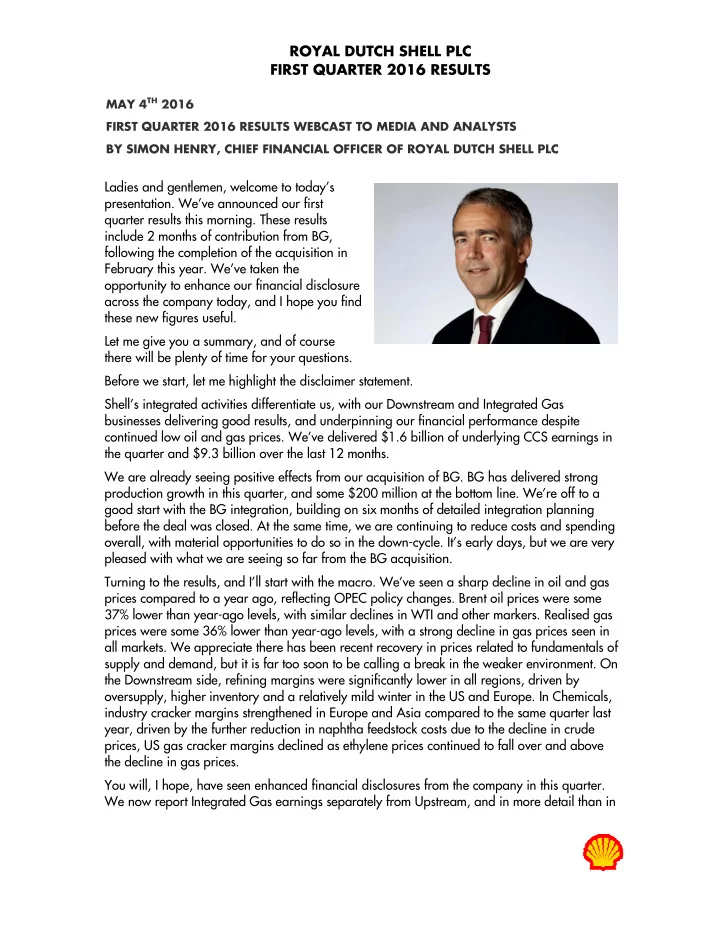
MAY 4TH 2016 FIRST QUARTER 2016 RESULTS WEBCAST TO MEDIA AND ANALYSTS BY SIMON HENRY, CHIEF FINANCIAL OFFICER OF ROYAL DUTCH SHELL PLC

Ladies and gentlemen, welcome to today’s

  • presentation. We’ve announced our first

quarter results this morning. These results include 2 months of contribution from BG, following the completion of the acquisition in February this year. We’ve taken the

  • pportunity to enhance our financial disclosure

across the company today, and I hope you find these new figures useful. Let me give you a summary, and of course there will be plenty of time for your questions. Before we start, let me highlight the disclaimer statement. Shell’s integrated activities differentiate us, with our Downstream and Integrated Gas businesses delivering good results, and underpinning our financial performance despite continued low oil and gas prices. We’ve delivered $1.6 billion of underlying CCS earnings in the quarter and $9.3 billion over the last 12 months. We are already seeing positive effects from our acquisition of BG. BG has delivered strong production growth in this quarter, and some $200 million at the bottom line. We’re off to a good start with the BG integration, building on six months of detailed integration planning before the deal was closed. At the same time, we are continuing to reduce costs and spending

  • verall, with material opportunities to do so in the down-cycle. It’s early days, but we are very

pleased with what we are seeing so far from the BG acquisition. Turning to the results, and I’ll start with the macro. We’ve seen a sharp decline in oil and gas prices compared to a year ago, reflecting OPEC policy changes. Brent oil prices were some 37% lower than year-ago levels, with similar declines in WTI and other markers. Realised gas prices were some 36% lower than year-ago levels, with a strong decline in gas prices seen in all markets. We appreciate there has been recent recovery in prices related to fundamentals of supply and demand, but it is far too soon to be calling a break in the weaker environment. On the Downstream side, refining margins were significantly lower in all regions, driven by

  • versupply, higher inventory and a relatively mild winter in the US and Europe. In Chemicals,

industry cracker margins strengthened in Europe and Asia compared to the same quarter last year, driven by the further reduction in naphtha feedstock costs due to the decline in crude prices, US gas cracker margins declined as ethylene prices continued to fall over and above the decline in gas prices. You will, I hope, have seen enhanced financial disclosures from the company in this quarter. We now report Integrated Gas earnings separately from Upstream, and in more detail than in

slide-2
SLIDE 2

ROYAL DUTCH SHELL PLC FIRST QUARTER 2016 RESULTS

the past. And in Downstream we have given an earnings split for the combination of refining & trading, and from marketing separately. We have also taken on board some comments around exchange rate impacts. We are now treating non-cash FX impacts on Australia and Brazil deferred tax assets as identified items, and you will see a restatement of that in the results tables today. As this effect was large and positive this quarter, it actually reduces what would have previously been our underlying results by some $570 million. Excluding identified items, Shell’s CCS earnings were $1.6 billion, a 63% decrease in earnings per share from the first quarter of 2015. That EPS figure for Q1 uses the weighted average number of shares in the quarter, with a lower opening balance and a higher balance at the end of the period due to the acquisition of BG. On a Q1 to Q1 basis we saw an increase in loss in Upstream and lower earnings in Integrated Gas and in Downstream. Return on average capital employed was 3.8%, excluding identified items, and cash flow from operations was around $650 million, or $4.6 billion excluding working capital movements. Our dividends distributed in the first quarter of 2016 were $3.7 billion, or $0.47 cents per share, of which $1.5 billion were settled under the scrip programme. Turning to the business segments in more detail. Upstream earnings excluding identified items for the first quarter 2016 were a loss of $1.4 billion, with $2 billion of cash flow excluding working capital effects. Low oil prices have dominated these earnings, a $1.4 billion effect compared to year-ago. However, I think it’s important to point out that our Upstream operating performance continues to improve, with a focus on margins, reliability and uptime is delivering, with an increase in underlying production, and a decline in operating costs. Turning to Integrated Gas. Integrated Gas earnings were $1.0 billion in the quarter, compared to $1.5 billion a year ago. Lower oil and gas prices reduced these results by some $700

  • million. And these results exclude dividends from the MLNG Dua joint venture, which were

some $90 million in the first quarter 2015, we exited that joint venture in May last year. Uplift from BG, increased contribution from Trading and lower well write-offs have combined to deliver a profitable quarter here, despite lower oil prices. Headline oil and gas production for the first quarter was 3.7 million boe per day, which is 16% higher than Q1 previous year. Uplift from the BG acquisition accounts for the majority of that

  • increase. But let me also note that we are seeing the benefits of Shell’s actions to improve asset

uptime, with less maintenance than a year ago, and better uptime, for example in the UK and

  • Malaysia. LNG volumes were also higher, mainly reflecting higher volumes as a result of the

BG combination. Turning to Downstream. Downstream earnings for the quarter, excluding identified items, were $2 billion, mainly due to lower results in Oil Products. In Oil Products, our Refining and Trading results were lower than in the same quarter last year, reflecting the weaker global refining conditions, and reduced availability due to downtime particularly at Bukom. Marketing delivered strong underlying performance for the quarter, with results at the same level as last

  • year. This performance resulted in higher unit margins and lower costs. Chemicals earnings

were 8% lower than year-ago levels, due to lower margins in US base chemicals, and downtime at Bukom, partly off-set by lower costs and recovery at the Moerdijk site in the

slide-3
SLIDE 3

ROYAL DUTCH SHELL PLC FIRST QUARTER 2016 RESULTS

  • Netherlands. Overall, this was a good quarter for Downstream, where ROACE on a clean CCS

basis was 18.8% at the end of the quarter, and with Downstream CFFO of around $11 billion

  • ver the last four quarters.

We’ve made several announcements on the Downstream portfolio during the quarter. In the United States, Shell and Saudi Aramco have decided to end the Motiva joint venture on the Gulf Coast, dividing the refining and marketing portfolio between them. We have recently completed the sale of the Denmark marketing business for around $300 million, and delivered a $400 million MLP equity offer. We expect to complete Showa Shell and complete the sale of shares in the refining company in Malaysia in 2016 and the Showa Shell, Malaysia, Denmark and typical MLP yearly deals should result in around $3 billion of disposals proceeds this year. Turning to our cash position. Cash flow from operations on a 12-month rolling basis was some $23 billion, at an average Brent price of around $48 per barrel. The cash portion of the BG deal was $19 billion, resulting in a negative free cash flow position for the quarter. Our net debt position now reflects the BG balance sheet and the purchase price. Gearing at the end of the quarter was 26.1%. We have taken the opportunity to recognize certain operating leases in BG as finance leases, such as FPSOs, vessels and LNG facilities. Overall BG added some 9% to

  • ur gearing, of which around 2% is as a result of these finance leases changes. The priorities

for cash have not changed: debt reduction, dividends, then capital investment and share buy-

  • backs. Dividends declared were $12.7 billion over the last 12 months.

Now, more specifically on the BG consolidation. The final transaction price for the BG acquisition was $54 billion or some GBP 37 billion. You will also find details of the accounting impacts for BG in the results announcement. Goodwill is $9 billion. This is an accounting definition, the balancing item between fair value and the purchase consideration. Under the accounting standards, fair value is calculated using forward price curves for the first two years and analyst macro forecasts thereafter. Let me remind you that the oil price on the 15th of February this year was around $33 per barrel, meaning that the futures oil price then was rather low. The P&L will include a $1.2 billion after-tax depreciation charge for PPA on an annual basis, with a $200 million impact in the first quarter 2016. Let me move to the ex-BG assets. We’ll talk more about this at the capital markets day that we are having in London on 7th June, however, it is good to see former BG assets growth coming through in the quarter. Oil and gas production from these assets averaged around 800 thousand boe per day in the first quarter, an increase of 25% from year-ago levels. In Q1 accounts, we have booked less than that, 522 thousand boe per day, reflecting two months of

  • combination. This growth comes from the ramp-up of QCLNG in Australia, and also the

seventh non-operated FPSO, Cidade de Marcia, in deep water Brazil. BG assets added around $200 million to Shell’s earnings in the quarter, and approximately $800 million of cash flow from operations. It’s early days, but the synergies programme is on track, you may have seen announcements recently to reduce our United Kingdom office presence. Based on the excellent progress in detailed integration planning, we will likely see delivery of those targets earlier than planned, and at a lower than expected implementation cost. Overall, a good start with BG integration, and a lot more to come there.

slide-4
SLIDE 4

ROYAL DUTCH SHELL PLC FIRST QUARTER 2016 RESULTS

We continue to reduce capital spending and operating costs, and continue to reduce costs across the board, and to re-design and postpone new options. Earlier this year we provided capital investment guidance for 2016 at $33 billion, with the potential to reduce that figure

  • further. Capital investment for 2016 is clearly trending towards $30 billion - as we look in

detail at BG - and continue to drive more capital efficiency in our opportunity funnel. This $30 billion figure is some 35% below combined 2014 levels and it includes well over $1 billion of non-cash items, for example for finance leases of FPSOs in Brazil, and Stones in the Gulf of Mexico, which we expect in 2016. Similarly, underlying operating costs are trending to a run rate of $40 billion at end 2016, over 20% lower than 2014 combined levels. In short, we are expecting to absorb BG’s costs and spend in Shell this year. With no increase overall on a combined basis. Let me sum up. Shell’s integrated activities differentiate us, with our Downstream and Integrated Gas businesses delivering good results and underpinning our financial performance despite continued low oil and gas prices. We are already seeing positive effects from our acquisition of BG. We are busy now with combining the two companies, to add more value for shareholders. At the same time, we are continuing to reduce costs and spending, with material opportunities there in the down-cycle. It’s early days, but we very pleased with what we are seeing so far from the BG acquisition. With that, let’s take your questions. Let me remind you that we are having a capital markets day in London on June 7th. Please could we have just one or two each, so that everyone has the opportunity to ask a question. Operator, please poll for questions. Thank you for your questions and for joining the call today. We will be having our capital markets day in London on Tuesday the 7th of June, and Ben and I, and other members of the Executive team, look forward to talking with you all then.

ROYAL DUTCH SHELL PLC MAY 4TH 2016 WWW.SHELL.COM/IR

slide-5
SLIDE 5

ROYAL DUTCH SHELL PLC FIRST QUARTER 2016 RESULTS

DEFINITIONS AND CAUTIONARY NOTE

NOT FOR RELEASE, PRESENTATION, PUBLICATION OR DISTRIBUTION IN WHOLE OR IN PART IN, INTO OR FROM ANY JURISIDICTION WHERE TO DO SO WOULD CONSTITUTE A VIOLATION OF THE RELEVANT LAWS OF SUCH JURISDICTION. Reserves: Our use of the term “reserves” in this presentation means SEC proved oil and gas reserves. Resources: Our use of the term “resources” in this presentation includes quantities of oil and gas not yet classified as SEC proved oil and gas reserves. Resources are consistent with the Society of Petroleum Engineers 2P and 2C definitions. Organic: Our use of the term Organic includes SEC proved oil and gas reserves excluding changes resulting from acquisitions, divestments and year-average pricing impact. Shales: Our use of the term ‘shales’ refers to tight, shale and coal bed methane oil and gas acreage. The companies in which Royal Dutch Shell plc directly and indirectly owns investments are separate legal entities. In this document “Shell”, “Shell group” and “Royal Dutch Shell” are sometimes used for convenience where references are made to Royal Dutch Shell plc and its subsidiaries in general. Likewise, the words “we”, “us” and “our” are also used to refer to subsidiaries in general or to those who work for them. These expressions are also used where no useful purpose is served by identifying the particular company or companies. ‘‘Subsidiaries’’, “Shell subsidiaries” and “Shell companies” as used in this document refer to companies over which Royal Dutch Shell plc either directly

  • r indirectly has control. Entities and unincorporated arrangements over which Shell has joint control are generally

referred to “joint ventures” and “joint operations” respectively. Entities over which Shell has significant influence but neither control nor joint control are referred to as “associates”. The term “Shell interest” is used for convenience to indicate the direct and/or indirect ownership interest held by Shell in a venture, partnership or company, after exclusion of all third-party interest. This document contains forward-looking statements concerning the financial condition, results of operations and businesses of Royal Dutch Shell. All statements other than statements of historical fact are, or may be deemed to be, forward-looking statements. Forward-looking statements are statements of future expectations that are based on management’s current expectations and assumptions and involve known and unknown risks and uncertainties that could cause actual results, performance or events to differ materially from those expressed or implied in these

  • statements. Forward-looking statements include, among other things, statements concerning the potential exposure of

Royal Dutch Shell to market risks and statements expressing management’s expectations, beliefs, estimates, forecasts, projections and assumptions. These forward-looking statements are identified by their use of terms and phrases such as ‘‘anticipate’’, ‘‘believe’’, ‘‘could’’, ‘‘estimate’’, ‘‘expect’’, ‘‘goals’’, ‘‘intend’’, ‘‘may’’, ‘‘objectives’’, ‘‘outlook’’, ‘‘plan’’, ‘‘probably’’, ‘‘project’’, ‘‘risks’’, “schedule”, ‘‘seek’’, ‘‘should’’, ‘‘target’’, ‘‘will’’ and similar terms and

  • phrases. There are a number of factors that could affect the future operations of Royal Dutch Shell and could cause

those results to differ materially from those expressed in the forward-looking statements included in this document, including (without limitation): (a) price fluctuations in crude oil and natural gas; (b) changes in demand for Shell’s products; (c) currency fluctuations; (d) drilling and production results; (e) reserves estimates; (f) loss of market share and industry competition; (g) environmental and physical risks; (h) risks associated with the identification of suitable potential acquisition properties and targets, and successful negotiation and completion of such transactions; (i) the risk of doing business in developing countries and countries subject to international sanctions; (j) legislative, fiscal and regulatory developments including regulatory measures addressing climate change; (k) economic and financial market conditions in various countries and regions; (l) political risks, including the risks of expropriation and renegotiation of the terms of contracts with governmental entities, delays or advancements in the approval of projects and delays in the reimbursement for shared costs; and (m) changes in trading conditions. All forward- looking statements contained in this document are expressly qualified in their entirety by the cautionary statements contained or referred to in this section. Readers should not place undue reliance on forward-looking statements. Additional risk factors that may affect future results are contained in Royal Dutch Shell’s 20-F for the year ended December 31, 2015 (available at www.shell.com/investor and www.sec.gov ). These risk factors also expressly qualify all forward looking statements contained in this document and should be considered by the reader. Each forward-looking statement speaks only as of the date of this document, 4 May, 2016. Neither Royal Dutch Shell plc nor any of its subsidiaries undertake any obligation to publicly update or revise any forward-looking statement as a

slide-6
SLIDE 6

ROYAL DUTCH SHELL PLC FIRST QUARTER 2016 RESULTS

result of new information, future events or other information. In light of these risks, results could differ materially from those stated, implied or inferred from the forward-looking statements contained in this document. We may have used certain terms, such as resources, in this document that United States Securities and Exchange Commission (SEC) strictly prohibits us from including in our filings with the SEC. U.S. Investors are urged to consider closely the disclosure in our Form 20-F, File No 1-32575, available on the SEC website www.sec.gov.