SLIDE 1 ROYAL DUTCH SHELL PLC 4th QUARTER 2012 RESULTS AND STRATEGY UPDATE
JANUARY 31st 2013 4th QUARTER 2012 RESULTS AND STRATEGY UPDATE TO ANALYSTS BY PETER VOSER, CHIEF EXECUTIVE OFFICER OF ROYAL DUTCH SHELL PLC AND SIMON HENRY, CHIEF FINANCIAL OFFICER OF ROYAL DUTCH SHELL PLC
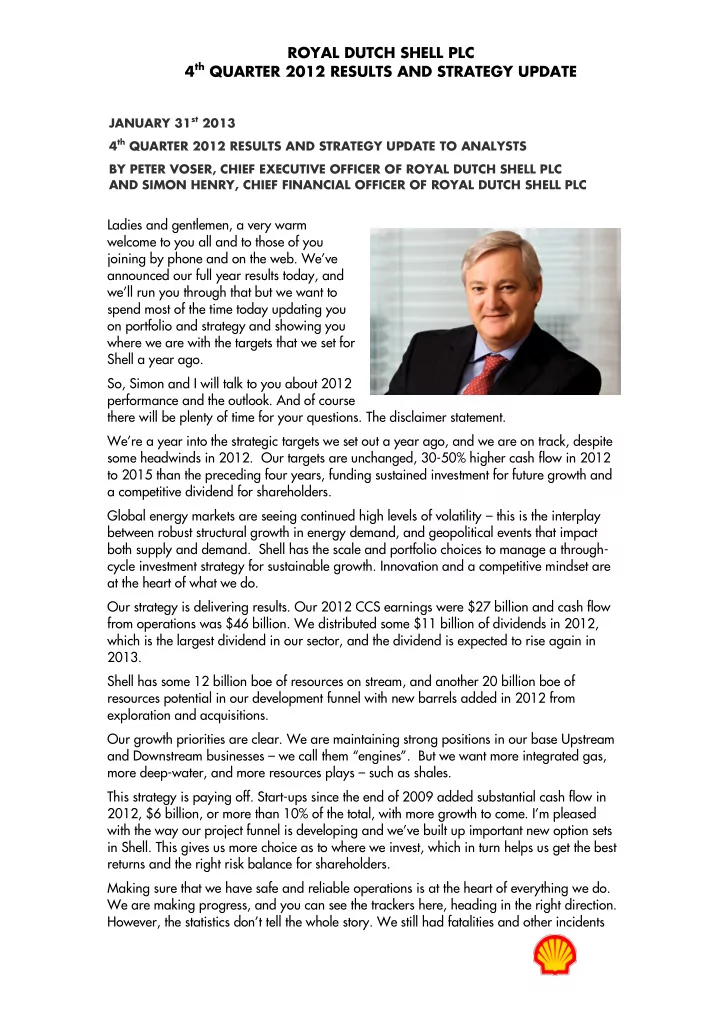
Ladies and gentlemen, a very warm welcome to you all and to those of you joining by phone and on the web. We‟ve announced our full year results today, and we‟ll run you through that but we want to spend most of the time today updating you
- n portfolio and strategy and showing you
where we are with the targets that we set for Shell a year ago. So, Simon and I will talk to you about 2012 performance and the outlook. And of course there will be plenty of time for your questions. The disclaimer statement. We‟re a year into the strategic targets we set out a year ago, and we are on track, despite some headwinds in 2012. Our targets are unchanged, 30-50% higher cash flow in 2012 to 2015 than the preceding four years, funding sustained investment for future growth and a competitive dividend for shareholders. Global energy markets are seeing continued high levels of volatility – this is the interplay between robust structural growth in energy demand, and geopolitical events that impact both supply and demand. Shell has the scale and portfolio choices to manage a through- cycle investment strategy for sustainable growth. Innovation and a competitive mindset are at the heart of what we do. Our strategy is delivering results. Our 2012 CCS earnings were $27 billion and cash flow from operations was $46 billion. We distributed some $11 billion of dividends in 2012, which is the largest dividend in our sector, and the dividend is expected to rise again in 2013. Shell has some 12 billion boe of resources on stream, and another 20 billion boe of resources potential in our development funnel with new barrels added in 2012 from exploration and acquisitions. Our growth priorities are clear. We are maintaining strong positions in our base Upstream and Downstream businesses – we call them “engines”. But we want more integrated gas, more deep-water, and more resources plays – such as shales. This strategy is paying off. Start-ups since the end of 2009 added substantial cash flow in 2012, $6 billion, or more than 10% of the total, with more growth to come. I‟m pleased with the way our project funnel is developing and we‟ve built up important new option sets in Shell. This gives us more choice as to where we invest, which in turn helps us get the best returns and the right risk balance for shareholders. Making sure that we have safe and reliable operations is at the heart of everything we do. We are making progress, and you can see the trackers here, heading in the right direction. However, the statistics don‟t tell the whole story. We still had fatalities and other incidents
SLIDE 2 ROYAL DUTCH SHELL PLC 4th QUARTER 2012 RESULTS AND STRATEGY UPDATE
last year. We have to make further improvements here – we look at these incidents and take the learning across our global portfolio, with a continuous improvement mindset. Turning to the macro… Rapid economic development in non-OECD countries is driving sustained and long-term demand growth for all forms of energy. Energy demand overall could double in the first half of this century, from the year 2000 to 2050. This growth will require huge industry investment, perhaps $15 trillion over the next 10 years. Higher volatility in energy prices, and volatility in our quarterly results, is a fact of life. We are looking through these short term effects, and implementing a long term strategy. During the last few years, downstream has been affected by excess industry refining capacity, which has dragged on industry margins. This overhang, currently some 4 to 5 million barrels per day, looks set to continue. More recently, the rapid growth in North America resources plays has led to depressed prices for natural gas, and inland crudes, such as WTI and WCS. We expect to see a narrowing of liquids differentials as new industry infrastructure comes into play, although this could take several years. Low North American natural gas prices look set to stay, which is a major opportunity for integrated gas projects like LNG, GTL and chemicals. Shell is one of the few companies that get the full value here, from integration along value chains. Shell‟s activities provide affordable, safe and reliable energy supplies for our customers, world-wide. In Upstream we are investing for growth, with a strong focus on deep-water, integrated gas and resources plays. In Downstream we‟ve taken out a lot of capacity in the last few years. Now, we are optimizing this re-shaped portfolio to maximize profitability with some very selective growth themes. On climate change, we are investing in natural gas and biofuels, which have a CO2 advantage, and we see mitigation opportunities in energy efficiency and CCS. For example, Shell is participating in the construction of 2 carbon capture and storage facilities storing over 4 mpta of CO2, in Canada oil sands and Australia LNG. On the financial side, we are planning for a balance between attractive payout for shareholders today, and investing for shareholder value in the longer term. Let me remind you about the agenda we set out a year ago. There‟s no change to the outlook for cash flow, capex, gearing and production and there‟s continued growth in the dividend. We continued to build up new options in the company – more choice for where to invest our dollars, and by implementing hard capital ceilings, we are driving tough choices in the company. Our drive to increase our option set means that Shell today is capital constrained, rather than opportunity constrained. I think this is a rather different position than many other sectors in the market today. Strong capital rationing means we can prioritize the most attractive opportunities, and re-scope or exit from other positions. For example, in 2012, we walked away from Cove on valuation grounds, and went ahead with an attractive acquisition in the Permian. We slowed down on North America tight gas drilling, and stepped up in liquids-rich plays. We slowed the pace on new FIDs for LNG in Australia, where there‟s cost inflation pressures; we‟re taking more time on Gorgon Train 4 and
- Arrow. And in the North Sea, we postponed the Linnorm FID in Norway, where there were
cost pressures, but went ahead with the Fram development in the UK. These are real
SLIDE 3 ROYAL DUTCH SHELL PLC 4th QUARTER 2012 RESULTS AND STRATEGY UPDATE
examples of dynamic decisions, which we can do, given the breadth of the portfolio we have in play. Let‟s look at the performance since 2010. Our CCS earnings have increased by some 45% and cash flow from operations has increased by some 70% to $46 billion. Underlying oil & gas production, and LNG volumes have both increased, as we deliver our growth plans. And for shareholders, our TSR - total shareholder return – was around 40% over the last 3 years, with a softer year in 2012. We‟ve been working hard to improve Shell‟s operating performance, which is a key driver
- f those results. Unplanned downtime in Downstream and reliability of facilities such as
LNG are now amongst the best in our industry and on the contracting and procurement side, our Projects & Technology division continues to drive a top quartile wells performance and to extract value from the supply chain; we spent $64 billion last year on contracting and procurement. I‟m pleased with the project flow over the last few years: we‟ve started up 18 new projects since end-2009, which delivered $6 billion cash flow in 2012 – over 10% of the total, and nearly 20% of our production. The Shell operated projects here had more than 1 billion man-hours with just 170 Lost Time Injuries. This is a good performance. The three largest of these developments – Pearl gas-to-liquids, Qatargas 4 LNG and AOSP – oil sands in Canada – produced over 400,000 barrels per day in the fourth quarter 2012, and Pearl completed its ramp up, with both GTL trains reaching over 90% utilization rate at the end of the quarter. These plays will generate cash flow for shareholders for decades to come. So, good progress, but a lot more to do… I‟ll pause there. Simon will give you more details
- n 2012 and then I‟ll come back on the outlook and then back to Simon on the financial
- framework. So, Simon, over to you please.
Thanks Peter. We‟re one year into a four year financial growth programme, and it‟s good to be here today to update you on that. Firstly, let me update you on the results we published today. Quarterly results are important, but they are a snapshot of performance in a long term business. Looking at the full year picture, earnings excluding identified items were broadly similar year-over-year, at $25 billion, and cash flow from operations increased by 25% to $46
- billion. Macro effects were in aggregate a positive in 2012, and growth projects were a
key driver of both earnings and cash flow with some offsets from depreciation, costs, and exploration charges. Our cash flow is growing faster than earnings, due to the increased depreciation from our growth portfolio.
SLIDE 4 ROYAL DUTCH SHELL PLC 4th QUARTER 2012 RESULTS AND STRATEGY UPDATE
For Q4 2012, reported CCS earnings for the quarter were $7.3 billion. Excluding identified item, CCS earnings were $5.6 billion and earnings per share increased by 14% compared to the fourth quarter of 2011. On a Q4 to Q4 basis we saw lower earnings in Upstream and higher results in Downstream. At a divisional level, excluding identified items; Upstream earnings were $4.4 billion in the fourth quarter 2012, a decrease of 14% versus the same quarter in 2011. Oil & gas price movements were in aggregate a negative in our Q4-Q4 results, alongside increased costs, including feasibility expenditure, depreciation plus exploration charges. Earnings benefited from the contribution of Integrated Gas, reflecting the ramp-up of Pearl GTL in Qatar. We saw a slight loss in our Upstream Americas business. This is really built up from a loss in onshore gas, and profits in heavy oil and deep water. For the first quarter of 2013 in Upstream, we should see the impact of growth projects, but let me highlight that we are expecting some 35,000 boe per day of maintenance impacts and exits on a Q1-Q1 basis, mostly in high margin North Sea fields. Turning to Downstream. Excluding identified items, Downstream earnings increased sharply from year-ago levels, with a step up in Oil Products results partly offset by a downturn in Chemicals. In Chemicals, the lower earnings were mainly due to higher
- perating expenses and supply constraints of advantaged feedstock in the U.S. In Oil
Products, the marketing and trading environment was more positive than year-ago
- levels. Industry refining margins were firm at the start of the quarter, as we saw in Q3
2012, supported by industry downtime. However, refining margins softened across the quarter, and have started 2013 at very low levels. We have seen weak demand for oil products and chemicals so far in the first quarter, and refining margins are under pressure. Repairs to the crude distillation unit at the Motiva refinery expansion have been completed, and Motiva restarted the refinery in January. We are expecting refinery and chemicals availability for the first quarter to be below first quarter 2012 levels, with major turn-arounds on the Gulf Coast and Germany. Cash generation excluding working capital in 2012 in was $50 billion, including $7 billion of disposals proceeds, with an average Brent price of $112 per barrel. Both the Upstream and Downstream segments generated surplus cash flow after
- investment. We‟ve rebalanced to a free cash flow position, a key strategic enabler for
us, with a cash surplus after investment, debt programmes and returns to shareholders in 2012. We‟ve taken advantage of attractive market rates during 2012, to add $4.2 billion of new, long-term debt to the balance sheet. Gearing sits at 9.2%, similar to the third quarter and is low in our zero to 30% range, as you would expect in strong oil price conditions. The 4.7% expected dividend increase we have announced today reflects both the improving cash flow position in the company, and our confidence in further growth. We expect to continue to grow the dividend over time, in measured, affordable steps.
SLIDE 5
ROYAL DUTCH SHELL PLC 4th QUARTER 2012 RESULTS AND STRATEGY UPDATE
Improving our capital efficiency is an important part of our strategy, allocating our dollars to the best new projects. There‟s no hard target here, but the value of our acquisitions and divestments have broadly balanced out over time. We‟ve sold $21 billion of assets in the last three years; that‟s the size of a mid-cap oil & gas company. We‟ve refocused Downstream to fewer markets and fewer refineries and in Upstream, we‟ve sold down over 130 thousand barrels per day, including late life positions, assets that don‟t fit the strategy, and we‟ve shared some positions with strategic partners. At the same time, we‟ve made $17 billion of acquisitions, recycling Downstream into Upstream. In 2012, we‟ve added growth potential in Permian and Australia and we‟ve increased our stakes in fields we know well, where we can add value with technology. So, good progress on capital efficiency. We‟ll report our SEC reserves position in detail in the 20F, as usual, in March. We‟d expect to see 3 year average headline proved reserves replacement ratios to be around 84%, with 44% in 2012. Our 3 year average RRR on an organic basis is around 115%, or 85% in 2012, setting aside acquisitions, divestments and oil & gas price impacts. We look at resources, as well as reserves to manage the business, and we have a substantial oil and gas resource base in Shell. The chart here is a sub-set of the total resources position, the part of our portfolio that is on stream or being actively worked towards production and returns. This represents around 32 billion boe, or about 26 years of current production. Shell has some 12 billion barrels of oil equivalent of resources on stream, a similar position to last year, and an increase of nearly 40% since 2009. We have a further 20 billion boe or so of resources potential under construction and in options, which should drive the cash flow up to the middle of this decade, and beyond. You can see how all of this is flowing through into the results. Return on capital in service was 20% in 2012, a satisfactory level of return. This underlying figure reduces by 7% percentage points to 13% through our growth investment. Capital under construction and non-productive acreage account for nearly 30% of our balance sheet, or $58 billion. This percentage has reduced slightly in 2012, as Pearl came on stream, which lifts our headline returns. We‟ve started to see a more competitive performance from Shell in the last few years and I think there‟s more to come here. Looking at the competitive picture to Q3 2012, for which we have all the information from our competitors, Shell has led our sector in earnings and cash flow growth, driven by our investment decisions, operating performance and continuous improvement programmes. Part of this reflects the fact that Shell took the decision to maintain our growth spending programmes and to pay a competitive dividend in the downturn. More recently, we‟ve seen other companies in our sector increasing their spending to similar levels to Shell‟s. In an industry with 5-7 year lead times, there should be a growth advantage for us over the competition, but let‟s see.
SLIDE 6
ROYAL DUTCH SHELL PLC 4th QUARTER 2012 RESULTS AND STRATEGY UPDATE
With that, let me pass you back to Peter on the outlook. Peter… Thanks Simon. Let me update you on the strategic priorities, and you will see that we are keeping the momentum on the strategic drive we have had in the company over the last few years. A year ago, we set new priorities for the company, to grow our cash flow by 30 to 50% for 2012 to 2015 compared to the preceding four years, in $80 and $100 oil price scenarios, to use that cash flow to fund $120 to $130 billion of investment and to pay a competitive dividend for shareholders. These are ambitious and exciting targets, and we know we‟ve got more to do to get there. I‟m really driven by this challenge, and so is the whole team here at Shell. We‟ve taken a fresh look at how we manage our portfolio. We are driving capital choices, innovation and human resources along a series of strategic themes which are really global, rather than just country level or regional. Each theme has distinctive drivers, specific technologies, markets, investment profiles and returns characteristics. Downstream and our mature Upstream positions – we call these “engines” – will see around $12 billion of spending in 2013, or about a third of the organic capex. These engines are generating strong free cash flow for the company today, about $11 billion in 2012. Here, we are looking to extend asset lives through technology and selective exploration in Upstream, and working hard on profitability and selective growth in Downstream. The growth priority is in Integrated Gas, where we are the number 1 IOC, in deep- water and in resources plays - tight gas and liquids rich shales - where we want to be a global leader in this exciting new trend. Our organic spend in these three themes will total some $18 billion, spread fairly evenly between the three. You‟ll also see a longer term, what we call future opportunities category here – reserves-rich plays, typically oily, but where there is going to be a slower development pace, driven by local conditions, communities and environmental considerations. Let me walk you through some of the portfolio, looking through this new lens, starting with Downstream.
SLIDE 7 ROYAL DUTCH SHELL PLC 4th QUARTER 2012 RESULTS AND STRATEGY UPDATE
Downstream accounts for some 15-20% of our capital investment, and about half of that is on maintaining safe and reliable operations, with the remainder going into selective growth projects. We‟re making good progress with the Raízen biofuels joint venture in Brazil, which has a 35 thousand barrel per day ethanol production
- capacity. In its first full year of operations Raízen contributed over 10% to our 2012
Oil Products earnings. We are also working on new chemicals capacity in North America and in Qatar, which would be integrated with Upstream gas for feedstock. These are pre-FID projects, and the Qatar opportunity entered FEED in 2012. Overall we will continue to have quite a measured approach to Downstream manufacturing: relatively small stakes in new manufacturing assets, building just one or two at a time, and positioning for low cost, advantaged feedstocks and market growth potential. Turning to Upstream… We are managing the company to get a steady flow of final investment decisions, construction and start-ups, as we replace decline and deliver financial growth over time. We started up 5 new developments in 2012, totalling nearly 200 thousand barrels of
- il equivalent per day of peak production potential. Shell has taken final investment
decision on further 7 developments over the last year, bringing the total number of projects under construction to around 30, which should unlock 7 billion boe of resources, and nearly 1 million barrels per day of peak production potential. 15 of these new fields will come on stream in the next 2 years, and you can see some
- f the larger ones here. Kashagan, where Shell will be the operator from first
production, this is a 300,000 barrels per day high sulphur development; Iraq, where we should reach 175,000 barrels per day, the first commercial production on Majnoon, in 2013, and start up the Basrah Gas Joint Venture and new oil & gas production in Asia Pacific, Malaysia and Australia. Putting all this together, we expect a slight increase in production in 2013 compared to 2012. Looking further into the future, we‟re working on another suite of new fields, which should come to FID in the next few years, with over 30 potential investments on the drawing board, and perhaps another 1 million barrels per day of peak production. We are maturing these and other options, and we will launch new projects according to portfolio fit, the profitability of the projects and affordability, which is of course partly linked to the development of oil prices and downstream margins. Let me take a few minutes to show you what we are up to some of our main Upstream themes, starting with our Upstream cash engines.
SLIDE 8 ROYAL DUTCH SHELL PLC 4th QUARTER 2012 RESULTS AND STRATEGY UPDATE
This category covers Shell‟s older, more mature positions, mostly in Europe, the Middle East and South Asia. We‟re working hard to maximize value here, by extending the lives of old fields in a safe and reliable way, and investing in new
- production. In Europe, we‟ve made several portfolio moves in the last year, with
increased stakes in growth projects, and new equity in older fields where we see technology plays that can add value. This should all result in relatively stable production in Europe for Shell, in what many people see as a declining oil & gas province. Turning to integrated gas… Shell is the leading IOC for integrated gas – that‟s LNG and GTL. Integrated Gas, which is LNG and GTL, earned over $9 billion in 2012, which is around 40% of our bottom line, and generated $12 billion of cash flow, or
- ver 20% of our total. We have 22 mtpa of LNG capacity on stream today, with 7%
growth in 2012. The next tranche of LNG growth for Shell is coming from Australia, with 7 mtpa under construction, which will lift our capacity by over 30% to 2017 and we‟ve been working hard to diversify Shell‟s integrated gas optionality, so that we can go ahead with the most attractive projects for the next tranche of growth. We have more than 20 mpta of new LNG options under study today, potentially another 70% uplift to capacity after 2017. Let me show you more details. Here, you can see more than 20 mpta of new options, in Australia and North
- America. We‟ve got more options here than many of our competitors have on stream
today, and it‟s a great opportunity for shareholders. Today, there is a lot of discussion in the industry about the cost and price structure for new LNG in the future. We don‟t claim to have all the answers. But I believe that LNG prices will remain dominated by oil price linkages, with some elements of Henry Hub in some contracts. Remember though, that Henry Hub landed in Tokyo Bay today could cost over $10 per mmBTU, not far away from recent LNG prices and with higher volatility. On the development cost side: Chevron recently announced a cost over-run at Gorgon in the over-heated Australian market. None of the partners like to see that, and this does impact our thinking on the pace of new FIDs in Australia, and we have slowed down there, concentrating on Prelude, which is being built in South Korea. Abadi, in Indonesia, which is also FLNG, may well be Shell‟s next LNG project in Asia Pacific. In North America, we‟re continuing to work on a range of integrated options. LNG for transport is going well, and we have 0.3 mtpa under construction. You may have seen we recently announced a joint venture with Kinder Morgan for a new 2.5 mtpa LNG facility at Elba. This will use low cost MMLS technology, and we are working with our partner to reach FID. We also have other gas to transport, GTL, chemicals and export LNG options on the drawing board. This is an exciting opportunity set for
- shareholders. It‟s too soon to say which will go ahead first, and this will take time.
Turning to deep-water…
SLIDE 9 ROYAL DUTCH SHELL PLC 4th QUARTER 2012 RESULTS AND STRATEGY UPDATE
Shell is one of the industry‟s pioneers in deep water oil & gas business. We have some 330 thousand barrels per day of production today, with a strong growth
- utlook. We‟re pushing hard on the exploration side, and I‟ll say more about that in a
- moment. We have 9 new fields under construction, in the Gulf, Brazil and South East
- Asia. The key here is to standardize the development concepts, to control costs and
speed up the development pace. For example, we have installed five tension leg platforms – TLPs - in the Gulf of Mexico since 1993. Our latest tension leg platform is Olympus, for the 100,000 barrels per day Mars B development. We took the FID on this one in 2010, during the moratorium after BP Macondo, when we saw a cost
- pportunity, with spare capacity in the supply chain. Today, the Olympus TLP has
moved from South Korea to the US, and we are working on the topsides. Mars B is on track for a late 2014 or early 2015 start up. Mars B and Cardamom are just two of a number of projects underway in the Gulf. We‟ve been working on three further developments: Stones, Vito and Appo. Appraisal drilling at Vito and Appo has gone well, and there is potentially more upside at Appo, as we drill in the Vicksburg area there this year. Let me make some comments on some of our longer term opportunities. This grouping covers countries and plays where Shell has access to very large resources positions - typically in oil – but where there are surface issues that can slow down the development pace, things like community and government relations, security
- f our staff, and evolving local fiscal and environmental regulations. We are in these
provinces for the long term potential, and we expect to continue to see a measured development pace. For example in Canada oil sands, we are investing in debottlenecking and carbon capture and storage, to improve the efficiency and environmental footprint of this
- asset. We‟re permitting for further, larger scale expansions, but there are no
immediate plans to take an FID - this is for the longer term. We also have growth projects underway in Kazakhstan, Iraq and Nigeria. In Iraq, we expect to reach first commercial production at the giant Majnoon field this year, at 175,000 barrels per
- day. 2013 will also mark the official start of the Basrah Gas Company, where Shell,
the South Gas Company and Mitsubishi will capture flared gas and condensate. Since the initial agreements were signed in 2011, this partnership has already increased associated gas capacity from 240 million scf per day to around 400 million scf per day. Let me make some comments on Alaska exploration, which is in this longer term category. This is not a new area for the industry. Over 100 offshore wells have been drilled in the US and Canadian arctic to date. In the Alaskan Beaufort and Chukchi seas alone, some 35 wells have been drilled, starting in the 1980s, including Shell. And there is some near-offshore production underway by our competitors. Since 2005, 6 oil & gas companies have taken up 569 exploration licences further offshore in Alaska, in the Beaufort and Chukchi Sea. Shell is a leading acreage holder there, and we began drilling operations in 2012.
SLIDE 10 ROYAL DUTCH SHELL PLC 4th QUARTER 2012 RESULTS AND STRATEGY UPDATE
We are taking a very cautious approach in this environmentally sensitive area. We have committed to have 2 rigs in theatre for relief well contingency, and each well will have 4 pressure barriers available to avoid oil spills. We halted the 2012 programme early, when we realized that the 4th of these barriers - the Arctic Containment System – would not be ready in time. Despite making some progress, we have run into problems in the last few months. Our rigs will need more work if they are going to be ready for a 2013 drilling season. One, the Noble Discoverer, needs a series of upgrades, and the other, the Kulluk, ran aground in a heavy storm on the New Year‟s Eve, and has been damaged. There are a number of reviews into the operating performance in the last season underway, and we will wait for that, before deciding
- n the next steps in Alaska.
Turning to exploration and business development more generally… We are driving our longer term growth with exploration and bolt-on deals. We‟ve made a change to our organisation in 2012, so that conventional exploration is now run as a separate activity from resources plays such as tight gas. This is a natural change, as the onshore activities get larger, and it will allow us to manage the rather different skill sets and performance drivers in these two businesses. We‟ve been re-loading our exploration portfolio in the last few years, with a build-up
- f frontier exploration acreage, as well as maintaining an active drilling portfolio in
- ur more mature heartlands. We‟ve added 120,000 square kilometres of acreage in
2012, and some 400,000 since 2008. On the resources side, we‟ve added some 5 billion boe in the last three years, for a cost of around $3 per boe, which is a good performance. Looking at 2012 in a bit more detail, we added 600 million barrels with conventional drilling in 2012. We had 7 notable discoveries and appraisal successes in 2012, and had a further 20 near field discoveries. For example, the Tukau Timur well in Malaysia discovered over 2 Tcf of potential, which in turn unlocks other near-by satellites, and should flow into Malaysia LNG. In Australia, we added more molecules for Gorgon Train 4, and a built up in Outer Exmouth, which could become
- FLNG. On the oil side, the Zabazaba well in Nigeria is part of the appraisal of a
sizable oil find, and we drilled successful appraisal wells in the Gulf, at the 500+ million barrel Appo. Turning to tight and shale activities… Fraccing technologies have opened up a very exciting new resources base for our industry, and we want Shell to be a leading player here; we‟re in the play in 13 countries now. You can see the build up of acreage and resources on this slide.
SLIDE 11 ROYAL DUTCH SHELL PLC 4th QUARTER 2012 RESULTS AND STRATEGY UPDATE
I think it‟s also important to highlight what we have been doing to build up our
- perating capabilities in these plays. We are working to reduce costs in the supply
chain, for example the Sirius joint venture in China, where we are joint owners of drilling rigs with PetroChina‟s service company Great Wall drilling. Managing what we call „non-technical risk‟ is also extremely important, and there are public concerns in many countries about the safety aspects of fraccing. You might have seen the global principles that we have published for fraccing operations, covering things like water and community relations. Quite simply, Shell aims to set industry standards in these areas, and standards need to rise. Let me give you a few more details on North America. We averaged some 260 thousand barrels oil equivalent per day in 2012 from North America resources plays. There‟s an important shift in strategy here. We took the decision to switch our drilling dollars from dry gas to liquids-rich plays around the end of 2011, due to low near-term gas prices, and that change accelerated in 2012. Organic spending in 2012 – excluding acreage deals - was around $6 billion, about 60-40 gas and liquids. In 2013, we expect lower spending overall, about $4.5 billion, and dominated by liquids-rich plays, about 75% of the total. This will mean lower near-term growth rates overall, with less gas development, and more liquids exploration and appraisal. On the liquids side: Eagle Ford is in development mode; we‟ve drilled 148 wells and built processing capacity for around 70 thousand barrels of oil equivalent per day, with production at the end of 2012 at around 20 thousand barrels of oil equivalent per day, and growing. On the exploration and appraisal side, we are in 10 LRS plays in North America, and we‟ve added Permian assets and further bolt-on acreage in 2012. We‟ve had successful drilling results in 7 of our 10 plays. These are large scale, contiguous acreage positions, and we are seeing initial production rates of over 1,000 barrels per day from multiple wells. Overall, we were producing around 50 thousand boe per day from LRS in North America at the end of 2012, with more growth to come. So, when you put all this together, we expect to see attractive growth in Upstream in the next few years. You can see the impact this is having on our production mix, with growth in integrated gas, deep water, resources plays, and more production from countries like Iraq, Nigeria and Kazakhstan. We‟re looking for financial growth here, and I see production growth as a longer term proxy for financial performance. Project start ups since the start of 2010 added $7 billion to our 2010 to 2012 cash flow, and $6 billion in 2012 alone. Taken together with the next wave of projects under construction today, we expect to see about $36 billion of cash flow from new projects in 2013 to 2015 combined, and some $15 billion in 2015 itself.
SLIDE 12 ROYAL DUTCH SHELL PLC 4th QUARTER 2012 RESULTS AND STRATEGY UPDATE
This growth wedge is an important driver of Shell‟s cash flow targets. Some 50% of
- ur 2013 capital investment should be flowing through into cash flows by end-2015.
This is all about positioning the company to have the most effective use of capital; getting the balance right between building long term asset positions, and generating early pay-back and good returns for shareholders today. I‟ll stop there, and pass you back to Simon. He‟s going to talk to you about the financial framework for a few minutes, and then we‟ll go for Q&A. Simon… Thanks Peter. We‟ve given you the outlook for strategy and
- portfolio. Let me spend a few minutes on the
financial outlook that underpins that strategy, and update you on where we are with our targets. Cash flow from operations was $143 billion for 2009 to 2012 combined at a $91 average oil price. A year ago, we targeted cash flow from operations to be some 30-50% higher for 2012-15 in aggregate, or around $175 to $200 billion, assuming $80-$100 Brent. We also assumed an improving downstream and North America gas price environment over this plan period, with more conservative assumptions in the near
- term. As part of that framework a year ago, we targeted $120-$130 billion of net
capital spending for 2012 to 2015 in total, again in $80-$100 scenarios. This ambitious outlook is underpinned by the ramp-up of the projects we have brought on stream in the last few years and new project start-ups. Last year‟s cash flow from operations was $46 billion or $43 billion excluding working capital movements. Reconciling to a $100 scenario, we saw macro effects like oil price, weak downstream conditions, lower North America gas and liquids realizations - in aggregate some $2 billion of uplift – and project slippage, for example Pearl, value choices like asset sales and a slow-down in North America gas drilling, in total around a $2 billion negative effect. Despite these movements, we are
- n track for our targets, despite some headwinds in 2012.
You can also see on this chart how the outlook could be affected if today‟s downstream and North America upstream differentials continue into the medium
- term. It‟s hard to make a macro forecast that far out, but you can see that from a
structural perspective, what we see today is not going to blow us off course from a free cash flow perspective. We‟ll look at the free cash flow carefully, and there‟s no simple formula. I expect incremental capex, debt management and payout to all play a part, although I want to be clear that we see share buy-backs as a tool to offset scrip dilution, rather than as a primary route to return cash to shareholders.
SLIDE 13 ROYAL DUTCH SHELL PLC 4th QUARTER 2012 RESULTS AND STRATEGY UPDATE
Shell delivered robust underlying production growth in 2012 – around 3%, with growth barrels comfortably ahead of decline. We are on track for around 4 million barrels per day of oil & gas in 2017-18, assuming 250,000 barrels per day of asset sales and licence expiries. However, there are quite a few moving parts out to 2017- 18, things like asset sales, the pace of drilling in North America onshore and the security and fiscal position in Nigeria. Oil & gas production is a reasonable proxy for financial growth, although it doesn‟t give you the full picture. For example the Basrah Gas Company and Elba LNG project, where we have made progress recently, both of these should be profitable, but neither of them comes with upstream production. We look at oil & gas production levels as an outcome of our investment decisions on a long wavelength basis, and not a primary strategic driver for the company. Cash flow should to continue to grow more quickly than production. Out to 2015, we are expecting to see strong growth in cash flow from deep water and resources plays and an uptick from some of our longer term plays, with growth in Kazakhstan and
- Iraq. A little bit further out, integrated gas should drive new growth, as new projects
build up in Australia. Exploration remains the lowest cost access to new resources, and Shell is a global exploration company. Combining conventional activity, resources plays and bolt-on deals over the last three years, we‟ve invested $36 billion here, and added around 12 billion barrels of potential resources, at a cost of around $3 per boe. I think a lot of our activity in the last few years has been about acreage build up. In 2013, the emphasis is changing to drilling, with core exploration spending in conventional exploration running ahead of resources plays. We‟ll be spudding some important new wells in the next two years, including oil prospects in the Gulf, French Guiana, West Africa, and gas plays in East Africa and Asia Pacific. We‟ll also continue with resources plays, with more drilling in Argentina, China and Ukraine, as well as North America. We continue to take a long term view on oil and gas prices for project planning, and we‟ve reviewed the assumptions we made in 2008, for both prices and costs. For Brent, we have adjusted our outlook to $70 to $110 per barrel, which is an increase from our previous deck, which was $50 to $90, and for Henry Hub, we are now using $3 to $5 per million BTU, which is a more conservative assumption – we were
- n $4 to $6. By refreshing these markers, we can continue to position the company
for oil price upside, and the lowest cost gas. With costs moving broadly in line with prices, Shell‟s strict hurdle rates for new projects are not changing here. Our net investment in 2012 was $30 billion, in line with our guidance a year ago. We‟ve taken 7 final investment decisions in 2012, and 24 over the last three years. Spending on these new projects is now building up and you can see the trend in our Q4 2012 figures, and this will nudge our net capex to $33 billion in 2013.
SLIDE 14 ROYAL DUTCH SHELL PLC 4th QUARTER 2012 RESULTS AND STRATEGY UPDATE
Let me highlight that we will have around $1 billion uplift in 2013 from capitalized leases, things like FPSO contracts, which are non-cash effects in capital investment, and we will be booking some $2 billion of acquisitions in 2013, from deals that we have already announced to the market in 2012, such as a $1 billion injection to form the Basrah Gas Company, and purchases in the North Sea. We are allocating broadly similar levels of spend to each of our strategic themes from 2012 to 2013, and I expect this to be a fairly steady picture in the next few years. Core exploration, which is allocated by theme in these charts, will increase from $6.4 to $7 billion in 2012 to 2013, excluding acreage acquisitions, covering both the conventional and resources plays. The returns on these projects are attractive for Shell and shareholders. The portfolio of projects we have underway has an oil price break even on an NPV basis of around $60 per barrel. We set tough investment hurdles in Shell. Our primary financial driver for investment decisions is discounted cash flow analysis, looking at how much value we create in different macro scenarios. For every $1 of capex invested in new growth projects we expect to create over $1.30 of present value. The outcomes do vary, due to for example project execution, the real macro conditions, and how the projects ultimately perform when they are on stream. In the end, there‟s no simple formula, and we take judgements on overall exposure to technologies, country risk and capital requirements. Over time, as these projects come on stream, we are expecting that these attractive full cycle returns will translate into a competitive return
- n capital employed and dividend from Shell.
Let me sum up. Shell‟s business strategy requires significant levels of capital investment, and this is designed to grow earnings and cash flow through the business
- cycle. We‟re on track for $175 to $200 billion of cashflow for 2012 to 2015, which
will fund a $120 to $130 billion net investment programme and a competitive dividend for shareholders. We are on trend to generate cash and invest at the upper end of both of those ranges. Spending levels will be driven by the investment choices we make, and the macro environment. We keep a conservative balance sheet to underpin our through-cycle spending and the dividend is linked to the financial
- performance. With that, let me hand you back to Peter.
Thanks Simon. We have covered a lot of
Energy demand could double in the first half of this century. Meeting this demand growth with clean and affordable energy will be challenging, and it is a major opportunity for Shell. Shell is on track for the growth targets we set out
SLIDE 15
ROYAL DUTCH SHELL PLC 4th QUARTER 2012 RESULTS AND STRATEGY UPDATE
in early 2012. Access to oil & gas resources is a key challenge for our industry, and I think we are doing well there. But we are not shy to sell positions which don‟t fit our strategy, or where others can add more value. We‟ve sold some $14 billion of Upstream assets; 130,000 boe per day since the start of 2010. We are using our improving cash flows to increase our investment for future growth So, an ambitious programme, and lots to do… The expected dividend increase announced today reflects our confidence in the delivery of the strategy, and Shell‟s commitment to pay competitive returns to shareholders. Shareholders are investing in Shell for profitable growth. So are we. With that, let‟s go for your questions.
ROYAL DUTCH SHELL PLC JANUARY 31st 2013 WWW.SHELL.COM/IR
DEFINITIONS AND CAUTIONARY NOTE
Reserves: Our use of the term “reserves” in this presentation means SEC proved oil and gas reserves. Resources: Our use of the term “resources” in this presentation includes quantities of oil and gas not yet classified as SEC proved oil and gas reserves. Resources are consistent with the Society of Petroleum Engineers 2P and 2C definitions. Organic: Our use of the term Organic includes SEC proved oil and gas reserves excluding changes resulting from acquisitions, divestments and year-average pricing impact. The companies in which Royal Dutch Shell plc directly and indirectly owns investments are separate entities. In this announcement "Shell", "Shell Group" and "Royal Dutch Shell" are sometimes used for convenience where references are made to Royal Dutch Shell plc and its subsidiaries in general. Likewise, the words "we", "us" and "our" are also used to refer to subsidiaries in general or to those who work for them. These expressions are also used where no useful purpose is served by identifying the particular company or companies. "Subsidiaries", "Shell subsidiaries" and "Shell companies" as used in this announcement refer to companies in which Shell either directly or indirectly has control, by having either a majority of the voting rights or the right to exercise a controlling influence. The companies in which Shell has significant influence but not control are referred to as "associated companies" or "associates" and companies in which Shell has joint control are referred to as "jointly controlled entities". In this announcement, associates and jointly controlled entities are also referred to as "equity-accounted investments". The term "Shell interest" is used for convenience to indicate the direct and/or indirect (for example, through our 23 per cent shareholding in Woodside Petroleum Ltd.) ownership interest held by Shell in a venture, partnership or company, after exclusion of all third-party interest. This announcement contains forward looking statements concerning the financial condition, results of operations and businesses of Shell and the Shell Group. All statements other than statements of historical fact are, or may be deemed to be, forward-looking statements. Forward-looking statements are statements of future expectations that are based on management's current expectations and assumptions and involve known and unknown risks and uncertainties that could cause actual results, performance or events to differ materially from those expressed or implied in these statements. Forward-looking statements include, among other things, statements concerning the potential exposure of Shell and the Shell Group to market risks and statements expressing management‟s expectations, beliefs, estimates, forecasts, projections and assumptions. These forward looking statements are identified by their use of terms and phrases such as "anticipate", "believe", "could", "estimate", "expect", "goals", "intend", "may", "objectives", "outlook", "plan", "probably", "project", "risks", "seek", "should", "target", "will" and similar terms and phrases. There are a number of factors that could affect the future operations of Shell and the Shell Group and could cause those results to differ materially from those expressed in the forward looking statements included in this announcement, including (without limitation): (a) price fluctuations in crude oil and natural gas; (b) changes in demand for Shell's products; (c) currency fluctuations; (d) drilling and production results; (e) reserves estimates; (f) loss of market share and industry competition; (g) environmental and physical risks; (h) risks associated with the identification of suitable potential
SLIDE 16 ROYAL DUTCH SHELL PLC 4th QUARTER 2012 RESULTS AND STRATEGY UPDATE
acquisition properties and targets, and successful negotiation and completion of such transactions; (i) the risk of doing business in developing countries and countries subject to international sanctions; (j) legislative, fiscal and regulatory developments including regulatory measures addressing climate change; (k) economic and financial market conditions in various countries and regions; (l) political risks, including the risks of expropriation and renegotiation of the terms of contracts with governmental entities, delays or advancements in the approval of projects and delays in the reimbursement for shared costs; and (m) changes in trading conditions. All forward looking statements contained in this announcement are expressly qualified in their entirety by the cautionary statements contained or referred to in this section. Readers should not place undue reliance on forward looking
- statements. Additional factors that may affect future results are contained in Shell's 20-F for the year ended 31
December 2011 (available at www.shell.com/investor and www.sec.gov ). These factors also should be considered by the reader. Each forward looking statement speaks only as of the date of this announcement, 31 January 2013. Neither Shell nor any of its subsidiaries nor the Shell Group undertake any obligation to publicly update or revise any forward looking statement as a result of new information, future events or other
- information. In light of these risks, results could differ materially from those stated, implied or inferred from the
forward looking statements contained in this announcement. Shell may have used certain terms, such as resources, in this announcement that the SEC strictly prohibits Shell from including in its filings with the SEC. U.S. investors are urged to consider closely the disclosure in Shell's Form 20-F, File No 1-32575, available on the SEC website www.sec.gov. You can also obtain these forms from the SEC by calling 1-800-SEC-0330.