Router Construction capacity shared among all hosts connected to - - PowerPoint PPT Presentation

router construction
SMART_READER_LITE
LIVE PREVIEW

Router Construction capacity shared among all hosts connected to - - PowerPoint PPT Presentation

Workstation-Based Aggregate bandwidth 1/2 of the I/O bus bandwidth Router Construction capacity shared among all hosts connected to switch example: 1Gbps bus can support 5 x 100Mbps ports (in theory) Packets-per-second I/O


slide-1
SLIDE 1

Spring 2005 CS 461 1

Router Construction

Outline

Switched Fabrics IP Routers Tag Switching

Spring 2005 CS 461 2

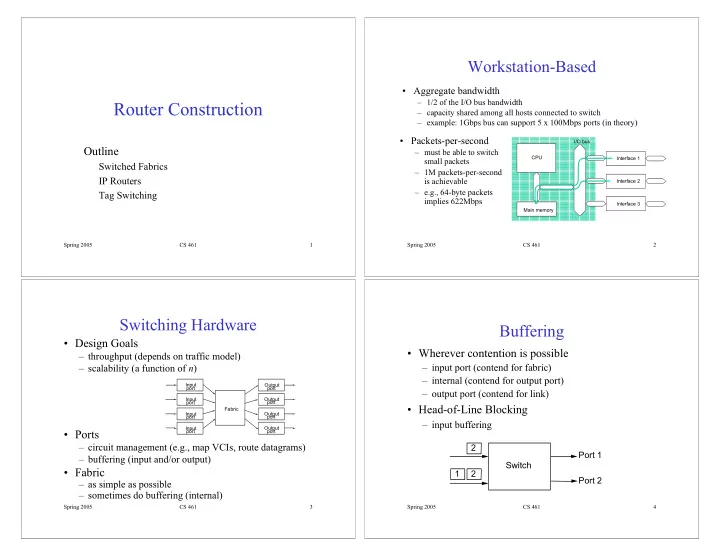
Workstation-Based

  • Aggregate bandwidth

– 1/2 of the I/O bus bandwidth – capacity shared among all hosts connected to switch – example: 1Gbps bus can support 5 x 100Mbps ports (in theory)

CPU Main memory I/O bus Interface 1 Interface 2 Interface 3

  • Packets-per-second

– must be able to switch small packets – 1M packets-per-second is achievable – e.g., 64-byte packets implies 622Mbps

Spring 2005 CS 461 3

Switching Hardware

  • Design Goals

– throughput (depends on traffic model) – scalability (a function of n)

  • Ports

– circuit management (e.g., map VCIs, route datagrams) – buffering (input and/or output)

  • Fabric

– as simple as possible – sometimes do buffering (internal)

Input port Input port Input port Input port Output port Output port Output port Output port Fabric

Spring 2005 CS 461 4

Buffering

  • Wherever contention is possible

– input port (contend for fabric) – internal (contend for output port) – output port (contend for link)

  • Head-of-Line Blocking

– input buffering

Switch 2 2 1 Port 1 Port 2

slide-2
SLIDE 2

Spring 2005 CS 461 5

Crossbar Switches

Spring 2005 CS 461 6

Knockout Switch

  • Example crossbar
  • Concentrator

– select l of n packets

  • Complexity: n2

1 2 3 4

Outputs Inputs Spring 2005 CS 461 7

Knockout Switch (cont)

  • Output Buffer

(c) Shifter Buffers (b) Shifter Buffers (a) Shifter Buffers

Spring 2005 CS 461 8

Self-Routing Fabrics

  • Banyan Network

– constructed from simple 2 x 2 switching elements – self-routing header attached to each packet – elements arranged to route based on this header – no collisions if input packets sorted into ascending order – complexity: n log2 n

001 011 110 111 001 011 110 111

slide-3
SLIDE 3

Spring 2005 CS 461 9

Self-Routing Fabrics (cont)

  • Batcher Network

– switching elements sort two numbers

  • some elements sort into ascending (clear)
  • some elements sort into descending (shaded)

– elements arranged to implement merge sort – complexity: n log2

2 n

  • Common Design: Batcher-Banyan Switch

Spring 2005 CS 461 10

High-Speed IP Router

  • Switch (possibly ATM)
  • Line Cards

– link interface (input, output) – router lookup (input) – common IP path (input) – packet queue (output)

  • Control Processor

– routing protocol(s) – exceptional cases

Line card (forwarding buffering) Line card (forwarding buffering) Line card (forwarding buffering) Line card (forwarding buffering)

Routing CPU Buffer memory Routing software w/ router OS Routing software w/ router OS

Spring 2005 CS 461 11

IP Forwarding is Slow

  • Problem: classless IP addresses (CIDR)
  • Route by variable-length Forwarding Equivalence

Classes (FEC)

– FEC = IP address plus prefix of 1-32 bits; e.g., 172.200.0.0/16

  • IP Router

– forwarding tbl: <FEC> <next hop, port> – match IP address to FEC w/ longest prefix

Spring 2005 CS 461 12

  • Primary goal: fast, cheap forwarding
  • 1Gb/s IP router: $187,000
  • 5Gb/s ATM switch: $41,000
  • Create Virtual Circuit at Flow Setup

– <in VCI> <port, out VCI>

  • Cell Forwarding

– index, swap, switch

ATM Forwarding

slide-4
SLIDE 4

Spring 2005 CS 461 13

Tag Switching (MPLS)

  • Add a VCI-like tag to packets

– <in tag> <next hop, port, out tag>

  • Use ATM switch hardware
  • IP routing protocols (OSPF, RIP, BGP)

– build forwarding table from routing table

  • Goal: IP router functionality at ATM switch

speeds/costs

Spring 2005 CS 461 14

Forwarding

  • Shim before IP header
  • Tag Forwarding Information Base (TFIB)

– <in tag> <next hop, port, out tag>

  • Just like ATM

– index, swap, switch TTL (8 bits) CoS S Tag (20 bits)

Spring 2005 CS 461 15

Tag Binding

  • New FEC from IP routing protocols

– Select local tag (index in TFIB) – <in tag> <next hop, port, ???>

  • Need <out tag> for next hop
  • Other routers need my <in tag>
  • Solution: distribute tags like other routing info

Spring 2005 CS 461 16

Tag Distribution Protocol

  • Send TDP messages to peers

– <FEC, my tag>

  • Upon receiving TDP message, check if sender is

next hop for FEC

– yes, save tag in TFIB – no, can discard or save for future use

  • ‘Control-driven’ label assignment
slide-5
SLIDE 5

Spring 2005 CS 461 17

The First Tag

  • Two kinds of routers: edge vs. interior
  • Edge: add shim based on IP lookup, strip at exit
  • Interior: forward by tag only

E I I E

Spring 2005 CS 461 18

Robustness Issues

  • What if tag fault?

– try to forward (default route) – discard packet

  • Forwarding Loops

– topology changes cause temporary loops – TTL field in tag, same as IP

Spring 2005 CS 461 19

Ipsilon: IP Switching

  • Run on ATM switch over ATM network

– ATM hardware + IP switching software

  • Idea: Exploit temporal locality of traffic to cache

routing decisions

  • Associate labels (VCI) with flows

– forward packets as usual – main difference is in how labels are created, distributed to other routers

Spring 2005 CS 461 20

Alternative: IP Switch

  • Assume default ATM virtual circuits between

routers

  • Router runs IP routing protocol, can forward IP

packets on default VCs

  • Identify flows, assign flow-specific VC

– flow = port pair or host pair

  • ‘Data-driven’ label assignment