Rough and tough: improving habitat to protect fish stocks Dr. Paul - - PowerPoint PPT Presentation

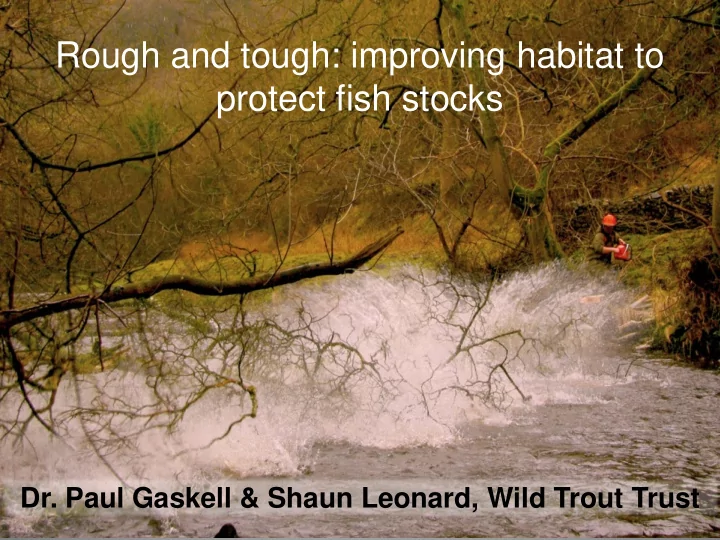
rough and tough improving habitat to protect fish stocks
SMART_READER_LITE
LIVE PREVIEW

Rough and tough: improving habitat to protect fish stocks Dr. Paul - - PowerPoint PPT Presentation

Rough and tough: improving habitat to protect fish stocks Dr. Paul Gaskell & Shaun Leonard, Wild Trout Trust Hudson Bay Company pelt records: the textbook classic predator/prey cycling example Krebs, C.J., R. Boonstra, S. Boutin et al .,

slide-1
SLIDE 1

Rough and tough: improving habitat to protect fish stocks

  • Dr. Paul Gaskell & Shaun Leonard, Wild Trout Trust
slide-2
SLIDE 2

Hudson Bay Company pelt records: the textbook classic predator/prey cycling example

Krebs, C.J., R. Boonstra, S. Boutin et al., What drives the snowshoe hare cycle in Canada's Yukon, in Wildlife 2001: Populations, D.R. McCullough and R.H. Barrett, Editors. 1992, Elsevier: New York. p. 886-896.

slide-3
SLIDE 3

Predator/Prey interactions

If nice neat cycles are rare: What do we know about habitat influence on predator/prey dynamics?

slide-4
SLIDE 4

Old school pure ecology: mites,

  • ranges and rubber balls

① Huffaker study: predatory + herbivorous mites in constructed ‘arenas’ to study the effect of habitat complexity ② ‘Arenas’ included: – Oranges (mite food) – Oranges + rubber balls etc (food + much more complex physical environment and greater prey refuge)

Huffaker, C.B., Experimental studies on predation: dispersion factors and predator - prey oscillations. Hilgardia, 1958. 27: p. 343-383.

slide-5
SLIDE 5
slide-6
SLIDE 6

So, might things be similar in fish populations?

Bring out the Bass!

slide-7
SLIDE 7

Bass predation on Bluegills

Gotceitas, V. & Colgan, P. (1989) Predator Foraging Success and Habitat Complexity - Quantitative Test of the Threshold Hypothesis. Oecologia, 80(2), 158-66.

Various artificial weed densities

slide-8
SLIDE 8

Predator success decreases as plant density increases Bluegills choose denser cover

slide-9
SLIDE 9

Refuge work here…

slide-10
SLIDE 10

Russell et al. (2008) UK cormorant study

  • Experimental ponds + artificial refuges

Control ponds with no artificial refuges

  • In the refuge ponds

฀ 79% less fish lost in refuge ponds ฀ 67% less fish eaten directly by cormorants ฀ 77% fewer visits to refuge ponds ฀ Cormorants c35% less efficient

Russell, I., et al., Reducing fish losses to cormorants using artificial fish refuges: an experimental study. Fisheries Management and Ecology, 2008. 15(3): p. 189-198.

slide-11
SLIDE 11

Classic predictions of habitat complexity versus predator/prey interactions ①In ‘simple’ habitats, predators efficient and systems unstable ① habitat complexity   predator efficiency and may tend to stabilize the interaction (lower risk

  • f prey extinction)

e.g. Crowder, L.B. & Cooper, W.E. (1982) Habitat Structural Complexity and the Interaction between Bluegills and Their Prey. Ecology, 63(6), 1802-13.

slide-12
SLIDE 12

How to make this stuff relevant in wild streams?

slide-13
SLIDE 13

To start: what’s good and bad habitat?

slide-14
SLIDE 14

How does WTT work increase habitat complexity?

slide-15
SLIDE 15

How does WTT work increase habitat complexity?

slide-16
SLIDE 16

How does WTT work increase habitat complexity?

slide-17
SLIDE 17

Would we expect this to protect against bird predation?

  • Optimal foraging theory…

A predator should leave a patch when its rate of food intake in the patch drops to the average rate for the habitat as a whole

  • So, increasing search time and reducing

capture efficiency by increasing habitat complexity should make predators give up on a patch sooner

e.g. Pyke, G.H., Pulliam, H.R. & Charnov, E.L. (1977) Optimal Foraging - Selective Review of Theory and Tests. Quarterly Review of Biology, 52(2), 137-54.

slide-18
SLIDE 18

Wye & Usk Foundation Work

22.8km of river bank completed in first year

slide-19
SLIDE 19

Any evidence it works?

Percentage change in numbers relative to reference site

Fry Parr Habitat works carried out

Nant Bran Salmon Abundance

slide-20
SLIDE 20

Habitat Work – Problems not Solutions?

  • Land Drainage Consent?
  • How to secure LWD/CWD?
  • What if the stuff does break away?
  • Does it actually work?
  • Is it fish aggregation or genuine increased

numbers?

  • Displaces not removes the issue?
  • Not good for some species e.g. grayling?
  • River users not happy – perception of

‘rubbish’ in the river!

slide-21
SLIDE 21

Best Shot?

  • Make and keep your river rough
  • Use LWD and CWD
  • Fish live in trees!
slide-22
SLIDE 22

Photo: C. Rangeley-Wilson