Ross grief stages about living well with Dysautonomia? Morwenna - - PowerPoint PPT Presentation

ross grief stages about living well
SMART_READER_LITE
LIVE PREVIEW

Ross grief stages about living well with Dysautonomia? Morwenna - - PowerPoint PPT Presentation

What we can learn from the Kubler- Ross grief stages about living well with Dysautonomia? Morwenna Opie, PhD, DipClinPsych Aims Shed some light on the emotional rollercoaster that is loss associated with chronic illness Suggest why


slide-1
SLIDE 1

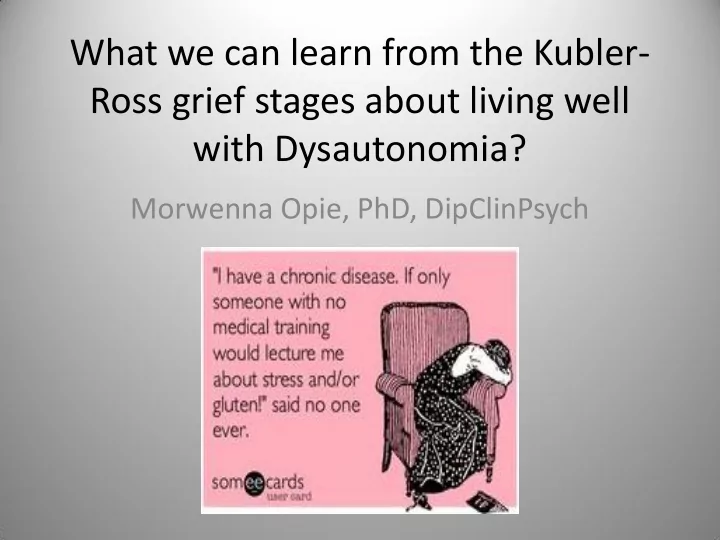
What we can learn from the Kubler- Ross grief stages about living well with Dysautonomia?

Morwenna Opie, PhD, DipClinPsych

slide-2
SLIDE 2

Aims

  • Shed some light on the

emotional rollercoaster that is loss associated with chronic illness

  • Suggest why particular

strategies and interventions from CBT are especially relevant at different parts of that ride

  • Make clear the

importance of acceptance in living well

2

slide-3
SLIDE 3

It will not...

  • Suggest psychological

processes cause dysautonomia

  • Suggest everyone

responds to loss or ill health in the same way

3

slide-4
SLIDE 4

Why a grief model?

  • Illness is undoubtedly

loss – self, immortality, and envisioned future,

  • Helps explain why

psychological support is relevant

  • Helps explain what might

be relevant when

  • Encourages self-

compassion and understanding and hope

  • Permission to grieve

4

slide-5
SLIDE 5

Why a K-R grief model?

  • Normalises a common

but highly individual and challenging experience and associated complex emotions

  • A reminder that loss and

adjustment is not binary

  • Has good face validity and

is helpful for targeting intervention

  • If it is good enough for

House...

5

slide-6
SLIDE 6

Examples of thoughts at each stage

  • DENIAL - “They are wrong” “This will pass” “I don’t

need to change”

  • ANGER - “Why me” “Why not you” “It is all their

fault” “I hate this and a world that did this to me”

  • BARGAINGING – “I will never say another mean word

if I can just be better” “Just let me do this one more test/ try one more treatment and I will do anything”

  • DEPRESSION – “My situation and my future is bleak”

“I don’t know who I am anymore”

  • ACCEPTANCE - “I don’t like this, but I can still live well

and find meaning and joy in life.” “I can balance time dedicated to looking after and improving my health – with still living and loving life with it in the meantime.”

6

slide-7
SLIDE 7

The Model

  • The 5 stages of grief by Swiss psychiatrist

Kubler-Ross On death and dying (1969)– expanded to include other loss including rejection and chronic illness

  • Not uncriticised. She herself first to

acknowledge that the model not complete and individuals do not progress through stages

  • Baxter Jennings, University of Kentucky,

2012 –inadequate consideration of the personal environment – social support and engagement in positive experiences as a very important mediating factor

  • McDougall –maximise skills and

knowledge and celebrate ongoing personal uniqueness

  • Legacy – discussing feelings candidly and

courageously as beneficial to outcome

7

slide-8
SLIDE 8

Why CBT?

  • CBT has a good empirical basis in helping navigate grief and also
  • protecting against developing more serious mental-health difficulties

8

slide-9
SLIDE 9

Put simply, CBT is...

  • The way we feel isn’t

directly determined by what life throws at us, but is mediated by our environment, our physiological responses, and also how we think about/evaluate it (our cognitions) and what we do as a result (our behaviours)

  • If we can gain some control
  • ver the latter two, we can

ultimately have some choice about how we feel.

9

slide-10
SLIDE 10

Put even more simply, CBT is...

  • CBT is about how to be as good a friend to
  • urselves as we generally are to others

10

slide-11
SLIDE 11

Flags and signposting

  • Examine each of the 5 stages of

loss in the K-R model

  • Consider the psychological

processes involved

  • Consider ways to support yourself
  • r a loved one at each phase (and

perhaps what not to attempt)

  • NB All emotions are legitimate and

understandable (or else we tell

  • urselves we are somehow

unacceptable with consequences for self-esteem and self-trust) – but we can consider them a flag to consider rather than an emotional/behavioural inevitability

11

slide-12
SLIDE 12

1). Shock and Denial

  • “They are wrong” “This

will pass” “I don’t need to change”

  • Reckless or

uncharacteristic behaviours

  • Emotions numbed

12

slide-13
SLIDE 13

1). Shock and/or denial

  • Process of emotional

protection, numbing, which can allow time to process manageably

  • Problematic when: Important

lifestyle advice and health- related behaviours are ignored e.g. failing to pace, medicate

  • r to self-sooth, & withdrawal.
  • Useful strategies for

shock/denial: 5 senses soothing, memory box, getting informed, company, establishing simple routines, TIME, rest

13

slide-14
SLIDE 14
  • Example of a memory/hope box

14

slide-15
SLIDE 15

2). Anger

  • “Why me” “Why not you”

“It is all their fault” “I hate this and a world that did this to me”

  • Aggressive behaviours
  • Externalised emotional

expression

15

slide-16
SLIDE 16

2). Anger

  • Primary emotions often emerge before more complex

emotions surface. Expression can be cathartic and allow more complex cognitive processes to follow and be worked through

  • Problematic when:

– a). misdirected and causes further loss as a result (friends, loved ones, medics) – b). anger is arousal, fight/flight, an inflammatory process counter to healing and which can exacerbate symptoms of dysautonomia

  • Useful strategies for anger

– To recognise it is justified is not the same as feeling it must be fuelled – Discreet safe cathartic activities (smashing things, noise etc) and exercise – Self-soothing - 5 senses, breathing, relaxation

16

slide-17
SLIDE 17

All-senses soothing strategy for strong emotions including anger

  • SELF-SOOTHING has to do with comforting, nurturing and being kind to yourself. One way to think of this is to think of ways
  • f putting together an activity plan/package which soothes each of your five senses:
  • VISION:

Look at the nature around you. Go to a museum with beautiful art. Buy a flower and put it where you can see it. Sit in a

  • garden. Watch the snowflakes decorate the trees during a snowfall. Light a candle and watch the flame. Look at a book with

beautiful scenery or beautiful art. Watch a travel movie or video. HEARING: Listen to beautiful or soothing music, or to tapes of the ocean or other sounds of nature. Listen to a baby gurgling or a small

  • animal. Sit by a waterfall. Listen to someone chopping wood. When you are listening, be mindful, letting the sounds come

and go. SMELL: Smell breakfast being cooked at home or in a restaurant. Notice all the different smells around you. Walk in a garden or in the woods, maybe just after a rain, and breathe in the smells of nature. Light a scented candle or incense. Bake some bread

  • r a cake, and take in all the smells.

TASTE: Have a special treat, and eat it slowly, savouring each bite. Cook a favourite meal. Drink a soothing drink like herbal tea or hot chocolate. Let the taste run over your tongue and slowly down your throat. Go to a potluck, and eat a little bit of each dish, mindfully tasting each new thing. TOUCH: Take a bubble bath. Pet your dog or cat or cuddle a baby. Put on a silk shirt or blouse, and feel its softness and smoothness,

  • r a favourite persons sweater. Sink into a really comfortable bed. Float or swim in a pool, play with playdough

17

slide-18
SLIDE 18

Humour, the great anger diffuser

18

slide-19
SLIDE 19

We have all been here...

19

slide-20
SLIDE 20

3). Bargaining

  • “I will never say another

mean word if I can just be better” “Just let me do this

  • ne more test/ try one more

treatment and I will do/give anything”

  • Can be prone to desperate

acts and illogical behaviours

  • Emotions can be chaotically

directed

20

slide-21
SLIDE 21

3). Bargaining

  • Attempt to gain some control over the situation (i.e. get rid
  • f all pain and symptoms and distress)
  • Problematic when: magical thinking becomes obsessive or
  • bstructive to positive planning and adaptation
  • Useful strategies for bargaining
  • Use this energy to begin engaging in healthy choices and

becoming responsible TO (not for) the illness

  • Hope
  • Meditation to step back to notice and defuse magical

thoughts and increase psychological flexibility

  • e.g. replace buts with ands & tolerating not running from

pain and difficulty

21

slide-22
SLIDE 22

Meditation

  • Meditation - benefits wide ranging in health, including bp,

cancer progression, even blood-sugar regulation in diabetes)

22

slide-23
SLIDE 23

Meditation cont.

23

slide-24
SLIDE 24

4). Depression

  • “My situation and my future

is bleak” “I don’t know who I am anymore”

  • Withdrawal, lack of self-care
  • Internalised emotion

24

slide-25
SLIDE 25

4). Reactive depression

  • Very present and deep grief and

sadness in reaction to loss. Not indicative of mental illness, but an appropriate response to loss and concern for the future. Associated with anxiety/disinterest in future

  • Problematic when incapacitating,

hope disappears, isolation

  • Useful strategies for reactive

depression

  • Paced behavioural activation
  • Cognitive work restoring more

balanced thinking

  • Typical thinking errors from those

experiencing loss – grey glasses including

25

slide-26
SLIDE 26

Reactive depression

26

slide-27
SLIDE 27

5). Acceptance

  • “I don’t like this, but I can still

live well and find meaning and joy in life.”

  • Healthy balanced behaviours

(challenges and recuperation)

  • Emotions channelled

productively

27

slide-28
SLIDE 28

5). ACTIVE Acceptance

  • A starting point to make plans, adaptations and

alterations to a new reality

  • Problematic when: stops values-based living and

seeking to make life as fulfilling as possible

  • Useful strategies for ACTIVE acceptance
  • Values-based living (still meet values on a ‘bad’ day,

short and long-term plans etc)

  • In focusing on what we can do, and tolerating what we

can’t, we can get a new appreciation for life and what truly is precious and live better, even if wounded, going forward.

28

slide-29
SLIDE 29

Acceptance – values can be met multiple ways

Me:

  • Somewhat

unconventional/qwerky

  • A new project on the go
  • Reciprocal valuing and

generous interactions

  • Silliness
  • Family – safe-base to

explore

  • Community/contribution
  • Art

29

slide-30
SLIDE 30

Values-based living template

30

slide-31
SLIDE 31

Take home messages

  • Rationale for seeking good

emotional and psychological support (to deal with acute distress, prevent long-term deterioration and help to maximise the future)

  • Find own ways to switch off

fight/flight and have self compassion respond to different ways we react in different times

  • Communicate your needs to
  • thers

31

slide-32
SLIDE 32

Final thoughts

  • Our capacity to heal is

affected by our stress (and associated inflammatory processes) and this is affected by our relationships, our behaviours and beliefs – we have a responsibility to do all we can to influence this process positively. Helping

  • urselves and seeking help

through the grief process is

  • ne of many important

factors in maximising our health.

  • Dr Kubler-Ross had very

powerful messages about self-compassion, silence within, sharing our experiences, and the inner- beauty that can emerge as people find their way through loss

32