Is it Depression or is it Grief? Symptoms and Significance in - - PowerPoint PPT Presentation

is it depression or is it grief
SMART_READER_LITE
LIVE PREVIEW

Is it Depression or is it Grief? Symptoms and Significance in - - PowerPoint PPT Presentation

Is it Depression or is it Grief? Symptoms and Significance in Bereavement Robert A. Neimeyer, PhD October 22, 2020 The Well of Grief David Whyte Todays Goals Compare and contrast symptoms of depression and grief in bereavement

slide-1
SLIDE 1

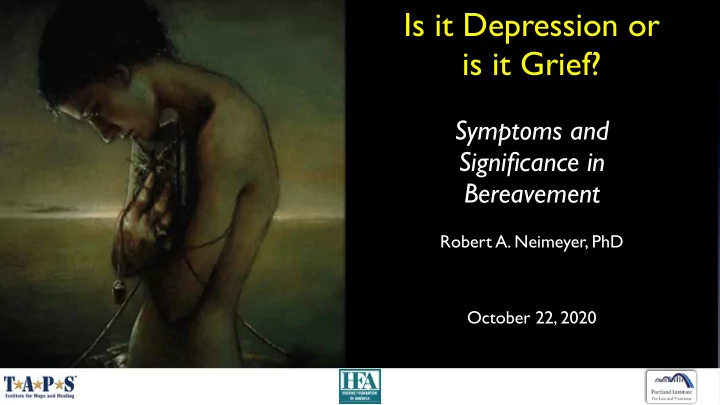
Is it Depression or is it Grief?

Symptoms and Significance in Bereavement

Robert A. Neimeyer, PhD October 22, 2020

slide-2
SLIDE 2

The Well

  • f Grief

David Whyte

slide-3
SLIDE 3

Today’s Goals

  • Compare and contrast symptoms of

depression and grief in bereavement

  • Recognize the role of a quest for meaning

in mourning, and growth in grief

  • Identify some practical principles for

addressing both forms of distress in bereavement

slide-4
SLIDE 4

Depression

  • Self-focused, alienated from
  • thers
  • Hopelessness
  • Low self-esteem, self-loathing
  • Guilt about feeling worthless or

useless to others

  • Pervasive inability to experience

pleasure with people or activities

  • Chronic feelings of not wanting to

live; acute suicide risk

  • Maintained connections to others
  • Hope for improvement
  • Overall feeling of self-worth
  • Guilt and regret about “letting

down” the deceased

  • Loss of pleasure related to

longing for loved one

  • Suicidal feelings related to

yearning for reunion

  • Consoled by friends, music, etc.

vs. Grief

slide-5
SLIDE 5

The Toll of Tragic Loss:

Grief, Trauma and Depression in Bereavement

McDevitt-Murphy, Neimeyer et al., Psychological Trauma

slide-6
SLIDE 6

Co-occurrence of PTSD, CG, and Depression (N=43)

PTSD 19% Depression 49% CG 56% 37% None

PTSD 19%

Complicated Grief 56% Depression 49% 37% None

Incidence of PTSD, CG, and Depression

slide-7
SLIDE 7

Co-morbidity of PTSD, CG, and Depression

PTSD total

19%

CG Total

56%

CG & Depression None 37%

19% 23% CG

  • nly

14% 7%

Depression Total

49% Dep.

  • nly
slide-8
SLIDE 8

Adaptive Grieving

  • Process “event story” of the

death, attempting to make sense

  • f it and its meaning for our lives

now

  • Access “back story” of

relationship to restore attachment security and resolve unfinished business with the deceased

Acute Grief Processes

Integrated Grief

  • Finality of death

acknowledged

  • Bittersweet emotions

accessible & changing

  • Mental representation
  • f deceased revised
  • Coherent narrative of

loss formulated

  • Life goals

redefined

slide-9
SLIDE 9

Sense-making predicts better grief adaptation in:

  • Palliative care
  • Natural death losses
  • Violent death losses
  • Bereaved:
  • Parents
  • Spouses
  • Young adults
slide-10
SLIDE 10
  • 617 ethnically diverse adults in first two years of loss
  • Controlled for cause of death, nature of relationship and other

background factors

F

  • r

P e e r R e v i e w

               

 

Complicated Grief Symptoms & Posttraumatic Growth

Currier, Holland & Neimeyer, Traumatology

slide-11
SLIDE 11

Boy van Dulman: Omdat ik hou van jou

Principles of Practice

  • Stabilize depression when present
  • Draw on people’s prior resources for coping
  • Practice self-soothing skills
  • Seek supportive interactions with others: DLRs
  • Structure days with manageable goals
  • Name and claim grid-related emotions, and

address the needs implicit in them

  • Honor the deceased, and restore the bond
  • Treat the trauma, when present
  • Find a way to tell the story, and make it whole
  • Integrate the loss into life in a way that

promotes growth and the capacity to love

  • Medicate depression when necessary, not grief
slide-12
SLIDE 12

Travelers

Lisa Jennings: The Eternal Circle

slide-13
SLIDE 13

Questions?