Rong Fu, Nelun Fernando, Lei Yin This is a collaborative work with - - PowerPoint PPT Presentation
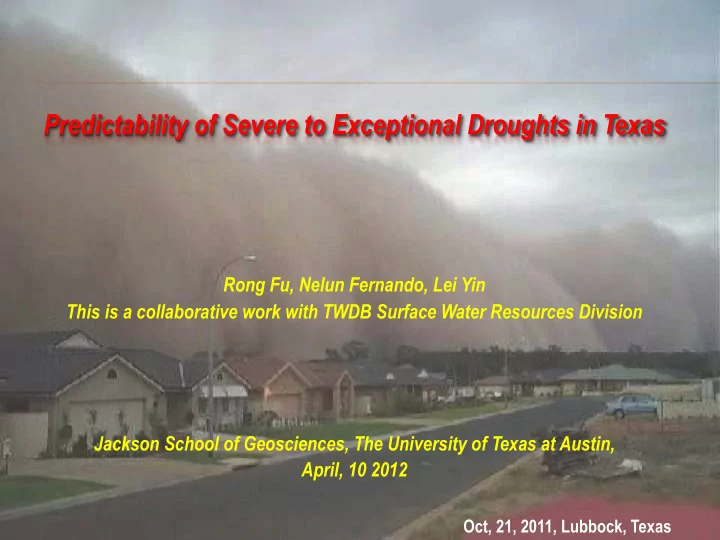
Rong Fu, Nelun Fernando, Lei Yin This is a collaborative work with TWDB Surface Water Resources Division Jackson School of Geosciences, The University of Texas at Austin, April, 10 2012 Oct, 21, 2011, Lubbock, Texas Agriculture loss: $7.62B
- Agriculture loss: $7.62B (the Texas AgriLife Extension Service)
- Fires: 10 people died, including 4 four firefighters, burned nearly
3.7M acres and 1915 homes
- Loss of power generation caused rolling back-outs, threatened
production of oil refinery (1/6 of the nation)
- The drought intensified rapidly in late spring and summer.
- A
H H H A H AH AH AH AH AH AH AH AH
U.S. Drought Monitor
H
June 28, 2011
Valid 8 a.m. EDT
The Drought Monitor focuses on broad-scale conditions. Local conditions may vary. See accompanying text summary for forecast statements.
Released Thursday, June 30, 2011
Author: Richard Heim/Liz Love-Brotak, NOAA/NESDIS/NCDC A AH Intensity: D0 Abnormally Dry D1 Drought - Moderate D2 Drought - Severe D3 Drought - Extreme D4 Drought - Exceptional
http://drought.unl.edu/dm
Drought Impact Types: A = Agricultural (crops, pastures, grasslands) H = Hydrological (water) Delineates dominant impacts H A H A A H A A A A A H A H H A AH AH AH AH AH AH AH
U.S. Drought Monitor
H
August 23, 2011
Valid 8 a.m. EDT
The Drought Monitor focuses on broad-scale conditions. Local conditions may vary. See accompanying text summary for forecast statements.
Released Thursday, August 25, 2011
Authors: Eric Luebehusen, U.S. Department of Agriculture Laura Edwards, Western Regional Climate Center A AH Intensity: D0 Abnormally Dry D1 Drought - Moderate D2 Drought - Severe D3 Drought - Extreme D4 Drought - Exceptional
http://drought.unl.edu/dm
Drought Impact Types: A = Agricultural (crops, pastures, grasslands) H = Hydrological (water) Delineates dominant impacts
How well the 2011 drought was predicted?
- CFS most-likely and full ensemble predictions and EPS ensemble
forecasts all fail to predict strong drought during summer of 2011.
National drought forecast analysis, http://www.emc.ncep.noaa.gov/mmb/nldas/forecast/TSM/prob/
June ne, 2 , 2011 August, 2 , 2011 CFS: Ini : Initial l soil mo l moisture ano noma mali lies i in n March 3 h 31, , 20 2011 1 CFS mo most- li likely: s ly: soil l mo moisture ano noma mali lies in A n April, l, 20 2011 1
What caused the worst one year drought in 2011?
- La Niña and AMO cannot explain why did drought worsen
rapidly in spring and summer of 2011?
Niño3, Niño4, Niño34 AMO SPI12
What cause severe-exceptional droughts in Texas?
(Source: Fernando et al., in-prep.)
– ESRL PSD 20th century reanalysis
Myoung and Nielsen-Gammon, 2010, J. Climate:
- Summer rainfall deficit over Texas is mainly caused by
- A higher CIN due to
- soil moisture feedbacks
- increase of cap inversion due to westerly advection of warm air from Mexican Plateau
- Enhanced upper-level anticyclonic flow, which reduce synoptic disturbance
Questions:
- What could cause 2011 exceptional drought in absence of strong La Niña and AMO
influence?
- Could spring rainfall deficit initiate a positive soil moisture feedbacks and contribute to
severe to exceptional summer drought over Texas?
- If so, could we identify the anomalous large-scale circulation pattern preferred by strong
spring rainfall deficit? Is this anomalous pattern predictable?
How importance is the spring condition to summer severe to exceptional droughts?
(Source: Fernando et al., in-prep.)
- During the 2011 and other three strongest summer droughts over Texas
since 1895,
- Sharp increase of CIN in spring occurred prior to all four strongest
summer droughts;
- U850hPa was strong westerly, instead of transition into easterly.
Data used:
- Historical period – ESRL PSD 20th century reanalysis
- 2011 – CFSV2 real-time data
Convective inhibition (CIN) climatology
2011
Zonal wind at 850hPa (850hPa)
θ anomaly April 2011
What caused sharp increase of CIN in spring?
850 hPa wind April 2011
(Source: Fernando et al., in-prep.)
- Warm air advected from Mexican Plateau and SW Texas increased capping
temperature appear to be an important contributor to the sharp increase of CIN in spring. Data used:
- 2011 – CFSV2 real-time data
MAM(dry)|JJA(dry) is generally associated with westerly in spring.
- This wind pattern, averaged over all dry spring and summer years, shows westerly
wind over Texas;
- This wind pattern is part of large-scale atmospheric flow pattern linking to ENSO
indices in spring.
- Thus, it could potentially serve as a predictor of spring trigger of summer drought.
(Source: Fernando et al., in-prep.)
Red: westerlies, Blue: easterlies Canonical pattern of April 850 hPa Geopotential height that explained 92% of the variance of April zonal winds over Texas Composite U850, April
Below-normal Near-normal Above-normal
Hindcast of U850hPa in April 2011 using the observed statistical relationship and Niño4 index of Feb. 2011:
(Source: Fernando et al., in-prep.) U850 forecast using Niño4 index for February Overall s ll ski kill: ll: between 15-75% with central Texas Ranging from 45-75%. No skill in southeast
- corner. Similar to skill from Niño3.4(Feb).
CFSv2 most-likely forecast predicted above normal westerly wind in April 2011 although it fails to predict 2011 summer drought:
(Source: Fernando et al., in-prep.) U850 forecast using CFSv2 realtime monthly forecast of April z850 initialized in February Forecast: : weighted towards above normal Overall s ll ski kill: ll: Central Texas has skill scores in the 15-30% range. South central region has no skill. Above-normal Near-normal Below-normal
Below-normal Near-normal Above-normal
However, CFSv2 full ensemble forecast did not capture the above normal westerly wind anomalies in April 2011:
(Source: Fernando et al., in-prep.) U850 forecast using CFSv2 ensemble forecast of z850 initialized in February Forecast: : weighted towards below normal Overall s ll ski kill: ll: Central Texas has skill scores in the 15-30% range. South central and western regions have no skill (based on 1982-2010)
- bs
!"#$%&'()'*+",-./+/#0'/1'2&-2/3-+'4/3-+'5"36'-.'789:;-'1/%'<*=;'%&-3-+02"2'-36'*>?;8',/6&+2' '
' ' ' !/%'@@A'2&-2/3B'.5/'C?DD',/6&+2':-E&'+&22'5"36'2F&&62'/E&%'&-2.&%3'F-%.'/1'GD)'
NCEP1
DJF MAM JJA SON
GFDLCM3 GISSE2H GISSE2R HadCM3 HadGEM2CC MPI IPSLCM5 m s1
4 2 2 4 6 8
Observed U850 hPa associated with spring-summer droughts modeled U850 hPa for the 5% droughts post 1950
– Mean 850 hPa zonal winds are too weak in the selected seven CMIP5 models. – Westerly zonal wind anomalies at 850hPa associated with top 5% droughts show a similar spatial pattern to that observed.
– HadGEM2 best capture the correlation between U850 and Niño3 and Niño4 indices in spring, whereas other 6 selected CMIP5 models do not. – Except for GISS-E2R, all other selected CMIP5 models fail to capture the sign of correlation between JJA dry rainfall anomalies and El Niño in summer.
- bs
Correlation with U850
OBS GFDLCM3 GISSE2H GISSE2R HadCM3 HadGEM2CC MPI IPSLCM5 Nino3 (DJF) Nino4 (DJF) Nino3 (MAM) Nino4 (MAM) Nino3 (JJA) Nino4 (JJA) Nino3 (SON) Nino4 (SON) 0.3 0.2 0.1 0.1 0.2 0.3
Correlation with Precipitation
O B S G F D L
- C
M 3 G I S S
- E
2 H G I S S
- E
2 R H a d C M 3 H a d G E M 2
- C
C M P I I P S L
- C
M 5 Nino3 (DJF) Nino4 (DJF) Nino3 (MAM) Nino4 (MAM) Nino3 (JJA) Nino4 (JJA) Nino3 (SON) Nino4 (SON) 0.3 0.2 0.1 0.1 0.2 0.3
- A strong increase of CIN due to westerly advection of the warm temperature and
surface dryness appear to contribute to the 2011 exceptional drought and the other three strongest droughts in Texas during the past century. This westerly anomalous is correlated to and potentially predictable based on ENSO index in early spring.
- While CFSv2 full ensemble and most-likely ensemble forecasts failed to predict the
soil moisture deficit during the 2011 summer drought, the CFSv2 most-likely ensemble forecast appear to capture the above-normal westerly winds at 850hPa in spring. We are exploring whether errors in rainfall response to this anomalous large-scale wind pattern or soil moisture feedbacks contribute to the failure of predicting strong soil moisture deficit in summer of 2011.
- Based on the historical runs, HadGEM appears to adequately capture the relationship