SLIDE 1
Rochford Primary School S.A.T.s Parents meeting Tuesday 24th January 2017
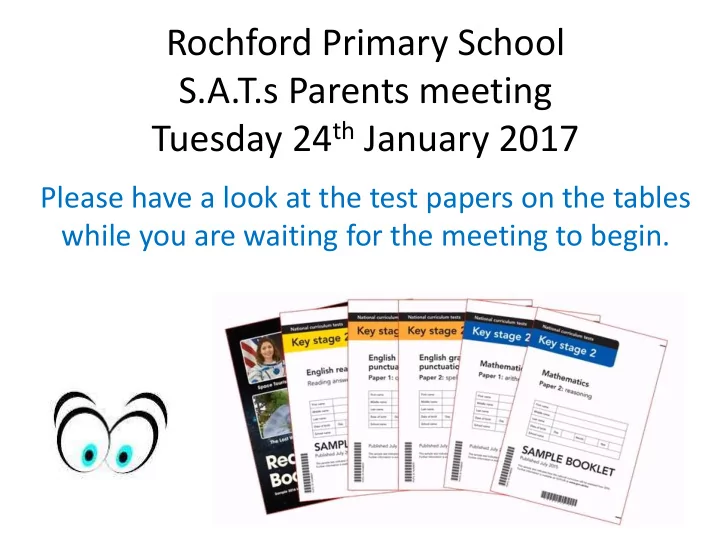
Please have a look at the test papers on the tables while you are waiting for the meeting to begin.
SLIDE 2
SLIDE 3 What are SATs? Standardised Assessment Test
- All Year 6 children in the country take the same
test on the same day
- Attainment of all children in this age group can
be monitored
- Information used by Secondary School,
Government and for Primary schools
SLIDE 4
SLIDE 5 S.A.Ts measure progress and attainment
From Year 2 = 2A/3C – W+ or above From Year 5 = W+ - Year 6 W+ or above
Band 6
Band 6
Band 6
Working at Expected Level for Year 6 Working at greater depth
Working Towards the Expected Level for 6
SLIDE 6
Monday 8 May 2017 Reading Test Tuesday 9 May 2017 Grammar, punctuation and Spelling Paper 1 & Paper 2 Wednesday 10 May 2017 Mathematics Paper 1: arithmetic Mathematics Paper 2: reasoning Thursday 11 May 2017 Mathematics Paper 3: reasoning
SLIDE 7 Reading Test
The reading test lasts for 60 minutes 3 texts with a mixture of questions. Ranking/ordering, e.g. ‘Number the events below to show the
- rder in which they happen in the story’
Labelling, e.g. ‘Label the text to show the title of the story’ Find and copy, e.g. ‘Find and copy one word that suggests what the weather is like in the story’ Short constructed response, e.g. ‘What does the bear eat?’ Open-ended response, e.g. ‘Look at the sentence that begins Once upon a time. How does the writer increase the tension throughout this paragraph? Explain fully, referring to the text in your answer.’
SLIDE 8 Talk about reading. Discuss books, news, work, shows, TV, poems, songs, language, what people said. Read together, read alone, read aloud, read quietly, read a variety Pause the TV! What happens next. Talk about shows, films, the news, stories, characters. Read newspapers, magazines, leaflets, brochures, finding out.
SLIDE 9
Maths Tests
Children sit three papers in maths: Paper 1: arithmetic, 30 minutes Papers 2 and 3: reasoning, 40 minutes per paper
SLIDE 10
Revision Guides Money & Change
SLIDE 11
SLIDE 12
Grammar, Punctuation & Spelling Tests
The grammar, punctuation and spelling test consists of two parts: a grammar and punctuation paper requiring short answers, lasting 45 minutes, and an spelling test of 20 words, lasting around 15 minutes. The grammar and punctuation test will include two sub-types of questions: Selected response, e.g. ‘Identify the adjectives in the sentence below’ Constructed response, e.g. ‘Correct/complete/rewrite the sentence below,’ or, ‘The sentence below has an apostrophe missing. Explain why it needs an apostrophe.’
SLIDE 13
SLIDE 14
Enjoy – enjoyable/enjoyment/enjoying/enjoys Revision Guides Spelling Homework Spelling Mat
SLIDE 15
Writing Assessment NO TEST
Assessed by class teacher Moderated by other staff/schools/outside (SATs Lady!) List of Key Skills across all writing in all subjects.
SLIDE 16
Encourage editing skills. Use of dictionary. Good readers = Good writers
SLIDE 17
How we support your child in school: Regular formal and informal assessments – analysis of children’s strengths and weaknesses. Interventions Fix It Time Discussion with children Practice papers Daily guided reading Exercise and practical activities, as well as our usual broad and balanced curriculum. Transfer literacy and maths skills across the IPC curriculum.
SLIDE 18
SLIDE 19
How we support your child during the tests Revision sessions before the test Calm and encouraging environment Readers and prompters where required Lots of praise, smiles and support Chilled & rewarding afternoons Child – led revision workshops A few treats!
SLIDE 20
The things we are trying to encourage the children to do are: Continue good homework routines Play an active role in lessons Ask for help if they don’t understand Be aware of targets. Challenge themselves to reach/better them. Try their best. Gain a perception of time
SLIDE 21 How you can support your child at home:
- Sensible bedtime
- Healthy diet – eat breakfast
- Drink plenty of water at home and school.
- Encourage your child positively, without putting too much
pressure on him/her.
- Support with homework – provide a quiet place for work,
share the targets.
- Use revision guides and websites to support your child’s
learning.
- Read with and to your child discussing the content and
choice of words the author has chosen.
SLIDE 22