Roberts Roberts Rules of Order Rules of Order (N (Newly Revised) - - PowerPoint PPT Presentation

robert s
SMART_READER_LITE
LIVE PREVIEW

Roberts Roberts Rules of Order Rules of Order (N (Newly Revised) - - PowerPoint PPT Presentation

Roberts Roberts Rules of Order Rules of Order (N (Newly Revised) l R i d) 1 st Edition written 1876 by General Henry M. Robert for the English Parliament, (AKA Parliamentary Procedure) Latest is 10 th Edition Roberts Rules of


slide-1
SLIDE 1

1

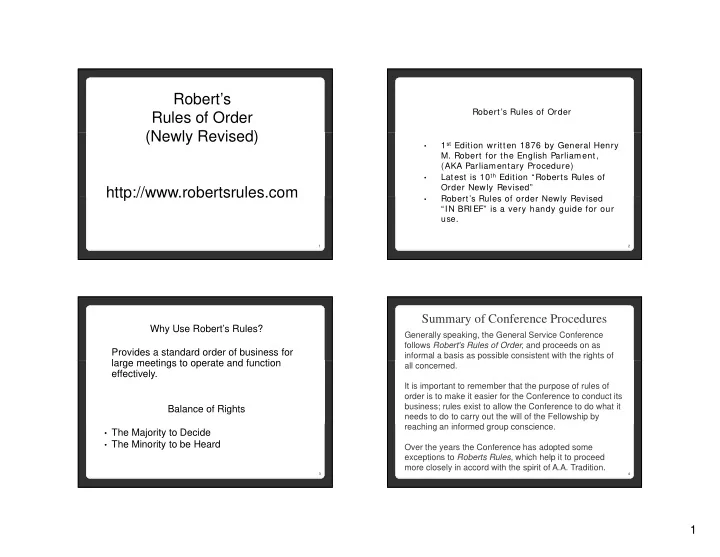
Robert’s Rules of Order (N l R i d) (Newly Revised) http://www.robertsrules.com http://www.robertsrules.com

1

Robert’s Rules of Order

  • 1st Edition written 1876 by General Henry
  • M. Robert for the English Parliament,

(AKA Parliamentary Procedure)

  • Latest is 10th Edition “Roberts Rules of

Order Newly Revised” R b t’ R l f d N l R i d

  • Robert’s Rules of order Newly Revised

“IN BRIEF” is a very handy guide for our use.

2

Why Use Robert’s Rules? Provides a standard order of business for l ti t t d f ti large meetings to operate and function effectively. Balance of Rights

  • The Majority to Decide
  • The Minority to be Heard

3

Summary of Conference Procedures

Generally speaking, the General Service Conference follows Robert's Rules of Order, and proceeds on as informal a basis as possible consistent with the rights of all concerned. It is important to remember that the purpose of rules of

  • rder is to make it easier for the Conference to conduct its

business; rules exist to allow the Conference to do what it needs to do to carry out the will of the Fellowship by hi i f d i reaching an informed group conscience. Over the years the Conference has adopted some exceptions to Roberts Rules, which help it to proceed more closely in accord with the spirit of A.A. Tradition.

4

slide-2
SLIDE 2

2

What Is A Motion? A Proposal that the entire Fellowship takes Action on, or a Stand on an Issue.

5

Committee System

  • To the extent possible, important matters to come

before the Conference will be handled via the "Committee system " Committee system.

  • This assures that a large number of questions can be

dealt with during Conference week. Each Committee considers carefully the items before it and presents its recommendations to the Conference as a whole for acceptance or rejection.

  • Recommendations of Conference committees are

automatically motions that have been made and seconded.

  • Members are urged to resist the temptation to edit

recommendations on the floor.

6

Presenting Motions

  • Obtain the Floor(microphone)

Make your Motion

  • Make your Motion
  • Wait for someone to 2nd your Motion
  • Chair can also call for a second
  • The Motion is lost if not seconded
  • Chair or Secretary restates the Motion

for Clarity for Clarity

  • Debate the Motion
  • Vote

7

General Rules of Debate and Voting

(Agreed to at the beginning of each Conference)

  • People who wish to speak line up at the microphones and are called
  • n in order.
  • Each person may speak for two (2) minutes.
  • No one may speak for a second time on a topic until all who wish to
  • No one may speak for a second time on a topic until all who wish to

have spoken for the first time.

  • Full discussion of a recommendation should take place before each

vote.

  • Everyone is entitled to, and should, express his or her opinion.

However, if your perspective has already been stated by someone y p p y y else, it is not necessary to go to the mike and say it again.

  • Premature actions (e.g., amending motions early in the discussion or

hastily calling the question) can divert attention from the subject at hand, thus confusing and/or delay-ing Conference business.

8

slide-3
SLIDE 3

3

Calling the Question Calling the question brings debate to a halt while Conference members decide whether to d di tl t t (th ti ) proceed directly to a vote on (the question) or go on with the debate. A motion to call the question:

  • Must be made in order at the microphone.
  • Must be made without comment.
  • Requires a second.

Requires a second.

  • Is not debatable.
  • Requires a two-thirds vote
  • Voting is by show of hands.

9

Minority Opinion

  • After each vote on a matter of policy, the side which did

not prevail will always be given an opportunity to speak to their position. p

  • If the motion passes with two-thirds vote, the minority

may speak. If the motion receives a majority vote, but fails to pass for lack of a two-thirds vote, the majority may speak. R b h i " i i i i " f f h

  • Remember that saving "minority opinions" for after the

vote, when there is no rebuttal, is a time-waster, for it can force the Conference body to reconsider a question that might well have been decided the first time around if it had been thoroughly examined from all sides.

10

POINTS… Point of Order Point of Information Point of Personal Privilege g

11

POINT OF ORDER A ti b t P A question about Process,

  • r

Objection and Suggestion of an Alternative Process M i l d t f th Ch i t May include a request for the Chair to rule on the process

12

slide-4
SLIDE 4

4

Point of Personal Privilege A comment about a Personal Need A comment about a Personal Need Example: A request to have members use the microphone

13

Point of Information A request for Information on Process or about the content of a Motion

14

Other Meeting Guidelines/ Considerations…

  • Allow questions for information to be

q asked before opening the debate

  • Discourage the repetition of arguments
  • Impose time limits on speakers if debate

p p carries on too long

15

Tabling a Motion Tabling a motion (moving the discussion to a later time during the same Conference):

  • Must be made without comment.
  • Requires a second

Requires a second.

  • Is not debatable.
  • Needs only a simple majority to pass.

Postponing a Motion Postponing a motion (moving the discussion to a later date in a later conference). Usually the next scheduled conference.

  • Must be made without comment.
  • Requires a second.
  • Is not debatable.
  • Needs only a simple majority to pass.

16

slide-5
SLIDE 5

5

Reconsideration

  • A motion to reconsider a vote may be made only by a

member who voted with the prevailing side, but it can be seconded by anyone seconded by anyone.

  • Only a simple majority is required.
  • If the majority votes to reconsider, full debate, pro and

con, is resumed. (Conference members are urged to limit discussion to new considerations of the question under discussion to new considerations of the question under debate.)

  • No action may be reconsidered twice.

17

Conference Quorum A Conference quorum – two thirds of all registered members is required to conduct Conference business Substantial Unanimity All matters of policy (Conference Advisory Actions) require substantial unanimity, that is, a two-thirds majority. Any actions, including amendments, that affect an Advisory Action or motions that might result in such an action, also require a two-thirds majority. Because the number of members present in the hall during the week of Conference varies from time to time, the phrase "two-thirds majority" is taken to mean two-thirds vote of the Conference members ti t th ti l th t t l t tit t C f voting at the time, as long as the total vote constitutes a Conference quorum.

18

The Group Conscience: The District Meeting: The Area Assembly:

function to hear the business items from the standing committees or special purpose committees. These do not initiate business items Its members may initiate These do not initiate business items. Its members may initiate agenda items through the committees. But do not initiate when acting as a Group conscience, District meeting or an Area assembly. These do not do the exhaustive detail work on items of business. The Committees or special committees do that. This would just bog down the process. It is much more effective for two or three committees to be trusted with the details of important

  • matters. These committees are members of A.A. and will have the

heart and best interest of A.A. These committees then present a consensus(recommendation) to the Group Conscience, District meeting, or Area assembly for oversight, discussion and vote.

19

Every service responsibility should be matched by an equal service authority‐the scope of such authority to be always well defined whether by tradition, by resolution, by specific job description or by appropriate charter and bylaws.

Concept 10

In our structure we have tried to create accurate definitions of authority and

  • responsibility. We have done this (a) by legal means,(b) by traditional means, and (c)

by principles under which doubtful and seemingly or really conflicting situations can be interpreted and readily resolved. Take the conference charter. It is not a legal instrument but practically speaking it is the substance of a contract between the A.A. groups and their

  • Conference. The Charter makes clear in a general way that the A.A. groups have

delegated some of their ultimate authority and all the needed operational authority to the Conference, which includes the Trustees and the active services. It is further suggested, in these present articles, that each Conference member on a final vote be entitled to cast his ballot according to the dictates of his own conscience; that the entitled to cast his ballot according to the dictates of his own conscience; that the Conference itself also be granted, under the traditional “Right of Decision” the privilege of choosing which matters it will decide by itself and which it will refer back to the groups for their discussion, guidance or direction. These are the traditional definitions which can check the natural tendency of the groups to over instruct

  • Delegates. This gives the Conference an authority equal to its real responsibility.

Page 43 A.A. Service Manual 2011‐2012

20