RM SECURED DIRECT LENDING 92 90 88 86 84 82 80 78 At the - - PDF document

rm secured direct lending
SMART_READER_LITE
LIVE PREVIEW

RM SECURED DIRECT LENDING 92 90 88 86 84 82 80 78 At the - - PDF document

17 March 2020 THE MATERIALS CONTAINED HEREIN ARE NOT FOR RELEASE, PUBLICATION OR DISTRIBUTION, Premium Equity Closed-Ended DIRECTLY OR INDIRECTLY, IN WHOLE OR IN PART, TO U.S. PERSONS OR IN OR INTO THE UNITED Investment Funds STATES, AUSTRALIA,


slide-1
SLIDE 1

Disclaimer: Attention of readers is drawn to important disclaimers printed at the end of this document

THE MATERIALS CONTAINED HEREIN ARE NOT FOR RELEASE, PUBLICATION OR DISTRIBUTION, DIRECTLY OR INDIRECTLY, IN WHOLE OR IN PART, TO U.S. PERSONS OR IN OR INTO THE UNITED STATES, AUSTRALIA, CANADA, JAPAN, THE REPUBLIC OF SOUTH AFRICA OR ANY OTHER JURISDICTION WHERE TO DO SO WOULD CONSTITUTE A VIOLATION OF THE RELEVANT LAWS OR REGULATIONS OF SUCH JURISDICTION.

RM SECURED DIRECT LENDING

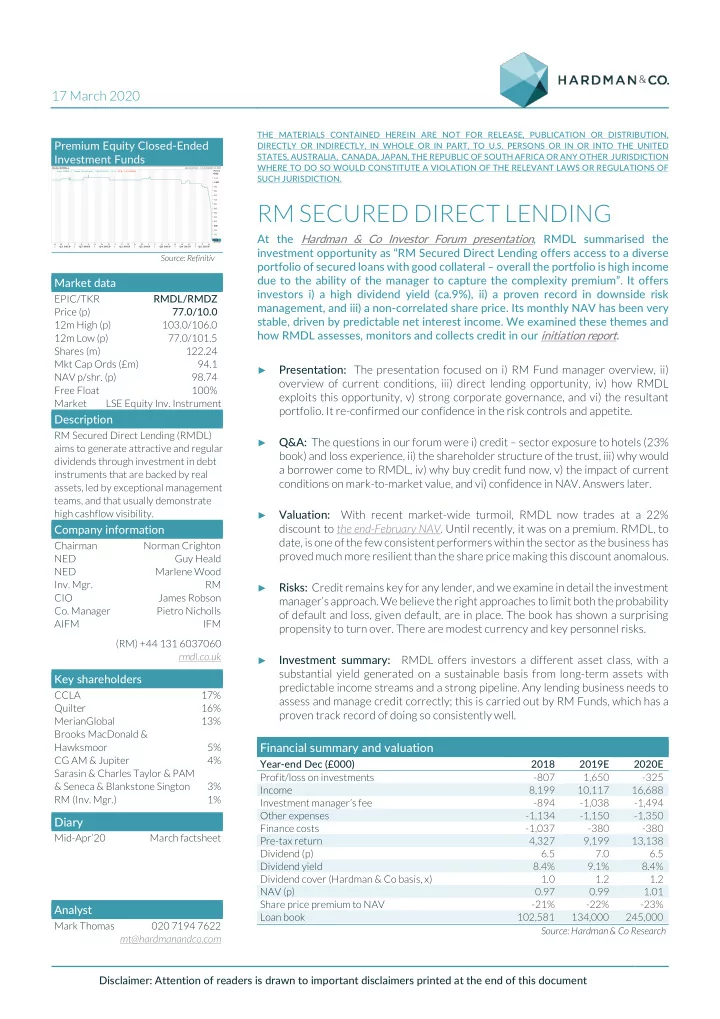
At the Hardman & Co Investor Forum presentation, RMDL summarised the investment opportunity as “RM Secured Direct Lending offers access to a diverse portfolio of secured loans with good collateral – overall the portfolio is high income due to the ability of the manager to capture the complexity premium”. It offers investors i) a high dividend yield (ca.9%), ii) a proven record in downside risk management, and iii) a non-correlated share price. Its monthly NAV has been very stable, driven by predictable net interest income. We examined these themes and how RMDL assesses, monitors and collects credit in our initiation report.

Presentation: The presentation focused on i) RM Fund manager overview, ii)

  • verview of current conditions, iii) direct lending opportunity, iv) how RMDL

exploits this opportunity, v) strong corporate governance, and vi) the resultant

  • portfolio. It re-confirmed our confidence in the risk controls and appetite.

Q&A: The questions in our forum were i) credit – sector exposure to hotels (23% book) and loss experience, ii) the shareholder structure of the trust, iii) why would a borrower come to RMDL, iv) why buy credit fund now, v) the impact of current conditions on mark-to-market value, and vi) confidence in NAV. Answers later.

Valuation: With recent market-wide turmoil, RMDL now trades at a 22% discount to the end-February NAV. Until recently, it was on a premium. RMDL, to date, is one of the few consistent performers within the sector as the business has proved much more resilient than the share price making this discount anomalous.

Risks: Credit remains key for any lender, and we examine in detail the investment manager’s approach. We believe the right approaches to limit both the probability

  • f default and loss, given default, are in place. The book has shown a surprising

propensity to turn over. There are modest currency and key personnel risks.

Investment summary: RMDL offers investors a different asset class, with a substantial yield generated on a sustainable basis from long-term assets with predictable income streams and a strong pipeline. Any lending business needs to assess and manage credit correctly; this is carried out by RM Funds, which has a proven track record of doing so consistently well. Financial summary and valuation

Year-end Dec (£000) 2018 2019E 2020E Profit/loss on investments

  • 807

1,650

  • 325

Income 8,199 10,117 16,688 Investment manager’s fee

  • 894
  • 1,038
  • 1,494

Other expenses

  • 1,134
  • 1,150
  • 1,350

Finance costs

  • 1,037
  • 380
  • 380

Pre-tax return 4,327 9,199 13,138 Dividend (p) 6.5 7.0 6.5 Dividend yield 8.4% 9.1% 8.4% Dividend cover (Hardman & Co basis, x) 1.0 1.2 1.2 NAV (p) 0.97 0.99 1.01 Share price premium to NAV

  • 21%
  • 22%
  • 23%

Loan book 102,581 134,000 245,000 Source: Hardman & Co Research

17 March 2020

Premium Equity Closed-Ended Investment Funds

Source: Refinitiv

Market data

EPIC/TKR RMDL/RMDZ Price (p) 77.0/10.0 12m High (p) 103.0/106.0 12m Low (p) 77.0/101.5 Shares (m) 122.24 Mkt Cap Ords (£m) 94.1 NAV p/shr. (p) 98.74 Free Float 100% Market LSE Equity Inv. Instrument

Description

RM Secured Direct Lending (RMDL) aims to generate attractive and regular dividends through investment in debt instruments that are backed by real assets, led by exceptional management teams, and that usually demonstrate high cashflow visibility.

Company information

Chairman Norman Crighton NED Guy Heald NED Marlene Wood

  • Inv. Mgr.

RM CIO James Robson

  • Co. Manager

Pietro Nicholls AIFM IFM (RM) +44 131 6037060 rmdl.co.uk

Key shareholders

CCLA 17% Quilter 16% MerianGlobal 13% Brooks MacDonald & Hawksmoor 5% CG AM & Jupiter 4% Sarasin & Charles Taylor & PAM & Seneca & Blankstone Sington 3% RM (Inv. Mgr.) 1%

Diary

Mid-Apr’20 March factsheet

Daily RMDL.L 19/03/2018 - 17/03/2020 (LON) Line, RMDL.L, Trade Price(Last), 16/03/2020, 73.5, -9.5, (-11.05%) Price GBp Auto 74 76 78 80 82 84 86 88 90 92 94 96 98 100 102 73.5 A M J J A S O N D J F M A M J J A S O N D J F M Q2 2018 Q3 2018 Q4 2018 Q1 2019 Q2 2019 Q3 2019 Q4 2019 Q1 2020

Analyst

Mark Thomas 020 7194 7622 mt@hardmanandco.com

slide-2
SLIDE 2

RM SECURED DIRECT LENDING

17 March 2020 2

IMPORTANT INFORMATION

THE MATERIALS CONTAINED HEREIN ARE NOT FOR RELEASE, PUBLICATION OR DISTRIBUTION, DIRECTLY OR INDIRECTLY, IN WHOLE OR IN PART, TO U.S. PERSONS OR IN OR INTO THE UNITED STATES, AUSTRALIA, CANADA, JAPAN, THE REPUBLIC OF SOUTH AFRICA OR ANY OTHER JURISDICTION WHERE TO DO SO WOULD CONSTITUTE A VIOLATION OF THE RELEVANT LAWS OR REGULATIONS OF SUCH JURISDICTION. The information and materials contained in this report are exclusively intended for persons who are not residents of the United States and who are not physically present in the United States. The information contained herein and on the preceding pages follow do not constitute an offer of securities for sale or a solicitation of an offer to purchase securities in the United States or in any jurisdiction or jurisdictions in which such offers or sales are unlawful. The securities referred to herein and on the pages that follow have not been nor will they be registered under the U.S. Securities Act of 1933, as amended (the “Securities Act”), or with any securities regulatory authority of any state or other jurisdiction of the United States and may not be offered, sold, resold, taken up, exercised, renounced, transferred, delivered or distributed, directly or indirectly, within the United States or to or for the account or benefit of U.S. Persons (as defined in Regulation S of the Securities Act) except pursuant to an exemption from, or in a transaction not subject to, the registration requirements of the Securities Act and applicable state securities laws. There will be no public offer of the securities in the United States, Australia, Canada, Japan or the Republic of South Africa or any jurisdiction in which such an offer would constitute a violation of the relevant laws or regulations of such jurisdiction. RM Secured Direct Lending Plc will not be registered under the U.S. Investment Company Act of 1940, as amended, and investors will not be entitled to the benefits of that Act. An investment in the securities referred to herein and on the pages that follow are only suitable for institutional investors and professionally-advised private investors who understand and are capable of evaluating the merits and risks of such an investment and who have sufficient resources to be able to bear any losses (which may equal to whole amount of amount invested) that may result from such an investment. Subject to certain exceptions, the securities referred to herein and on the pages that follow may not be offered, sold, resold, taken up, exercised, renounced, transferred, delivered or distributed, directly or indirectly, in Australia, Canada, Japan, the Republic of South Africa or any jurisdiction where to do so would constitute a violation

  • f the relevant laws or regulations of such jurisdiction or to any resident or citizen of

Australia, Canada, Japan or the Republic of South Africa. The offer and sale of the securities referred to herein and on the pages that follow have not been and will not be registered under the applicable securities laws of Australia, Canada, Japan or the Republic of South Africa. Recipients of this information in any other jurisdiction should inform themselves about and observe any applicable legal requirements in their jurisdiction.

slide-3
SLIDE 3

RM SECURED DIRECT LENDING

17 March 2020 3

Hardman executive summary

We believe two key investment attractions for RMDL are the high yield and the sustainability of the dividend. With regard to the former, the company’s target annual yield of ca.6.5% appears credible (indeed is likely to be ca.9.1% this year) and

  • achievable. Sustainability is supported by predictable, multi-year income streams, a

rising gross return on assets, and an improving efficiency ratio. The stability of returns has led to very limited NAV volatility since launch, which we believe investors will also

  • value. We note the additional attraction that the economic drivers supporting this

yield provide diversification from other asset classes. RMDL is operating in a part of the market where competition is moderate. High-street banks have significantly withdrawn from non-standard lending, and the size of RMDL’s participation (£2m-£10m+) is too small for many corporate lenders/capital market investors looking to structure complex deals. RMDL can thus charge for intellectual capital, and its permanent capital structure means it can also exploit illiquidity

  • premiums. The spreads it charges reflect all these factors, as well as credit.

Credit risk management is core to any lender. We conclude that credit at RMDL is well controlled, significantly reducing the risk that impairments will put the dividend under

  • pressure. In particular, we note i) robust credit assessment with appropriate measures

specific to the bespoke nature of the clients, ii) the benefits from control post drawdown, iii) the value of security, and iv) the diversification of the portfolio. Credit risk management is about limiting the probability of default and reducing any loss in the event of default. RMDL’s procedures appear well positioned to do both and, to date, there have been no major loss incidences. We note that the investment manager (RM) owns ca.1% of the company (ca.£1.2m value), as it has re-invested part of the management fees since launch. These shares are locked in for 12 months from purchase and, with a three-year programme, the manager showed great confidence that targeted returns would be achieved. RMDL has a number of discount management policies in place to limit any downside, in particular a buyback programme should the discount hit 6% and a liquidity event at NAV (less costs) at year four. Having such policies may, of course, prevent the discount ever reaching 6%, as the market will expect the company to be a buyer at that level. We believe some gearing is appropriate to leverage returns. It is, in essence, taking some liquidity risk, instead of increasing credit risk, in order to achieve the same

  • return. It must, however, be carefully managed to ensure that the company never gets

into a position of being a forced seller of assets in times of distress. We believe RMDL achieves these objectives, with i) the total debt cap set at 20% of NAV, ii) the use of Zero Dividend Preference (ZDP) shares, which include no restrictive covenants, and iii) the use of a revolving facility to cover short-term needs and reduce a cash drag from issuing equity too far in advance of asset growth. Other attractions include the following: i) RM has significant scale and experience in niche markets, and has extensive and proven origination capacity; ii) with 45% of the portfolio on a floating/inflation-linked rate, RMDL has benefited and is likely to benefit from future, rising market interest rates; and iii) in a limited number of situations, RMDL has taken warrants as part of its remuneration, typically where it has wanted to share upside in growth company finance (in March 2019, this resulted in a gain over book value of £0.6m – we have not built anything further into our forecasts and regard such returns as icing on the cake, rather than core returns, but the gain on the sale of warrants does show accounting conservatism). We discuss accounting in more detail in our initiation report, but note that 32% of the book is on Level 2 accounting, where there are significant market inputs (peers either 100% Level 3 or value loans off IFRS9 models).

ca.9% dividend yield paid from predictable, multi-year income streams, with rising revenue yields and economies

  • f scale

Niche market with limited competition, where superior returns can be earned from structuring complex deals and illiquidity premium Right policies in place to assess credit and manage it once a loan is drawn down, and also to manage accounts in difficulty. High value of security, and risk is diversified. Investment manager has ca.£1.2m in RMDL and aligned to shareholder interests Discount management policies in place likely to limit downside Appropriate gearing Other attractions include market presence

  • f investment manager, income benefit

from rising rates, limited number of warrant situations, and accounting significantly driven by observable inputs

slide-4
SLIDE 4

RM SECURED DIRECT LENDING

17 March 2020 4 As with any lending business, investors need to focus on credit, credit, and then again

  • credit. We believe that losses in medium-sized enterprises are likely to rise as the

credit cycle turns from its current low level. This increases the risk that even good lenders may see losses, especially those with non-senior debt positions. We also note that the wide range of gross spreads RMDL generates (up to 12%) could be perceived as carrying a tail risk of a limited number of accounts, which are at well above-average credit risk. However, investors need to put any prospective turn in the credit cycle into

  • perspective. The most likely outturn remains a gentle rise in impairments, which is

highly likely to be accompanied by an increase in spreads (we have already seen some

  • f the latter in recent months). The balance between higher fair value writedowns

against increased ongoing income may even be positive. We note from the RMDL accounts that the RMDL book has an above-average propensity to turn over (the volume of investments being redeemed relative to

  • pening stock). However, it is important to understand the business messages behind

the accounting number. Only a third of the investments are seeing principal repaid, in line with the average life of loans. We understand that half of the 2018 turnover figure relates to syndicated facilities re-pricing or re-documenting, rather than repayments

  • f principal. In the near term, this may be considered an optical rather than real risk, as

RMDL has kept the relationship and substantially the revenue streams. There is a prospective danger that such customers may seek better pricing in due course, so it is an area to watch. Noting RMDL is in a growth cycle and so already constantly seeking new investments, it will have to work even harder if more customers re-finance externally in the future. It may also face periods of increased cash drag pending re- deployment of loan repayment proceeds, although repayment penalties are usually in place to cover such losses. We believe the risk, and at this stage it is only a potential risk, thus lies in getting the right re-investments if more loans are repaid early. Other risks include i) key personnel risk (although we believe the long expected life of the loan book moderates the risk of losing key staff at the investment manager), ii) currency risk, as ca.20% of the book is in non-sterling loans/bonds (in addition to movements due directly to currency, the hedging policy currently segregates £1.5m

  • f cash and, in extreme market conditions, could see further margin calls), and iii)

perceived potential conflicts of interest (although we believe them to be more perception than reality). In our initiation report, we reviewed the business model, noting the competitive advantages in origination, the unique customer profile (including some of the specific aspects to consider when lending to private equity-backed deals, which account for 74% of book), and RM’s approach to recoveries and arrears management. We also detailed the portfolio mix at that time and compared it with peers. In addition, we considered the fee structure, for both the investment manager’s fees and what the investors pay, together with the economies of scale noted above. In the section on accounting in that note, we detailed the implications for RMDL in valuing its loan book off fair-value accounting. In normal market conditions, we do not believe this will make a material difference to peers, who value loans at amortised cost but, in adverse conditions, this may see a lower value at RMDL, as it will include a market-sentiment discount. There may also be more volatility. Such an approach, though, especially with 32% of assets based off observable market prices, is likely to be viewed by investors as more reflective of the actual realisable value of the assets at each valuation point. In the financial section, we provided a Hardman & Co adjusted profit and loss to give investors a view on what the profit and loss may look like on an amortised cost basis. For the purposes of the Forum, we believe investors should focus more on the portfolio characteristics detailed on the next page. In terms of valuation, we believe the significant and sustainable yield will be a key investor consideration. RMDL trades at a record discount to NAV when historically it has been at a premium.

Credit is the key risk, especially as cycle is likely to turn. Gentle rise in impairments would also see improving income. RMDL book appears to have above- average propensity to turn over Other risks, including key personnel, currency and potential conflicts of interest, appear modest Competitive advantages in origination Fair-value accounting may, in extreme downside scenario, see more volatility, as NAV will be market-sentiment-driven. In normal conditions, likely to be perceived as truer picture of realisable asset values at each accounting date.

slide-5
SLIDE 5

RM SECURED DIRECT LENDING

17 March 2020 5

Manager’s Forum presentation

RM Secured Direct Lending PLC (the “Company”) is a £120m market capitalisation investment trust, which aims to preserve capital and generate a dividend of 6.5p per annum, paid quarterly. RM Funds (the “Investment Manager”) aims to achieve this through a real asset lending strategy, by providing loans to borrowers across a variety

  • f sectors. Since inception, it has delivered dividends of 17.72p (2016 4.2p, 2017 6.5p,

2018 7.025p). The NAV has been stable (opening NAV December 2016: 98p closing NAV 31 January 2020: 98.31). There is a strong manager alignment, with the investment manager owning 1.1m shares and committed to make further purchases. RM Funds specialises in alternative asset fund management with ca.$300m assets under management. It was founded in 2010 and currently manages RM Secured Direct Lending PLC (“RMDL”) and VT RM Alternative Income (“RMAI”). The 36-month track record for RMDL, is stable NAV and stable income. The 20-month track record for RMAI, is that it is ranked 2/130 Citywire Conservative GBP for total return, 1/130 for max drawdown. The leadership team include: i) Petro Nicholls with 14 years of experience and expertise in corporate lending and credit structuring including advising listed and unlisted and government related entities on credit; and ii) James Robson with 22 years of experience and expertise in risk management and traded credit and the former Head of European Corporate Credit Trading at HSBC. Hardman view: The core to us is the culture of the manager. Anyone can lend money but getting it back requires the right experience and approach to credit assessment, monitoring and control. Our discussions with RM give us confidence in that core requirement. The three key themes are: i) credit spreads are at historically tight levels despite considerable macro risk ‒ there is room for significant spread widening and disorderly market conditions to reduce high yield and leverage loan prices; ii) default rates are at historically low levels reflecting the tail end of business cycle ‒ defaults are likely to pick up from here; and iii) covenants at historically weak and borrower-friendly levels ‒ losses in default likely to be higher than previous cycles (although we note the probability of default is likely to be less). Hardman view: We concur with the managers, and we believe the consensus view, that market-wide credit will deteriorate from here. When the tide goes out, you learn who has been swimming naked and RM’s record to date has been excellent. The worsening market impairment position should improve pricing and so revenue opportunities. The key points the manager made here were: i) access to an illiquid asset class; ii) proven ability of manager to source opportunities; iii) offering enhanced security over traditional high-yield and leverage loan investments; iv) robust investor protections through covenants, secured assets and high collateralisation levels; v) RMDL offers fixed income fund exposure with a modest duration; vi) in the chosen niche there is limited competition, but deep opportunity set; and viii) RMDL can capture illiquidity & complexity premium. Hardman view: We explored these issues in our initiation note. We especially highlight the credit management, and limited competition in a chosen niche where skill can generate enhanced returns. As noted above, the majority of the book is sponsor-backed (i.e. private equity), which can be a demanding and challenging client. We also direct investors to the section on economic sensitivity on pages 42-46 in our note on the PE fund of fund investor Pantheon International. While some investors focus on the gearing, PE-backed companies

  • utperform the market in downturns, partially because they have more committed funding

lines, improving operational efficiency and a long-term focused investor.

Summary Manager overview Current market conditions RM Secured Direct Lending opportunity

slide-6
SLIDE 6

RM SECURED DIRECT LENDING

17 March 2020 6 RM’s approach to lending is as follows: i) all due diligence is in-house; ii) loans benefit from robust security packages designed to maximise protection; iii) interest rate protection is built in; iv) there is in-depth knowledge of borrowers and their business; v) credit committee retains oversight and involvement throughout the life the investment / loan; and vi) there is active post-investment monitoring. Hardman view: We believe RMDL is a lender to its fingertips. It is not a technology or marketing company that happens to be in lending. While some credit difficulties and impairment are possible/to be expected in any book, the culture of RMDL from credit assessment, monitoring and collections is likely to limit both the probability of default and the loss in the event of default. The four pillars of strong governance were identified as: i) a strong RMDL Board consisting of Norman Crighton (Chairman), Guy Heald (Non-Executive Director), and Marlene Wood (Non-executive Director and Chair of the Audit Committee); ii) independent valuation agent in Mazars LLP; iii) appropriate accounting policies - marking to fair value; and iv) excellent investor disclosures/monthly reporting. Hardman view: The focus on strong corporate governance has never been higher. Again, we emphasise the importance of culture and in particular, will the board challenge the manager in a positive, constructive way to protect shareholder value. We believe RMDL has such a board. We detail the portfolio in the section below. It is, however, worth highlighting the sector diversity shown in the manager’s presentation. We have shaded the sectors according to our view as to how investors will perceive them. Three quarters, we believe are defensive. Even in the highest risk sectors (hotel and real estate), we note management’s comment about security, strong covenants allowing early intervention and its use of stress testing in advance of lending. Losses also cannot be ruled out in low-risk areas – for example, fuel purchase from forecourts will fall if there is mass isolation, but the impact of a short but sharp interruption to business life may be offset by the government interventions announced in the budget.

Sector allocations (%) at end-December 2019

Note: Hardman & Co shading between perceived higher risk sectors (darkest blue), medium risk (medium blue) and low risk (light blue) Source: RMDL, Hardman & Co Research

23% 3% 5% 8% 5% 6% 8% 13% 9% 16% 3% 1% Hotel Real estate Services consumer Services business Automobiles and components Food Manufacturing Forecourt operators Finance asset finance Healthcare Infrastructure - social Infrastructure other Finance receivables

Approach to lending Governance Portfolio defensively positioned

slide-7
SLIDE 7

RM SECURED DIRECT LENDING

17 March 2020 7

Q&A

During the course of the Forum, there was the opportunity for investors to ask questions in both a formal and an informal setting. We believe the key areas of focus were: Credit quality – what can management say about the hotel exposures and what has been bad debt experience more generally? RMDL highlighted the borrower equity in the deals (low LTV) and that, unlike many lenders, covenants are not

  • compromised. Accordingly, there is the option for an early intervention, which should

reduce the losses in the event of a default with, for example, customer cashflows locked up in the lending structure and not available for other creditors/uses. Management sees the business, which earns yields in excess of 9%, as a good risk/return opportunity. Management also highlighted that, with mark-to-market accounting, there is visibility on the monthly changes in the books’ creditworthiness and there had not been any “down the drain” situations. Hardman view: Credit is absolutely fundamental to a lender and we gave investors a detailed review of RMDL’s processes and approach in our initiation note and 26 September 2019 note Defensive qualities in uncertain times and our 6 January 2020 note Social infrastructure: RMDL an alternative alternative. Losses can never be ruled out in any lender, but we believe RMDL has the right culture to limit the probability of them happening and the scale of loss when they do happen. Shareholder structure of the trust – are there any dominant players? RMDL highlighted the broad institutional holdings (see front page) with over 50 names on the

  • books. It also highlighted the efforts to give best-in-class disclosure.

Why would a borrower come to RMDL? RMDL highlighted that, for many customers, the service they get from their bank for anything other than mainstream lending can be

  • poor. Borrowers can get shoe-horned into inappropriate boxes. Providing quality

service, in complex situations with borrower-led solutions makes RMDL very attractive. Why buy credit fund now? We note the resilience in the portfolio and that the NAV stability reflects this. There is a price for everything and the discount of ca.10% appears anomalous with RNDL’s historical record. What is the impact of current conditions on mark-to-market value? RMDL notes that the market index spread had widened from ca.200bp to ca.500bps with the risk aversion recently seen. RMDL had not tightened its spreads as spreads rallied and likewise will be less affected in business terms from widening now. The index in three days tightened by 55bp to 445 and has proved extremely volatile. Hardman view: It is impossible to read across from the market indices to RMDL’s own book given the company-specific nature of the security and covenants in complex situations. Investors also need to bear in mind the relatively short life of the book and there is also a partial offset from lower benchmark rates. How do we get confidence in NAV/what are the external valuation checks and balances? More than 30% of the book is from external prices and there is an independent valuer (Mazars). Hardman view: Being able to verify the NAV is hugely important and again we went into some detail in our initiation report. It needs external pairs of eyes, a robust and experienced board and, perhaps most importantly, the right culture. RMDL appears to have the right checks and balances in place.

slide-8
SLIDE 8

RM SECURED DIRECT LENDING

17 March 2020 8

Portfolio

The key messages we take from the portfolio stats below are i) incredibly stable NAV generated from net interest income (the spike reflects early repayment penalties), ii) stable average life, iii) rising yields, and iv) more junior and Hold co structures (see initiation report for more detail on these vehicles and how risk is managed in them). Monthly NII as % of NAV (%)… … NAV has been remarkably stable (p)

Source: RMDL factsheets, Hardman & Co Research

Portfolio mix by weighted average life (%)… …and yield (%)

Source: RMDL factsheets, Hardman & Co Research

Portfolio mix by coupon type (%)… …and investment type (%)

Source: RMDL factsheets, Hardman & Co Research

0.00% 0.20% 0.40% 0.60% 0.80% 1.00% 1.20% 1.40% 1.60% 10 20 30 40 50 60 70 80 90 100 110 Jan-17 Apr-17 Jul-17 Oct-17 Jan-18 Apr-18 Jul-18 Oct-18 Jan-19 Apr-19 Jul-19 Oct-19 Jan-20 1 2 3 4 5 0% 20% 40% 60% 80% 100% Jun-17 Sep-17 Dec-17 Mar-18 Jun-18 Sep-18 Dec-18 Mar-19 Jun-19 Sep-19 Dec-19

0-3 years 3-5 years >5 years average no years (RHS)

7 7.5 8 8.5 9 0% 20% 40% 60% 80% 100% Jun-17 Sep-17 Dec-17 Mar-18 Jun-18 Sep-18 Dec-18 Mar-19 Jun-19 Sep-19 Dec-19

< 7.5% 7.5-9.5% >9.5% average (% RHS)

0% 20% 40% 60% 80% 100% Jun-17 Sep-17 Dec-17 Mar-18 Jun-18 Sep-18 Dec-18 Mar-19 Jun-19 Sep-19 Dec-19 Fixed Floating 0% 20% 40% 60% 80% 100% Jun-17 Sep-17 Dec-17 Mar-18 Jun-18 Sep-18 Dec-18 Mar-19 Jun-19 Sep-19 Dec-19 Senior Junior HoldCo

slide-9
SLIDE 9

RM SECURED DIRECT LENDING

17 March 2020 9

Disclaimer

Hardman & Co provides professional independent research services and all information used in the publication of this report has been compiled from publicly available sources that are believed to be reliable. However, no guarantee, warranty or representation, express or implied, can be given by Hardman & Co as to the accuracy, adequacy or completeness of the information contained in this research and they are not responsible for any errors or omissions or results obtained from use of such

  • information. Neither Hardman & Co, nor any affiliates, officers, directors or employees accept any liability or responsibility in respect of the information which is subject

to change without notice and may only be correct at the stated date of their issue, except in the case of gross negligence, fraud or wilful misconduct. In no event will Hardman & Co, its affiliates or any such parties be liable to you for any direct, special, indirect, consequential, incidental damages or any other damages of any kind even if Hardman & Co has been advised of the possibility thereof. This research has been prepared purely for information purposes, and nothing in this report should be construed as an offer, or the solicitation of an offer, to buy or sell any security, product, service or investment. The research reflects the objective views of the analyst(s) named on the front page and does not constitute investment

  • advice. However, the companies or legal entities covered in this research may pay us a fixed fee in order for this research to be made available. A full list of companies or

legal entities that have paid us for coverage within the past 12 months can be viewed at http://www.hardmanandco.com/legals/research-disclosures. Hardman may provide other investment banking services to the companies or legal entities mentioned in this report. Hardman & Co has a personal dealing policy which restricts staff and consultants’ dealing in shares, bonds or other related instruments of companies or legal entities which pay Hardman & Co for any services, including research. No Hardman & Co staff, consultants or officers are employed or engaged by the companies or legal entities covered by this document in any capacity other than through Hardman & Co. Hardman & Co does not buy or sell shares, either for their own account or for other parties and neither do they undertake investment business. We may provide investment banking services to corporate clients. Hardman & Co does not make recommendations. Accordingly, they do not publish records of their past

  • recommendations. Where a Fair Value price is given in a research note, such as a DCF or peer comparison, this is the theoretical result of a study of a range of possible
  • utcomes, and not a forecast of a likely share price. Hardman & Co may publish further notes on these securities, companies and legal entities but has no scheduled

commitment and may cease to follow these securities, companies and legal entities without notice. The information provided in this document is not intended for distribution to, or use by, any person or entity in any jurisdiction or country where such distribution or use would be contrary to law or regulation or which would subject Hardman & Co or its affiliates to any registration requirement within such jurisdiction or country. Some or all alternative investments may not be suitable for certain investors. Investments in small and mid-cap corporations and foreign entities are speculative and involve a high degree of risk. An investor could lose all or a substantial amount of his or her investment. Investments may be leveraged and performance may be volatile; they may have high fees and expenses that reduce returns. Securities or legal entities mentioned in this document may not be suitable or appropriate for all investors. Where this document refers to a particular tax treatment, the tax treatment will depend on each investor’s particular circumstances and may be subject to future change. Each investor’s particular needs, investment objectives and financial situation were not taken into account in the preparation of this document and the material contained herein. Each investor must make his or her own independent decisions and obtain their own independent advice regarding any information, projects, securities, tax treatment or financial instruments mentioned herein. The fact that Hardman & Co has made available through this document various information constitutes neither a recommendation to enter into a particular transaction nor a representation that any financial instrument is suitable or appropriate for you. Each investor should consider whether an investment strategy of the purchase or sale of any product or security is appropriate for them in the light of their investment needs, objectives and financial circumstances. This document constitutes a ‘financial promotion’ for the purposes of section 21 Financial Services and Markets Act 2000 (United Kingdom) (‘FSMA’) and accordingly has been approved by Capital Markets Strategy Ltd which is authorised and regulated by the Financial Conduct Authority (FCA). No part of this document may be reproduced, stored in a retrieval system or transmitted in any form or by any means, mechanical, photocopying, recording or otherwise, without prior permission from Hardman & Co. By accepting this document, the recipient agrees to be bound by the limitations set out in this notice. This notice shall be governed and construed in accordance with English law. Hardman Research Ltd, trading as Hardman & Co, is an appointed representative of Capital Markets Strategy Ltd and is authorised and regulated by the FCA under registration number 600843. Hardman Research Ltd is registered at Companies House with number 8256259. (Disclaimer Version 8 – Effective from August 2018)

Status of Hardman & Co’s research under MiFID II

Some professional investors, who are subject to the new MiFID II rules from 3rd January, may be unclear about the status of Hardman & Co research and, specifically, whether it can be accepted without a commercial arrangement. Hardman & Co’s research is paid for by the companies, legal entities and issuers about which we write and, as such, falls within the scope of ‘minor non-monetary benefits’, as defined in the Markets in Financial Instruments Directive II. In particular, Article 12(3) of the Directive states: ‘The following benefits shall qualify as acceptable minor non-monetary benefits only if they are: (b) ‘written material from a third party that is commissioned and paid for by a corporate issuer or potential issuer to promote a new issuance by the company, or where the third party firm is contractually engaged and paid by the issuer to produce such material on an ongoing basis, provided that the relationship is clearly disclosed in the material and that the material is made available at the same time to any investment firms wishing to receive it or to the general public…’ The fact that Hardman & Co is commissioned to write the research is disclosed in the disclaimer, and the research is widely available. The full detail is on page 26 of the full directive, which can be accessed here: http://ec.europa.eu/finance/docs/level-2-measures/mifid-delegated-regulation-2016- 2031.pdf In addition, it should be noted that MiFID II’s main aim is to ensure transparency in the relationship between fund managers and brokers/suppliers, and eliminate what is termed ‘inducement’, whereby free research is provided to fund managers to encourage them to deal with the broker. Hardman & Co is not inducing the reader of our research to trade through us, since we do not deal in any security or legal entity.

slide-10
SLIDE 10

research@hardmanandco.com 35 New Broad Street London EC2M 1NH www.hardmanandco.com +44(0)20 7194 7622