
SLIDE 1
Risk Communication
Giancarlo Sturloni International School for Adavced Studies, SISSA, Trieste
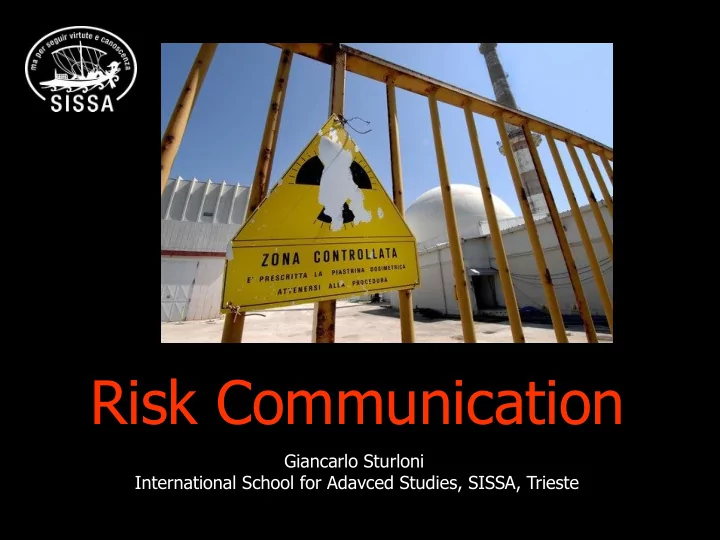
Risk Communication Giancarlo Sturloni International School for - - PowerPoint PPT Presentation
Risk Communication Giancarlo Sturloni International School for Adavced Studies, SISSA, Trieste The bomb and the orange soda Alamogordo, 16 July 1945 The dark side of technology Earth Day, 22 April 1970 The risk society Ulrich Beck Nicholas
Giancarlo Sturloni International School for Adavced Studies, SISSA, Trieste
The bomb and the orange soda
Alamogordo, 16 July 1945
The dark side of technology
Earth Day, 22 April 1970
The risk society
Ulrich Beck
Nicholas Joseph Cugnot, 1769
Bhopal, 3 December 1984
The accident that could never have happened
Chernobyl, 26 April 1986
«Exhaustive studies conducted in Soviet Union have conclusively proved that nuclear plants are safe for human health». (Lev Feoktistov, Deputy director of the Kurchatov Institute of Atomic Energy, 1985)
It must be stressed that such an accident could never have happened in a Western nuclear power plant PWR o BWR, i.e. in the plant types currently working or under construction in the Western countries. […] This is why I think that the security requirements adopted by our country are adequate and that there are the necessary conditions to proceed with the implementation of the National Energetic Plan.
Uncertainty
As for the Chernobyl-cloud induced radioactivity levels in Italy and the so-called “risk thresholds” imposed by the Italian law, there’s a complete, total chaos. Providing a sad example of what should be the “objectivity of science”, experts of various proveniences (state research institutes, universities, and professionals) engage in heated quarrels, each calling out the most disparate numbers as if they were playing bingo.
«Of course, this resistance comes from the Parliament’s fear of being overcome and deprived of its specific powers. But I think that we must now start to accept new forms
(Stefano Rodotà, a referendum promoter, explaining the reasons why Italians political parties were not looking favourably at the Italian referendum against nuclear power production, Corriere della Sera, 22 May 1986)
The role of the mass media
Marie Claire Cantone, Giancarlo Sturloni, Giancarlo Brunelli, “The role play by stakeholders in the public debate that brought Italy out of the club of nuclear energy producers”, Health Physics Journal, Vol. 93, Issue 4, October 2007, p. 261-266.
Frame analysis results Occurrence (%) Corriere Occurrence (%) Repubblica Health emergence 29,8 22,2 Technological safety/risk 18,1 12,7 Debate/Uncertainty/Trust 11,7 11,6 International politic/Superiority
the western technology 9,6 10,2 Lack of information/Censorship 7,1 8,6 Italian politics/Referendum 6,9 13,7 Economics outcomes 6,7 8,6 Technical explanation 3,5 3,0 Cronicles and evidences from URSS 3,3 6,3 Immaginary/Folks/Satire 3,3 3,1
Marie Claire Cantone, Giancarlo Sturloni, Giancarlo Brunelli, “The role play by stakeholders in the public debate that brought Italy out of the club of nuclear energy producers”, Health Physics Journal, Vol. 93, Issue 4, October 2007, p. 261-266.
The mass media acted as a public arena and a widespread distribution of social actors played an active part in the public debate. The discussion was highly politicized and not limited to the close examination of the techno-scientific aspects of nuclear power. Nuclear power issues attracted the attention of the mass media and sparks public debate only when they generated social conflict.
In the logic of mass communication, the importance of a risk depends on its newsworthiness (the value of the news), to which contribute elements of a different nature: sociocultural = novelty, proximity, expectations, breach of shared norms. narrative = protagonists or identifiable victims, attribution of guilt, conflicts, inclusion in an existing trend, framing. technical = availability of images.
Risk Communication
consensum communication = support the dialogue between the stakeholders in a risk controversy to take informed and shared decisions (examples: GMOs, nuclear waste, vaccinations) care communication = motivate people exposed to a recognized risk to change their harmful behavior by offering them an available remedy (examples: smoking, road safety, AIDS) crisis communication = make people aware of the risks they are exposed to promote a responsible behavior of self-protection and safeguard their safety in an emergency situation (examples: epidemics, environmental disasters)
The deficit model of risk communication
EXPERTS PUBLIC
OBJECTIVE ASSESSMENT ALARMING HEADLINES REAL RISKS PERCEIVED RISKS
MASS MEDIA
CITIZENS’ COMMETTEE NATIONAL GOVERNMENT ENVIRONMENTAL ASSOCIATIONS PRIVATE COMPANIES EUROPEAN UNION LOCAL AUTHORITIES MASS MEDIA SCIENTIFIC INSTITUTIONS
The ecosystem of public communication