
SLIDE 1
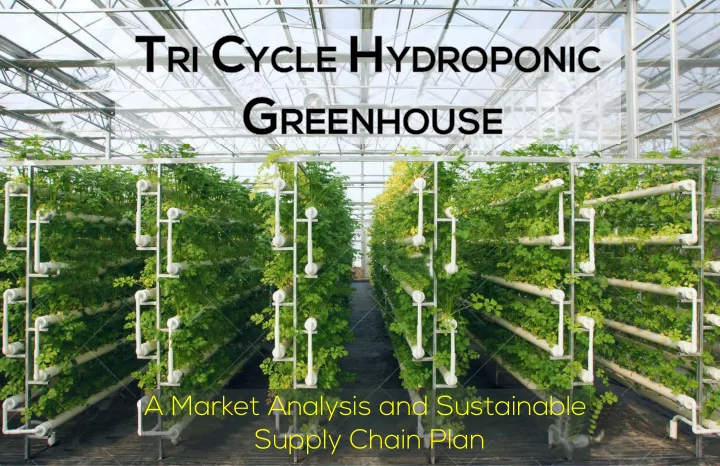
RI C C YCLE YCLE H H YDROPONIC YDROPONIC G REENHOUSE REENHOUSE A - - PowerPoint PPT Presentation
T RI RI C C YCLE YCLE H H YDROPONIC YDROPONIC G REENHOUSE REENHOUSE A Market Analysis and Sustainable Supply Chain Plan P ROJECT S COPE Initial Market Analysis Initial Market Analysis Working with Sara Gould and Laura Gray We stet our
Initial Market Analysis Initial Market Analysis
Working with Sara Gould and Laura Gray We stet our Objectives:
Finding Potential vendors in the local area.
Reduce Mileage and Fossil Fule use.
Deciding which crops are profitable for Tri Cycle’s Tri Cycle’s system.
products produced at products produced at Tri Cycle Farms Tri Cycle Farms Hydroponic Greenhouse.
How to minimize food, water, and packaging waste.
Valuing and conserving nature Promoting & supporting effective and equitable governance
resources Deploying nature-based solutions to address societal challenges
SUSTAINABLE GOALS CREATING
REATING THE THE S
SURVEY
URVEY
Working with Sara and Laura, Working with Sara and Laura, a survey was created to get a survey was created to get answers to questions about answers to questions about where to market the product where to market the product and to help them determine and to help them determine which crops should go into which crops should go into the greenhouse. the greenhouse.
Paper survey given orally and in-person to 13 local and in-person to 13 local businesses businesses
Target Group: Restaurants & Grocers/Markets & Grocers/Markets
QUESTION 1
Yes No I don’t know
Yes No I don’t know QUESTION 2
Yes No
Penalty Premium
Yes No I don’t know
Not important Somewhat Very important QUESTION 3
Yes No
data,since many people either didn’t know or felt that price depended on a variety of factors including season, qualityof the produce, offer price, and/or company requirements.
not answer.
FOOD SUPPLY CHAIN
RETAIL & FOOD SERVICE FARMING & AGRICULTURE PROCESSING LOGISTICS STORAGE
Potential Profitable Crops:
Most deliveries are DAILY or WEEKLY and almost all are delievered vie Refrigerated Truck. Most businesses consider hydroponic crops a MARKET PREMIUM and would consider selling them at their establishment. Many were ambivalent about the Certified Naturally Grown label, “certified organic or bust” mentality. CNO NOT a beneficial selling point. ble Crops: Herbs re DAILY or WEEKLY and almost all e Refrigerated Truck. consider hydroponic crops a M and would consider selling them ment. valent about the Certified Naturally tified organic or bust” mentality. eficial selling point.
SUSTAINABLE LOCAL FOOD SYSTEM
PRODUCTION ACCESS P R O C E S S I N G CONSUMPTION RESOURCE/ W A S T E RECOVERY DISTRIBUTION