
SLIDE 1
RGGI Workshop
Township of Ocean| Hosted by NJDEP
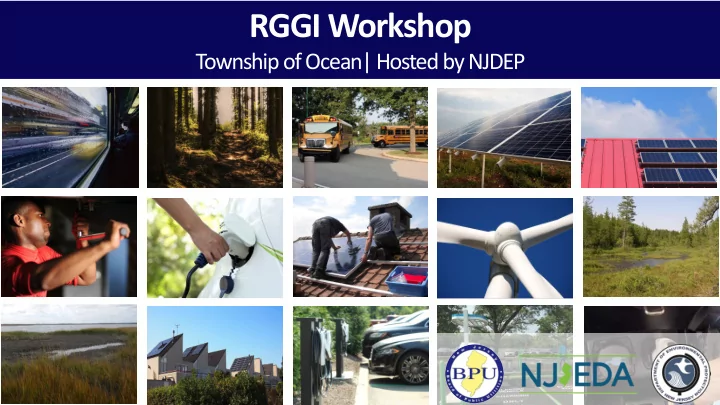
RGGI Workshop Township of Ocean| Hosted by NJDEP Paul Baldauf - - PowerPoint PPT Presentation
RGGI Workshop Township of Ocean| Hosted by NJDEP Paul Baldauf Assistant Commissioner Air Quality, Energy & Sustainability New Jersey Department of Environmental Protection Introduction to the RGGI Strategic Funding Plan Christine Schell |
Township of Ocean| Hosted by NJDEP
Paul Baldauf Assistant Commissioner Air Quality, Energy & Sustainability New Jersey Department of Environmental Protection
Image Source: Port Authority of NY & NJ
1
emissions for 3-year control period
CO2
ALLOWANCE2
The amount of money received will depend upon the price of carbon at the time of each auction.
Best Guess: $80 million in 2020
3
EDA
$48 Million
BPU
$16 Million
DEP
$8 Million + $8 Million
Why you are here: The Strategic Funding Plan
NJEDA to coordinate the use of RGGI funds through a Strategic Funding Plan developed at least every three years.
ways to compliment and amplify state funding to meet the State’s climate and clean energy goals and ensure investment in disproportionately impacted communities.
benefit your communities and New Jersey as a whole.
4
4
Identifies initiatives each agency will sponsor during the corresponding funding period. FUNDING PLAN FRAMEWORK Host four public meetings to educate about the funding requirements and to gather input on spending priorities.
Develop Initiatives Public Meetings Rank Initiatives Report Out
Ranks initiatives against six
must be ranked critical to at least one initiative.
1 2 3
Subsequent funding plans must report on previously funded projects and programs.
5
marshes
6
Strategic Funding Plan Objective #1 Net reduction in greenhouse gas emissions or net sequestration of carbon.
7
Strategic Funding Plan Objective #2 Significant reductions in greenhouse gas emissions
significant contribution to the achievement of the state's 2050 Global Warming Response Act limit (relative to cost).
8
Strategic Funding Plan Objective #3 Reduce energy use.
9
Strategic Funding Plan Objective #4 Be directly responsive to the recommendations submitted by the Department to the Legislature pursuant to the Global Warming Response Act.
10
Strategic Funding Plan Objective #5 Provide co-benefits to the state.
11
Strategic Funding Plan Objective #6
Be directly responsive to the negative effects on human health and the environment in communities that are disproportionately impacted by the effects of environmental degradation and climate change. 12
Electrification of transportation in the State.
Governor’s Funding Priorities
Provide meaningful benefits to communities most affected by pollution and climate change
13
What is the Scoping Document?
The Scoping Document is: A tool to educate the public about the legal and regulatory framework surrounding the distribution of RGGI auction proceeds Provides example initiatives that put the framework into context Explains the Governor’s funding priorities The Scoping Document is not: A draft strategic funding plan A summary of the final initiatives that will be funded by the state agencies
14
The Scoping Document includes seven example funding initiatives.
15
Agency Sponsor(s):
Initiative 1: Clean Transportation
Initiative One seeks to accelerate transportation electrification in the State, focusing on programs and projects that will have a beneficial impact on communities disproportionately impacted by the effects of environmental degradation and climate change. 16
Image Source: Port Authority of NY & NJ
Initiative 2: New Jersey Green Bank
Initiative Two seeks to increase the pace of clean energy investment through the creation of the New Jersey Green Bank. RGGI funding would be used by the NJEDA to capitalize a Green Bank to provide direct loans, or financial enhancements to support private lending.
Agency Sponsor(s):
17
Initiative 3: Community Clean Energy Microgrid
Initiative Three seeks to reduce electricity consumption in low- and moderate-income (LMI) households through the development and implementation of a Community Clean Energy Microgrid (CCEM) program, a coordinated, comprehensive, and holistic neighborhood energy approach for all LMI single- and multi- family building customers.
Agency Sponsor(s):
18
Initiative 4: Net-Zero Energy Solutions for Waste Management
Initiative Four seeks to reduce emissions from waste disposal. Funding would be provided to facilities for net-zero energy use through the implementation of proven technologies and best practices in the areas of energy conservation, demand reduction and enhanced production.
Agency Sponsor(s):
19
Image Source: Princeton University
Initiative 5: Beneficial Role of New Jersey Forests in the Carbon Cycle
Initiative Five seeks to promote, protect and maintain the beneficial role of New Jersey forests in the carbon cycle.
Agency Sponsor(s):
20
Image Source: NJ Tree Foundation
Initiative 6: Sequester “Blue Carbon” in Coastal Habitats
Initiative Six seeks to promote, protect and maintain the beneficial role of New Jersey tidal marshes in the carbon cycle.
Agency Sponsor(s):
21
Initiative 7: Strengthen Clean Tech Innovation
Under this initiative, NJEDA could provide funding and in-kind assistance to strengthen clean tech innovation in the state through support for the innovation ecosystem (e.g., incubators, proof of concept centers, research databases, etc.), the funding of individual early-stage clean tech companies and entrepreneurs, and support for basic research.
Agency Sponsor(s):
22
Example Funding Initiatives
23
Timeline
24
Initiative 1: Clean Transportation Initiative 2: New Jersey Green Bank Initiative 3: Community Clean Energy Microgrid Initiative 4: Net-Zero Energy Solutions for Waste Management Initiative 5: Beneficial Role of New Jersey Forests in the Carbon Cycle Initiative 6: Sequester “Blue Carbon” in Coastal Habitats Initiative 7: Strengthen Clean Tech Innovation
Which initiatives, projects and/or programs presented in the Scoping Document should the state prioritize for funding? Why?
Are there other funding priorities not listed in the Scoping Document that should be considered? Why?
How can municipalities best reduce greenhouse gas emissions in their communities? How can RGGI funding be utilized to support these efforts?
Are you aware of any current or planned coastal salt marsh creation, enhancement or restoration projects that could utilize future RGGI funding?
How should the 10% of RGGI funding allocated to coastal marshes and forests be split between the two programs? Why?
How should we measure the success of the projects once they are implemented? What metrics are most effective? What would success look like to you?
Any other feedback?
Contact Us: njrggi@dep.nj.gov Website: nj.gov/rggi/ Next Workshops: