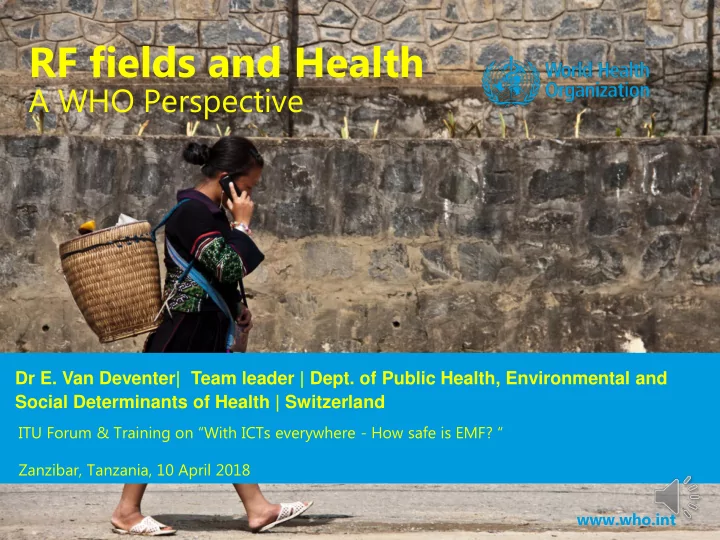
RF fields and Health A WHO Perspective Dr E. Van Deventer| Team - - PowerPoint PPT Presentation

rf fields and health
SMART_READER_LITE
LIVE PREVIEW

RF fields and Health A WHO Perspective Dr E. Van Deventer| Team - - PowerPoint PPT Presentation

RF fields and Health A WHO Perspective Dr E. Van Deventer| Team leader | Dept. of Public Health, Environmental and Social Determinants of Health | Switzerland ITU Forum & Training on With ICTs everywhere - How safe is EMF? Zanzibar,


slide-1
SLIDE 1

RF fields and Health

A WHO Perspective

www.who.int ITU Forum & Training on “With ICTs everywhere - How safe is EMF? “ Zanzibar, Tanzania, 10 April 2018

Dr E. Van Deventer| Team leader | Dept. of Public Health, Environmental and Social Determinants of Health | Switzerland

slide-2
SLIDE 2

OUTLINE

Introduction Assessing the health risks Discussion

slide-3
SLIDE 3

World Health Organization

Function: act as the UN directing and coordinating authority on international health work Objective: "the attainment by all peoples of the highest possible level of health"

slide-4
SLIDE 4

HEALTH a state of COMPLETE physical, mental and social well-being and not merely the ABSENCE of disease or infirmity" (Constitution, 1948)

slide-5
SLIDE 5

The Present EMF Context

  • Increasing EMF human exposure due to

electricity demand, medical technologies and wireless devices

  • Concern from the public
slide-6
SLIDE 6

Applications using radiofrequency fields

(100 kHz – 300 GHz)

Navigation/Radar Broadcasting Wi-Fi Telecommunications Commercial Residential sources Vehicular technologies

slide-7
SLIDE 7
slide-8
SLIDE 8

http://www.satprnews.com/2017/09/11/global-5g-technology-and-solutions-for-iot-market-forecasts-to-2022-and-analysis/

Applications using radiofrequency fields

(100 kHz – 300 GHz)

slide-9
SLIDE 9
slide-10
SLIDE 10

WHO International EMF Project

  • Established in 1996
  • Coordinated by WHO HQ
  • A multinational, multidisciplinary effort to create and

disseminate information on human health risk from EMF

  • Membership
  • Open to any WHO Member State government department or

representatives of national institutions concerned with radiation protection

  • Over 60 national authorities are currently involved in the Project
slide-11
SLIDE 11
slide-12
SLIDE 12

Do EMFs pose a heath risk?

Risk Assessment

The Evidence

Risk Management

The Policies

Risk Perception

The Public Concern

slide-13
SLIDE 13

OUTLINE

Introduction Assessing the health risk

slide-14
SLIDE 14
  • Large and increasingly sophisticated database
  • Known mechanisms
  • International exposure guidelines based on

established health effects

  • Scientific uncertainty

The Present Scientific Knowledge

slide-15
SLIDE 15

What do we know?

Frequency

100 kHz 300 MHz 10 GHz

slide-16
SLIDE 16

What do we know? Mechanisms of interaction

Induced currents Induced currents and heating Heating Non-thermal effects?? Frequency

100 kHz 300 MHz 10 GHz

Surface heating (skin)

slide-17
SLIDE 17

What do we know? Mechanisms of interaction

Frequency

100 kHz 300 MHz 10 GHz

 Below 1 GHz  1 – 6 GHz  Above 6 GHz and most likely above 24 GHz

?

slide-18
SLIDE 18

Research Balance of studies needed

http://www.niehs.nih.gov/emfrapid/booklet/emf2002.pdf

slide-19
SLIDE 19

Laboratory Studies

Cellular studies

  • Genotoxicity
  • Gene expression

Animal studies

  • Cancer
  • Behaviour
  • BBB
  • Skin

Human studies

  • Sleep
  • EEG
  • Hormones
  • EHS
slide-20
SLIDE 20

From Martin Röösli

dose near-field dose far-field dose

slide-21
SLIDE 21

Epidemiological studies

Studies on mobile phones

Tumours in head and neck

  • Glioma, meningioma, acoustic neuroma, parotid gland

Numerous studies on the use of mobile phones

  • Published: USA, Nordic countries, INTERPHONE,

CEFALO

  • Ongoing: MOBI-Kids, COSMOS, GERoNiMO, …
slide-22
SLIDE 22

Epidemiological studies

Base stations and wireless networks

Some studies have been performed

  • Well-being and performance
  • Cancer

Personal exposure assessment

Wi-Fi

GSM GSM 3GWi-Fi

Kenneth R. Foster, Radiofrequency exposure from wireless LANs utilizing WI-FI technology. Health Phys. 92(3):280 –289; 2007

slide-23
SLIDE 23

Problem Formulation

Health Risk Assessment

Exposure Assessment

Determine the amount, duration and pattern of exposure to the agent

Hazard Identification

Review key research to identify any potential health problems that an agent can cause

Exposure-Response Assessment

Estimate how much of the agent it would take to cause varying degrees of health effects that could lead to illnesses

Risk Characterization

Assess the risk for the agent to cause cancer or

  • ther illnesses in the

general population

RF fields classified as "possibly carcinogenic to humans" (Group 2B)

slide-24
SLIDE 24

All studied

  • utcomes

Problem Formulation

Health Risk Assessment (cont'd)

Exposure Assessment

Determine the amount, duration and pattern of exposure to the agent

Hazard Identification

Review key research to identify any potential health problems that an agent can cause

Exposure-Response Assessment

Estimate how much of the agent it would take to cause varying degrees of health effects that could lead to illnesses

Risk Characterization

Assess the risk for the agent to cause cancer or other illnesses in the general population

Radiofrequency Fields
slide-25
SLIDE 25

Discussion “5G, EMF & Health”

  • Is it too early to discuss this point?
slide-26
SLIDE 26
  • Exposure assessment
  • Compliance assessment
  • Epidemiological studies

Challenges

https://www.gsma.com/publicpolicy/wp-content/uploads/2017/10/5g_iot_web_FINAL.pdf

slide-27
SLIDE 27
slide-28
SLIDE 28

Discussion “5G, EMF & Health”

  • Is it too early to discuss this point?
  • Is exposure to radiofrequency fields from wireless technologies the main health concern?

HEALTH a state of COMPLETE physical, mental and social well-being and not merely the ABSENCE of disease or infirmity" (Constitution, 1948)

slide-29
SLIDE 29

Discussion “5G, EMF & Health” (cont’d)

slide-30
SLIDE 30

Challenges to governments….

  • Rapidly evolving RF technologies
  • Launched on the market before health evaluation
  • Disparities in risk management measures and regulations around the world
  • Concern from the public
slide-31
SLIDE 31

Conclusions

  • Need for clear roles and responsibilities in government on this topic
  • Need for adoption and compliance of health-based standards
  • Need for a public information program and dialogue with stakeholders
  • Need for promoting research to reduce uncertainty

We are a "global village"

slide-32
SLIDE 32

Dr E. Van Deventer Team leader, Radiation Programme Dept of Public Health, Environmental and Social Determinants of Health WHO 20, Avenue Appia 1211 Geneva Switzerland

www.who.int

Thank you.