
SLIDE 1
1
SWEN-261 Introduc2on to So3ware Engineering
Department of So3ware Engineering Rochester Ins2tute of Technology
Reviewing OO Concepts
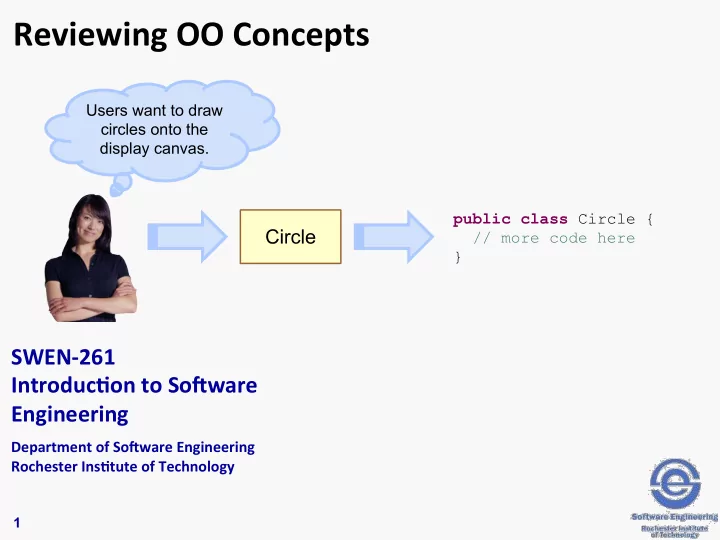
Users want to draw circles onto the display canvas. public class Circle { // more code here }
Reviewing OO Concepts Users want to draw circles onto the display - - PowerPoint PPT Presentation
Reviewing OO Concepts Users want to draw circles onto the display canvas. public class Circle { // more code here } SWEN-261 Introduc2on to So3ware Engineering Department of So3ware Engineering Rochester Ins2tute of Technology 1 OO
1
Department of So3ware Engineering Rochester Ins2tute of Technology
Users want to draw circles onto the display canvas. public class Circle { // more code here }
2
3
Users want to draw circles onto the display canvas.
Users want to draw circles onto the display canvas. public class Circle { // more code here }
4
5
public void make_multiple_objects() { Circle c1 = new Circle(); Circle c2 = new Circle(); Circle c3 = new Circle(); if (c1 != c2) { // Two distinct objects have different identities. } }
Users want to draw circles onto the display canvas. public class Circle { void draw() { // TBD } }
6
7
8
9
public class Circle { void draw() { /* TBD */ } boolean hasPoint() { /* TBD */ } void move() { /* TBD */ } void scale() { /* TBD */ } }
A circle has a center position and a radius.
10
Well, I did say the center is a position. The radius must be a number. public class Circle { Position center; int radius; // more code here }
11
12
public class Circle { private Position center; private int radius; // more code here }
13
public class Circle { private Position center; private int radius; public Position getCenter() { return center; } public void setCenter(Position c) { this.center = center; } public int getRadius() { return radius; } public void setRadius(int r) { this.radius = radius; } } Just because you can doesn't mean you should.
14
public class Circle { private Position center; private int radius; public Position getCenter() { return center; } public void move(Position c) { this.center = c; } public int getRadius() { return radius; } public void scale(float factor) { this.radius = (int) (radius * factor); } }
15
Users want to draw rectangles onto the display
and scale them.
Code on the next page.
16
public class Rectangle { private Position topLeftCorner; private int width; private int height; public Rectangle( final Position topLeftCorner, final int width, final int height) { this.topLeftCorner = topLeftCorner; this.width = width; this.height = height; } public Position getTopLeftCorner() { return topLeftCorner; } public void move(Position toPosition) { this.topLeftCorner = toPosition; } public int getWidth() { return width; } public int getHeight() { return height; } public void scale(float factor) { width = (int) factor * width; height = (int) factor * height; } public void draw() { /* TBD */ } public boolean hasPoint(Position p) { /* TBD */ } }
17
18
The drawing app now deals with two kinds of shapes: circles and rectangles.
19 public class Shape { private Position position; public Shape(final Position position) { this.position = position; } public void move(Position position) { this.position = position; } public void draw() { /* TBD */ } // more code not shown }
20 public class Circle extends Shape { private int radius; public Circle(final Position center, final int radius) { super(center); this.radius = radius; } public int getRadius() { return radius; } public void setRadius(int r) { this.radius = r; } public void draw() { /* TBD */ } // more code not shown }
Use the extends keyword to allow the Circle class to inherit the attributes and methods of the super class: Shape. Use the super keyword to invoke the Shape constructor.
21
22
public abstract class Shape { private Position position; protected Shape(final Position position) { this.position = position; } public void move(Position position) { this.position = position; } public abstract void draw(); // more code not shown } Make the class abstract. Make all constructors protected. Make some methods abstract.
23
Looking at the attributes of the DrawingUI and DrawingCanvas classes it appears that there are relationships in the objects. Is there a UML notation for representing these types of relationships?
24
Add a role name if the instance variable is known.
25
26
27
28
public class DrawingUI extends JComponent { private final DrawingCanvas myDrawing; /// more code here @Override protected void paintComponent(Graphics g) { super.paintComponent(g); // Draw the canvas myDrawing.draw(g); } }
29
public class DrawingCanvas { private Set<Shape> shapes = new HashSet<>(); public void addShape(final Shape s) { shapes.add(s); } public void draw(Graphics g) { // Draw each shape for (Shape s : shapes) { s.draw(g); } } }
public void draw(Graphics g) { final int diameter = 2 * radius; final Position pos = getPosition(); g.drawOval(pos.getX() - radius, pos().getY() - radius, diameter, diameter); }
public void draw(Graphics g) { final Position pos = getPosition(); g.drawRect(pos.getX(), pos.getY(), width, height); }
30
31
public void draw(Graphics g) { // Draw each shape for (Shape s : shapes) { s.draw(g); } } How does the compiler know which shape draw method is invoked? (Circle or Rectangle?)
32