Review of neutrino Data/Theory Steve Dytman, Univ. of Pittsburgh - - PowerPoint PPT Presentation

review of neutrino data theory
SMART_READER_LITE
LIVE PREVIEW

Review of neutrino Data/Theory Steve Dytman, Univ. of Pittsburgh - - PowerPoint PPT Presentation

Review of neutrino Data/Theory Steve Dytman, Univ. of Pittsburgh Emphasis on resonances 4 October, 2019 Existing n data is sparse Low statistics for nucleon and nuclei Calculations start with electron scattering, add axial from


slide-1
SLIDE 1

Review of neutrino Data/Theory Emphasis on resonances 4 October, 2019

Steve Dytman, Univ. of Pittsburgh

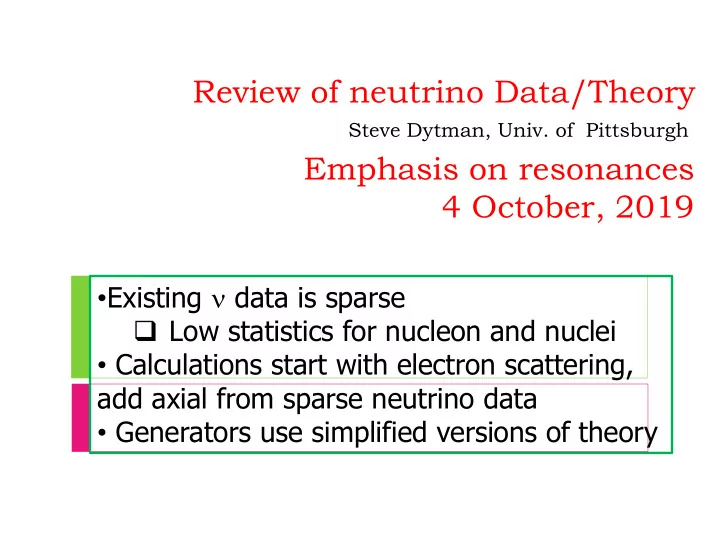
  • Existing n data is sparse

 Low statistics for nucleon and nuclei

  • Calculations start with electron scattering,

add axial from sparse neutrino data

  • Generators use simplified versions of theory
slide-2
SLIDE 2

Data overview

4 October 2019 Resonance Data/Theory Overview 2

 Effort for quasielastic data/theory significantly larger than

for resonances

 More recent experiments at low energy (T2K, MiniBooNE,

MicroBooNE)

 T2K uses QE as signal for oscillation measurements

 NOvA, MINERvA

are running at higher energies

 DUNE matches

these expts better

 Sensitive to

Res/DIS signal

slide-3
SLIDE 3

DUNE requirements

4 October 2019 Resonance Data//Theory Overview 3

 Detect pions, protons, neutrons, etc. with enough

accuracy to get neutrino energy accuracy of a few %

 Response will largely be resonances, dis processes  Method will likely be calorimetric reconstruction

slide-4
SLIDE 4

Deep Inelastic (DIS) properties

4 October 2019 Resonance Data//Theory Overview 4

 Need neutrino PDFs and hadronization  Subject of NusTec workshop last fall  Very active discussions with the emphasis on

understanding existing data and anticipating needs

 This workshop is the counterpart for resonances  The separation is not well-defined

slide-5
SLIDE 5

RES as we know it

4 October 2019 Resonance Data//Theory Overview 5

 All based on electron scattering (modern) and Rein-Sehgal 1981  PDG summary table on left, GENIE for n on right  Can n validate anything here? (need high statistics D expt.)

GENIE events 5 GeV nm C

slide-6
SLIDE 6

RES vs. DIS

4 October 2019 Resonance Data//Theory Overview 6

 DIS response comes from quark structure, smooth  RES is states on top of smooth background  Theory, e.g. Bodek-Yang, can explain smoothed spectra

slide-7
SLIDE 7

eN for resonances

4 October 2019 Resonance Data//Theory Overview 7

 Major subject of CLAS for 2000’s…  Added polarized targets in 2010’s…  One example, Egiyan, et al. Phys. Rev. C73, 025204 (2006)  ep → e’np+  Q2=0.4 response

functions

 N.B. 1mb/sr=

10-30 cm2

slide-8
SLIDE 8

MAID- Unitary Isobar Model

Drechsel, Kamalov, Tiator – Eur. Phys. A34, 69 (2007)

4 October 2019 Resonance Data//Theory Overview 8

 Breit-Wigner resonances with nonresonant amplitudes  Resonant/nonresonant amplitude interference  Fit all (e,e’p) N data to extract helicity amplitudes for

13 resonances – can be matched to Rein-Sehgal formalism

slide-9
SLIDE 9

Bubble Chamber data

11 October 2018 Resonances in the Transition Region 9

 Summarized nicely in Rein-Sehgal (RS) (1981)

 p+, p-, and p0  Basis of their model (ANL, not BNL)

 Many complaints about this – “old and out-moded”  Knowledge about resonances/non resonant bkgd has

greatly improved since 1981!!

 Electron scattering experiments (my emphasis long ago)

have fantastic statistics/interpretation on many targets

 Masses, widths, photocoupling (Jlab) greatly improved

 Nonrelativistic quark model is no longer important  Dividing line between resonances/DIS remains in dispute

slide-10
SLIDE 10

Bubble chamber data (Rein-Sehgal)

11 October 2018 Resonances in the Transition Region 10

 Total cross sections still best

available

 Low statistics, excellent

channel identification

𝜉𝑞 → 𝜈 −𝑞𝜌+

Rein-Seghal model (1981)

𝜉𝑜 → 𝜈 −𝑞𝜌0 𝜉𝑜 → 𝜈 −𝑜𝜌+

slide-11
SLIDE 11

W spectra (GGM n, n)

11 October 2018 Resonances in the Transition Region 11

 These are from Rein-

Sehgal paper (1981)

 ANL but not BNL then

𝜉𝑞 → 𝜈 −𝑞𝜌+ 𝜉𝑜 → 𝜈 −𝑞𝜌0 𝜉𝑞 → 𝜈 +𝑞𝜌−

slide-12
SLIDE 12

Electron scattering - nucleus

4 October 2019 Resonance Data//Theory Overview 12

 Huge database for (e,e’), all of it in GENIE. Adi and Afro

have been using it heavily. Lots for C, Ca, Fe, and Pb.

 New data from JLab for Ar target (VT group)  Much less (e,e’p) (collect!), no (e,e’p) (important meas!)

slide-13
SLIDE 13

Many recent nA experiments

4 October 2019 Resonance Data//Theory Overview 13

 MiniBooNE (2011) had excellent statistics, acceptance

 Dominated by D(1232), distributions for muon, pion

 MINERvA (≥2015), T2K (≥2018) have fewer statistics

 Mixture of D (1232) and higher resonances – also muon, pion

 Argoneut (2018) has argon target, very low statistic

slide-14
SLIDE 14

Modern experiments – MiniBooNE <Ev>~1 GeV

4 October 2019 Resonance Data//Theory Overview 14

 High statistics, excellent acceptance (CH2 target)  Muons via Cerenkov, also pions via p inelastic reactions  Fine binning, results for both

p and m, p+ and p0.

 Lots of theory interest theory ev gen

slide-15
SLIDE 15

MINERvA LE results <En>~3.5 GeV

4 October 2019 Resonance Data//Theory Overview 15

 Finely segmented (~1.2 cm) scintillator tracker (38k

bars) CH target (Signal is m-p± , but p+ dominates)

 Moderate statistics, very good acceptance  Michel electron from p→m→e decay gives excellent purity

slide-16
SLIDE 16

The p+ puzzle

4 October 2019 Resonance Data//Theory Overview 16

 Energy dependence not according to theory

 Dangerous to have 2 measurements

 NuWro and GENIE agree on energy dependence in 2015,

not on shape of kinetic energy distribution

 Sobczyk and Zmuda (PRD 2015) see same problem

slide-17
SLIDE 17

New GENIE deuterium tune

4 October 2019 Resonance Data//Theory Overview 17

 Old tune emphasized inclusive data, new tune uses both inclusive

and exclusive data [tension!]

 Similar to Rodrigues, McFarland, Wilkinson fit, decrease p production  Data quality shows poor underpinning for the entire field

nm p → m- p+ p

c2= 67.6/ 29 dof (old) c2= 40.5/ 29 dof (new)

nm p total cross section

slide-18
SLIDE 18

More recent developments

4 October 2019 Resonance Data//Theory Overview 18

 We discovered differences in data treatment, no issues  All generators evolve, but tension remains  GENIE new fit to D data decreases all pion calculations

 Old tune agrees with MiniBooNE, new tune agrees with MINERvA

slide-19
SLIDE 19

TENSIONS - More global set of comparisons

4 October 2019 Resonance Data//Theory Overview 19

 Workshop in 2016, published Phys. Repts. 773, 1 (2018)  Both magnitude and shape discrepancies ~10-20%  FSI bigger issue than nuclear structure

slide-20
SLIDE 20

New T2K data - Just accepted in PRD

4 October 2019 Resonance Data//Theory Overview 20

 Compared to (very) old GENIE, NEUT  published despite no reference to MiniBooNE data!?  Need generator/Nuisance/Tensions paper for comparison  Looks like T2K is ~same as NEUT 5.1.4.2 which is below mB,

therefore in better agreement with MINERvA from E dep (got that?)

2.6.4 5.1.4.2

slide-21
SLIDE 21

qpion might also have problems

4 October 2019 Resonance Data//Theory Overview 21

 GiBUU BNL is better, shape similar to the generators  modern generators all have isotropic D decay, no strong sensitivity

seen so far.

 TENSIONS-2016 comparison (L), T2K 2019 (R)  Could be a problem for only MINERvA, also seen in 2019 p- paper

2.6.4 5.1.4.2

slide-22
SLIDE 22

Relevant published work from MINERvA

11 October 2018 Resonances in the Transition Region 22

 B. Eberly et al. (MINERvA) Phys. Rev. D92, 092008 (2015)

 nm CH → p± X (no p0, no baryons) Wtrue<1.4 GeV, <1.8 GeV  Signal definition using Wtrue causes model dependence

 C.L. McGivern et al. (MINERvA) Phys. Rev. D94, 052005 (2016)

 nm CH → p± X (no p0, no baryons) Wexp<1.8 GeV, (<1.4 GeV)  nm CH → 1p0 X (no p±, no baryons) Wexp<1.8 GeV  Added muon KE & q, Q2, En

 O. Altinok, et al. Phys. Rev D96, 072003 (2017)

 nm CH → p0 (p)X Wexp<1.8 GeV

 Trung Le et al. (MINERvA) Phys. Rev. D100, 052008 (2019)

 nm CH → 1p- X Wexp<1.8 GeV  Completes a complete set of 4 results

slide-23
SLIDE 23

CC p0 - MINERvA

4 October 2019 Resonance Data//Theory Overview 23

 p0 identification isn’t easy

 p- even harder  Purity ~50%

 Reconstruction of W difficult

 p0 p invariant mass

 MnvGENIE used here

slide-24
SLIDE 24

Np± 2015 vs. 2016

11 October 2018 Resonances in the Transition Region 24

 Same event sample, different signal definition, updated flux

Wexp instead of Wtrue (~18% larger cross section)

 Updated MC calculations  Not a true cross section because multiplicity not measured

Can be calculated within any model

slide-25
SLIDE 25

New analysis of Minerva 1p± data

(really almost all p+)

14 March 2017 SLAC Neutrino Workshop 25

 Improved definition of W in signal – Wreco

Takes away fear of strong model dependence

~10% decrease in cross section independent of kinematics

 Improved flux (now in all Minerva LE results)

~10% decrease in cross section independent of kinematics

 New data should be used in future, used in following plots

p Kinetic Energy (GeV) GENIE simulation for MINERvA signal

slide-26
SLIDE 26

Q2 detail – FSI decomposition

11 October 2018 Resonances in the Transition Region 26

 cc

slide-27
SLIDE 27

Theory of resonances

start with electron and hadron beams

4 October 2019 Resonance Data//Theory Overview 27

 Long history with hadron and electromagnetic probes

 Best knowledge of vector interaction by far

 This is subject of Jerry Miller’s following talk

 Sidelight: I first learned about D(1232) from Jerry at CMU ~1973

 Many experiments with single energy beams and very

high statistics

 Many theory efforts start with electron scattering

(validation of nuclear structure, vector interactions)

 Axial interactions then get added on based on validation

with existing data (see earlier slides)

 Generators do their best to keep up with theory (easy)

slide-28
SLIDE 28

Short review

4 October 2019 Resonance Data//Theory Overview 28

 Valencia (Hernandez, Nieves, Vicente-Vacas)

 Analytic model for nucleon→nucleus  Focus on D(1232), but have also investigated D13(1520)  Talk this workshop by Juan Nieves

 GiBUU (Mosel, Leitner, Buss….)

 Monte Carlo well beyond Generators used in experiments  Semi-classical calculation that allows medium corrections  Talk this workshop by Ulrich Mosel

 MK (Minoo Kabirnizhad)

 Updates Rein-Sehgal model in significant ways  Adds nonresonant amplitudes/interference with resonances  Limited to 1p production  Talk this workshop by Minoo

slide-29
SLIDE 29

Nonresonance/resonance interference

4 October 2019 Resonance Data//Theory Overview 29

 Since final states are same, interference is natural  However, this is difficult to include in a Generator (use

cross sections rather than amplitudes for random nos.)

 Existing generators add cross sections for NonRes and

Res from different sources (ugh!)

 Some resonances interfere, e.g. S11(1535) and S11(1650).

Does it matter?

slide-30
SLIDE 30

Resonance/DIS mixing

4 October 2019 Resonance Data//Theory Overview 30

 Calculations done by different communities  Where is the dividing line?  How fuzzy is the dividing line?  If final state is same, do they interfere?  The resonance picture is more accurate than the DIS

picture when you need to look at details of the final

  • state. Which is more important, details or simple

picture?

slide-31
SLIDE 31

Recent article of interest

4 October 2019 Resonance Data//Theory Overview 31

 N. Rocco, S. Nakamura, T.S.H. Lee, and A. Lovato

 arXiv: 1907.01093[nucl-th]

 Merges nuclear structure of Benhar-Rocco with DCC model of

Sato-Lee-Nakamura

 Left: model progression - GRFG= RFG, CBF PWIA adds

Spectral Func, CBF+FSI adds FSI

 Right: components for CC – 1 body, 2 body, p production

(e,e’) Carbon (nm,m-) Carbon

slide-32
SLIDE 32

Generators

4 October 2019 Resonance Data//Theory Overview 32

 Link between theory and

experiment

 GENIE, NEUT largely experimenters  NuWro, GiBUU largely theorists

 Most theory comes from nuclear

theorists

 Gives best picture of nuclear structure,

vector interaction

 Subject to unfortunate barriers in DOE

(must be rectified)

 D in nucleus well-studied in last

few decades

 Important subject of Jerry Miller

slide-33
SLIDE 33

Generators as of 2016 (1st Tensions wkshp)

4 October 2019 Resonance Data//Theory Overview 33

Model N res Non resonant Nucleon Momentum MEC RPA GENIE 2.12.0alt Berger- Sehgal + Bodek-Yang (extrap low W Local Fermi gas Valencia Valenica NEUT 5.3.6 Berger- Sehgal + Rein-Sehgal Global (rel) Fermi gas Valencia Valencia NuWro Adler (D

  • nly)

Bodek-Yang (extrap low W) Local Fermi gas Valenica Valencia GiBUU Leitner et al. Lalakulich et al.

  • empirical

Local Fermi gas Home- grown Home- grown GENIE 2.6.3/2.8.6 Rein-Sehgal Bodek-Yang (extrap low W) Global (rel) Fermi gas None none NEUT 5.1.4.2 Rein-Sehgal Rein-Sehgal Global (rel) Fermi gas None none

slide-34
SLIDE 34

Comparison of models - 2017

4 October 2019 Resonance Data//Theory Overview 34

  • Differences more in detail than fundamental (physics)
  • GENIE has larger goals, therefore slower

Model N res Non resonant Nucleon Momentum D mods FSI Athar Schreiner-Von Hippel none Local Fermi gas Fit to (g,p) Attenuation

  • nly

GiBUU Leitner et al. Lalakulich et al.

  • empirical

Local Fermi gas Fit to (g,p) Oset Transport Valencia Hernandez et al. Chiral model Local Fermi gas Fit to (g,p) Salcedo- Oset (full) GENIE Rein-Sehgal, Berger-Sehgal Bodek-Yang (extrap low W) Local Fermi gas none Effective cascade NEUT Berger-Sehgal Rein-Sehgal Local Fermi gas Via FSI model Salcedo- Oset (full) NuWro Adler (D

  • nly)

Bodek-Yang (extrap low W) Local Fermi gas Via FSI model Salcedo- Oset (full)

slide-35
SLIDE 35

Generator features – GENIE RES vs. DIS nm C at En=5 GeV

4 October 2019 Resonance Data//Theory Overview 35

 DIS calculation from Bodek-Yang includes all processes  RS or BS includes only resonances  Use RS or BS up to Wtr, full BY above, scale down

contribution below to match deuterium data

slide-36
SLIDE 36

More detail

4 October 2019 Resonance Data//Theory Overview 36

 RES on left, DIS on right  Subdivided according to final state - all, 1, 2 pions, strange  Goal for experiments? Even smeared out, would be great

slide-37
SLIDE 37

Repeat comparison from NUINT14

4 October 2019 Resonance Data//Theory Overview 37

 Complaints about Rein-Sehgal often assume same

masses, width, and form factors as 1981 paper.

 GENIE regularly updates resonance parameters GiBUU from Tina Leitner, NUINT08

slide-38
SLIDE 38

GENIE interaction systematics

4 October 2019 Resonance Data//Theory Overview 38

 A list of some of

the systematics available via reweighting

 Too many values

  • nly loosely

based on data.

 Needs updates

slide-39
SLIDE 39

Generators – looking ahead

4 October 2019 Resonance Data//Theory Overview 39

 Need better data – nucleon, nucleus  With large data base, MAID has amplitudes for (e,e’p)

with resonant/nonresonant amplitudes

 GiBUU has this model  Luis Alvarez-Ruso have tried to include in GENIE for many years

 D(1232) is well-studied in (e,e’p)

 Medium corrections needed (Jerry Miller)  At this time, not included in GENIE (which one is best?)

slide-40
SLIDE 40

challenges

4 October 2019 Resonance Data//Theory Overview 40

 Semi-exclusive and exclusive eA data

 Pion transparency (e4nu)

 Higher statistics, better defined nA data

 Dedicated beams closer to monoenergetic

 Better nN data

 Lots of discussion, high cost

 Better nuclear physics in generators

 Underway, good progress  Need similar basis for res/nonres for D(1232)  More realistic systematic errors (from fits to data)

 Better integration of what we’ve learned from eN and eA

into n theory/generators

 Definitely underway

slide-41
SLIDE 41

Summary

4 October 2019 Resonance Data//Theory Overview 41

 Resonance structure is a rich subject

 Can be seen with p, e, and n (part of plan for this workshop)  Interesting similarities and differences, but the same resonances

 e data very detailed, rich

 Far better for nucleon, strong need for e nucleus data

 n data looks pale in comparison

 Poor statistics for both nucleon and nucleus  Need clean definition despite broad flux distribution  Future for D(1232) good, tougher for higher resonances

 Recent theory efforts merge e and n models – super!  Generators are getting better at keeping up

 Good efforts to include updated theory models underway

slide-42
SLIDE 42

Note on Np cross section

11 October 2018 Resonances in the Transition Region 42

 p energy spectra can have multiple entries per event

 ~10% of events in data have 2 pions, none with 3

 Multiplicity not measured as a cross section  To get a cross section, divide by the average multiplicity