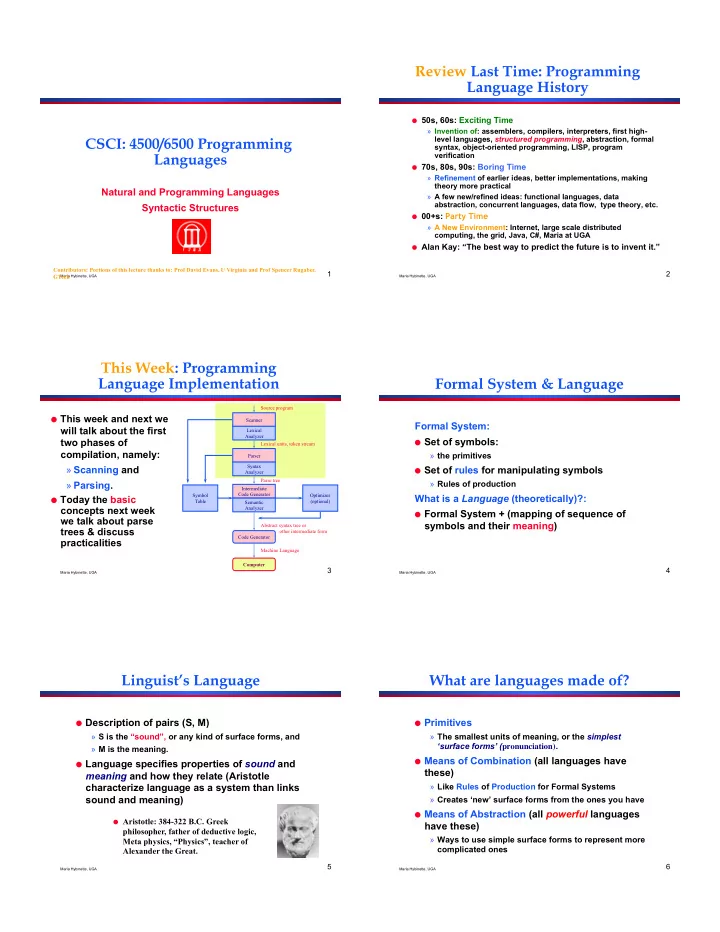

SLIDE 1
Maria Hybinette, UGA
1
CSCI: 4500/6500 Programming Languages
Natural and Programming Languages Syntactic Structures
Contributors: Portions of this lecture thanks to: Prof David Evans, U Virginia and Prof Spencer Rugaber, GTech
Maria Hybinette, UGA
2
Review Last Time: Programming Language History
50s, 60s: Exciting Time
» Invention of: assemblers, compilers, interpreters, first high- level languages, structured programming, abstraction, formal syntax, object-oriented programming, LISP, program verification
70s, 80s, 90s: Boring Time
» Refinement of earlier ideas, better implementations, making theory more practical » A few new/refined ideas: functional languages, data abstraction, concurrent languages, data flow, type theory, etc.
00+s: Party Time
» A New Environment: Internet, large scale distributed computing, the grid, Java, C#, Maria at UGA
Alan Kay: “The best way to predict the future is to invent it.”
Maria Hybinette, UGA
3
This Week: Programming Language Implementation
This week and next we
will talk about the first two phases of compilation, namely: »Scanning and »Parsing.
Today the basic
concepts next week we talk about parse trees & discuss practicalities
Code Generator Intermediate Code Generator Semantic Analyzer Scanner Lexical Analyzer Parser Syntax Analyzer Computer Symbol Table Lexical units, token stream Parse tree Abstract syntax tree or
- ther intermediate form
Machine Language Optimizer (optional) Source program
Maria Hybinette, UGA
4
Formal System & Language
Formal System:
Set of symbols:
» the primitives
Set of rules for manipulating symbols
» Rules of production
What is a Language (theoretically)?:
Formal System + (mapping of sequence of
symbols and their meaning)
Maria Hybinette, UGA
5
Linguist’s Language
Description of pairs (S, M)
» S is the “sound”, or any kind of surface forms, and » M is the meaning.
Language specifies properties of sound and
meaning and how they relate (Aristotle characterize language as a system than links sound and meaning)
Aristotle: 384-322 B.C. Greek
philosopher, father of deductive logic, Meta physics, “Physics”, teacher of Alexander the Great.
Maria Hybinette, UGA