Reversal Cody Craven, PharmD PGY-1 Pharmacy Resident SSM Health - - PowerPoint PPT Presentation

reversal
SMART_READER_LITE
LIVE PREVIEW

Reversal Cody Craven, PharmD PGY-1 Pharmacy Resident SSM Health - - PowerPoint PPT Presentation

Evaluation of 4-Factor Prothrombin Complex Concentrates Dosing For Factor Xa Inhibitor Reversal Cody Craven, PharmD PGY-1 Pharmacy Resident SSM Health Saint Louis University Hospital James Braun, PharmD, BCCCP Robert Sbertoli, PharmD, BCCCP


slide-1
SLIDE 1

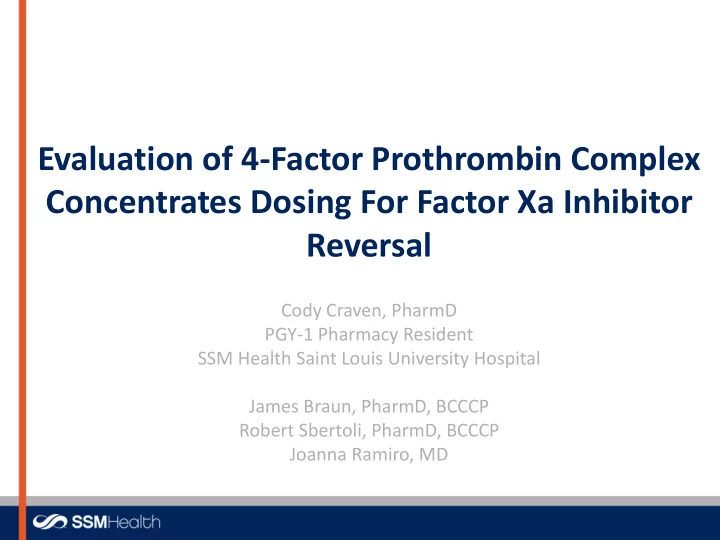
Evaluation of 4-Factor Prothrombin Complex Concentrates Dosing For Factor Xa Inhibitor Reversal

Cody Craven, PharmD PGY-1 Pharmacy Resident SSM Health Saint Louis University Hospital James Braun, PharmD, BCCCP Robert Sbertoli, PharmD, BCCCP Joanna Ramiro, MD

slide-2
SLIDE 2

Background

  • Direct acting oral anticoagulants (DOACs)

– Factor Xa inhibitors (FXaI) – Direct thrombin inhibitors

  • Indications

– Atrial fibrillation – VTE prophylaxis – VTE treatment

  • Landmark trials
  • Increased risk of bleeding
  • 4-factor prothrombin complex concentrates (4F-

PCC) as a possible reversal agent

2

Patel MR, et al. N Engl J Med. 2011;365:883–891. Bauersachs R, et al. N Engl J Med. 2010;363:2499–2510. Granger CB, et al. N Engl J Med. 2011;365:981–992. Agnelli G, et al. N Engl J Med. 2013;369:799–808.

slide-3
SLIDE 3

Evidence Progression

Randomized Trials

  • Small studies in healthy volunteers
  • Used laboratory parameters to assess bleeding reversal
  • Complete reversal at 50 units/kg

Guidelines

  • NCS 2016, ACC 2017, ASH 2018 guidelines recommend 4F-PCC for reversal of

FXaI-associated bleeding

  • Recommended dose: 50 units/kg

Observations

  • Patients with FXaI-associated major bleeds
  • Study doses approximated 25 units/kg
  • 4F-PCC appears to be safe and effective

Andexanet Alfa

  • FDA approved in May 2018
  • ANNEXA-4: no comparison to standard of care/restrictive exclusion criteria
  • High rates of thromboembolic complications

Levi M, et al. J Thromb Haemost. 2014;12:1428–1436. Eerenberg ES, et al. Circulation. 2011;124:1573–1579. Cheung YW, et al. J Thromb Haemost. 2015;13:1799–1805. Zahir H, et al. Circulation. 2015;131:82–90. Tomaselli GF, et al. J Am Coll Cardiol. 2017;70:3042–3067. Frontera JA, et al. Neurocrit Care. 2015;24:6–46. Schulman S, et al. J Thromb Haemost. 2018;118:842–851. Majeed A, et al. Blood. 2017;130:1706–1712. Grandhi R, et al. World Neurosurg. 2015;84:1956–1961. Connolly SJ, et al. N Engl J Med. 2019;380:1326–1335.

3

slide-4
SLIDE 4

SLUH Approach

4

  • Anticoagulation reversal policy

– Established in 2014 – Recommended 4F-PCC dose = 50 units/kg for FXaI-associated major bleeding – Mirrors guideline recommendations

  • Andexanet alfa not on current formulary
slide-5
SLIDE 5

Study Design

  • Purpose: To evaluate the efficacy and safety of

administering 4F-PCC at a dose of 50 units/kg for the reversal of FXaI-associated bleeding at SSM Health Saint Louis University Hospital

  • Retrospective chart review
  • Approved by SLU IRB

5

Primary stroke center Level I trauma 356-bed academic center

slide-6
SLIDE 6

Selection Patients

Inclusion Criteria

  • Age 18 years or older
  • Received 4F-PCC for

reversal of FXaI- associated bleed Exclusion Criteria

  • Placed on comfort

care measures within 48 hours of admission

  • Acute coronary

syndrome or ischemic stroke within the past 30 days

6

slide-7
SLIDE 7

Outcomes

Primary

  • Efficacy
  • Achievement of excellent/good

hemostasis

  • Safety
  • Thromboembolic events at 30 days

Secondary

  • All-cause mortality
  • Time from 4F-PCC order to admin
  • Length of stay in ICU
  • Length of stay in hospital
  • Modified Rankin Score at discharge

7

slide-8
SLIDE 8

Modified Sarode Criteria

Bleed Type Excellent (effective) Good (effective) Poor/none (not effective) Intracerebral hemorrhage ≤20% increase in hematoma volume compared to baseline on follow-up imaging >20% but ≤35% increase in hematoma volume compared to baseline on follow-up imaging >35% increase in hematoma volume compared to baseline on follow-up imaging Subarachnoid bleed ≤20% increase in maximum thickness using the densest area compared to baseline on follow-up imaging >20% but ≤35% increase in maximum thickness using the densest area compared to baseline on follow-up imaging >35% increase in maximum thickness using the densest area compared to baseline

  • n follow-up imaging

Subdural hematoma ≤20% increase in maximum thickness compared to baseline on follow-up imaging >20% but ≤35% increase in maximum thickness compared to baseline on follow-up imaging >35% increase in maximum thickness compared to baseline on follow-up imaging

8

slide-9
SLIDE 9

Statistical Approach

  • Hypothesis:

– In patients with FXaI-associated bleeds, 4F-PCC at a dose

  • f 50 units/kg will demonstrate effective hemostasis

with low rates of thromboembolism.

  • Categorical data

– Fisher’s exact test

  • Continuous data

– Expressed as medians and ranges – Mann-Whitney U-test

  • Binary logistic regression
  • All analysis completed via SPSS software

9

slide-10
SLIDE 10

Study Population

Screened: 41 patients Final Analysis: 30 patients Apixaban: 17 Rivaroxaban: 13 Excluded: 11 patients 9 - Comfort Care at 48 hrs 1 - 4F-PCC never administered 1 - Andexanet alfa at OSH

10

slide-11
SLIDE 11

Baseline Characteristics

Baseline Characteristics

Variable n = 30 Age, years, median (range) 75.5 (31-94) Sex, male, n (%) 19 (63.3) Weight, kg, median (range) 82.8 (51.3-129.3) Apixaban, n (%) 17 (56.7) Rivaroxaban, n (%) 13 (43.3) Time Since Last Dose Reported, n (%) Yes 1 (3.3) No 29 (96.7) Indication, n (%) Atrial Fibrillation 24 (80.0) VTE 4 (13.3) VTE Prophylaxis 1 (3.3) Concomitant Medications, n (%) Antiplatelets 16 (53.3) NSAIDs 4 (13.3)

11

slide-12
SLIDE 12

Characteristics of Bleed

Baseline Characteristics

Variable n = 30 Bleed Location, n (%) ICH 22 (73.3) SAH 7 (23.3) IVH 2 (6.7) IPH 10 (33.3) SDH 3 (10.0) Gastrointestinal 3 (10.0) Other 5 (16.7) ICH Score, median (range) 2 (0-4) 0, n (%) 1 (3.3) 1 3 (10) 2 5 (16.7) 3 1 (3.3) 4 1 (3.3) Admission GCS, median (range) 14 (3-15)

12

slide-13
SLIDE 13

Characteristics of Bleed

Baseline Characteristics

Variable n = 30 Trauma, n (%) 13 (43.3) Surgery, n (%) 12 (40.0) Craniotomy - 2 (6.6) 2 (6.6) Exploratory laparotomy with colonic resection 2 (6.6) Decompressive craniectomy 1 (3.3) Burr hole hematoma evacuation 1 (3.3) Aneurysm coiling embolization 1 (3.3) Epidural hematoma evacuation 1 (3.3) Colonoscopy 1 (3.3) Axillary thrombectomy 1 (3.3) Above knee amputation 1 (3.3) Pericardiocentesis 1 (3.3)

13

slide-14
SLIDE 14

Reversal Characteristics

Bleed Reversal Characteristics 4F-PCC Dose, units, median (range) 3935 (2052-5130) 4F-PCC Dose, units/kg, median (range) 49.0 (25.1-52.1) 4F-PCC Re-dose, n (%) 0 (0.0) 4F-PCC Order to Admin Time, hrs, median (range) 0.9 (0.4-2.3) Blood Products, n (%) PRBCs 9 (30.0) FFP 8 (26.7) Platelets 6 (20.0)

14

slide-15
SLIDE 15

Patient Outcomes

Primary Outcomes

Hemostatic Efficacy, n (%) Excellent/good 24 (80.0) Excellent 22 (73.3) Good 2 (6.67) Poor/none 6 (20.0) Thromboembolic Event, n (%) 1 (3.3)

Secondary Outcomes

Death, n (%) 5 (16.7) Modified Rankin at Discharge, median (range) 4 (0-6) LOS Hospital, days, median (range) 7.1 (0.2-34.9) LOS ICU, days, median (range) 2.9 (0.6-27.0) Time to Restarting Anticoagulation, days, median (range) 14.4 (2-369)

15

slide-16
SLIDE 16

Discussion Panos et al.

Excellent/good: 81.8% Thrombotic Events: 3.8% Mortality: 19.0%

Korobey et al.

Excellent/good: 88% Thrombotic Events: 11.9% Mortality: 10.2%

This Study

Excellent/good: 80.0% Thrombotic Events: 3.3% Mortality: 16.7%

16

Panos, et al. Neurocrit Care. 2020. Korobey, et al. Circulation 2020.

slide-17
SLIDE 17

Discussion

ANNEXA-4

Restrictive exclusion criteria

High thrombotic potential Lack of control group

17

ANNEXA-4 This Study Excellent/ good Hemostasis 82.0% 80.0% Thrombotic Events 10% 3.3% Mortality 14% 16.7% Key Exclusion Criteria

  • ICH with GCS < 7
  • Hematoma volume > 60 mL
  • Expected survival < 1 month
  • Planned surgery within 12 hours

Connolly SJ, et al. N Engl J Med. 2019;380:1326–1335.

slide-18
SLIDE 18

Strengths and Limitations

  • Assessed efficacy using ANNEXA-4 hemostasis definitions
  • Minimal exclusion criteria
  • Dosing strategy mirrored guideline recommendations
  • Imaging reviewed by board-certified neurointensivist

Strengths

  • Lack of comparator
  • Small sample size
  • Did not evaluate blood pressure control
  • Inconsistent documentation of blood products administered
  • Time since last dose of FXaI not readily available

Limitations

18

slide-19
SLIDE 19

Conclusions

4F-PCC 50 units/kg is effective and safe for the reversal of FXaI-associated major bleeding 50 units/kg dose associated with low rates of thromboembolism Findings demonstrate 4F-PCC as a viable treatment

  • ption for reversal of FXaI-associated bleeding

RCT needed comparing 4F-PCC to andexanet alfa

19

slide-20
SLIDE 20

Evaluation of 4-Factor Prothrombin Complex Concentrates Dosing For Factor Xa Inhibitor Reversal

Cody Craven, PharmD PGY-1 Pharmacy Resident SSM Health Saint Louis University Hospital James Braun, PharmD, BCCCP Robert Sbertoli, PharmD, BCCCP Joanna Ramiro, MD