REU Program Preliminary Revision of Anthurium Sect. Polyneurium - - PowerPoint PPT Presentation

reu program preliminary revision of anthurium sect
SMART_READER_LITE
LIVE PREVIEW

REU Program Preliminary Revision of Anthurium Sect. Polyneurium - - PowerPoint PPT Presentation

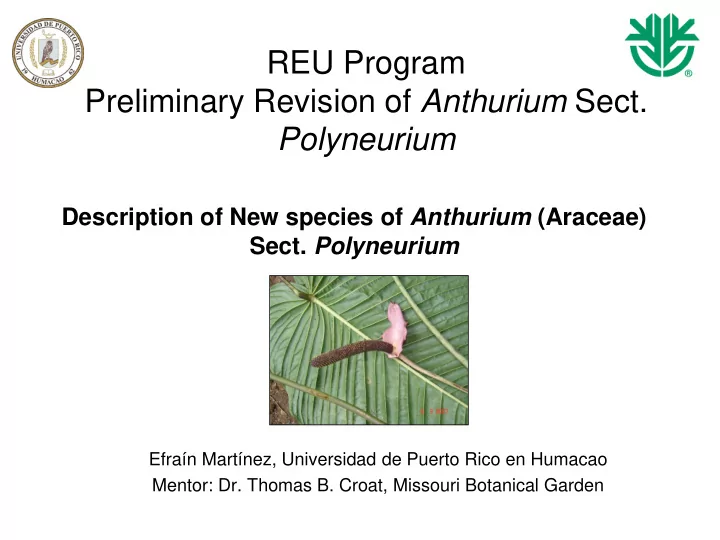
REU Program Preliminary Revision of Anthurium Sect. Polyneurium Description of New species of Anthurium (Araceae) Sect. Polyneurium Efran Martnez, Universidad de Puerto Rico en Humacao Mentor: Dr. Thomas B. Croat, Missouri Botanical Garden


slide-1
SLIDE 1

REU Program Preliminary Revision of Anthurium Sect. Polyneurium

Efraín Martínez, Universidad de Puerto Rico en Humacao Mentor: Dr. Thomas B. Croat, Missouri Botanical Garden

Description of New species of Anthurium (Araceae)

  • Sect. Polyneurium
slide-2
SLIDE 2

Anthurium genus

  • Is a Neotropical genus
  • 1250 to 1500 species
  • The flowers are bisexual
  • Leaf blades with net-reticulate

venation

slide-3
SLIDE 3
  • Sect. Polyneurium
  • Numerous closely parallel

primary lateral veins

  • Blades sagittate more or less
  • blong and acute to subcordate

at the base

slide-4
SLIDE 4
  • Spadix usually

purplish

  • Cataphylls fiber

residues

slide-5
SLIDE 5

Aroid Research Program

  • Program consists of Tom Croat

Carla Kostelac, Emily Colletti and 16 volunteer research assistants

  • Activities:

– Operating Lucid Key to Anthurium and Philodendron – Decisions on possible novelties – Describing plants

slide-6
SLIDE 6

The Process of Identification

  • Lucid key is used to test unknown species

to determine if they are new.

Character states in Anthurium key:

  • Ecology
  • Stem
  • Roots
  • Cataphylls
  • Leaves
  • Inflorescence
  • Infructescences
slide-7
SLIDE 7

Lucid screen program

slide-8
SLIDE 8

What features are good to start the identification?

  • Geographic distribution
  • Elevation
  • Genus section
  • Internodes
  • Cataphylls: persistence
  • Blades: shape, size, glossiness and texture
  • Inflorescences: spathe and spadix color
  • Infructescences: spathe persistence, berries color
slide-9
SLIDE 9

Comparing specimen with existing species

Deciding it a plant is new and preparing diagnosis

slide-10
SLIDE 10

Describing New Species

  • Once a species is deemed to be new the

material is assigned to a describer.

slide-11
SLIDE 11

analyzing the inflorescence taking measures analyzing the texture of leaf surface writing the description

slide-12
SLIDE 12
slide-13
SLIDE 13

New species described

  • Anthurium castrillonense Croat
  • A. blanquitense Croat
  • A. cajambrense Croat
  • A. carmenense Croat
  • A. castrillonense Croat
  • A. convencionense Croat
  • A. cotundoense Croat
  • A. dolichocaulum Croat
  • A. eforeroi Croat
  • A. efrainii Croat
  • A. falleniae Croat
  • A. frieri Croat
  • A. griseolaminum Croat
  • A. griseosessilis Croat
  • A. herediae Croat
  • A. ipariaense Croat
  • A. jasarum Croat
  • A. jeanlindenii Croat
  • A. josecamposii Croat
  • A. killipii Croat
  • A. liberum Croat
  • A. longifilamentum Croat
  • A. pedrazae Croat
  • A. puchinaense Croat
  • A. vargastorresense Croat
slide-14
SLIDE 14

Future works

  • I will continue collaborating with Dr. Croat

after I return to Puerto Rico by working on the Revision of Anthurium sect. Polyneurium.

  • It is expected that by the means of loans

to my institute I will be able to continue preparing descriptions of other new species.

slide-15
SLIDE 15

Special thanks to

  • Dr. Thomas B. Croat for mentoring and

dedication to the project and Carla V. Kostelac (editor). Finally thanks to the Missouri Botanical Garden, REU coordinators Dr. Sandra Arango-Caro and David Bogler, and the National Science Foundation (NSF) for this opportunity.