Retractions, Post-Publication Peer Review, and Fraud: Scientific - - PowerPoint PPT Presentation

retractions post publication peer review and fraud
SMART_READER_LITE
LIVE PREVIEW

Retractions, Post-Publication Peer Review, and Fraud: Scientific - - PowerPoint PPT Presentation

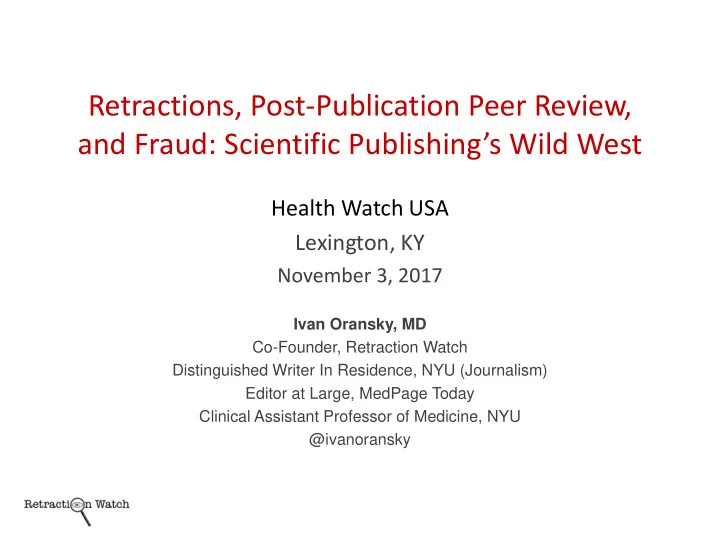
Retractions, Post-Publication Peer Review, and Fraud: Scientific Publishings Wild West Health Watch USA Lexington, KY November 3, 2017 Ivan Oransky, MD Co-Founder, Retraction Watch Distinguished Writer In Residence, NYU (Journalism)


slide-1
SLIDE 1

Health Watch USA Lexington, KY

November 3, 2017

Ivan Oransky, MD Co-Founder, Retraction Watch Distinguished Writer In Residence, NYU (Journalism) Editor at Large, MedPage Today Clinical Assistant Professor of Medicine, NYU @ivanoransky

Retractions, Post-Publication Peer Review, and Fraud: Scientific Publishing’s Wild West

slide-2
SLIDE 2

Is This Publishing Today?

slide-3
SLIDE 3

Robots No Longer Considered Harmful I.P. Freely, Oliver Clothesoff, Jacques Strap, Hugh Jazz, Amanda Huginkiss

Is This Publishing Today?

slide-4
SLIDE 4

Faking It

slide-5
SLIDE 5

Stealing It

slide-6
SLIDE 6

Fake It ‘Till You Make It

slide-7
SLIDE 7

Retractions By The Numbers

Year # of Retractions # of Papers Published %

2000 30 1MM .003 2008 332 1.2MM .028 2010 3917 1.4MM .280* 2014 678 1.6MM .042 2016 1305 1.8MM .073

retractiondatabase.org

slide-8
SLIDE 8

Where To Keep Track

retractiondatabase.org

slide-9
SLIDE 9

Common Reasons for Retractions

  • Duplication (“self-plagiarism”)
  • Plagiarism
  • Image Manipulation
  • Faked Data
  • Fake Peer Reviews
  • Publisher Error
  • Authorship Issues
  • Legal Reasons
  • Not Reproducible
slide-10
SLIDE 10

Most Retractions Due to Misconduct

PNAS online October 1, 2012

slide-11
SLIDE 11

Are We Catching Them All?

Allison et al Nature 2016 http://www.nature.com/news/reproducibility-a-tragedy-of-errors-1.19264

slide-12
SLIDE 12

Are We Catching Them All?

“Overall, 3.8% of published papers contained problematic figures, with at least half exhibiting features suggestive of deliberate manipulation. The prevalence of papers with problematic images has risen markedly during the past decade.”

slide-13
SLIDE 13

Are We Catching Them All?

“A pooled weighted average of 1.97% (N = 7, 95%CI: 0.86–4.45) of scientists admitted to have fabricated, falsified or modified data or results at least once –a serious form of misconduct by any standard– and up to 33.7% admitted other questionable research

  • practices. In surveys asking about the behaviour of

colleagues, admission rates were 14.12% (N = 12, 95% CI: 9.91–19.72) for falsification, and up to 72% for other questionable research practices.”

Fanelli, D. http://journals.plos.org/plosone/article?id=10.1371/journal.pone.0005738

slide-14
SLIDE 14

Who Retracts Most?

slide-15
SLIDE 15

Which Journals Retract?

  • Infection and Immunity 2011
slide-16
SLIDE 16

What Happens to Retracted Papers’ Citations?

  • Assn of College & Research Libraries 2011
slide-17
SLIDE 17

What Happens to Retracted Papers’ Citations?

Budd et al, 1999:

  • Retracted articles received more than 2,000 post-

retraction citations; less than 8% of citations acknowledged the retraction

  • Preliminary study of the present data shows that

continued citation remains a problem

  • Of 391 citations analyzed, only 6% acknowledge

the retraction

slide-18
SLIDE 18

The Most Highly Cited

slide-19
SLIDE 19

Do Journals Get the Word Out?

slide-20
SLIDE 20

Do Journals Get the Word Out?

“Journals often fail to alert the naïve reader; 31.8% of retracted papers were not noted as retracted in any way.”

slide-21
SLIDE 21

Is This A Useful Retraction Notice?

“At the request of the authors, the following manuscript has been retracted:” [citation]

  • Journal of Neuroscience
slide-22
SLIDE 22

Why The Opacity?

slide-23
SLIDE 23

Now This Is Good News

The JBC’s practice of saying very little in retraction and withdrawal notices has been described by many in the community as opaque—and rightfully so. After reviewing the practices of other journals and consulting with our legal counsel and publications committee, we’ve reconsidered our approach. JBC retraction and withdrawal notices now will explain, with as much detail as possible, why papers have been withdrawn

  • r retracted.
  • Journal of Biological Chemistry
slide-24
SLIDE 24

What Should Retraction Notices Look Like?

www.PublicationEthics.org

slide-25
SLIDE 25

Post-Publication Peer Review On The Rise

slide-26
SLIDE 26

“PubPeer was created specifically to bypass the suffocating and restricted channels of ‘correspondence to the editors’ and journal commenting. The tens of thousands of useful comments that users have posted

  • n PubPeer were previously suppressed by that system,

yet facilitated by an open framework encouraging factual discussion. We’re not going back.”

  • - Brandon Stell, co-founder, PubPeer

Post-Publication Peer Review On The Rise

slide-27
SLIDE 27

http://nautil.us

slide-28
SLIDE 28

False Claims Act

slide-29
SLIDE 29

Crime Doesn’t Pay Anymore

slide-30
SLIDE 30

Doing The Right Thing Does

slide-31
SLIDE 31

The Real Problem?

“Our ranking results seem to suggest that selective reporting, selective citing, and flaws in quality assurance and mentoring are the major evils of modern

  • research. A picture emerges not of concern about

wholesale fraud but of profound concerns that many scientists may be cutting corners and engage in sloppy science, possibly with a view to get more positive and more spectacular results that will be easier to publish in high-impact journals and will attract many citations.”

Bouter et al, Research Integrity and Peer Review, 2016

slide-32
SLIDE 32

Contact Info/Acknowledgements

  • ransiØ1@nyu.edu

http://retractionwatch.com @retractionwatch Thanks: The MacArthur Foundation The Arnold Foundation The Helmsley Trust