Retirement Research Foundation - - PDF document

retirement research foundation
SMART_READER_LITE
LIVE PREVIEW

Retirement Research Foundation - - PDF document

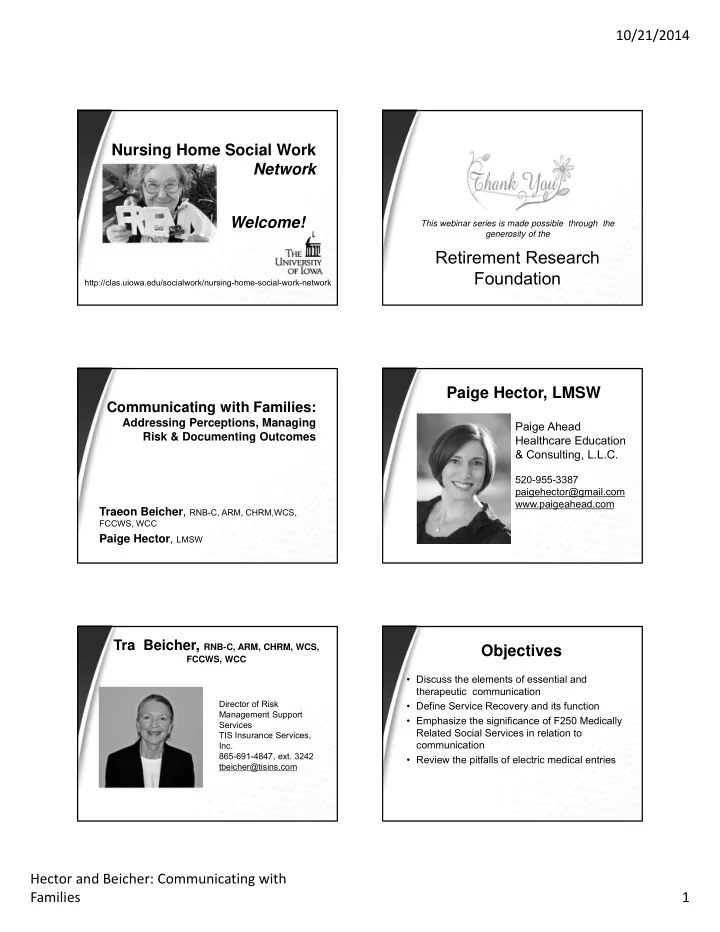
10/21/2014 Nursing Home Social Work Network Welcome! This webinar series is made possible through the generosity of the Retirement Research Foundation http://clas.uiowa.edu/socialwork/nursing-home-social-work-network Paige Hector, LMSW


slide-1
SLIDE 1

10/21/2014 Hector and Beicher: Communicating with Families 1

Nursing Home Social Work Network

http://clas.uiowa.edu/socialwork/nursing-home-social-work-network

Welcome!

This webinar series is made possible through the generosity of the

Retirement Research Foundation

Communicating with Families:

Addressing Perceptions, Managing Risk & Documenting Outcomes Traeon Beicher, RNB-C, ARM, CHRM,WCS,

FCCWS, WCC

Paige Hector, LMSW

Paige Hector, LMSW

Paige Ahead Healthcare Education & Consulting, L.L.C.

520-955-3387 paigehector@gmail.com www.paigeahead.com

Tra Beicher, RNB-C, ARM, CHRM, WCS,

FCCWS, WCC Director of Risk Management Support Services TIS Insurance Services, Inc. 865-691-4847, ext. 3242 tbeicher@tisins.com

Objectives

  • Discuss the elements of essential and

therapeutic communication

  • Define Service Recovery and its function
  • Emphasize the significance of F250 Medically

Related Social Services in relation to communication

  • Review the pitfalls of electric medical entries
slide-2
SLIDE 2

10/21/2014 Hector and Beicher: Communicating with Families 2

Information Sharing: Four Components

  • Communication
  • Notification
  • Documentation
  • Service Recovery

Communication

Regulatory Legal Economic Ethical Emotional

Communication: FACTS

Beyond Your Control

  • The circumstances which brought this resident to

the facility

  • Non-modifiable contributing factors that impact

caregiving

  • Some adverse events
  • Family dynamics are way beyond
  • Will always be some insensitivities to clinical

intervention and some irrationalities to care delivery system

  • Family complaints are seldom clinical
  • No adverse events are expected

Anticipate Miscommunication

Recognize the Barriers:

  • Work schedules of Nursing Management,

Administration and Social Services

  • Unit Nurses working in a vacuum of their shift
  • Clinicians’ learn to think clinically
  • Time constraints
  • Most communication by staff is by phone
  • Compassion at times can overtake facts at the

bedside

  • Families often do not know the questions to ask

Questions to Ask

When a decline is recognized, families who are not prepared tend to find problems with caregiving or ask multiple questions (How is Dad eating? Has Dad gone to the bathroom?) The real problem is the decline.

  • Would you like to talk about the changes in

your father?

  • Would you like more information about his

medical issues?

  • Would you like to review the care plan again?

Essential Communication

  • At the time of admission
  • The first 4 weeks of service
  • During the care plan process
  • When families visit
  • The unexpected outcomes
  • The expected outcomes
  • Progression of Disease Timeline
slide-3
SLIDE 3

10/21/2014 Hector and Beicher: Communicating with Families 3

Progression of Disease Time Line

Walking → increased confusion → increased falls → non ambulatory → refusals → combativeness → lack of interest in food → inability to swallow → loss of weight → stiffness → compromised skin → Death

Notification: FACTS

  • Families seldom expect adverse events
  • How and who you disclose to should depend on

severity

  • Clinicians trained to notify, not how to notify
  • Clinicians are often unclear about responsibility

and accountability

Notification: The Five Rights

  • The right information
  • The right time
  • The right sequence
  • The right person
  • The right attitude

Documentation: FACTS

  • Nurses are required to make and keep records of their

professional practice

  • There are no proficient standards for documentation
  • There are many limitations to the nursing record for

care delivery

  • There is no way to fix a broken record that will not be

in question

  • Electronic medical records will gather more data but

may not accurately reflect the resident

Documentation: Communication

  • Should be planned in advance
  • Should be taught
  • Should meet procedural expectations
  • Keep it fact based
  • Timing matters
  • Call in the team

Service Recovery

Resuming caregiving following service disruption; restoring confidence to residents, families and staff:

  • Resolve clinical situation efficiently based on

skill and protocol

  • Identify failure points in the system (even for

a near miss…staff knows it occurred)

  • Provide understanding, empathy, guidance

and nurturing for those involved

slide-4
SLIDE 4

10/21/2014 Hector and Beicher: Communicating with Families 4

F250 Medically Related Social Services

The facility must provide medically-related social services to attain or maintain the highest practicable physical, mental, and psychosocial well-being of each resident.

When Staff Should Refer to Social Services

  • Lack of effective family/support system
  • Behavioral symptoms
  • Resident aggression
  • Presence of a chronic disabling medical or

psychological condition

  • Depression
  • Chronic or acute pain
  • Difficulty with personal interaction and

socialization skills

Social Services Referrals, cont.

  • Presence of legal or financial problems
  • Abuse of alcohol or other drugs
  • Inability to cope with loss of function
  • Need for emotional support
  • Changes in family relationships, living

arrangement, and/or resident’s condition or functioning

  • A physical or chemical restraint
  • Resident who develop mental disorders

Additional Factors for F250

Factors with a potentially negative effect on physical, mental, and psychosocial wellbeing include an unmet need for:

  • Dental / denture care
  • Podiatric care
  • Eye care
  • Hearing services
  • Equipment for mobility or assistive eating devices
  • Need for home-like environment, control, dignity,

privacy

Pitfalls of Electronic Medical Records (EMRs)

23

Regardless of the Software…

  • All sections must be complete
  • Write narratives, especially when your

assessment differs from the MDS

slide-5
SLIDE 5

10/21/2014 Hector and Beicher: Communicating with Families 5

Beware of Inadequate Software Assessments

  • Some EMRs offer thorough clinical

assessments and tools (skin, falls, bowel and bladder)

  • Psychosocial assessments lacking
  • Check boxes are often inadequate and do not

convey the depth of the assessment

  • An assessment asks about discharge goals, but

not aspects of prior living (ADLs and IADLs)

Example: Section 3 Mood

Mood is appropriate to circumstances Shows symptoms of depression, crying, withdrawals from activities, etc. Restless, anxious, complaints, etc. Diagnosis affects mood Unable to determine

Describe, if necessary:

Example: Section 8 Physical Condition

Adjusted to physical limitations Does not fully understand physical limitations Does not accept physical limitations Repetitive health complaints Unable to determine Describe, if necessary:

Another EMR Example

Psychosocial Evaluation and Social History

Section B: Quality of Life

Does the resident have enough clothing? Does the resident feel compatible with roommate? Is the resident’s room personalized and homelike? Is the resident aware of the spiritual services offered in the facility and how to engage in them?

Same EMR, Different Section

Section D: Mood and Behavior

Has the resident been free of weight loss and sleep pattern disturbance? Has the resident been free of abuse? Is the resident free from any adjustment/mood/ behavior problem?

 If yes to above questions, what problems does the resident have?

What Social Workers DO

  • Conduct assessments based in systems

perspective

  • Identify barriers, possible solutions or ways to

ease hardship

  • Recognize the bigger picture of the entire

care process

  • Share information in the stand-up meeting
  • Check in with family, see how they are doing
  • Provide thorough and timely documentation
slide-6
SLIDE 6

10/21/2014 Hector and Beicher: Communicating with Families 6

Social Service Interaction and Collaboration

  • Increase in self directed care or other change of

condition

  • Care choices that affect caregiving

– Resistance or declination of care

  • Changes in mood or behavior
  • Expected decline, family needing support

– Therapeutic communication

The Goal is not to “Fix” Everything

  • Physical limitations of caregivers
  • Financial limitations
  • Long-standing family dysfunction
  • Issues related to mental illness
  • Breakdowns within “the medical system”

Be Proactive

  • Meet with resident and family often, not just at

care conferences

  • Identify realistic expectations for care based on

diagnoses and prognosis

  • Identify realistic limitations of the nursing home.
  • AND, be creative and demonstrate willingness to

explore options even if it’s “not how we do things.”

  • Invite resident and family to be in charge of

appropriate aspects of their loved ones care

  • Determine what they feel is important and give it to

them, such as Dad’s blood sugar levels, therapy updates, meal percentage consumed

Beicher, Tra, RNC, ARM, HRM, CWS, A Facility-Based Risk Management Program, American Health Care Association, 2003

Stay Proactive!

  • Be visible
  • Find a reason to go into the room, ask the

family if all is well and offer information:

  • “She chose the blue dress again this

morning.”

  • “He really enjoyed the movie after lunch.”
  • “The doctor was here earlier and…”

Beicher, Tra, RNC, ARM, HRM, CWS, A Facility-Based Risk Management Program, American Health Care Association, 2003

“None of us is as smart as all of us.”

  • -Ken Blanchard

35

Thank You For Attending

Traeon Beicher, RNB-C, ARM, CHRM, CWS, FCCWS, WCC

Director of Risk Management Support Services TIS Insurance Services, Inc. 865-691-4847, ext. 3242 tbeicher@tisins.com www.tisins.com

Paige Hector, LMSW

Paige Ahead Healthcare Education & Consulting, L.L.C. 520-955-3387 paigehector@gmail.com www.paigeahead.com