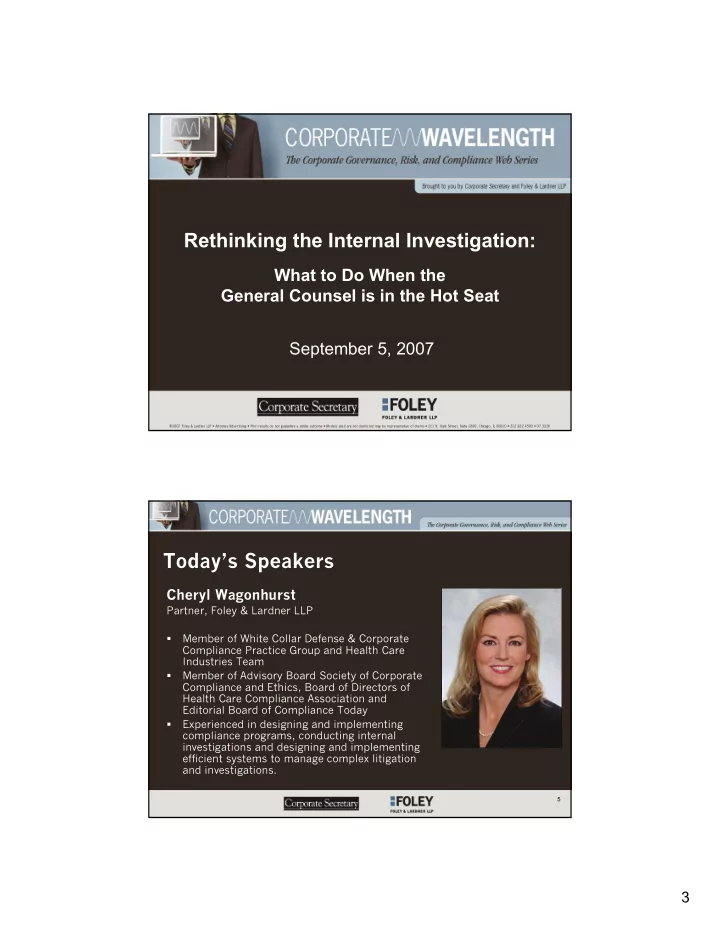
Rethinking the Internal Investigation: What to Do When the General - - PDF document

rethinking the internal investigation
SMART_READER_LITE
LIVE PREVIEW

Rethinking the Internal Investigation: What to Do When the General - - PDF document

Rethinking the Internal Investigation: What to Do When the General Counsel is in the Hot Seat September 5, 2007 Todays Speakers Cheryl Wagonhurst Partner, Foley & Lardner LLP Member of White Collar Defense & Corporate


slide-1
SLIDE 1

3

Rethinking the Internal Investigation:

What to Do When the General Counsel is in the Hot Seat September 5, 2007

5

Today’s Speakers

Cheryl Wagonhurst

Partner, Foley & Lardner LLP

  • Member of White Collar Defense & Corporate

Compliance Practice Group and Health Care Industries Team

  • Member of Advisory Board Society of Corporate

Compliance and Ethics, Board of Directors of Health Care Compliance Association and Editorial Board of Compliance Today

  • Experienced in designing and implementing

compliance programs, conducting internal investigations and designing and implementing efficient systems to manage complex litigation and investigations.

slide-2
SLIDE 2

4

6

Today’s Speakers

Dawson Horn, III

Assistant General Counsel, Altria Corporate Services, Inc.

  • Primary responsibilities include product liability

and civil RICO litigation work

  • Recently managed defense of multi-billion dollar

RICO law suit by the DOJ against major cigarette companies

  • Previous positions include litigator with Pepper

Hamilton & Scheetz, counsel to Scott Paper Risk Management Department where he was responsible for coverage issues, procurement counsel for Campbell Soup Company and leading corporate transactions for UnitedAuto Group and Dannon

7

Today’s Moderator

Brendan Sheehan

Executive Editor, Corporate Secretary

  • Editorial mission: To provide innovative

and insightful analysis for corporate secretaries, general counsel and compliance officers

  • Corporate Secretary is the leading source of

information on matters relating to the SEC, Sarbanes-Oxley, D&O insurance, shareholder communications, proxy solicitation and voting, director education and compensation, listing requirements and entity management

slide-3
SLIDE 3

5

Rethinking the Internal Investigation:

What to Do When the General Counsel is in the Hot Seat September 5, 2007

9

Overview

Increased pressures for internal investigations present new role and challenges for the General Counsel How these challenges impact the commencement and implementation of an internal investigation Managing the results of the internal investigation

slide-4
SLIDE 4

6

10

Increased Pressure – Auditor’s Increased Focus

SOX (2002):

Section 301: Requires Audit Committees (AC) to establish procedures for the receipt and retention, and treatment of complaints regarding accounting, internal accounting controls or auditing matters. Also requires that the AC have the authority to engage independent counsel and other advisers, as necessary to carry out its duties, and be provided with appropriate funding to pay said advisers. Section 303: Made it unlawful for officers or directors

  • f an issuer or any other person to to take action to

fraudulently influence, manipulate or mislead any independent accountant performing an audit.

11

Increased Pressure - Whistleblowers

slide-5
SLIDE 5

7

12

Increased Pressure – Government Investigations

Increased state activity – Elliot Spitzer Healthcare industry – billing, coding, quality of care and kickbacks to referral sources Pharmaceutical industry Financial industry Energy industry Subprime lenders/marketing

13

Increased Pressure – Government Investigations (cont’d)

Backdating stock options Over 100 companies under investigation by SEC,DOJ

  • r both

Approximately 15 General Counsel nationally have been forced out of their positions

slide-6
SLIDE 6

8

14

Increased Pressure – SEC Actions Against General Counsels

Failing to furnish material information or providing false information to company auditors Preparing and/or filing false and misleading public financial information Distributing unregistered securities Issuing improper legal opinions

15

Increased Pressure – Legislative, Regulatory and other Government Actions

SOX Federal Sentencing Guidelines Seaboard Report McNulty Memorandum

slide-7
SLIDE 7

9

16

The General Counsel’s (new) Role

General Counsel’s role as: Facilitating the meeting of business objectives An important gatekeeper in the prevention and detection of fraudulent activity; Defending the organization; and Coordinating with others in the organization to reduce risk and ensure compliance– Chief Compliance Officer Chief Ethics Officer Chief Risk Officer Ethical considerations for the General Counsel

17

General Counsel as Chief Compliance Officer

Pros

Chief legal officer of organization should have oversight and responsibility for assuring the implementation of an effective legal compliance system under the oversight of the board of directors. (ABA Task Force)

Cons

Too much emphasis/resources devoted to putting out fires and not enough focus on proactive preventative measures Lack of independence from management One Iowa Senator’s view – “It doesn’t take a pig farmer from Iowa to smell the stench of conflict in that arrangement” of the General Counsel and Chief Compliance Officer wearing two hats .…”

slide-8
SLIDE 8

10

18

General Counsel as Chief Compliance Officer

Helpful resource document – OIG/AHLA “An Integrated Approach to Corporate Compliance: A Resource for Health Care Boards of Directors” July 1, 2004

Polling Question 1

To ensure appropriate governance and compliance in today’s environment, your organization is reconsidering the respective roles of general counsel (GC) and chief compliance officer (CCO). Which of the four choices makes the most sense:

  • No need for a CCO. The GC’s role is to provide a legal compliance

system under the oversight of the board

  • The CCO and GC should be separate positions with the CCO

reporting to the GC. Both have a dotted line to the board

  • The GC and CCO should report to the CEO and both the GC and

CCO should have a dotted line to the board

  • The CCO should report directly to the board. The GC should report

to the CEO with a dotted line to the board

Live Meeting Poll

Changes directly made to this slide will not be displayed in Live Meeting. Edit this slide by selecting Properties in the Live Meeting Presentation menu.

slide-9
SLIDE 9

11

20

How do these new challenges for the General Counsel impact internal investigations?

21

  • 1. What triggers an internal investigation?

Internal audits & monitoring Hot line calls; Internal complaints Other non-compliance (e.g., cost accounting, quality of care, etc.) Third-party complaints/accusations Legal proceedings Subpoenas Outside audits & reviews Suppliers/vendors Third-party billing Patients/beneficiaries Competitors Former employees

slide-10
SLIDE 10

12

22

Iraq Weapons Are a Focus of Criminal Investigations

By JAMES GLANZ and ERIC SCHMITT Published: August 28, 2007

BAGHDAD, Aug. 27 — Several federal agencies are investigating a widening network of criminal cases involving the purchase and delivery of billions of dollars of weapons, supplies and other matériel to Iraqi and American forces, according to American officials. The

  • fficials said it amounted to the largest ring of fraud and

kickbacks uncovered in the conflict here.

The New York Times

23

  • 2. What factors influence the scope of

an investigation?

Number of complaints Reliability of sources Control systems Seriousness of complaint Likelihood and scope of wrongdoing

slide-11
SLIDE 11

13

24

Element of an effective compliance program and fulfills board’s duty to investigate Determine if federal/state liability before government or whistleblowers Identify and end improper/illegal practices Minimize criminal and civil exposure to extent possible Minimize sanctions Public relations

  • 3. Why is it advisable to conduct an

internal investigation?

25

  • 4. How is an internal investigation
  • rganized and structured?

Who is the client? Who should manage and oversee the investigation? Cost and impact of the issues – striking the right balance But, if the person leading the investigation is NOT an attorney, then the investigation is not

  • rdinarily privileged

Un-privileged investigations can be subpoenaed by government agencies

slide-12
SLIDE 12

14

26

  • 5. Who should conduct the

investigation?

Who should conduct the investigation? Compliance officer In-house counsel Internal audit or other multidisciplinary team Outside counsel Special counsel When is it necessary to formally retain outside counsel? Is it always necessary to have an investigative plan?

Polling Question 2

What is the best use of resources in order to carry

  • ut an internal investigation involving serious

allegations?

Use in-house counsel to conduct the investigation and

  • utside counsel at the conclusion to advise on disclosure

Use outside counsel to conduct the internal investigation and in-house counsel to assist with the results, such as corrective action Use a combination of in-house and outside counsel and other resources as necessary Use “independent” outside counsel

Live Meeting Poll

Changes directly made to this slide will not be displayed in Live Meeting. Edit this slide by selecting Properties in the Live Meeting Presentation menu.

slide-13
SLIDE 13

15

28

  • 6. How should the internal

investigation be implemented?

Initial notification and communication Issues Auditors, audit committee and shadow auditors, if necessary D&O and other insurance carriers Regulators Public Relations – talking points Internal employee communications Relevant employees Contractors and vendors Benefits to drafting a written investigative plan

29

  • 7. What additional steps should be taken

to implement the internal investigation?

Preserve documents Rationale Document preservation memorandum Preserve ability to assert the company’s attorney-client privilege Resolve conflict issues Employee/officer indemnification Joint defense agreements Use caution Not available unless counsel is making the agreement – extension of the attorney-client privilege

slide-14
SLIDE 14

16

30

  • 8. How do you control the flow of

information during the investigation?

Critical to identify from the beginning who may learn and who may not learn about the progress of the investigation Strong pressure from supervisors to be kept “in the loop” Courts and prosecutors pay close attention to this issue Lack of control over the flow of information can torpedo an expensive and time-consuming investigation Have a plan and stick to it – no exceptions Enforce “no comparing stories” admonitions Briefing groups of employees on “what is going on” is a recipe for problems

31

  • 9. How is the investigation commenced:

document analysis, interviewing and documenting witnesses interviews?

Understand the system and consider cost efficiencies up front! Retain necessary expert consultants to assist Retrieve and organize relevant and key documents Use documents to identify current and former employees and third parties to interview Consider order of interviews and setting Upjohn warnings and avoid giving legal advice Documenting the interview

slide-15
SLIDE 15

17

32

  • 10. What steps should be taken to report and

disclose the results of the investigation?

First, consider the recipient of the report Oral vs. written report Truly oral Power point aided Written report Dissemination of report Mandatory disclosure Voluntary disclosure – pros and cons and key elements

  • f a voluntary disclosure

33

  • 11. You have the results of your

investigation, what do you do now?

Dismiss/reinstate employees Update public filings, as necessary Issue press statement Work with appropriate corporate resources and/or outside counsel to implement all additional corrective action, as necessary Preserve investigation file

slide-16
SLIDE 16

18

34

  • 12. When to waive attorney-client &

work product protections?

McNulty considerations Full vs. limited waiver Crime/fraud exceptions for communications made in furtherance of contemplated criminal/fraudulent conduct Shareholder litigation Use of privileged documents to prepare witnesses Waiver in civil litigation

Polling Question 3

Your internal investigation and found that the “serious” allegations have been substantiated as events “material” to the organization. Disclosure to the public would likely cause a stock tumble with shareholder litigation. Your first course of action is to

  • Disclose results to regulators immediately because the risk of info

leaking through a whistleblower is too great.

  • Obtain advice from outside counsel on the risks and benefits of

waiving the privilege and disclosure.

  • Bring the matter to the board and the external auditors and let them

decide.

  • Resign. The pressure too great, your stock options are likely to

become worthless and ski season is just around the corner.

Live Meeting Poll

Changes directly made to this slide will not be displayed in Live Meeting. Edit this slide by selecting Properties in the Live Meeting Presentation menu.

slide-17
SLIDE 17

19

36

Conclusion

Internal investigations can be very healthy and necessary for an

  • rganization

The General Counsel must rethink his/her role in the process of considering and conducting the internal investigation Thank you for your participation

For more information on the Corporate Wavelength web conference series, visit Foley.com/corporatewavelength Dawson Horn (dawson.horn@altria.com) Cheryl Wagonhurst (cwagonhurst@foley.com)