Rethinking Class-Balanced Methods for Long-tailed Visual Recognition - - PowerPoint PPT Presentation

β–Ά
rethinking class balanced methods for long tailed visual
SMART_READER_LITE
LIVE PREVIEW

Rethinking Class-Balanced Methods for Long-tailed Visual Recognition - - PowerPoint PPT Presentation

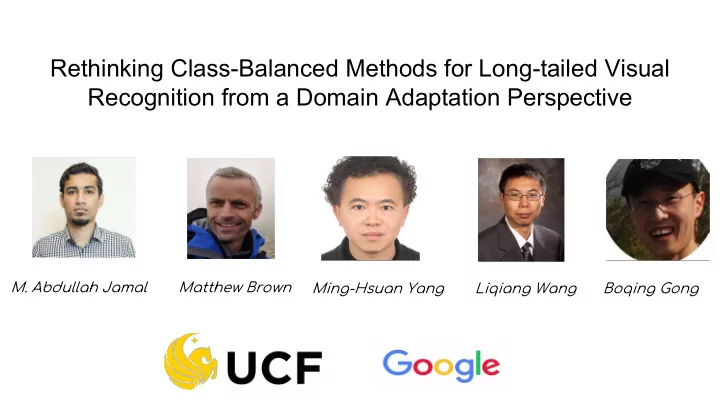
Rethinking Class-Balanced Methods for Long-tailed Visual Recognition from a Domain Adaptation Perspective M. Abdullah Jamal Matthew Brown Ming-Hsuan Yang Liqiang Wang Boqing Gong Long-tailed Problem Emerging challenge as the datasets grow

slide-1
SLIDE 1

Rethinking Class-Balanced Methods for Long-tailed Visual Recognition from a Domain Adaptation Perspective

  • M. Abdullah Jamal

Matthew Brown Ming-Hsuan Yang Liqiang Wang Boqing Gong

slide-2
SLIDE 2

Long-tailed Problem

Emerging challenge as the datasets grow in scale Prevalent in fine-grained recognition, detection, etc. Datasets: iNaturalist, LVIS, ImageNet, COCO, etc.

Vi Visual Genome

slide-3
SLIDE 3

Ac Accuracy on

  • n Head Classes

Ac Accuracy on

  • n Tail Classes

Ac Accuracy on

  • n Head Classes

Ac Accuracy on

  • n Tail Classes

Accu Accuracy cy on n Hea ead Classes es Accu Accuracy cy on n Tail Classes es

Shortcomings of Current Approaches

slide-4
SLIDE 4

New Perspective - Domain Adaptation

Slide source

slide-5
SLIDE 5

Existing Works

Assume target shift

𝜭s(x|Common Slider) = 𝜭t(x|Common Slider) 𝜭s(x|King Eider) = 𝜭t(x|King Eider)

slide-6
SLIDE 6

But

𝜭s(x|Common Slider) = 𝜭t(x|Common Slider)

𝜭s(x|King Eider) β‰  𝜭t(x|King Eider)

slide-7
SLIDE 7

A Bird’s Eye View

Expects to perform well

  • n all classes

Ζ’(x;πœ„) Ζ’(x;πœ„) w

Example weights

β„’

Training Loss

Training Stage Inference Stage

slide-8
SLIDE 8

Two-Component Approach

[ICML’18] Learning to reweight examples for robust deep learning

Meta-learning framework

[CVPR’19] Class-Balanced Loss Based on Effective Number of Samples

(1 - 𝞬 ) / ( 1- 𝞬 n )

slide-9
SLIDE 9

Two-Component Approach

[ICML’18] Learning to reweight examples for robust deep learning

Meta-learning framework

[CVPR’19] Class-Balanced Loss Based on Effective Number of Samples

(1 - 𝞬 ) / ( 1- 𝞬 n )

L2RW Ours Pre-training X βœ“ Clip negative 𝝑 βœ“ X Normalization βœ“ X Free Space of 𝝑 reduced larger

slide-10
SLIDE 10

Experiments

Six datasets

  • CIFAR-LT-10
  • CIFAR-LT-100
  • iNaturalist 2017 & 2018
  • ImageNet-LT
  • Places-LT
slide-11
SLIDE 11

CIFAR-LT-10 - Results

slide-12
SLIDE 12

CIFAR-LT-10 - Results

slide-13
SLIDE 13

CIFAR-LT-10 - Results

slide-14
SLIDE 14

CIFAR-LT-10 - Results

slide-15
SLIDE 15

What are the learned 𝝑

slide-16
SLIDE 16

Long-tailed visual recognition

  • A new perspective from Domain

Adaptation

  • A two-component approach
  • SOTA results on six datasets

Domain Adaptation

  • Domain-invariant representations
  • Maximum Mean Discrepancy
  • Curriculum Domain Adaptation
  • Adversarial adaptation
  • Self-supervised adaptation

A powerhouse of ideas & techniques

slide-17
SLIDE 17