Reconfigurable and Adaptive Systems (RAS) Adaptive Systems (RAS) - - PowerPoint PPT Presentation

reconfigurable and adaptive systems ras
SMART_READER_LITE
LIVE PREVIEW

Reconfigurable and Adaptive Systems (RAS) Adaptive Systems (RAS) - - PowerPoint PPT Presentation

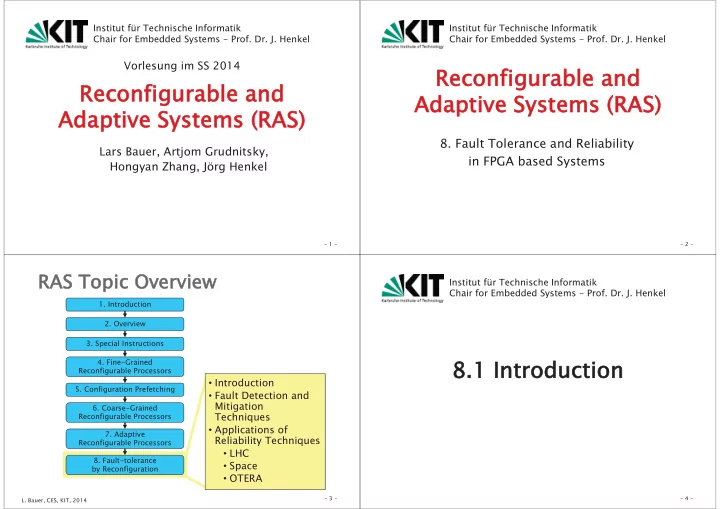
Institut fr Technische Informatik Institut fr Technische Informatik Chair for Embedded Systems - Prof. Dr. J. Henkel Chair for Embedded Systems - Prof. Dr. J. Henkel Vorlesung im SS 2014 Reconfigurable and Reconfigurable and Adaptive


slide-1
SLIDE 1

Institut für Technische Informatik Chair for Embedded Systems - Prof. Dr. J. Henkel

Lars Bauer, Artjom Grudnitsky, Hongyan Zhang, Jörg Henkel

Vorlesung im SS 2014

Reconfigurable and Adaptive Systems (RAS)

  • 1 -

Institut für Technische Informatik Chair for Embedded Systems - Prof. Dr. J. Henkel

Reconfigurable and Adaptive Systems (RAS)

  • 2 -
  • 8. Fault Tolerance and Reliability

in FPGA based Systems

  • L. Bauer, CES, KIT, 2014
  • 3 -

RAS Topic Overview

  • 1. Introduction
  • 3. Special Instructions
  • 6. Coarse-Grained

Reconfigurable Processors

  • 8. Fault-tolerance

by Reconfiguration

  • 2. Overview
  • 4. Fine-Grained

Reconfigurable Processors

  • 7. Adaptive

Reconfigurable Processors

  • 5. Configuration Prefetching
  • Introduction
  • Fault Detection and

Mitigation Techniques

  • Applications of

Reliability Techniques

  • LHC
  • Space
  • OTERA
  • 4 -

Institut für Technische Informatik Chair for Embedded Systems - Prof. Dr. J. Henkel

8 8.1 Introduction

slide-2
SLIDE 2
  • L. Bauer, CES, KIT, 2014
  • 5 -

Why Fault Tolerance?

# dopant atoms # of dopant atoms in Transistor-channel

ITRS

Gordon E. Moore (co-founded Intel in 1968)

CMOS Scaling increases

  • ccurrence of

Manufacturing defects Post-deployment degradation Especially important for FPGAs as they have a high amount of transistors and interconnect wires

Environmental conditions can

incur temporary faults

E.g. Aerospace industry – use hardened devices for mission critical tasks, FPGAs for non-critical data processing

Unlike ASICs, FPGAs can adapt

to deal with permanent and temporary faults

  • L. Bauer, CES, KIT, 2014
  • 6 -

Permanent Faults: e.g. stuck-at failures in CLBs and opens,

bridges, shorts in the programmable switching matrix

Could occur during the fabrication process without being detected Damage of device resources may also appear in the life cycle of FPGAs

Transient Faults: have a temporary cause that can alter

signal values or state stored in memory cells, which creates indefinite and incorrect states in the computation

E.g. by a high energy particle strike resulting in an energy exchange and charge displacement

Intermittent Faults: have a permanent cause in the

structure of the circuit but their effect is intermittent, e.g. depending on temperature or power consumption

Types of Faults

  • L. Bauer, CES, KIT, 2014
  • 7 -

Breakdown of Si-H bonds at

the silicon-oxide interface due to voltage/thermal stress causes interface traps

Affects mostly P-MOSFETs

because of negative gate bias

Effect in N-MOSFETS is negligible

Despite research focus:

NBTI is observed, but not yet fully understood

Negative Bias Temperature Instability (NBTI)

n p S

  • xide

gate D

Si Si Si H+ O H

P-type MOSFET

Si Si O H

Vg Vg < 0 STRESS!

p

trap

  • L. Bauer, CES, KIT, 2014
  • 8 -

NBTI manifests itself as a shift in

Vth

Causes increase in transistor delay NBTI leads to delay faults and resulting circuit failure

Recovery effect in periods of no

stress

When voltage and temperature are low, Vth can shift back towards its original value Full recovery from a stress period

  • nly possible in infinite time

In practice, overall Vth shift increases over longer periods, e.g. months or years

Negative Bias Temperature Instability (NBTI) (cont‘d)

Vth shift [V] Time

Stress Recovery

Vg [V]

  • 1
slide-3
SLIDE 3
  • L. Bauer, CES, KIT, 2014
  • 9 -

Temperature plays important aspect in NBTI modeling Higher temperatures

increase shift in threshold voltage

Vth approximately

50% higher at 75°C than 55°C

NBTI effect at 75°C

is approximately equal to alternating between 85°C and 25°C

NBTI and Temperature

  • L. Bauer, CES, KIT, 2014
  • 10 -

NBTI Impact on Lifetime of SRAM

0% 5% 10% 15% 20% 25% 30% 35% 40% Signal to Noise Margin (SNM) degradation after 7 years in 32nm Percentage of time that the cell stores zero [%]

src: S. Kothawade, K. Chakraborty, S. Roy, "Analysis and mitigation of NBTI aging in register file: An end-to-end approach"

The NBTI effect is minimum here because the NBTI stress will equally be distributed between the two PMOS transistors existing in the SRAM

  • L. Bauer, CES, KIT, 2014
  • 11 -

Types of Degradation (cont’d)

Hot-Carrier Injection (HCI): build up of

trapped charges in the gate-channel interface region

progressive reduction of carrier mobility increase in CMOS threshold voltage Switching speed slower, leads to timing problems

  • L. Bauer, CES, KIT, 2014
  • 12 -

Time-Dependent Dielectric Breakdown

(TDDB): over time conducting path forms in thin oxide layers

Types of Degradation (cont‘d)

[CCMA10]

G D S

slide-4
SLIDE 4
  • L. Bauer, CES, KIT, 2014
  • 13 -

Main Reason for many of these effects: High-Fields

src: Radhakrishnan et al., IEDM (2001)

Most of device problems can be tracked down to high-field

effects – related to the failure to follow Dennard Scaling

  • L. Bauer, CES, KIT, 2014
  • 14 -

Assuming a constant area Chip freq. may reduce due to wire delay Voltage scales 1/S Power squared [W/mm2]

Dennard Scaling vs. Power Density

Transistor and power scaling are no longer

balanced

Scaling is limited by power

Higher power density leads to thermal problems

Accelerates aging effects

src: G. Venkatesh et al., “Conservation Cores: Reducing the Energy of Mature Computations”, ASPLOS ‘10

Device count S2 Device frequency S Device power (cap) 1/S Device power (Vdd) 1/S2 Power Density 1

S: Scaling Factor; Device: Transistor

Classical scaling (Dennard)

  • L. Bauer, CES, KIT, 2014
  • 15 -

Dennard Scaling vs. Power Density

Transistor and power scaling are no longer

balanced

Scaling is limited by power

Higher power density leads to thermal problems

Accelerates aging effects

src: G. Venkatesh et al., “Conservation Cores: Reducing the Energy of Mature Computations”, ASPLOS ‘10

Device count S2 Device frequency S Device power (cap) 1/S Device power (Vdd) 1/S2 Power Density 1

S: Scaling Factor; Device: Transistor

Classical scaling (Dennard)

Device count S2 Device frequency S Device power (cap) 1/S Device power (Vdd) ~1 Power Density S2

Power Limited Scaling

  • L. Bauer, CES, KIT, 2014
  • 16 -

Electromigration: thermally activated metal

ions may leave their potential wells

electric field and momentum exchange through electrons direct metal ion migration can lead to open/short circuits

Types of Degradation (cont‘d)

[wikipedia]

slide-5
SLIDE 5
  • L. Bauer, CES, KIT, 2014
  • 17 -

Sources: Intel, S. Borker@DAC’03, Patrick-Emil Zörner, W.D. Nix, 1992, L.Finkelstein, Intel 2005, R. Baumann, TI@Design&Test’05, Ziegler, IBM@IBM JRD’96

n+ n+ p+ N-Well P-Well P-Substrate Isolation Gate

+

  • +
  • +
  • +
  • +
  • +
  • +
  • +
  • +
  • +
  • Depletion

Region High-Energy Particle (Neutron or Proton)

Radiation induced faults

Single Event Upsets/Single Event Transients Most common: single bit flip in SRAM cell SEU effect on ASIC

Transient (only variation is time duration of fault) Even if latched, will be eventually overwritten

SEU effect on FPGAs

Permanent (until reset/ reconfiguration) if configuration memory hit by SEU

Radiation induced faults

  • 18 -

Institut für Technische Informatik Chair for Embedded Systems - Prof. Dr. J. Henkel

8 8.2 Fault Detection and Mitigation Techniques

  • L. Bauer, CES, KIT, 2014
  • 19 -

Masks errors, but does not correct underlying

fault

Problem: error accumulation

External

Multiple FPGAs working in lockstep, i.e. per- forming the same operation in each cycle Output sent to radiation hardened voter

Internal

Replicate functional block in FPGA

Popular configurations

Triple Modular Redundancy (TMR) Duplication with Comparison (DWC)

Modular Redundancy

  • L. Bauer, CES, KIT, 2014
  • 20 -

Fault detection methods comparison

Detection Speed Resource Overhead Performance O Overhead Granularity Coverage Modular Redundancy Fast: as soon as fault is manifest Very large: triplicate + voter Very small: Voter delay Coarse: protect module sized blocks Good: All manifest errors detected src: [SCC08]

slide-6
SLIDE 6
  • L. Bauer, CES, KIT, 2014
  • 21 -

More space efficient design than modular redundancy Error coding algorithms (e.g. parity) at data

flows/stores

Time redundancy can be used for concurrent error

detection

Repeat computation in a way that allows errors to be detected First computation at t0: compute result in combinational logic, store result Second computation at t0+d: encode operands, compute in combinational logic, decode result, compare to first result

Concurrent Error Detection

  • L. Bauer, CES, KIT, 2014
  • 22 -

Concurrent Error Detection (cont’d)

src: [LCR03]

  • L. Bauer, CES, KIT, 2014
  • 23 -

Different techniques for encode/decode, e.g. bit

inversion to detect stuck-at faults

Recomputation with shifted operands (RESO) for

faulty arithmetic slices

Encode: left shift operands Decode: right shift result

Combine with Duplication with Comparison (DWC)

RESO determines which module is faulty, DWC uses result

  • f other module

Less area required than TMR Slightly slower (time-shifted re-computation)

Concurrent Error Detection (cont’d)

  • L. Bauer, CES, KIT, 2014
  • 24 -

Fault detection methods comparison

Detection Speed Resource Overhead Performance O Overhead Granularity Coverage Modular Redundancy Fast: as soon as fault is manifest Very large: triplicate + voter Very small: Voter delay Coarse: protect module sized blocks Good: All manifest errors detected Concurrent error detection Fast: as soon as fault is manifest Medium: tradeoff with coverage Small: CRC logic delay Medium: tradeoff with resource Medium: Not practical for all types of functionality src: [SCC08]

slide-7
SLIDE 7
  • L. Bauer, CES, KIT, 2014
  • 25 -

Built-in Self-Test: does not use external test

equipment

In FPGAs: test configurations containing

Test pattern generator (TPG) Output response analyzer (ORA) Between them: Device (i.e. logic and interconnect) under test (DUT)

Can test for faults that are difficult to cover in

  • nline tests, e.g. clock network

Major drawback: system must enter dedicated

test mode

Offline-BIST

  • L. Bauer, CES, KIT, 2014
  • 26 -

Fault detection methods comparison

Detection Speed Resource Overhead Performance O Overhead Granularity Coverage Modular Redundancy Fast: as soon as fault is manifest Very large: triplicate + voter Very small: Voter delay Coarse: protect module sized blocks Good: All manifest errors detected Concurrent error detection Fast: as soon as fault is manifest Medium: tradeoff with coverage Small: CRC logic delay Medium: tradeoff with resource Medium: Not practical for all types of functionality Off-line BIST Slow: only when offline Very small Small: start- up delay Fine: possible to detect exact error Very good: All faults including dormant src: [SCC08]

  • L. Bauer, CES, KIT, 2014
  • 27 -

Online BIST Split FPGA into equal-sized regions One region performs self-test, others perform design

function

When test complete: swap test region with untested

functional region and test the new region

Lower area overhead (1 region + controller logic) Problems:

swapping may “stretch” connections between regions slower timing (may require clock speed reduction) Functional blocks may be inoperable during swap (depends

  • n how it is implemented)

Roving

  • L. Bauer, CES, KIT, 2014
  • 28 -

STARs consist of tiles performing BIST

STARs rove over FPGA leftright (H-STAR) and updown (V-STAR) Test Pattern Generator (TPG) sends data to Block under test (BUT); Output Response Analyzer (ORA) detects fault

Self Testing AReas (Roving STARs)

src: [ESSA00]

slide-8
SLIDE 8
  • L. Bauer, CES, KIT, 2014
  • 29 -

Roving controlled by embedded processor Blocks under Test tested in different

configurations, e.g. User RAM, LUT, adder, etc.

Test strategy does not use signature analysis, but

tests 2 identically configured blocks and compares response

Each block in tile tested twice with different partner block

H-STAR 2 rows high, V-STAR 2 columns wide

Tiles not necessarily 2x2, can also be 2x3, etc.

Roving STARs

TPG BUT BUT ORA

  • L. Bauer, CES, KIT, 2014
  • 30 -

Depending on current location of STARs, working

area of FPGA is divided into 1, 2 or 4 regions

Virtual coordinate system of working area without STARs

Roving STARs

src: [ESSA00]

  • L. Bauer, CES, KIT, 2014
  • 31 -

Model: FPGA system function composed by “logic

cell functions”

Each fits into 1 Configurable Logic Block (CLB) on the FPGA “Logic cell functions” defined by coordinates in virtual coordinate system CLBs defined in physical coordinate system Mapping depends on the position of the STAR

Blocks can be faulty, partially usable, fault-free

Partially faulty blocks can implement some, but not all logic cell functions STARs test blocks in different modes and can determine which mode is fault-free

Roving STARs

  • L. Bauer, CES, KIT, 2014
  • 32 -

Fault Tolerance approach, 3 Levels:

I. STAR Parking: when fault detected, STAR that detected fault stops moving. User application notified for possible rollback. Determine fault and report to controller II. Reconfigure system function: if logic cell can use block (usable or sufficiently partially usable), do not

  • reconfigure. Otherwise remap logic cell to spare

working block. Remapping performed by controller while STARs parked. When done: STARs continue roving

  • III. STAR stealing: when no spares are available, take out

part of the STARs and use them as spares. Tiles may no longer be able to perform BIST. Try to maintain at least 1 roving STAR

Roving STARs

slide-9
SLIDE 9
  • L. Bauer, CES, KIT, 2014
  • 33 -

Fault detection methods comparison

Detection Speed Resource Overhead Performance O Overhead Granularity Coverage Modular Redundancy Fast: as soon as fault is manifest Very large: triplicate + voter Very small: Voter delay Coarse: protect module sized blocks Good: All manifest errors detected Concurrent error detection Fast: as soon as fault is manifest Medium: tradeoff with coverage Small: CRC logic delay Medium: tradeoff with resource Medium: Not practical for all types of functionality Off-line BIST Slow: only when offline Very small Small: start- up delay Fine: possible to detect exact error Very good: All faults including dormant Roving Medium: order

  • f 1 second

Medium: empty test block + controller Large: stop clock to swap blocks. Critical paths may lengthen Fine: possible to detect exact error Very good: multiple manifest and latent faults detected

src: [SCC08]

  • L. Bauer, CES, KIT, 2014
  • 34 -

Repair faults in configuration memory by

updating affected configuration frame

For Xilinx FPGAs there are 3 ways to access

configuration memory: JTAG (slow external), SelectMAP (fast external), ICAP (fast internal)

Scrubbing protects only configuration data, not

memory elements

Can not scrub LUTs that are used as User RAM (“Distributed RAM”) Ca not scrub BlockRAM (embedded memory in FPGAs) Use other protection schemes for memory elements, e.g. parity or error-correcting codes

Scrubbing

  • L. Bauer, CES, KIT, 2014
  • 35 -

Strategy: Continuous overwriting

Read original configuration frame from external memory Write it to FPGA, even if no SEUs present

Advantages: Simple implementations, minimal

additional hardware, fast repair

Blind Scrubbing

src: [HSWK09]

  • L. Bauer, CES, KIT, 2014
  • 36 -

Strategy: only overwrite frame if fault detected

Read back configuration data Check against original configuration data (e.g. CRC comparison) On error: write corrected configuration data back to FPGA

Advantages: SEU logging

Readback Scrubbing

src: [HSWK09]

slide-10
SLIDE 10
  • L. Bauer, CES, KIT, 2014
  • 37 -

Strategy:

Read configuration frame via ICAP Check frame-internal CRC code and correct errors if necessary Write configuration frame via ICAP

Xilinx proprietary method No external memory required Uses BRAM scrubber vulnerable to SEUs Error correction can only correct 1 Bit errors, 2

bit errors are detected but not corrected, 4 and 8 bit errors can go completely undetected

Internal Scrubbing

  • L. Bauer, CES, KIT, 2014
  • 38 -

Traditional Scrubbing methods can not be used with

partial reconfiguration

Scrubbing uses configuration port constantly When loading PR bitstream, scrubber tries to read/write to configuration memory, while PR logic tries write to it Even if scrubbing pauses for PR, scrubber will immediately

  • verwrite PR region again (i.e. scrubber ‘repairs’ the region)

Potential Solution: Update “golden” bitstream

Golden bitstream contains reference bitstream in radiation hardened memory used for scrubbing Writing the PR modifications to golden bitstream in an atomic

  • peration (i.e. scrubbing should not read that part from hardened

memory in between) Then, scrubbing will reconfigure the PR part to the FPGA after a short delay

Partial Reconfiguration Scrubbing

  • L. Bauer, CES, KIT, 2014
  • 39 -

Implemented on

Virtex-4

Communication

Interface – UART, receive bitstreams from host computer

Memory - 64 MB

SDRAM for bitstream storage

Arbiter resolves decoder/scrubber memory access conflicts

Partial Reconfiguration Scrubbing

src: [HSWK09]

  • L. Bauer, CES, KIT, 2014
  • 40 -

Bitstream decoder – prepare bitstream for insertion into

golden bitstream

Configuration Controller – manage scrubbing

Read frame from golden bitstream and configuration memory Compute CRC values If different, write frame from golden bitstream to configuration memory

Partial Reconfiguration done automatically by

Configuration Controller

Golden bitstream updated with PR bitstream Configuration Controller detects SEUs in modified frames Frames in configuration memory overwritten PR complete

Partial Reconfiguration Scrubbing

slide-11
SLIDE 11
  • L. Bauer, CES, KIT, 2014
  • 41 -

Column/Row shifting: spare lines of cells at

end of array

When error detected in row/col bypass whole row/col via multiplexers and use spare

Alternative configurations: split FPGA into

tiles such that multiple configurations for each tile implement same functionality

Once error located, load configuration that does not use faulty resource

Others: online re-routing, …

Other Fault repair techniques

  • 42 -

Institut für Technische Informatik Chair for Embedded Systems - Prof. Dr. J. Henkel

8 8.3 Reliability for LHC

  • L. Bauer, CES, KIT, 2014
  • 43 -
  • One of the

experiments using the Large Hadron Collider (LHC) at CERN

  • Task: Characterize

quark gluon plasma produced through collisions of heavy ions

  • Transition Radiation

Detector (TRD) identifies fast electrons in central barrel

  • Consists of 540

readout chambers

ALICE - A Large Ion Collider Experiment

src: CERN, ALICE Set Up, http://aliceinfo.cern.ch/ Public/Objects/Chapter2/ALICE-SetUp-NewSimple.jpg

  • L. Bauer, CES, KIT, 2014
  • 44 -

Task: ensure safe operation of TRD

Provide front-end electronics with configuration and calibration data

Some Design Goals from the Design Report:

Coherent and homogeneous: to allow for integration of independently developed components Flexible and scalable: e.g. hardware upgrades, procedural changes Must be operational throughout lifetime of experiment, even during shutdown phases Available, safe, reliable: safety of detector equipment Equipment configuration and data archiving easily maintainable

Detector Control System (DCS)

slide-12
SLIDE 12
  • L. Bauer, CES, KIT, 2014
  • 45 -

DCS Board

Developed at the Kirchoff Institute

  • f Physics

(Heidelberg)

Detector Control System (DCS)

Several variants for different components of the detector, but using

FPGA allows using same board layout

Interface with front end electronics in readout chambers - 540

boards

Low/high voltage power control & trigger control - 50 boards Control & configure readout control units (which pass

measurement data to data acquisition systems) - 216 boards

src: [K08]

  • L. Bauer, CES, KIT, 2014
  • 46 -

Altera Excalibur FPGA

SRAM based 4190 Logic Elements (about 100k gates) Embedded ARM 9 processor

MMU, SDRAM Controller, UART, watchdog, etc 32 MB SDRAM, 8 MB Flash (FPGA configuration

data, bootloader, software)

ARM’s Advanced High Performance Bus (AHB)

used for on-board interconnect

Ethernet ( PC), LVDS ( front end electronics)

DCS Board - Hardware

  • L. Bauer, CES, KIT, 2014
  • 47 -

Bootloader

At beginning of flash memory Initializes CPU, configures FPGA, loads kernel into RAM

Linux Kernel File System with user software

Drivers for most board components as modules Application for detector control Standard UNIX utilities

DCS Board - Software

  • L. Bauer, CES, KIT, 2014
  • 48 -

If a board fails to start up (e.g. flash image

corrupted by radiation), it can be reconfigured from a neighbor board

Boards connected in a ring in addition to Ethernet Accessible via JTAG Special FPGA Configuration that receives data over Ethernet and writes it to flash bypasses CPU and reduces reconfiguration time

DCS Board – Flash Reconfiguration

slide-13
SLIDE 13
  • L. Bauer, CES, KIT, 2014
  • 49 -

More potential points of failure than a

dedicated ASIC Controller

But: also more mechanisms to deal with such faults

Expected: no permanent damage to

hardware, only Single Event Upsets (SEU) in memory/registers

Radiation tests at level of radiation expected

in detector: 1 SEU every few hours per board

DCS Board Radiation Tolerance

  • L. Bauer, CES, KIT, 2014
  • 50 -

SDRAM: fill memory with pattern, read out and verify, send

UDP packet via network on error

CPU not used, OS not needed 100% of memory can be tested

FPGA Configuration SRAM

Triple modular redundancy + majority voter detect functional error No readback of configuration data possible with this FPGA Find configuration error by testing TMR functionality

SDRAM and SRAM Tests can be used to estimate radiation

susceptibility – not used in regular operation

Online Memory Self-Test

Fill unused memory with test patterns and verify Implemented as kernel module

DCS Test Mechanisms

  • 51 -

Institut für Technische Informatik Chair for Embedded Systems - Prof. Dr. J. Henkel

8 8.4 Reliability in Space

  • L. Bauer, CES, KIT, 2014
  • 52 -

Different scenario: FPGAs in space-based applications Preprocessing of data on-board to minimize

downlink bandwidth

Common fault detection/mitigation

Radiation hardened devices – very expensive, lower performance TMR - Problem: area overhead (> 200% more), assumes worst-case scenario

Use reconfiguration to adapt to desired level of

redundancy/performance

Developed at University of Florida

Reconfigurable Fault Tolerance (RFT) in Space

slide-14
SLIDE 14
  • L. Bauer, CES, KIT, 2014
  • 53 -

SoC with Partial Reconfiguration Regions (PRR) that contain

additional processing modules/accelerators

All components except PRRs may be protected by TMR

MicroBlaze keeps track of modules

active or not switch fault tolerance strategies using ICAP Initiate recovery when module encounters error

RFT Architecture

src: [JGC09]

  • L. Bauer, CES, KIT, 2014
  • 54 -

Triple modular redundancy (TMR) mode: replicate

module in three different PRRs

Voting implemented in RFT Controller Error Interrupt to MicroBlaze, which initiates recovery

Save system state Reconfigure PRR Load module state back

High Performance mode: no fault tolerance by

system

Reliability through module-internal means still possible

RFT Modes

  • L. Bauer, CES, KIT, 2014
  • 55 -

Self-checking Pair (SCP) mode:

Replicate module in two different PRRs Error reconfigure both, repeat computation

Switching Reconfigurable Fault Tolerance

(RFT) modes:

Triggered by external events or prior knowledge of the environment RFT controller disables affected PRRs, extracts their state and changes voting procedures Partial bitstreams sent to ICAP RFT controller re-enables bus connections

RFT Modes

  • L. Bauer, CES, KIT, 2014
  • 56 -

International Space Station

Low Earth Orbit – 400km height, 92 min to complete, avoids travel

  • ver poles to minimize radiation exposure to crew

SEU rates depend on solar activity, particular device, etc.

Here: only estimates

RFT Case Study - ISS

src: [JGC09]

slide-15
SLIDE 15
  • L. Bauer, CES, KIT, 2014
  • 57 -

Prior knowledge of

  • rbit and solar

conditions

High Performance

mode in sections with low SEU rates

Reconfigure to TMR

mode when radiation exposure high

During both modes:

Scrubbing of configu- ration memory in 30

  • sec. cycles

RFT Case Study - ISS

src: [JGC09]

  • L. Bauer, CES, KIT, 2014
  • 58 -

Results

Configuration memory repair rate (scrubbing) much higher than SEU rate During high radiation periods traditional TMR and RFT perform similar (RFT in TMR mode) During low radiation parts RFT performs better Average performance of RFT over TMR: 2.3x

RFT Case Study - ISS

  • L. Bauer, CES, KIT, 2014
  • 59 -

Highly Elliptical Orbit (HEO) stay longer over an area and can cover polar

regions

Used by communication satellites Geostationary orbits only cover

equatorial regions

Average

radiation higher

RFT Case Study - HEO

src: [JGC09]

  • 59 -
  • L. Bauer, CES, KIT, 2014
  • 60 -

RFT Case Study - HEO

System switches between TMR (3 PRRs used) and Self-

checking Pair (4 PRRs used running 2 applications) modes

Modules checkpoint state every 5 minutes

slide-16
SLIDE 16
  • 61 -

Institut für Technische Informatik Chair for Embedded Systems - Prof. Dr. J. Henkel

8 8.5 OTERA

  • L. Bauer, CES, KIT, 2014
  • 62 -

RISPP revisited: Reliable online-reconfiguration using online test

Fabric fault free? Reconfiguration process completed correctly?

Must be ensured at runtime!

OTERA – Online TEst strategies for

runtime Reconfigurable Architectures

Reconf. Container

Inter- Cont. Buses …

Memory Controller

Core Pipeline

Data Cache/Scratchpad Off-Chip Memory IF ID MEM WB EXE

Reconf. Container

Inter- Cont. Buses Load/Store Units & Address Generation Units Inter- Container Buses Inter- Cont. Buses Inter- Cont. Buses Interface

Reconf. Container

  • L. Bauer, CES, KIT, 2014
  • 63 -

Pre-configuration test (PRET)

Tests structural integrity of reconfigurable fabric Executed online before reconfiguration with mission logic

Post-configuration test (PORT)

Test correct reconfiguration and interconnection Functional, software-based test Execured online, at speed

OTERA – Test Methods

  • L. Bauer, CES, KIT, 2014
  • 64 -

Principal structure:

Truth table, multiplexer

2 test configurations

Set each memory cell to 0 and 1 XOR and XNOR Exhaustive test set (2n patterns)

Optimizations: C-testable array Pipelining for at-

speed test

Example: Testing a Lookup- Table

1 0 1 1 XOR configuration 0 0 1 1 0 1 0 1

slide-17
SLIDE 17
  • L. Bauer, CES, KIT, 2014
  • 65 -
  • 1. Basic pre-configuration online test

OTERA – Test Procedure

src: [BBI+12]

Run-time System Recon- fig Port PRET

  • L. Bauer, CES, KIT, 2014
  • 66 -
  • 2. Reconfigure the accelerator into the

container

OTERA – Test Procedure

src: [BBI+12]

Run-time System Recon- fig Port PRET Bitstr. Data

  • L. Bauer, CES, KIT, 2014
  • 67 -
  • 3. Post-reconfiguration online test (PORT)

After reconfiguration Periodically during operation

OTERA – Test Procedure

src: [BBI+12]

PORT Run-time System Recon- fig Port PRET Bitstr. Data

  • L. Bauer, CES, KIT, 2014
  • 68 -

TPG & ORA

Inter- Cont. Buses

  • Connect Test Pattern Generator (TPG) and Output Response Analyzer

(ORA) with the Reconf. Containers

  • Can use the Inter-Container Buses for communication
  • After loading a Test Configuration (TC), the test is performed like a

regular application-specific Special Instruction

OTERA - PRET System Integration

Memory Controller

Core Pipeline

Data Cache/Scratchpad Off-Chip Memory IF ID MEM WB EXE

Load/Store Units & Address Generation Units

Inter- Container Buses Inter- Cont. Buses

Reconf. Container

Inter- Cont. Buses …

Reconf. Container

Inter- Cont. Buses

Interface Run- time System TC data ICAP

TPG & ORA

Inter- Cont. Buses

Test Config. src: [BBI+12]

slide-18
SLIDE 18
  • L. Bauer, CES, KIT, 2014
  • 69 -

9 Test configurations (TCs) to cover all targeted faults in CLBs Test configuration scheduling integrated into system scheduling &

configuration infrastructure

Test Configurations

TC Tested CLB subcomponents PRET over-

  • h

head [CLBs] Bitstream s size [KB] Freq. [ [MHz] Number of Patterns 1 LUT as XOR, via FF 2 24.0 207 64 2 LUT as XNOR, via FF 2 24.0 207 64 3 Carry MUX, via latch 1 28.6 168 6 4 Carry MUX, via latch 1 26.1 154 6 5 Carry XOR, via FF 1 28.0 168 6 6 Carry XOR, via FF 1 28.2 154 6 7 Carry-I/O multiplexed 1 27.1 183 6 8 LUT as Shift Reg. with slice MUX 1 22.9 157 6 9 LUT as RAM with slice output 7 22.3 225 320

  • L. Bauer, CES, KIT, 2014
  • 70 -

OTERA - Test Scheduling

Legend:

SAD Transform SAV QuadSub PointFilter 1 2 4 5 3 Clip 1 2 4 5 3 Test Configuration 1 2 4 5 3 Time Time

Container index Container index Container index a) Accelerator configurations without tests b) 1 test config. per accelerator configuration c) 9 test configurations per accelerator configuration

Time

  • L. Bauer, CES, KIT, 2014
  • 71 -

H.264 video encoding running on reconf. system Investigating different test frequencies

1 Test Config. (TC) per X Accelerator Configurations (AC)

Negligible

appl. perfor- mance impact

Typ. < 1%

OTERA - Performance Overhead

0.0% 0.2% 0.4% 0.6% 0.8% 1.0% 1.2% 1.4% 5 6 7 8 9 10 11 12 13 14

Performance loss [%] 1 TC / 1 AC 1 TC / 2 ACs 1 TC / 3 ACs 1 TC / 4 ACs Number of reconfigurable Containers src: [BBI+12]

  • L. Bauer, CES, KIT, 2014
  • 72 -

Test Latency: the time to complete all tests (9 test

configurations for all containers)

Short test

latency (between 1.2 and 14.1 s)

Depends

  • n num-

ber of contai- ners and test frequency

OTERA - Test Latency

2 4 6 8 10 12 14 16 5 6 7 8 9 10 11 12 13 14

Average test latency [s] 1 TC / 1 AC 1 TC / 2 ACs 1 TC / 3 ACs 1 TC / 4 ACs Number of reconfigurable Containers

src: [BBI+12]

slide-19
SLIDE 19
  • L. Bauer, CES, KIT, 2014
  • 73 -

Implement functional modules

in different ways in terms of CLB usage (Placement constraint)

Diversified configurations

Module Diversification

A1

A2 A3 A4 used unused faulty

src: [ZBK+13]

  • L. Bauer, CES, KIT, 2014
  • 74 -

Goal: Create a minimal set of

diversified configurations that tolerate any single-CLB fault

Track for each CLB how many configurations already used it Create a new configuration out of an existing one by swapping the most often used CLBs with the least often used ones

Generate Diversified Configurations

Score matrix

A1 A2 A3

1 1 1 2 2 2 2 2 2 src: [ZBK+13]

  • L. Bauer, CES, KIT, 2014
  • 75 -

CLBs are stressed non-uniformly Decrease stress = reduce aging Distribute the stress over CLBs

Stress Balancing for Aging Mitigation

Stress Estimation src: [ZBK+13]

  • L. Bauer, CES, KIT, 2014
  • 76 -

a), b) two diversified configurations c) an alternating schedule d) a balanced schedule of the min. set (4 configurations)

Stress Reduction

src: [ZBK+13]

slide-20
SLIDE 20
  • L. Bauer, CES, KIT, 2014
  • 77 -

Goal: Maximize performance under given reliability

constraints

GUARD: GUAranteed Reliability in Dynamically Reconfigurable Systems

Reliability constraints

A3 A1 A2 A3

Reconfigurable Containers Current soft- error rate Runtime Variants Selection Scrubbing Controller Reconfiguration Controller New in GUARD Base architecture Failure rate < 10-10 src: [ZKI+14]

  • L. Bauer, CES, KIT, 2014
  • 78 -

Variants of Accelerated Functions

  • A3

A1 A2 A3 A1 A2 A3 A3

Voter

a) Example for an Ac- celerated Function c) Reliable variant with Tripli- cated implementation of A3

A3 A1 A2

b) Faster variant with two parallel instances of A3

A3 A3 A3 A3 A3

Voter

Step 1 Step 2 Step 3

Trade-off performance with reliability

3 Containers 4 Containers 5 Containers

A1 A2 A3 Different accelerator types

Legend:

src: [ZKI+14]

  • L. Bauer, CES, KIT, 2014
  • 79 -

Number of critical configuration bits Resident

time

Reliability of Accelerators

non-critical bit critical bit

Fresh (reconf., scrubbing) Reliability

1

Time Constraint

src: [ZKI+14]

  • L. Bauer, CES, KIT, 2014
  • 80 -

Number of critical configuration bits Resident

time

Reliability of Accelerators

non-critical bit critical bit

Fresh (reconf., scrubbing) Reliability

1

Time Constraint e.g. with more redundancy

src: [ZKI+14]

slide-21
SLIDE 21
  • L. Bauer, CES, KIT, 2014
  • 81 -

Number of critical configuration bits Resident

time

Reliability of Accelerators

non-critical bit critical bit

Reliability

1

Time Constraint More frequent scrubbing

src: [ZKI+14]

  • L. Bauer, CES, KIT, 2014
  • 82 -

Variants Selection – Greedy Algorithm

Prune unreliable variants in C Search for the variant with highest speed-up per container: vbest C: All variants of required accelerated functions Update R and remove vbest from C Update container requirements Prune unfitting variants in C R: Selected variants C is empty? No Yes Determine scrubbing rate src: [ZKI+14]

  • L. Bauer, CES, KIT, 2014
  • 83 -

Results: Runtime Adaptation

Average performance improvement: 42.6%

Threshold DWC [Jacobs2012] Threshold TMR [Jacobs2012] r = 10 r = 9 Soft-error rate

DWC/TMR threshold (r=10)

Soft-error rate Threshold TMR Threshold DWC GUARD r = 10 GUARD r = 9

Performance [Million Accel. Functions/s] src: [ZKI+14]

  • L. Bauer, CES, KIT, 2014
  • 84 -

Developed a thorough CLB test and integrated it into

a reconfigurable system

Using system facilities for reconfiguration and test access Extended tool-chain to create partial bitstreams for Test Configurations Transparent for the application Very low area & performance overhead and fast test latency

Realized fault-tolerance and aging mitigation via

diversified module configurations

Dynamic performance/reliability trade-off Validated on HW Prototype

Conclusion

slide-22
SLIDE 22
  • L. Bauer, CES, KIT, 2014
  • 85 -

[CCMA10] M. Choudhury, V. Chandra, K. Mohanram, and R. Aitken: “Analytical model for TDDB- based performance degradation in combinational logic”, In Proceedings of the Conference on Design, Automation and Test in Europe (DATE '10). Leuven, Belgium, 423-428. 2010. [LCR03] F. Lima, L. Carro, R. Reis: “Designing fault tolerant systems into SRAM-based FPGAs”, Design Automation Conference (DAC), pp. 650-655, 2003. [CCCV05] N. Campregher, P.Y.K. Cheung, G.A. Constantinides, M. Vasilko: “Analysis of yield loss due to random photolithographic defects in the interconnect structure of FPGAs”, 13th international symposium on Field-programmable gate arrays (FPGA), pp. 138-148, 2005. [SSC08] E. Stott, P. Sedcole, P. Cheung: “Fault tolerant methods for reliability in FPGAs”, Int’l Conference on Field Programmable Logic and Applications (FPL), pp. 415-420, 2008. [ESSA00] J. Emmert, C. Stroud, B. Skaggs, M. Abramovici: “Dynamic fault tolerance in FPGAs via partial reconfiguration”, IEEE Symposium on Field-Programmable Custom Computing Machines (FCCM), pp. 165-174, 2000. [LC07] A. Lesea, K. Castellani-Coulie: “Experimental study and analysis of soft errors in 90nm Xilinx FPGA and beyond”, 9th European Conference on Radiation and it’s Effects on Components and Systems, pp. 1-5, 2007. [B06] M. Berg: “Fault tolerance implementation within SRAM based FPGA designs based upon the increased level of single event upset susceptibility”, 12th IEEE International On-Line Testing Symposium (IOLTS), p. 89-91, 2006.

Sources, References, Further Reading

  • L. Bauer, CES, KIT, 2014
  • 86 -

[HSWK09] J. Heiner, B. Sellers, M. Wirthlin, J. Kalb: “FPGA partial reconfiguration via configuration scrubbing,” Int’l Conf. on Field Programmable Logic and Applications (FPL), pp. 99-104, 2009. [K08] T. Krawutschke: “A flexible and reliable embedded system for detector control in a high energy physics experiment”, Int’l Conf. on Field Pr. Logic and Appl. (FPL), pp. 155-160, 2008. [M07] J. Mercado: “The ALICE Transition Radiation Detector Control System”, Int’l Conference on Accelerators and Large Experimental Physics Control Systems (ICALEPCS), pp. 181-183, 2007. [ALCol03] ALICE Collaboration: “ALICE Technical Design Report of the Trigger Data Acquisition High-Level Trigger and Control System”, ISBN 92-9083-217-7, pp. 359 – 412, 2003. [JGC09] A. Jacobs, A. George, G. Cieslewski: “Reconfigurable fault tolerance: A framework for environmentally adaptive fault mitigation in space”, International Conference on Field Programmable Logic and Applications (FPL), pp. 199-204, 2009. [BBI+12] L. Bauer, C. Braun, M. E. Imhof, M. A. Kochte, H. Zhang, H.-J. Wunderlich, J. Henkel: “OTERA: Online Test Strategies for Reliable Reconfigurable Architectures”, NASA/ESA Conference on Adaptive Hardware and Systems (AHS), pp. 38-45, 2012. [ZBK+13] H. Zhang, L. Bauer, M. A. Kochte, E. Schneider, C. Braun, M. E. Imhof, H.-J. Wunderlich, J. Henkel: “Module Diversification: Fault Tolerance and Aging Mitigation for Runtime Reconfigurable Architectures”, IEEE International Test Conference (ITC'13) , pp. 1-10, 2013. [ZKI+14] H. Zhang, M. A. Kochte, M. Imhof, L. Bauer, H.-J. Wunderlich, J. Henkel: “GUARD: GUAranteed Reliability in Dynamically Reconfigurable Systems”, IEEE/ACM Design Automation Conference (DAC'14) , 2014.

Sources, References, Further Reading