
SLIDE 1
1
Jeffery T. Mitchell – Quark Matter 2012 - 8/17/12
The RHIC Beam Energy Scan Program: Results from the PHENIX Experiment
Jeffery T. Mitchell Brookhaven National Laboratory and the PHENIX Collaboration
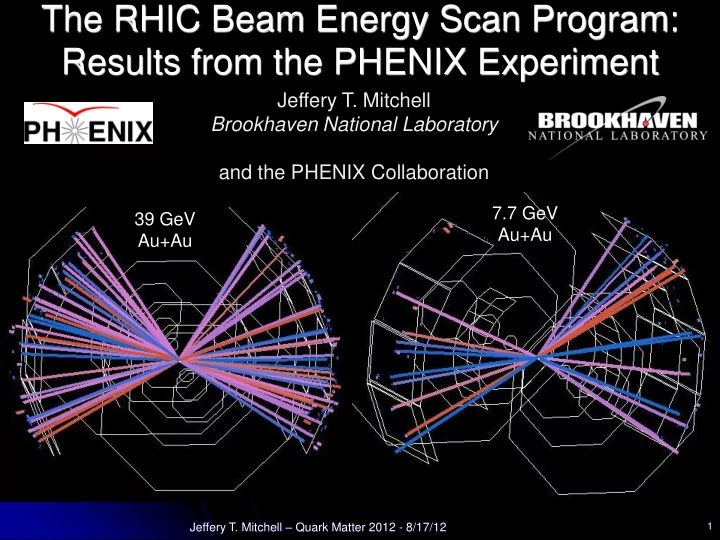
39 GeV Au+Au 7.7 GeV Au+Au
Results from the PHENIX Experiment Jeffery T. Mitchell Brookhaven - - PowerPoint PPT Presentation
The RHIC Beam Energy Scan Program: Results from the PHENIX Experiment Jeffery T. Mitchell Brookhaven National Laboratory and the PHENIX Collaboration 7.7 GeV 39 GeV Au+Au Au+Au Jeffery T. Mitchell Quark Matter 2012 - 8/17/12 1 The RHIC
1
Jeffery T. Mitchell – Quark Matter 2012 - 8/17/12
Jeffery T. Mitchell Brookhaven National Laboratory and the PHENIX Collaboration
39 GeV Au+Au 7.7 GeV Au+Au
Jeffery T. Mitchell – Quark Matter 2012 - 8/17/12
2
sqrt (sNN) [GeV]
2001 2002 2003 2004 2005 2006 2007 2008 2009 2010 2011 2012
200 130 62.4 39 27 22.5 19.6 11.5 7.7 5.0 Au+Au Cu+Cu
d+Au Cu+Au U+U
STAR
Test run
Jeffery T. Mitchell – Quark Matter 2012 - 8/17/12
3
By systematically varying the RHIC beam energy, heavy ion collisions will be able to probe different regions of the QCD phase diagram. PHENIX is searching for signatures of the onset of deconfinement and searching for signatures of the critical point. Outline:
Jeffery T. Mitchell – Quark Matter 2012 - 8/17/12
4
27 GeV Au+Au 27 GeV Au+Au
5% centrality distributions
5% centrality distributions
Jeffery T. Mitchell – Quark Matter 2012 - 8/17/12
5
The 200 GeV Au+Au analysis is described in Phys. Rev. C71 (2005) 034908
The particle density increases with increasing collision energy. There is an increase in particle density for more central collisions at all collision energies. The Au+Au and U+U particle densities are similar. Mid-rapidity
Jeffery T. Mitchell – Quark Matter 2012 - 8/17/12
6
The red line is a logarithmic fit to all data points excluding the LHC points. At or below RHIC energies, the multiplicity per participant pair increases linearly with log(sqrt(sNN)). Central collisions Mid-rapidity
Jeffery T. Mitchell – Quark Matter 2012 - 8/17/12
7
collision energies.
the same collision energy. Mid-rapidity
Jeffery T. Mitchell – Quark Matter 2012 - 8/17/12
8
New RHIC energy density record in U+U collisions = 6.15 GeV/fm2/c. The upper U+U point is for the upper 1% centrality bin. All other points are 5% centrality bins.
eBJ increases by a factor of 3.8 when going from 7.7 to 200 GeV.
Mid-rapidity
Npart
Mid-rapidity
Jeffery T. Mitchell – Quark Matter 2012 - 8/17/12
9
Monotonic behavior is observed in ET production in 0-5% central Au+Au
Central collisions Central collisions Mid-rapidity
Jeffery T. Mitchell – Quark Matter 2012 - 8/17/12
10
particle density or transverse energy from 7.7 GeV Au+Au collisions up to 2.76 TeV Pb+Pb collisions.
Jeffery T. Mitchell – Quark Matter 2012 - 8/17/12
11
The transverse energy per charged particle is flat as a function of centrality for all collision energies from 7.7 GeV to 200 GeV. Mid-rapidity
Jeffery T. Mitchell – Quark Matter 2012 - 8/17/12
12
There is very little change in the transverse energy per charged particle from 7.7 GeV to 200 GeV. There is only a slight increase at LHC energies (16%). Central collisions Mid-rapidity
Jeffery T. Mitchell – Quark Matter 2012 - 8/17/12
13
compressibility of the system near the critical point.
T B NBD ch
2
Grand Canonical Ensemble N “Scaled Variance” The scaled variance is quoted within the PHENIX acceptance and has been corrected for contributions from impact parameter fluctuations (ch,dyn). The centrality-dependent shape of the fluctuations is primarily driven by contributions from flow.
Jeffery T. Mitchell – Quark Matter 2012 - 8/17/12
14
The NA49 data is from C. Alt et al., Phys. Rev. C78, 034914 (2008). The dashed red line is a constant fit to the PHENIX data only. No significant increase in multiplicity fluctuations have been observed. Stay tuned for new results at 19.6 and 27 GeV. It would be interesting to add a point at 15 GeV. Central collisions
Jeffery T. Mitchell – Quark Matter 2012 - 8/17/12
15
The correlation length (x) is related to various moments of conserved quantities:
Variance: 2 = <(N-N)2> ~ x2 Skewness: S = <(N-N)3>/3 ~ x4.5 Kurtosis: k = <(N-N)4>/4-3 ~ x7
Since the correlation length is expected to diverge at the critical point, it is expected that the quantities S and k2 will be large there. Skewness Kurtosis “bulging” Black: k=0 Red: k=∞ The quantities S and k2 are related to the quark number susceptibilities (c): S ~ c(3) /c(2) and k2 ~ c(4) /c(2).
Jeffery T. Mitchell – Quark Matter 2012 - 8/17/12
16
All datasets cover several orders of magnitude.
Jeffery T. Mitchell – Quark Matter 2012 - 8/17/12
17
The skewness and kurtosis tends to increase with decreasing beam energy. The skewness and kurtosis tends to decrease in more central collisions.
(<N>)
Jeffery T. Mitchell – Quark Matter 2012 - 8/17/12
18
The products of the moments are relatively flat as a function of centrality.
Jeffery T. Mitchell – Quark Matter 2012 - 8/17/12
19
The products of the net charge moments show no significant increase above URQMD, HIJING, or Hadron Resonance Gas predictions. Stay tuned for new results at 19.6 and 27 GeV.
Jeffery T. Mitchell – Quark Matter 2012 - 8/17/12
20
Rout, Rside, and Rlong all increase with increasing centrality.
Jeffery T. Mitchell – Quark Matter 2012 - 8/17/12
21
There is no significant change in Rout and Rside vs. sqrt(sNN) from 39 to 200 GeV. Rlong increases with sqrt(sNN).
Jeffery T. Mitchell – Quark Matter 2012 - 8/17/12
22
The quantity Rout*Rside*Rlong estimates the pion freeze-out volume, Vf. The PHENIX data are consistent with the trend displayed by previous results.
Jeffery T. Mitchell – Quark Matter 2012 - 8/17/12
23
Scaling of v2 and v3 by the number of constituent quarks is preserved at 62 GeV and 39 GeV.
Jeffery T. Mitchell – Quark Matter 2012 - 8/17/12
24
arXiv:1204.1526v1 RAA at 62 GeV is similar to that at 200 GeV. Strong suppression is still observed at 39 GeV, but it is less than at higher energies. p0 RAA results at 27 GeV are coming soon.
Jeffery T. Mitchell – Quark Matter 2012 - 8/17/12
25
New results from 39, 27, 19.6, and 7.7 GeV Au+Au collisions are shown.
logarithmically with sqrt(sNN) up to the top RHIC energy.
shows little change from 7.7 GeV to 2.76 TeV.
GeV.
HIJING, or Hadron Resonance Gas predictions at 7.7 or 39 GeV.
established in previous measurements.
seen at 39 GeV.
soon.
Jeffery T. Mitchell – Quark Matter 2012 - 8/17/12
26
Jeffery T. Mitchell – Quark Matter 2012 - 8/17/12
27
PRL101, 162301
Jeffery T. Mitchell – Quark Matter 2012 - 8/17/12
28
p0 RAA as a function of pT in PHENIX at √sNN = 39, 62 and 200 GeV.
Jeffery T. Mitchell – Quark Matter 2012 - 8/17/12
29
There is little change in the magnitude of v2 from 39 GeV to 200 GeV.
Jeffery T. Mitchell – Quark Matter 2012 - 8/17/12
30
Jeffery T. Mitchell – Quark Matter 2012 - 8/17/12
31