Response to Planning Commission Questions: 1. Logic behind fee in - - PDF document

response to planning commission questions
SMART_READER_LITE
LIVE PREVIEW

Response to Planning Commission Questions: 1. Logic behind fee in - - PDF document

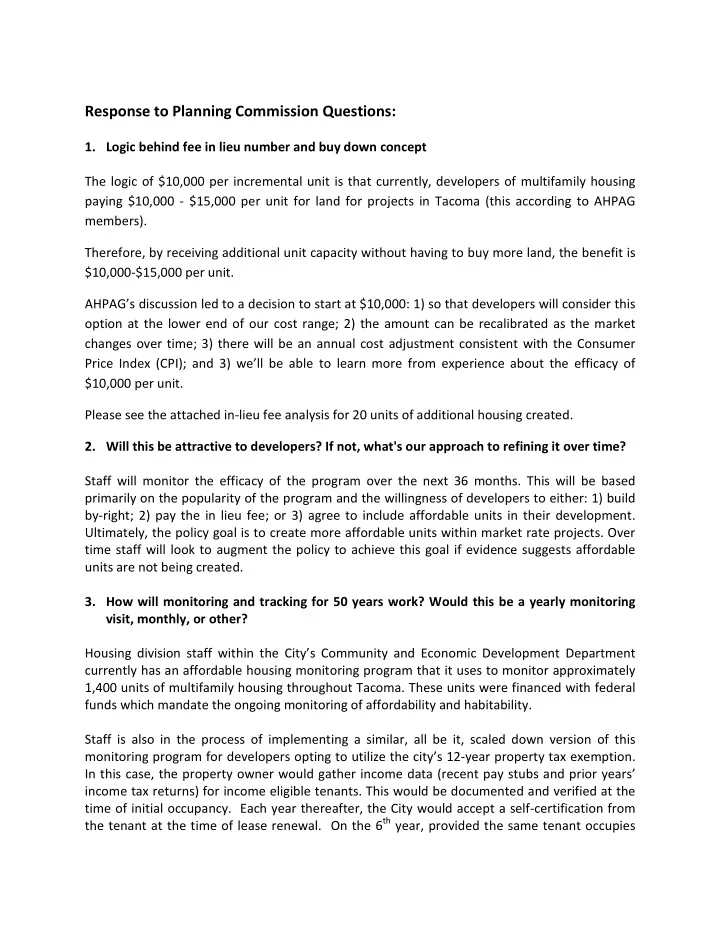
Response to Planning Commission Questions: 1. Logic behind fee in lieu number and buy down concept The logic of $10,000 per incremental unit is that currently, developers of multifamily housing paying $10,000 - $15,000 per unit for land for


slide-1
SLIDE 1

Response to Planning Commission Questions:

  • 1. Logic behind fee in lieu number and buy down concept

The logic of $10,000 per incremental unit is that currently, developers of multifamily housing paying $10,000 - $15,000 per unit for land for projects in Tacoma (this according to AHPAG members). Therefore, by receiving additional unit capacity without having to buy more land, the benefit is $10,000-$15,000 per unit. AHPAG’s discussion led to a decision to start at $10,000: 1) so that developers will consider this

  • ption at the lower end of our cost range; 2) the amount can be recalibrated as the market

changes over time; 3) there will be an annual cost adjustment consistent with the Consumer Price Index (CPI); and 3) we’ll be able to learn more from experience about the efficacy of $10,000 per unit. Please see the attached in-lieu fee analysis for 20 units of additional housing created.

  • 2. Will this be attractive to developers? If not, what's our approach to refining it over time?

Staff will monitor the efficacy of the program over the next 36 months. This will be based primarily on the popularity of the program and the willingness of developers to either: 1) build by-right; 2) pay the in lieu fee; or 3) agree to include affordable units in their development. Ultimately, the policy goal is to create more affordable units within market rate projects. Over time staff will look to augment the policy to achieve this goal if evidence suggests affordable units are not being created.

  • 3. How will monitoring and tracking for 50 years work? Would this be a yearly monitoring

visit, monthly, or other? Housing division staff within the City’s Community and Economic Development Department currently has an affordable housing monitoring program that it uses to monitor approximately 1,400 units of multifamily housing throughout Tacoma. These units were financed with federal funds which mandate the ongoing monitoring of affordability and habitability. Staff is also in the process of implementing a similar, all be it, scaled down version of this monitoring program for developers opting to utilize the city’s 12-year property tax exemption. In this case, the property owner would gather income data (recent pay stubs and prior years’ income tax returns) for income eligible tenants. This would be documented and verified at the time of initial occupancy. Each year thereafter, the City would accept a self-certification from the tenant at the time of lease renewal. On the 6th year, provided the same tenant occupies

slide-2
SLIDE 2

the unit, a re-certification would occur where income data would again be collected, reviewed and confirmed. Note that as a condition of obtaining a Certificate of Occupancy, the city would record an affordability covenant against the property that would be in effect for the period of affordability or until such time the developer opts out of the program. In all likelihood this will be the monitoring protocol used for the new density bonus program.

  • 4. What's the administrative burden on the private side and on the City?

Administrative burden private side: additional income documentation/verification would be

  • btained at the time of initial occupancy. Annual interface with City staff regarding (minimal)

document review would be required. This would mainly be comprised of submitting tenant’s annual self-certification to the appropriate city staff. Administrative burden city side: Recordation of a covenant agreement at the time of awarding a certificate of occupancy. Retrieval and review of self-certifications and related file monitoring documents would be conducted annually. To the extent a property owner opts out of the program a calculation of the applicable in-lieu fee would be conducted and billed to the owner. Upon receipt of payment the affordability covenant would be reconveyed.

  • 5. How will the income limits work

Income limits will be provided to the City on an annual basis by HUD and will be applicable to Tacoma/Pierce County. This information will be available to all participants in the Program on

  • r before July 1st of each year. See attached rent and income limits for 2015.

Referring to the attached income limits a household of two earning 50% of AMI would earn $28,400 per annum. On a monthly basis this equates to $2,367. The amount of monthly income allocated to housing cost (rent + utilities) is $710 (30% of gross monthly income). Reducing this amount by a predetermined monthly utility allowance provides an amount of $576 available for the payment of rent.

slide-3
SLIDE 3

Year Scenario 1 Scenario 2 Scenario 3 Unit Value Increase 10,000 $ 12,500 $ 15,000 $ Additional Units Created 20 20 20 In Lieu Fee (Upfront) 200,000 $ 250,000 $ 300,000 $ Annual Buy-down (per year) (4,000) $ (5,000) $ (6,000) $ Annual Balance (year-end) 1 196,000 $ 245,000 $ 294,000 $ 2 192,000 $ 240,000 $ 288,000 $ 3 188,000 $ 235,000 $ 282,000 $ 4 184,000 $ 230,000 $ 276,000 $ 5 180,000 $ 225,000 $ 270,000 $ 6 176,000 $ 220,000 $ 264,000 $ 7 172,000 $ 215,000 $ 258,000 $ 8 168,000 $ 210,000 $ 252,000 $ 9 164,000 $ 205,000 $ 246,000 $ 10 160,000 $ 200,000 $ 240,000 $ 11 156,000 $ 195,000 $ 234,000 $ 12 152,000 $ 190,000 $ 228,000 $ 13 148,000 $ 185,000 $ 222,000 $ 14 144,000 $ 180,000 $ 216,000 $ 15 140,000 $ 175,000 $ 210,000 $ 16 136,000 $ 170,000 $ 204,000 $ 17 132,000 $ 165,000 $ 198,000 $ 18 128,000 $ 160,000 $ 192,000 $ 19 124,000 $ 155,000 $ 186,000 $ 20 120,000 $ 150,000 $ 180,000 $ 21 116,000 $ 145,000 $ 174,000 $ 22 112,000 $ 140,000 $ 168,000 $ 23 108,000 $ 135,000 $ 162,000 $ 24 104,000 $ 130,000 $ 156,000 $ 25 100,000 $ 125,000 $ 150,000 $ 26 96,000 $ 120,000 $ 144,000 $ 27 92,000 $ 115,000 $ 138,000 $ 28 88,000 $ 110,000 $ 132,000 $ 29 84,000 $ 105,000 $ 126,000 $ 30 80,000 $ 100,000 $ 120,000 $ 31 76,000 $ 95,000 $ 114,000 $ 32 72,000 $ 90,000 $ 108,000 $ 33 68,000 $ 85,000 $ 102,000 $ 34 64,000 $ 80,000 $ 96,000 $ 35 60,000 $ 75,000 $ 90,000 $ 36 56,000 $ 70,000 $ 84,000 $ 37 52,000 $ 65,000 $ 78,000 $ 38 48,000 $ 60,000 $ 72,000 $ 39 44,000 $ 55,000 $ 66,000 $ 40 40,000 $ 50,000 $ 60,000 $ 41 36,000 $ 45,000 $ 54,000 $ 42 32,000 $ 40,000 $ 48,000 $ 43 28,000 $ 35,000 $ 42,000 $ 44 24,000 $ 30,000 $ 36,000 $ 45 20,000 $ 25,000 $ 30,000 $ 46 16,000 $ 20,000 $ 24,000 $ 47 12,000 $ 15,000 $ 18,000 $ 48 8,000 $ 10,000 $ 12,000 $ 49 4,000 $ 5,000 $ 6,000 $ 50

  • $
  • $
  • $

Shaded column denotes recommended scenario IN-LIEU FEE BASED ON 20 ADDITIIONAL UNITS OF HOUSING CREATED (RENTAL)

slide-4
SLIDE 4

I:\CHD\Committee\TCRA\Application Process\Housing Development\Income Guidelines 05/29/15

HOME Program Income Limits

HOME Effective: June 1, 2015

Family Size Median Income 30% of Median Income Limit 50% of Median Income Limit 60% of Median Income Limit 65% of Median Income Limit 80% of Median Income Limit 1 $49,700 $14,900 $24,850 $29,820 $32,305 $39,700 2 56,800 17,000 28,400 34,080 36,920 45,400 3 63,900 19,150 31,950 38,340 41,535 51,050 4 70,900 21,250 35,450 42,540 46,085 56,700 5 76,600 22,950 38,300 45,960 49,790 61,250 6 82,300 24,650 41,150 49,380 53,495 65,800 7 88,000 26,350 44,000 52,800 57,200 70,350 8 93,600 28,050 46,800 56,160 60,840 74,850

Rent Limits: Effective June 1, 2015

Studio 1-Bedroom 2-Bedroom 3-Bedroom 4-Bedroom 5-Bedroom 6-Bedroom

Fair Market $689 $839 $1,093 $1,611 $1,936 $2,226 $2,517 Low Home Rent 627 672 807 932 1,040 1,148 1,254 High Home Rent 689 839 1,027 1,178 1,295 1,410 1,525

The maximum SF home value for an existing home is $204,000 (after-rehab value), as of 4/13/2015. The maximum SF home value for new construction is $264,000, as of 4/13/2015.

slide-5
SLIDE 5
slide-6
SLIDE 6