Responding to Internal Complaints: Complaints Procedures and the - - PDF document

responding to internal complaints
SMART_READER_LITE
LIVE PREVIEW

Responding to Internal Complaints: Complaints Procedures and the - - PDF document

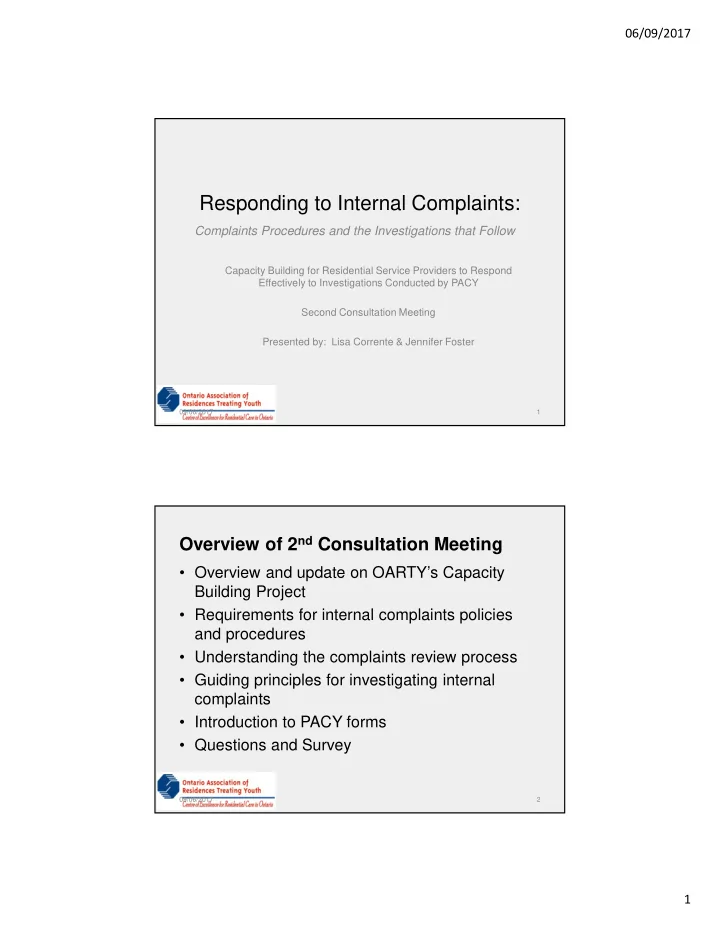
06/09/2017 Responding to Internal Complaints: Complaints Procedures and the Investigations that Follow Capacity Building for Residential Service Providers to Respond Effectively to Investigations Conducted by PACY Second Consultation Meeting


slide-1
SLIDE 1

06/09/2017 1

Responding to Internal Complaints:

Complaints Procedures and the Investigations that Follow

Capacity Building for Residential Service Providers to Respond Effectively to Investigations Conducted by PACY Second Consultation Meeting Presented by: Lisa Corrente & Jennifer Foster

1 09/06/2017

Overview of 2nd Consultation Meeting

  • Overview and update on OARTY’s Capacity

Building Project

  • Requirements for internal complaints policies

and procedures

  • Understanding the complaints review process
  • Guiding principles for investigating internal

complaints

  • Introduction to PACY forms
  • Questions and Survey

2 09/06/2017

slide-2
SLIDE 2

06/09/2017 2

I. Overview and Update on OARTY’s Capacity Building Project

3 09/06/2017

Overview and Update on OARTY’s Capacity Building Project

  • Province-wide project
  • Available to all residential placements that accept child welfare clients

regardless of purpose of placement

  • Province-wide systemic approach to responding to PACY investigations and

recommendations

  • Support effective communication between PACY and residential service

providers

  • Support the efficient use of residential service providers’ resources (human

and financial)

  • Improve outcomes for children, youth and families

4 09/06/2017

slide-3
SLIDE 3

06/09/2017 3

Project Update

  • Attended initial meeting with PACY
  • Held 1st consultation meeting
  • Disseminated survey and contact with service providers
  • Created a comprehensive Compliance Manual Index
  • Received documentation/forms from PACY which form part of its

investigative process

  • Held 2nd consultation meeting
  • Next steps:
  • Drafting of Compliance Manual and development of templates
  • Ongoing Survey dissemination and consultation with service

providers

  • Final consultation meeting
  • Training
  • Finalize Compliance Manual

5 09/06/2017

Timelines

  • Start date – March 2017
  • 1st and 2nd Consultation Sessions – March and June

2017

  • Draft Compliance Manual – July 2017
  • Final Consultation Session – July 2017
  • Training sessions begin (2) – August – December 2017
  • Final Manual (English and French) – December 31, 2017

6 09/06/2017

slide-4
SLIDE 4

06/09/2017 4

Purpose of the Compliance Manual

  • To develop and build the capacity of residential

service providers to follow a consistent, sector- wide approach to responding to investigations conducted by PACY

  • The Manual will support effective communication

between PACY and service providers, as well as efficient use of service providers resources (human and financial)

  • It will enable service providers to learn from issues

raised in the course of investigations, promote sector-wide service delivery improvements and, ultimately, improve outcomes for children, youth and their families

7 09/06/2017

Purpose of the Compliance Manual

  • The intention of the Manual is also to:

– recommend a comprehensive and systemic method of communicating an organization’s internal complaint policy and procedures – provide guidance on how to thoroughly investigate internally and document complaints and resolutions in order to avoid a PACY investigation or be prepared to meet the requests of PACY during an external investigation

  • The Auditor General Report from 2006-2016 has identified the

need for a more comprehensive and systematic method of tracking client complaints as a method of identifying and addressing client trends of issues while in care. MCYS has been directed to comply with collecting data through the monitoring of complaint logs kept by mental health agencies.

8 09/06/2017

slide-5
SLIDE 5

06/09/2017 5

Compliance Manual Content

  • Legislation governing residential service providers
  • Residential care regulations and requirements
  • Role of Office of the Provincial Advocate for

Children and Youth (“PACY”)

  • Overview of PACY Investigations
  • Obligations of residential service providers during

an investigation

9 09/06/2017

Forms and Templates

  • Complaint forms (internal and external)
  • Complaints policy and procedures
  • Investigation policy and procedure
  • Forms for completing internal investigations

– Investigation plan – Introductory letters to parties – Checklist for witness interviews – Witness statements – Template investigative report

  • PACY forms

10 09/06/2017

slide-6
SLIDE 6

06/09/2017 6

SPECIAL CONSIDERATIONS FOR DIVERSE AND COMPLEX NEEDS GROUPS

– Special Considerations for Children with Cognitive, Emotional and Physical Disabilities – Special Considerations for Children Identifying as LGTB2SQ – Special Considerations for Cultural, Racial and Religious Diversity – Special Consideration for Language Needs – Special Consideration for Children identifying as First Nations, Inuit, Innu, and Métis – Special Considerations for Children who are considered Deaf/hearing impaired – Special Considerations for Children from out of province

11 09/06/2017

II. Requirements for Internal Complaints Policies and Procedures

12 09/06/2017

slide-7
SLIDE 7

06/09/2017 7

Types of Complaints

  • 1. Non-compliance with legislation
  • 2. Complaints concerning organizational policy
  • 3. Complaints concerning organizational practice

Subcategories Rights Physical Environment Self-esteem Development

‘Any expression of dissatisfaction about the quality, lack of, or refusal, of a service that the person complaining is entitled to use’ (National Standards for Foster Care )

13 09/06/2017

Requirement for Written Complaints Procedure

  • Child & Family Services Act, s. 109(1)
  • A service provider who provides residential

services to children or places children in residential placements shall establish a written procedure for hearing and dealing with complaints regarding alleged violations of the rights of children in care

14 09/06/2017

slide-8
SLIDE 8

06/09/2017 8

Requirement for Written Complaints Procedure

  • O.Reg. 70, s. 73
  • Every licensee shall maintain an up to date

written statement of policies and procedures with respect to each residence operated by the licensee that sets out:

– procedures governing the expression of concerns or complaints by residents

15 09/06/2017

Contents of Written Complaints Procedure

  • O. Reg. 70, s. 41
  • The written complaints procedure must set out:

– the methods by which a child in care may express concerns with respect to alleged violations of rights

  • in the presence of other children or young persons and to a program

staff person

  • in private to a program staff person, and
  • in private to the service provider or a person designated by the

service provider – the method by which a parent or other person representing a child may express concerns with respect to alleged violations of the child’s rights

  • in private to a program staff person, and
  • in private to the service provider

16 09/06/2017

slide-9
SLIDE 9

06/09/2017 9

Requirement to Conduct Review of Complaints

  • Child & Family Services Act, s. 109(2)
  • A service provider shall conduct a review and

seek to resolve a complaint of:

– a child in care; – the child’s parent; or – another person representing the child

17 09/06/2017

Right to be Informed

  • Child & Family Services Act, s. 108
  • A child in care has a right to be informed, in a

language suitable for the child’s level of understanding, of,

– the internal complaints procedure and the further review available

18 09/06/2017

slide-10
SLIDE 10

06/09/2017 10

Right to be Informed

  • O. Reg. 70, s. 83
  • Every licensee must ensure that, upon

admission, the child or young person is informed

  • f the procedures that exist for a resident to

express concerns or complaints

19 09/06/2017

Ministry Licensing Manual

  • Indicators

– Written complaints procedure – Residence log must note complaints and that licensee has sought to resolve them – Review of sample resident files to see if use of complaints procedure has been documented – Resident’s knowledge of complaints procedure must be reinforced at the first plan of care, and at least every 6 months thereafter – A sample of staff and residents is aware of the complaints procedure – Poster or notice explaining complaint procedure

20 09/06/2017

slide-11
SLIDE 11

06/09/2017 11

CARF Standards – Rights of Persons Served

  • An organization implements a policy and written

procedures by which persons served may formally complain to the organization

– Definition of formal complaint – Complaint will not result in retaliation or barriers to service – How efforts will be made to resolve the complaint – Levels of review, which include availability of external review – Timeframes for prompt consideration and timely decisions – Procedures for written notification regarding actions to be taken to address complaint – Rights and responsibilities of each party – Availability of advocates or other assistance

21 09/06/2017

CARF Standards – Rights of Persons Served

  • Organization makes the complaint procedure and any

applicable forms:

  • Readily available to the persons served
  • Understandable to the persons served
  • Organization documents formal complaints received
  • Organization completes a written analysis of all formal

complaints

  • Conducted at least annually
  • Determines trends and areas needing performance

improvements

  • Actions to be taken to address the improvements needed
  • Actions taken or changes made to improve performance

(CARF Manual, 2017)

22 09/06/2017

slide-12
SLIDE 12

06/09/2017 12

III. Understanding the Complaints Review Process

23 09/06/2017

Ministry Review of Complaints

  • Child & Family Services Act, s. 110
  • If a complainant is not satisfied with the result of

the review conducted by the service provider, the complainant may request, in writing, that the Minister appoint a person to conduct a further review of the complaint

– the Minister shall appoint a person who is not employed by the service provider

24 09/06/2017

slide-13
SLIDE 13

06/09/2017 13

Ministry Review of Complaints

  • Child & Family Services Act, s. 110
  • Person appointed must review the complaint and may do

so by holding a hearing

  • Within 30 days after the appointment, the person must:

– complete the review – set out findings and recommendations in a report – include the reasons for not holding a hearing – provide copies of the report to:

  • complainant
  • service provider
  • Minister

25 09/06/2017

Ministry Review of Complaints

  • Child & Family Services Act, s. 111
  • Where the Minister decides to take any action

with respect to a complaint after receiving a report, the Minister shall advise the complainant and service provider of the decision

26 09/06/2017

slide-14
SLIDE 14

06/09/2017 14

PACY Investigations

  • PACY has the authority to investigate any matter that

comes to its attention from any source that concerns a child (or group of children) and the services they receive from a residential licensee where a CAS is the placing agency

27 09/06/2017

PACY Investigations

  • 1st Step – PACY requires complainants to use the

internal complaints process

  • 2nd Step – If the complainant is not satisfied with how the

service provider handled the complaint, they may complain to the Ministry

  • 3rd Step – If the problem is still not resolved, the

complainant may request an investigation by PACY

  • PACY will not conduct an investigation until after other

investigations are completed (e.g. internal investigation, police, Ministry of Labour, coroner)

28 09/06/2017

slide-15
SLIDE 15

06/09/2017 15

Advocacy v. Investigations

  • PACY has separate investigative and advocacy functions
  • “Advocacy” means promoting the views and preferences of children and

youth, including (but not limited to):

  • Promoting the rights of children in care
  • Informal dispute resolution between children/youths and agencies/service providers
  • Receive and respond to complaints
  • Conduct reviews and make reports (in response to a complaint or on own initiative)
  • Provide advice and make recommendations
  • Provide advocacy to children and youth during an investigation.
  • “Advocacy” does not include conducting investigations or providing legal

advice or legal representation

29 09/06/2017

Other External Processes

  • Complaints to:

– Office of the Children’s Lawyer – Ombudsman – Children’s Aid Society Internal Review Board – Child and Family Services Review Board – College of Social Workers and Social Service Workers – Members Code of Ethics – Ontario Association of Child and Youth Care – Members Code of Ethics – Ontario Association of Residences Treating Youth - Members

30 09/06/2017

slide-16
SLIDE 16

06/09/2017 16

IV. Guiding Principles for Investigating Internal Complaints

31 09/06/2017

A good complaint process will be:

Fair – The complainant and the person being complained about should have the opportunity to present their version of events, provide supporting information and respond to any potential negative decisions. The person investigating and/or making decisions should be impartial Confidential – The information about a complaint is only provided to those people who need to know about it, in order for the complaint to be actioned properly Transparent – The complaint process and the possible outcomes of the complaint should be clearly explained and those involved should be kept informed of the progress of the complaint and the reasons for any decisions Accessible – The complaint process should be easy to access and understand, and everyone should be able to participate equally Efficient – The complaint process should be conducted without undue delay. Information relevant to the complaint may deteriorate or be lost, which will impact on the fairness of the

  • process. In addition, unresolved complaints can have a negative and ongoing impact on a

workplace Safe - Protect complainant from being victimized because they have made a complaint, protect from vexatious and malicious counter – complaints and ensure appropriate confidential records are kept about complaints and that this information is stored and managed appropriately

32 09/06/2017

slide-17
SLIDE 17

06/09/2017 17

Guiding Principles for Conducting Investigations

#1 – Decision to Conduct an Investigation – An investigation should occur when it is required by law, policy or standards

  • Infringement of communication rights (e.g. PACY)
  • Infringement of rights to care
  • Detaining or restraining a child
  • Abuse or neglect
  • Injury
  • Death
  • Anything giving rise to a serious occurrence report

33 09/06/2017

Guiding Principles for Conducting Investigations

#2 – Select an Investigator – Impartial and objective

  • Not involved in the incident
  • Not in chain of command
  • Role not to protect the service provider

– Possess the necessary skills and experience – Have the time to complete a timely investigation – Other considerations (e.g. severity of incident, media/public scrutiny, maintaining privilege)

34 09/06/2017

slide-18
SLIDE 18

06/09/2017 18

Guiding Principles for Conducting Investigations

#3 – Scope of Investigation – Service Provider and investigator should have a mutual understanding of the scope of the investigation

  • What are the allegations to be investigated?

– Not too narrow

35 09/06/2017

Guiding Principles for Conducting Investigations

#4 – Plan the Investigation – Investigator plans for a timely and effective investigation

  • Review legislation and relevant policies
  • Review of documents (e.g. written complaint, resident

files, logs, emails, personnel records, etc.)

  • Location – neutral, private, comfortable
  • Who to interview (start with complainant and then…)
  • Draft questions or subject areas
  • Initial communication with parties and witnesses
  • Experts needed?

36 09/06/2017

slide-19
SLIDE 19

06/09/2017 19

Guiding Principles for Conducting Investigations

#5 – Witness Interviews – Standard admonitions – purpose, role, expectations, reprisals policy – Open-ended questions – who, what, where, when, how, why

  • Let witness tell the story!

– Personal knowledge and hearsay

  • Weigh hearsay appropriately

– Wrap up questions

  • Anything else I should be aware of?
  • Anyone else that I should speak to?

37 09/06/2017

Guiding Principles for Conducting Investigations

#6 – Gather and Preserve Evidence – Gather all relevant evidence

  • Hard copy documents (e.g. witness statements)
  • Physical evidence (e.g. photos, site visit)
  • Electronically stored information

– Email/SMS/IM – Social media – Video surveillance – Log-in data

38 09/06/2017

slide-20
SLIDE 20

06/09/2017 20

Guiding Principles for Conducting Investigations

#7 – Investigation Findings – Assess and weigh the evidence

  • Reliability (e.g. personal knowledge or hearsay)
  • Credibility

– Past history – Consistency of evidence – Motivation to lie – Plausibility – Corroboration

– Balance of probabilities (i.e. what is more likely than not to have occurred)

39 09/06/2017

Guiding Principles for Conducting Investigations

#8 – Reports – Introduction and scope – Investigative background

  • Initial contact (e.g. date, summary of allegations,

advisories)

  • Interim actions
  • Witnesses and dates of interviews
  • Documents
  • Laws and policies
  • Evidentiary standard
  • Timeline

40 09/06/2017

slide-21
SLIDE 21

06/09/2017 21

Guiding Principles for Conducting Investigations

#8 – Reports

  • Factual background

– Service Provider – Parties – Prior claims

  • Allegations

– Complaint – Response – Witness statements

  • Analysis and Findings
  • Recommendations

41 09/06/2017

Guiding Principles for Conducting Investigations

#8 – Reports

  • Acknowledge both points of view
  • Analysis supports reasoned conclusion
  • Do not use “loaded” language
  • Evidence needs to tip in favour of one party
  • Do the hard work

42 09/06/2017

slide-22
SLIDE 22

06/09/2017 22

Guiding Principles for Conducting Investigations

#9 – Communicate Outcome

  • Provide report to service provider, head office
  • Communicate results of investigation and any

corrective action in writing to complainant and the accused in a timely manner after the completion of the investigation

43 09/06/2017

Guiding Principles for Conducting Investigations

#10 – Implement Corrective Action

  • Steps service provider has taken or will take to

prevent a similar incident

– Implementation of new policies – Training on new or existing policies – Sensitivity training or other courses – Discipline – Risk assessment and safety measures

44 09/06/2017

slide-23
SLIDE 23

06/09/2017 23

  • V. Introduction to PACY Forms

45 09/06/2017 46 09/06/2017

slide-24
SLIDE 24

06/09/2017 24

47 09/06/2017 48 09/06/2017

slide-25
SLIDE 25

06/09/2017 25

49 09/06/2017 50 09/06/2017

slide-26
SLIDE 26

06/09/2017 26

51 09/06/2017 52 09/06/2017

slide-27
SLIDE 27

06/09/2017 27

53 09/06/2017 54 09/06/2017

slide-28
SLIDE 28

06/09/2017 28

55 09/06/2017 56 09/06/2017

slide-29
SLIDE 29

06/09/2017 29

57 09/06/2017 58 09/06/2017

slide-30
SLIDE 30

06/09/2017 30

59 09/06/2017 60 09/06/2017

slide-31
SLIDE 31

06/09/2017 31

61 09/06/2017 62 09/06/2017

slide-32
SLIDE 32

06/09/2017 32

63 09/06/2017 64 09/06/2017

slide-33
SLIDE 33

06/09/2017 33

65 09/06/2017 66 09/06/2017

slide-34
SLIDE 34

06/09/2017 34

  • VI. Questions & Survey
  • PLEASE COMPLETE!

67 09/06/2017

Lisa Corrente

Partner, Employment & Labour Group/Health Law Group, Torkin Manes LLP Phone: 416 643 8800 Email: lcorrente@torkinmanes.com

68 09/06/2017