Responding to a Reasonable Modification Request 1 9/8/2016 What - - PDF document

responding to a reasonable modification request
SMART_READER_LITE
LIVE PREVIEW

Responding to a Reasonable Modification Request 1 9/8/2016 What - - PDF document

9/8/2016 DAY IN THE LIFE OF AN ADA COORDINATOR Nancy Greene, ADA Compliance Manager Montgomery County, MD Irene Bowen, J.D. President, ADA One, LLC What we plan to cover with your participation! Discuss some of those gray areas in


slide-1
SLIDE 1

9/8/2016 1

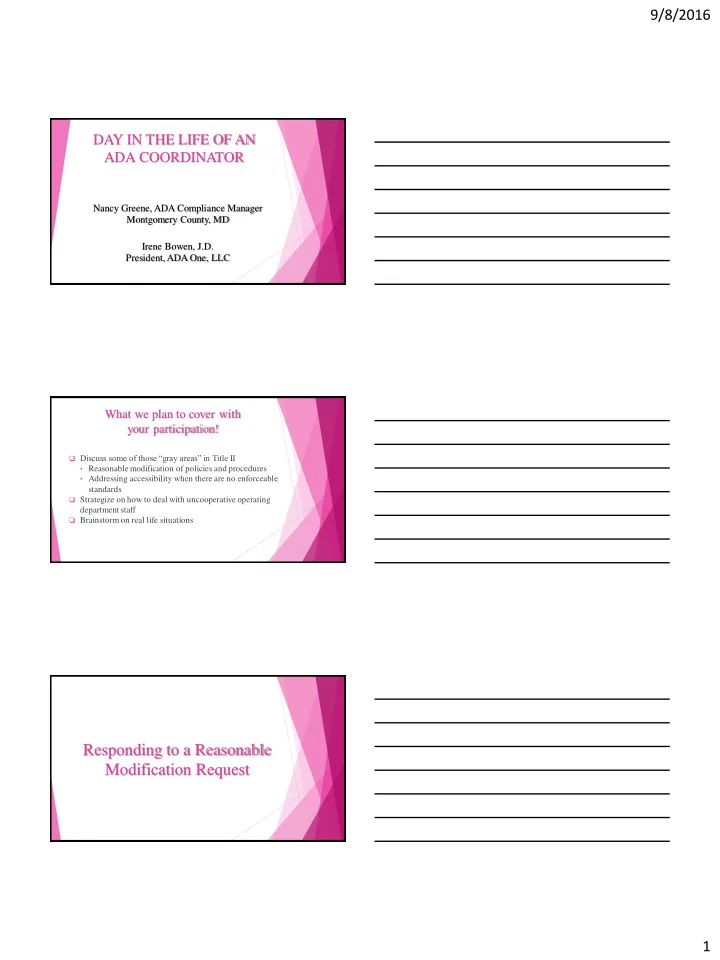
DAY IN THE LIFE OF AN ADA COORDINATOR

Nancy Greene, ADA Compliance Manager Montgomery County, MD Irene Bowen, J.D. President, ADA One, LLC

What we plan to cover with your participation!

 Discuss some of those “gray areas” in Title II

  • Reasonable modification of policies and procedures
  • Addressing accessibility when there are no enforceable

standards

 Strategize on how to deal with uncooperative operating

department staff

 Brainstorm on real life situations

Responding to a Reasonable Modification Request

slide-2
SLIDE 2

9/8/2016 2

What is a “reasonable modification” of policies, procedures and practices?

 Term “reasonable modification” is not defined in the

regulations.

 Modification: a change in something.  Policies, procedures and practices: formal or informal,

that guide how a program or service operates.

 Reasonable –is necessary, reasonable, and does not

create a fundamental alteration of the program.

Determining “reasonable”:

 If the modification is easy to do, you may want to just do it

as good customer service

 If it is not, evaluate the request and make a determination  Remember - decisions are made on a case basis based on

the specific request

 Don’t be afraid to make a decision but do your research

first

 Use an interactive process similar to Title I

Understand the request: Talk with the requestor

 Is the person a qualified individual with a disability, i.e. able to

meet the eligibility requirements with or without a reasonable modification or an auxiliary aid or service?

 Make sure you know what is being requested and why. What is

the barrier for this individual?

 How will that change make the program or service more

accessible to the individual?

 Are there other modifications that might also work?

slide-3
SLIDE 3

9/8/2016 3

Understand the program, service or activity: Talk with the department

 Who does it serve? What is the purpose?  Are there eligibility requirements for participation? Are

those necessary?

 How is the program or service described to the public -

flyers, on the web, press releases, registration materials, etc.?

 If the department feels they can’t make the requested

change, understand why. What can they do?

Do your research and make a decision:

 Research the DOJ website, particularly the settlement

agreements, to see if there are similar cases.

 Contact the Mid-Atlantic Center, use the Title II Network.  Try to provide the requested modification or to provide an

alternative that will provide greater access.

 Be ready to explain your analysis to the department or to

the requestor.

Working with Staff in Operating Departments

slide-4
SLIDE 4

9/8/2016 4

Implementing the ADA:

 Department/program staff are key in implementing

reasonable modifications and in responding to complaints.

 Know how your jurisdiction operates.  Know your level of authority and how to work within that

  • level. Make your position visible.

 Have backup support when you need it - your manager,

your department head, your County attorney.

 Develop a network within your jurisdiction.

Strategies for Dealing with Resistant Staff:

 Remember you are not DOJ, your role is to assist your

entity in complying with Title II

 You are the expert in the ADA, other staff are experts in

their work. Share your expertise but acknowledge competing demands

 Don’t point fingers - use “we” instead of “you”  Provide targeted technical assistance when available  Use your back up resources-department head, attorney-

when needed

Providing Technical Assistance:

 Good idea to review the applicable regulations and

standards adopted by DOJ even if you are sure you know the answer.

 Use available technical assistance resources when you have

questions.

 Remember 28 C.F.R. § 35.177-”A public entity cannot be

excused from compliance with requirements of this part because of any failure to receive technical assistance …. “

 Even if there are no standards or technical assistance

available from DOJ, you still must comply.
slide-5
SLIDE 5

9/8/2016 5

Providing Technical Assistance:

 Do your research - start by using your Title II

regulations and the 2010 Standards.

 Use your resources - Mid-Atlantic Center, Access

Board, federal enforcing agencies: FHWA, FTA, industry groups, disability organizations.

 If no standards exist, understand how the new feature

will be used and incorporate any applicable standards that would be involved - reach range, clear floor space, etc.

 No scoping? 5% or one is the rule of thumb.

Challenges:

 Technical staff: engineers, computer programmers,

architects want to have clear, black and white standards.

 Draft Public Rights of Way Accessibility Guidelines

and similar guidelines should be used as “best practice.”

 Can’t ignore the issue (Remember 28 C.F.R. § 35.177)

Come up with a plan!

Group Exercises: What would you do?

slide-6
SLIDE 6

9/8/2016 6

Responding to a request for reasonable modification:

A library is closed for renovation so patrons must use a very busy nearby library. Mr. Smith, who has multiple disabilities impacting his vision and manual dexterity, uses the designated accessible computer but requests that he be permitted unlimited use rather than following the library’s one hour limit policy. The library manager tells you that patrons are already fighting over the

  • computers. She says she can’t make this change. It will set a

precedent and she will be inundated with similar requests.

Reasonable Modification: Volunteer Program

Your jurisdiction has a popular volunteer program for those interested in the historic preservation program. Volunteers commit two days per week, 5 hours per day. They assist in the

  • ffice and answer visitor questions on site at historic properties.

Mary, who is deaf, applies to be a volunteer and requests an ASL interpreter for the week-long orientation session as well as for all of the hours of her assignments both in the office and on site with the public. The manager is concerned about the cost since this means two interpreters. Mary is definite that on-site interpreting is the only means of effective communication for

  • her. How would you handle this?

Dealing with Resistant Departmental Staff:

Your County operates liquor stores. A resident tells you that on her last visit, she could not open the heavy front door, a turnstile blocked her access and the aisles were too narrow for her scooter. You plan to set up a meeting with the Manager responsible for the stores to resolve this but before the meeting you find out he is mad about the complaint, thinks the stores are perfectly fine and that you are making an issue out of nothing. He has a reputation for being difficult to work with. What do you do?

slide-7
SLIDE 7

9/8/2016 7

Providing technical assistance for new services:

Your County decides to provide free electronic vehicle charging stations for residents at several recreation

  • centers. The manager in charge of the program asks if

there are any requirements in the ADA for these

  • features. How do you respond?

Summing it up:

 Be proactive in keeping up with all of the rulemaking,

technical assistance and guidance on all aspects of Title II

 Participate in the Title II network - webinars, meetings,

list serve

 Develop networks within your jurisdiction  Be responsive, collaborative and credible

Nancy Greene Title II Compliance Manager Montgomery County Government 101 Monroe Street, 9th Floor Rockville, MD 20850 nancy.greene@montgomerycountymd.gov Voice: 240-777-6023 TTY: 240-777-6197 Fax: 240-777-6195

CONTACT:

slide-8
SLIDE 8

9/8/2016 8

Irene Bowen, J.D. President ADA One, LLC 9 Montvale Court Silver Spring, MD 20904 IreneBowen@ADA-One.com Voice: 301-879-4542

CONTACT: