The Probabilistic Method Week 7: Alterations Joshua Brody - - PowerPoint PPT Presentation

the probabilistic method
SMART_READER_LITE
LIVE PREVIEW

The Probabilistic Method Week 7: Alterations Joshua Brody - - PowerPoint PPT Presentation

The Probabilistic Method Week 7: Alterations Joshua Brody CS49/Math59 Fall 2015 Reading Quiz What is the alteration technique? (A) Generate GOOD object by choosing random object, then removing any badness by hand (B) Generate GOOD


slide-1
SLIDE 1

The Probabilistic Method

Joshua Brody CS49/Math59 Fall 2015
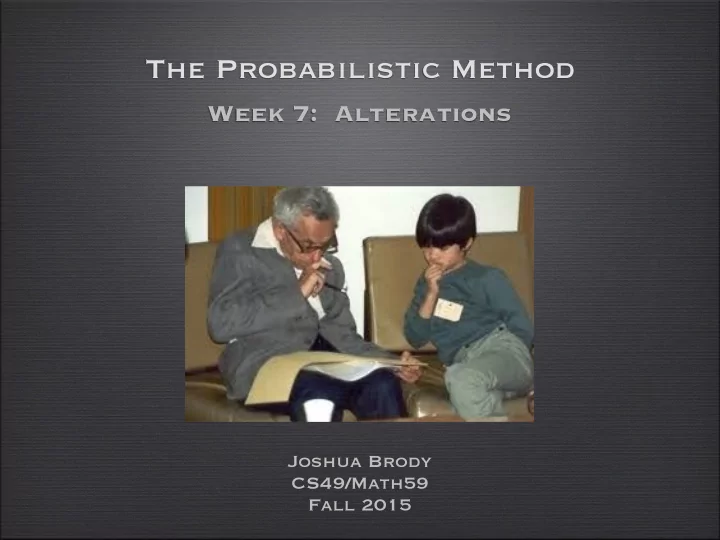
Week 7: Alterations

slide-2
SLIDE 2

Reading Quiz

(A) Generate GOOD object by choosing random object, then removing any badness “by hand” (B) Generate GOOD object by choosing random object, then showing BAD probability < 1 (C) Generate GOOD object by choosing random object, then using Chernoff Bound (D) Choose edges of graph by alternating between red edges and blue edges (E) None of the above

What is the alteration technique?

slide-3
SLIDE 3

Reading Quiz

(A) Generate GOOD object by choosing random object, then removing any badness “by hand” (B) Generate GOOD object by choosing random object, then showing BAD probability < 1 (C) Generate GOOD object by choosing random object, then using Chernoff Bound (D) Choose edges of graph by alternating between red edges and blue edges (E) None of the above

What is the alteration technique?

slide-4
SLIDE 4

Ramsey Theory

R(k,k) := smallest n such that for every two-coloring

  • f Kn, there is red Kk subgraph or a blue Kk subgraph.

Basic Method: If then R(k,k) > n.

( )

n k

1-( )

k 2

2 < 1 Alterations: R(k,k) > n -

( )

n k

1-( )

k 2

2

slide-5
SLIDE 5

Ramsey Theory

R(k,k) := smallest n such that for every two-coloring

  • f Kn, there is red Kk subgraph or a blue Kk subgraph.

Basic Method: R(k,k) > (1+o(1)) k2k/e√2 Alterations: R(k,k) > (1+o(1)) k2k/e

slide-6
SLIDE 6

Clicker Question

(A) Yes (B) No (C) Maybe (D)None of the above

Will alterations always give improvement over basic probabilistic method approach?

slide-7
SLIDE 7

Independent Sets

  • Independent Set: set of

vertices which share no edges

  • α(G): size of largest

independent set

slide-8
SLIDE 8

Independent Sets

  • Independent Set: set of

vertices which share no edges

  • α(G): size of largest

independent set Theorem: If G = (V,E) is a graph with n vertices and nd/2 edges, then α(G) ≥ n/2d

slide-9
SLIDE 9

Theorem: If G = (V,E) is a graph with n vertices and nd/2 edges, then α(G) ≥ n/2d

slide-10
SLIDE 10

Theorem: If G = (V,E) is a graph with n vertices and nd/2 edges, then α(G) ≥ n/2d

slide-11
SLIDE 11

Theorem: If G = (V,E) is a graph with n vertices and nd/2 edges, then α(G) ≥ n/2d

slide-12
SLIDE 12

Theorem: If G = (V,E) is a graph with n vertices and nd/2 edges, then α(G) ≥ n/2d

slide-13
SLIDE 13

Clicker Question

(A) E[Y] = (nd/2)*p (B) E[Y] = nd*p (C) E[Y] = nd*p2 (D) E[Y] = 2nd*p2 (E) None of the above

What is E[Y]?

slide-14
SLIDE 14

Clicker Question

(A) E[Y] = (nd/2)*p (B) E[Y] = nd*p (C) E[Y] = nd*p2 (D) E[Y] = 2nd*p2 (E) None of the above

What is E[Y]?

slide-15
SLIDE 15

Minimizing Area

Let S be a set of n points on unit square [0,1]x[0,1] T(S) := minP

,Q,R ∈ S area(PQR)

T(n) := maxS T(S) Theorem: T(n) = Ω(1/n2)

slide-16
SLIDE 16

Clicker Question

(A) E[#small triangles] ≤ (n choose 3)*16*∏/100n2 (B) E[#small triangles] ≤ (n choose 3)/100n2 (C) E[#small triangles] ≤ (2n choose 3)*16*∏/100n2 (D) E[#small triangles] ≤ 2nd*p2 (E) None of the above

What is E[#triangles w/area ≤ 1/100n2]?

slide-17
SLIDE 17

Clicker Question

(A) E[#small triangles] ≤ (n choose 3)*16*∏/100n2 (B) E[#small triangles] ≤ (n choose 3)/100n2 (C) E[#small triangles] ≤ (2n choose 3)*16*∏/100n2 (D) E[#small triangles] ≤ 2nd*p2 (E) None of the above

What is E[#triangles w/area ≤ 1/100n2]?

slide-18
SLIDE 18

Minimizing Area

Let S be a set of n points on unit square [0,1]x[0,1] T(S) := minP

,Q,R ∈ S area(PQR)

T(n) := maxS T(S) Theorem: T(n) = Ω(1/n2)

slide-19
SLIDE 19

The Probabilistic Method