RESOURCES Get Ahead or Get Parched: Six Ways to Survive the - - PowerPoint PPT Presentation

resources
SMART_READER_LITE
LIVE PREVIEW

RESOURCES Get Ahead or Get Parched: Six Ways to Survive the - - PowerPoint PPT Presentation

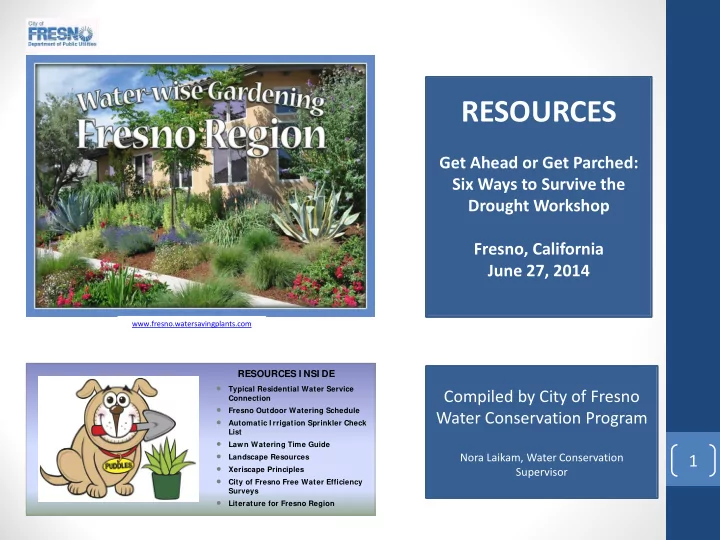
RESOURCES Get Ahead or Get Parched: Six Ways to Survive the Drought Workshop Fresno, California June 27, 2014 www.fresno.watersavingplants.com RESOURCES I NSI DE Typical Residential Water Service Compiled by City of Fresno Connection


slide-1
SLIDE 1

1

RESOURCES

Get Ahead or Get Parched: Six Ways to Survive the Drought Workshop Fresno, California June 27, 2014 Compiled by City of Fresno Water Conservation Program

Nora Laikam, Water Conservation Supervisor

RESOURCES I NSI DE

  • Typical Residential Water Service

Connection

  • Fresno Outdoor Watering Schedule
  • Automatic I rrigation Sprinkler Check

List

  • Lawn Watering Time Guide
  • Landscape Resources
  • Xeriscape Principles
  • City of Fresno Free Water Efficiency

Surveys

  • Literature for Fresno Region

www.fresno.watersavingplants.com

slide-2
SLIDE 2

2 Learn what is below ground before digging.

slide-3
SLIDE 3

Reporting Water Waste

If you see water being wasted, contact the City of Fresno Water Conservation Program.

  • Phone: Conservation Hotline at: (559) 621-5480
  • Email: waterconservation@

fresno.gov

  • Online: click on Report Leaks/ Water Waste at

www.fresno.gov/ water.

City of Fresno Outdoor Watering Schedule

3 Fresno Municipal Code Section 6- 520 Wastage of Water

slide-4
SLIDE 4

√ CHECK FOR LEAKS

Manually turn on each sprinkler station valve and check to make sure there are no broken sprinkler heads or pipes in each area. Make all repairs and clean the filters in pop-up sprayers. While the sprinklers are running, it's a good time to check your entire sprinkler

  • system. Look for clogged, realigned or broken

emitters or pipes. You may want to remove a sprinkler at the end of the system and flush out any

  • dirt. Flush out drip and micro system filters and
  • tubing. Check each station for leaks at least every

two weeks.

√ CORRECT OVER SPRAY

While checking each station for leaks adjust any sprinkler heads that are spraying onto driveways, sidewalks or the street by rotating the head, adjusting the amount of flow from the heads, and/or using the correct spray pattern.

√ DETERMINE ‘RUN OFF’ POINT

S tart your system through its automatic cycle. As each station comes on make a note of the time it

  • starts. Watch each station and note how many

minutes it takes to start running over the curb, onto the sidewalk or driveway, or to start forming puddles. This is the “run off point.”

√ HOW TO AVOID ‘RUN OFF’

Using the shortest length of time noted above reset each station on your time so the individual stations will shut off at this “run off point”. If you have clay or compacted soil that is slow to absorb water, set your time to run a second cycle (again to the “point of runoff”) that begins AFTER the first cycle has soaked in.

√ AVOID POW ER OUTAGE PROBLEMS

Replace battery in controller with recommended type. A good battery maintains the controller’s memory during power outages.

√ W ATER SCHEDULE

S et your system to follow the City of Fresno Water S

  • chedule. Water only on your watering day and

watering time.

AUTOMATIC IRRIGATION S P RINKLE R S YS TE M √ CHE CK LIS T

E fficient water us e is es pecially important during the hot s ummery months when more than 60 percent of home water us e is for watering lawns and gardens .

Contact the City of Fresno Water Conservation P rogram for more information. Call (559)621-5480 E mail: waterconservation@fresno.gov Online: www.fresno.gov/water

4

slide-5
SLIDE 5

*Based on Full Circle Rotors. Less time needed for ½ and ¼ Circle Rotors Call (559) 621-5480, for a Free City of Fresno Lawn Watering Timer Guide refrigerator magnet.

HOW TO USE THE LAWN WATERING TIME GUIDE

The Lawn Watering Time Guide above, shows the approximate lawn watering time needed in minutes per week for both warm and cool season grasses using both spray and rotor heads if there is no rainfall. Warm season grasses grown in our region include Common Bermuda, Hybrid Bermuda, and Buffalo Grass; they thrive in hot weather and turn brown due to dormancy in cold weather. Cool season grasses grown in our region include both Fine and Tall Fescues and Perennial Ryegrass (used to over seed winter-dormant grasses); these grasses thrive in the spring and fall and maintain their color year round. Cool season grasses require more water than the warm season grasses.

Rotor Minutes

per week*

Spray Minutes

per week

% of July Month Rotor Minutes

per week*

Spray Minutes

per week

% of July 20 5 12 January 20 5 8 36 9 21 February 50 13 20 88 22 51 March 100 25 40 120 30 70 April 196 48 76 136 34 79 May 166 41 65 136 34 79 June 232 58 92 172 43 100 July 252 63 100 140 35 81 August 182 46 73 88 22 51 September 116 29 46 52 13 30 October 62 16 26 24 6 14 November 36 9 15 12 3 7 December 14 4 6

Lawn Watering Time Guide

(Approximate Minutes per week) Warm Season Grass Cool Season Grass

Lawn Watering Guide - Irrigating Your Garden

Continued

5

slide-6
SLIDE 6

To use this chart remember that the minutes of watering time needed is for an entire week, so you must consider the frequency that you are going to water during the week. Let us use July with a cool season grass and spray heads as our example. We chose to water three days a week, and cycle three times on our watering days to avoid run-off; then 63 minutes per week divided into 3 days equals 21 minutes per day. Three cycles per day makes the 21 minutes per day into 7 minute cycles. Ideally, timers should be reprogrammed monthly. If your irrigation timer has a water budget (%) feature, the timer may be programmed in the spring for the anticipated July usage (100%) and then on a monthly basis rather than reprogramming all of the run times just the water budget (%) feature needs to be adjusted to reflect the monthly % of July. Using the example above with the lawn needing 63 minutes a week in July, then setting the Water Budget (%) for March at 40%, gives 40 % of 63 minutes, or roughly the 25 minutes of irrigation needed, divided equally between the days of the week and all cycles. Recognize that the above chart is based on historical averages and may not meet the current needs of your lawn because of unusual weather.

Irrigating Your Garden

There are many factors involved in developing an irrigation schedule for your garden. These factors include soil particle size (sand, clay), chemical properties of the soil, slope, sun/shade, plant rooting depth, plant water needs, soil amendments, mulch, type of irrigation system, rate of application, so on and so forth. However, the person who is establishing the irrigation schedule does not have to be formally educated in the field of irrigation in order to develop a good schedule. Observing what is happening in each garden area is the key to good watering practices. Get to know your soil-determine how quickly the water being applied by your existing irrigation system is absorbed, the ‘run-off’ point of time, the depth of absorption, and how quickly the soil dries out in the root area. You will need to do some observing and digging in your soil to determine this information. On a well designed and maintained irrigation system any one valve (station) should have the following:

  • 1. plants with similar water needs
  • 2. plants with similar rooting depth
  • 3. same sun/shade exposure
  • 4. slope
  • 5. matched precipitation (nozzles or other type of emitting devises that apply water at an even rate)
  • 6. emitting devises that operate at the actual operating pressure
  • 7. emitting devises that cover the proper area.
  • 8. emitting devises not blocked by plants or other objects.

Your system probably does not meet the above criteria. Alter it where possible-change sprinkler nozzles to help slow the water application rate, prune or transplant plants blocking sprinkler distribution, etc. Then develop your irrigation schedule based on the knowledge you have acquired from your observations. Our typical garden plants require the most water during the summer and little in the

  • winter. Starting in spring, here in the Central Valley plant water needs increase each

month through July. After July, plants need less water each month, and by November,

  • ften little or no irrigation is required until March or April depending on the season’s
  • rainfall. Ideally, your irrigation timer should be reprogrammed on a monthly basis to

give your plants the correct water for optimum growth and to save water.

Lawn Watering Guide – Irrigating Your Garden continued

6

slide-7
SLIDE 7

Compiled by the City of Fresno Water Conservation P rogram

Are you using more water than is needed in your yard? On average over 60%

  • f home water is used outdoors for watering lawns

and gardens. This is where we can save the most water. Water that flows

  • nto the sidewalks and into the gutters is water being wasted. Does it really

make any sense to water concrete? Rethink Traditional Landscape & Irrigation Most water is wasted in your landscape by watering when your plants do not need water or by not maintaining the irrigation system. Many landscape problems are directly related to over-watering. By combining water conservation practices with creative landscape design, you can create an attractive haven that’s relatively hassle-free. Water use can be reduced by rethinking traditional grass lawns, planting water-wise plants, and using a properly designed and operated irrigation system. The City of Fresno Water Conservation P rogram can help you develop efficient outdoor water watering practices. FRE E landscape consultation for residential and commercial/industrial customers are available. The service includes irrigation and plant material tips, and the Landscape S pecialist will help you develop an irrigation schedule as well as help set your timer. Free water leak audits are also available. For an appointment, call 621-5480 or email waterconservation@fresno.gov. Let’s get started! Learn more about landscape and efficient watering from the resources that follow: All About Sprinklers and Drip Systems. Ortho Books, IS BN: 0-89721-515-X California Master Gardener Handbook, University of California Cooperative E xtension, text book developed for UC Master Gardener training classes, covers full range of fundamental horticultural knowledge. Drip Irrigation for Every Landscape and All

  • Climates. IS

BN: 0-9615848-2-3 Garden W atering Systems. S unset P ublishing Landscape Plants for W estern Regions: An Illustrated Guide to Plants for W ater Conservation - Author Bob P erry, Library of Congress # 92-073474, Land Design P ub, Claremont

  • CA. Drought tolerant plants for western US

regions with pictures of mature plants. Sunset W estern Garden Book S unset P ublishing supplies the western US climate zones with descriptions, provides plant selection- plant lists for different categories and gardening techniques, keyed extensive plant encyclopedia to climate zones, water needs, sun/shade conditions, and a glossary of terms. It is the most used reference book in the horticulture industry written in layman’s terms.

Things to Read!

Book References providing landscape information

Things to Read! P laces to Visit! Web S ites to View!

7

slide-8
SLIDE 8

City of Fresno Conservation Gardens 1919 E McKinley, Fresno www.fresno.gov/water Garden that Blooms Year Around. A water-wise demonstration garden for small business lots. Clovis Botanical Gardens 945 N Clovis Ave, Clovis http://clovisbotanicalgarden.org/ Three-acre botanical garden with climate appropriate

  • plants. Drip irrigation demonstration site.

Fresno State – California State University 5241 N Maple Ave, Fresno http://www.fresnostate.edu/adminserv/arboretum/

  • Allergy-Free Demonstration Garden –

E ncompasses an acre and over 50 non- allergenic trees and shrubs.

  • Arboretum An arboretum is a place where

plants, especially trees and shrubs are grown for exhibition and study. A tree guide is available.

  • Iris Garden – Memorial Garden with over

100 different varieties of bearded iris.

  • W ater W ise Garden – featuring water-

wise plants in the Horticulture Greenhouse P ark at the Nursery. Garden of the Sun 1750 N Winery, Fresno http://ucanr.edu/sites/mgfresno/Garden_of_the_S un_ Demonstration_Garden/ One-acre UCCE Master Gardener demonstration Garden with an extensive food production garden and a lovely perennial garden. Adult education classes and other events. California Urban W ater Conservation Council S aving water outside and inside the home http://h2ouse.org/ Center for Irrigation Technology, Fresno State Interactive irrigation scheduling program. www.wateright.org Central Valley Friendly Landscape Awards Program View many examples of sustainable landscape efforts in the Fresno/Clovis region http://ucanr.edu/sites/cvlandscape/2011_Awards/ City of Fresno W ater Division Lawn Watering Time Guide (click conservation, literature) www.fresno.gov/water Save Our W ater View many tips and examples of yards in California that are saving water. http://www.saveourh2o.org W ater-wise Gardening, Fresno Region http://www.fresno.watersavingplants.com/ University of California, Cooperative Extension, Master Gardeners, Local Water Agencies – Local Water Agencies 621-5300

P laces to Visit!

Local water efficient public gardens

Web S ites!

Useful Web S ites for landscape resource information

8

slide-9
SLIDE 9

California Department of W ater Resources Lands cape Water Us e Program www.water.ca.gov/wateruseefficiency/landscape

  • Water Efficient Lands

cape State Ordinance www.water.ca.gov/wateruseefficiency/docs/MWE LO0 9-10-09.pdf California Irrigation management Information System (CIMIS) Current daily E T values www.cimis.water.ca.gov California Landscape Contractors Association http://clca.org/ – P rotecting landscape/trees during drought http://www.clca.org/clca/about/consumer/drought/ E P A WaterS ense P rogram www.epa.gov/watersense Irrigation Association www.irrigation.org Irrigation Tutorials, J ess Stryker http://www.irrigationtutorials.com/ Tree Fresno http://www.treefresno.org/ University of California - W ater Use Classification of Landscape W UCOLS IV S pecies, trees, shrubs, perennials rated for water needs in various state regions http://ucanr.edu/sites/WUCOLS / UC Guide to Healthy Lawns www.ipm.ucdavis.edu/TOOLS /TURF/MAINTAIN/irrs ched.html Underground Service Alert North 811 (USA) Call 811 Before You Dig http://usanorth811.org/ Association of Metropolitan Water Agencies – Local Water Agencies 621-5300 Bakman Water Company http://bakmanwater.publishpath.com/ California Department of Transportation – S torm Water Management 488-4045 Center for Irrigation Technology, Fresno S tate http://www.fresnostate.edu/jcast/cit/index.html Central Valley Water Awareness Committee http://centralvalleywater.org/ City of Clovis P ublic Utilities http://www.ci.clovis.ca.us/Departments-and- S ervices/P ublic-Utilities City of Fresno Water Division www.fresno.gov/water Fresno County P ublic Works & P lanning, Water http://www.co.fresno.ca.us/DepartmentP age.aspx? id= 58137 Fresno County Farm Bureau http://www.fcfb.org/ Fresno Irrigation District http://www.fresnoirrigation.com/ Fresno Metropolitan Flood Control District http://fresnofloodcontrol.org/ Friant Water Authority http://friantwater.org/ International Center for Water Technology http://www.californiawater.org/ Kings River Conservation District http://www.krcd.org/ Kings River Water Association http://www.kingsriverwater.org/ Malaga County Water District http://www.malagacwd.org/ P inedale County Water District http://pcwdonline.com/ S an J

  • aquin Valley Air P
  • llution Control District

http://www.valleyair.org/Home.htm US Green Building Council, Central Valley Chapter http://usgbccc.org/ LOCAL AGENCIES & GROUPS ADDITIONAL RESOURCES

9

slide-10
SLIDE 10

Xeriscape

Consider the principles of xeriscaping when planning your landscape design. Although xeriscaping (xeros = dry) originally related to landscaping in extremely dry climates, its principles, which include using water-efficient and drought-tolerant plants, fit well with conservation goals. For example, using regionally adapted plants, such as the growing variety of natives, ensures that the plant can handle this area's seasonal temperatures and rainfall, along with other environmental and soil conditions. But non-natives can also be used to add color and texture to the garden, especially those which are suited for dry, sunny locations. Xeriscaping does not mean using only colorless plants; it does mean using the right plant in the right place. It is a water-wise landscape using colorful flowers, plants and trees as a water-saving alternative to grass.

Principles of X eriscape

  • Planning and design - Successful xeriscapes begin with a good design that consider the

function of the landscape and the mature size and water needs of the plant. Consider the view, slope, exposure and soils of the area. Take into account the existing vegetation and topography of the site and intended use. Decide where things will be. Decide when things will be

  • done. Most landscapes are best done in phases.
  • Soil improvements - Soils can vary within any site. Use organic matter to improve the soil when
  • planting. This will improve root development, water penetration and retention. It also feeds

nutrients to your plants. Improve the soil before planting and installing the irrigation system.

  • Appropriate turf areas - Locate grass only in areas where it provides functional benefits like

family recreational or children's play areas. Keep grass away from sidewalks, walls and fences for easier maintenance. Avoid planting grass in oddly shaped areas that can't be watered and maintained efficiently. The reduction or elimination of high-water-use turf areas, and locating them separately so that they may be watered more efficiently, can result in significant reductions in water use.

  • Low water-use plants - Most plants have a place in Xeriscape - even those that have high

water needs. Plant selection should be based on the intended use in the landscape. Use of more plants with low water needs and native plants will allow the maximum water conservation. Some provide shade and screening, others are perfect for borders and accents. Many low water flowering plants are seasonal.

  • Efficient irrigation - Irrigation systems should be well planned. Irrigate grass areas separately

from other plantings. Group plants with like water needs, and water each group on separate zones. Not all plants need the same amount of water. Irrigate according to the needs of the plants rather than watering on a fixed schedule. Even plants used in Xeriscape will require supplemental irrigation until they become established. Change the irrigation schedule with seasonal weather changes.

  • Surface mulches - Use mulches to cover and cool the soil, decrease evaporation, reduce weed

growth and slow erosion. Organic mulches such as bark chips or wood shavings will decompose slowly over time, but it will improve the soil by adding nutrients. Inorganic mulches like rock and gravel should be used sparingly. Surrounding a home with rock will increase the temperatures.

  • Appropriate maintenance - A landscape adapted to the environment will require less

maintenance, less fertilizer and reduce the use of pesticides and other chemicals than traditional landscapes, but some regular maintenance is required. Proper pruning, weeding, fertilization and pest control will preserve and enhance the quality of your xeriscape. Irrigation system maintenance and adjustments help save water.

10

slide-11
SLIDE 11

CITY OF FRESNO W ATER CONSERVATION W ATER EFFICIENCY SURVEYS

Looking for ways to save money by reducing your water use? Take advantage of these FRE E services offered to City of Fresno water customers. Call today for an appointment

convenient for you can be made for any or all of these FRE E Water E fficiency S urvey services. Hmong and S panish translation is also available.

  • Interior and E

xterior Leak S urveys

  • Water-wise landscape consultation
  • Irrigation efficiency audit
  • Help setting irrigation controllers
  • Meter use reports

The City of Fresno Water Conservation P rogram offers all customers F RE E Water E fficiency S urveys to help save water inside and outside. During the water survey appointment, Conservation specialists will check for water inefficiencies at the location. The specialist may provide a water-wise landscape consultation if requested. A report with the findings and recommendations is left with the customer. The specialist will also discuss with customers methods of using water more efficiently. Interior surveys are designed to help you save water. The survey includes:

  • Check for leaks at all points where water

enters the structure such as leaks at faucets, showerheads, toilets, clothes washers, and under sinks.

  • P

rovide low-flow showerheads and faucet aerators, if needed.

  • E

xplain rebates for high-efficiency clothes washers and WaterS ense toilets.

  • P

rovide conservation tips and literature.

Interior Exterior

The F RE E exterior surveys and landscape consultations are very popular with our customers. We show you methods of saving water in the yard and also offer water- wise landscape design ideas.

  • Inspect irrigation systems, and suggest

improvements and adjustments.

  • Discuss irrigation products.
  • Help with your irrigation scheduling and show

you how to set your irrigation timer.

  • Check for signs of faucet, irrigation and water

feature leaks (pools, spas, fountains, etc.)

  • Answer questions about your landscape, and

provide a water-wise landscape consultation including design ideas.

  • P

rovide a hose nozzle and other conservation materials.

  • P

rovide water conservation tips and literature.

Contact us: Call (559)621-5480 E mail: waterconservation@fresno.gov Online: www.fresno.gov/water

11

City of Fresno Water Conservation services include: Water-wise landscape consultations Irrigation efficiency audit, including setting controller Water leak surveys Rebates for clothes washers and WaterSense toilets Meter use reports Public outreach - speakers, tours, literature Enforcement of Fresno City Water regulations / schedule
slide-12
SLIDE 12

Approximate Lawn W atering Time MAGNE T Indicates how many minutes to water turf each month. Central Valley Friendly Landscape Program Awards Annual Fresno- Clovis Metropolitan area Landscape Awards Commercial Demonstration Garden W ater Conservation

  • Office. Brochure

showing small commercial type garden that blooms year around Creating a Fresno-Friendly Garden Plant Choices & W ater Conservation Tips for our Climate P lant list for local conditions Creating a W ater-wise Landscape, Seven Steps to Follow for Our Climate. Considering local conditions for landscape. Creating Green Grass Alternatives - How to Replace Thirsty Lawn with W ater-wise Groundcover & Ornamental Grasses. Turf removal and replacement Drip Irrigation - A Guide to Installation and Maintenance A Guide to Installation and Maintenance Illustrations and information Home W ater Use Survey Interior and Exterior. Landscape/leak survey about this free service for Fresno customers Outdoor W atering Schedule E xcerpt of watering schedule regulations W ater Conservation Landscape Ideas - Park Strips and Median Islands Ideas to make these small areas water- wise W ater-wise Gardening for Fresno Region Gardens in Fresno/Clovis area. Describes how to use this Online resource www.fresno.waters avingplants.com W hat you Should Know Before you Mow Tips for saving water while maintaining a lawn

City of Fresno Water Conservation Program - Developed for Fresno Region Contact us today to request one or more brochures. Phone: (559) 621-5480 Email: waterconservation.gov Online: www.fresno.gov/water

12 Literature developed for the Fresno Region