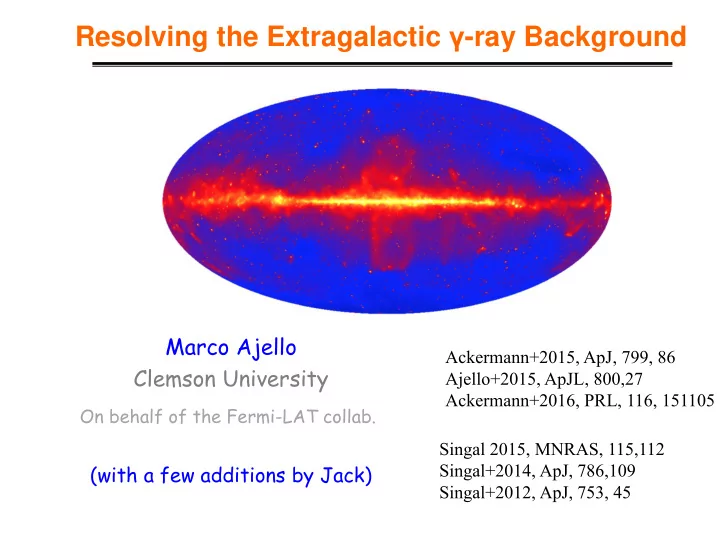
Resolving the Extragalactic -ray Background Marco Ajello - - PowerPoint PPT Presentation

resolving the extragalactic ray background
SMART_READER_LITE
LIVE PREVIEW

Resolving the Extragalactic -ray Background Marco Ajello - - PowerPoint PPT Presentation

Resolving the Extragalactic -ray Background Marco Ajello Ackermann+2015, ApJ, 799, 86 Clemson University Ajello+2015, ApJL, 800,27 Ackermann+2016, PRL, 116, 151105 On behalf of the Fermi-LAT collab. Singal 2015, MNRAS, 115,112 (with a few


slide-1
SLIDE 1

Marco Ajello Clemson University

Resolving the Extragalactic γ-ray Background

On behalf of the Fermi-LAT collab. Ackermann+2015, ApJ, 799, 86 Ajello+2015, ApJL, 800,27 Ackermann+2016, PRL, 116, 151105

(with a few additions by Jack)

Singal 2015, MNRAS, 115,112 Singal+2014, ApJ, 786,109 Singal+2012, ApJ, 753, 45

slide-2
SLIDE 2

Fermi: Bigger, Sharper, Faster

Large Area Telescope (LAT):

  • 100 MeV - > >500 GeV
  • 2.4 sr FoV (scans entire sky every ~3hrs)

Gamma-ray Burst Monitor (GBM)

  • 8 keV - 40 MeV
  • views entire unocculted sky
slide-3
SLIDE 3

The Gamma-ray Sky as Seen by Fermi

Nearly isotropic all-sky component ( includes residual cosmic-ray background ) ~10% ~80% ~10%

Galactic emission is 2 body process so very highly concentrated in plane Suppressed in halo

slide-4
SLIDE 4

4

20 deg wide patch 1 year, > 1 GeV

slide-5
SLIDE 5

5

20 deg wide patch 5 years, > 1 GeV

slide-6
SLIDE 6

Total Extragalactic Gamma-ray Background

Systematic uncertainty from Galactic foreground represented by yellow band Ackermann et al. 2015

slide-7
SLIDE 7

EGB: Why is it important ?

  • sa

Undetected sources Diffuse processes

üc

üc

üc Markevitch

Blazars

Dominant class of LAT extra- galactic sources. Many estima- tes in literature. EGB contribu- tion ranging from 20% - 100%.

Non-blazar active galaxies

27 sources resolved in 2FGL ~ 25% contribution of radio galaxies to EGB expected. (e.g.

Inoue 2011)

Star-forming galaxies

Several galaxies outside the local group resolved by LAT. Significant contribution to EGB

  • expected. (e.g. Pavlidou & Fields,

2002, Ackermann et al. 2012)

GRBs High-latitude pulsars

Small contributions expected.

(e.g. Dermer 2007, Siegal-Gaskins et al. 2010)

Intergalactic shocks

Widely varying predictions of EGB contribution ranging from 1% to 100% (e.g. Loeb & Waxman

2000, Gabici & Blasi 2003)

Dark matter annihilation

Potential signal dependent on nature of DM, cross-section and structure of DM distribution

(e.g. Ullio et al. 2002)

Interactions of UHE cosmic rays with the EBL

Dependent on evolution of CR sources, predictions varying from 1% to 100 % (e.g. Kalashev et al. 2009)

Extremely large Galactic electron halo (Keshet et al. 2004) CR interaction in small solar system bodys (Moskalenko & Porter

2009)

bodies

slide-8
SLIDE 8

Blazars

  • Blazars contribute a grand-total of (5-7)×10-6 ph cm-2 s-1 sr-1

1. Blazars produce ~50% of the EGB

  • 2. Blazars + EBL are responsible for the cut-off of the EGB spectrum

Ajello+15

slide-9
SLIDE 9

Blazars (JS)

  • Ways to calculate

1. Use blazar source counts Advantage: straightforward to determine at fluxes observed Disadvantage: Unknown below flux cutoff Flux cutoff is photon energy dependent

  • 2. Use blazar luminosity functions

Advantage: more straightforward to extrapolate Lum fn. down than source counts Disadvantage: more complicated integration to get total

slide-10
SLIDE 10

Blazars (JS)

  • Ways to calculate

1. Use blazar source counts

Singal, 2015, MNRAS, 115, 112

FSRQs BL Lacs EGRB

100 Mev-100 GeV FSRQs % BL Lacs % Total % Probed 20 10 30 Extrapolated 35 (+35/-9) 17 (+44/-12) 52 (+all/-15)

slide-11
SLIDE 11

Blazars (JS)

  • Ways to calculate
  • 2. Use blazar luminosity functions

z=0 “local” lum. fn. (stars)

with Ajello et al. (2012, ApJ, 751, 108) (lines)

z=1 lum. fn. (stars)

with Ajello et al. (2012, ApJ, 751, 108) (lines) and Inoue et al. (2010, PASJ, 62, 1005) (dash-dot)

 

 

 

 

z g L z z L

L L L     

 

'

,   

Singal, Ko, & Petrosian, 2014, ApJ, 786, 109 FOR FSRQs

Here FSRQs in toto account for 22(+10/-4)% of the EGB in 100 Mev- 100 GeV

slide-12
SLIDE 12

Blazars (JS)

  • How did we calculate the source counts or luminosity function?

Lynden-Bell method modified with the use of associated sets for truncated data

 

 

 

 

z g L z z L

L L L     

 

'

,   

   

           k n L

k k

1 1 '

Cumulative lum. fn. Determined by modified Lynden-Bell (1971, MNRAS, 155, 95) modified with associated sets (e.g. Singal et al., 2012, ApJ, 764, 43)

slide-13
SLIDE 13

Blazars

  • Blazars contribute a grand-total of (5-7)×10-6 ph cm-2 s-1 sr-1

1. Blazars produce ~50% of the EGB

  • 2. Blazars + EBL are responsible for the cut-off of the EGB spectrum

Ajello+15

slide-14
SLIDE 14

Star forming galaxies

  • as

Markus Ackermann | Fermi Symposium, Monterey | 11/01/2012 | Page

> 8 galaxies detected by the LAT > Almost linear correlation between

gamma-ray luminosity and tracers of star formation

▪ bolometric infrared luminosity ▪ 1.4 GHz radio continuum emission

> Detection + upper limits can be used to

constrain correlation

> Use gamma-ray / IR luminosity

correlation to calculate EGB contribution based on IR luminosity function of galaxies.

30

Milky Way M 82 NGC 253 SMC LMC M 31 NGC 1068 NGC 4945

Ackermann et al., ApJ 755, 164, 2012

Marco Ajello 14

LAT detects all famous C-Thick AGN

slide-15
SLIDE 15

Star forming Galaxies

  • Star-forming galaxies contribute 13%(±9%) of the EGB

Ackermann+12, ApJ, 755, 164

Marco Ajello 15

slide-16
SLIDE 16

Radio Galaxies

  • Fermi has detected 15 radio galaxies (Abdo+10, ApJ 720, 912 and Nolan+12, ApJS, 199, 31)
  • A correlation exists between the g-ray and the core luminosity
  • Using the Willott+01 Luminosity Function, the contribution to the IGRB is:

25% (+58%/-16%)

Di Mauro, Ajello+14

Marco Ajello 16

slide-17
SLIDE 17

Dark Matter Limits

  • DM limits reach higher masses due to the high-energy reach (820 GeV) of

the EGB measurement

  • Decreasing the uncertainties on source contributions can improve the

limits by a factor of 5

Ajello + 2015

slide-18
SLIDE 18

Summing Everything Up

Ajello+15

slide-19
SLIDE 19

Conclusion

  • Fermi-LAT

– Among the few instruments able to measure and resolve a cosmic background at the same time

  • EGRB:

– It can be explained entirely (between 100 MeV and 800 GeV) by known source populations – Blazars (FSRQs > BL Lacs) > SFGs > Radio Galaxies > DM

  • EGRB is an important tool in multi-messenger astrophysics

19