ALFALFA ALFALFA The Arecibo Arecibo Legacy Fast ALFA Legacy Fast - - PowerPoint PPT Presentation

alfalfa alfalfa
SMART_READER_LITE
LIVE PREVIEW

ALFALFA ALFALFA The Arecibo Arecibo Legacy Fast ALFA Legacy Fast - - PowerPoint PPT Presentation

ALFALFA ALFALFA The Arecibo Arecibo Legacy Fast ALFA Legacy Fast ALFA The Extragalactic Survey Extragalactic Survey (An Exploration of the z~ 0 HI (An Exploration of the z~ 0 HI Universe) Universe) Riccardo Giovanelli Giovanelli


slide-1
SLIDE 1

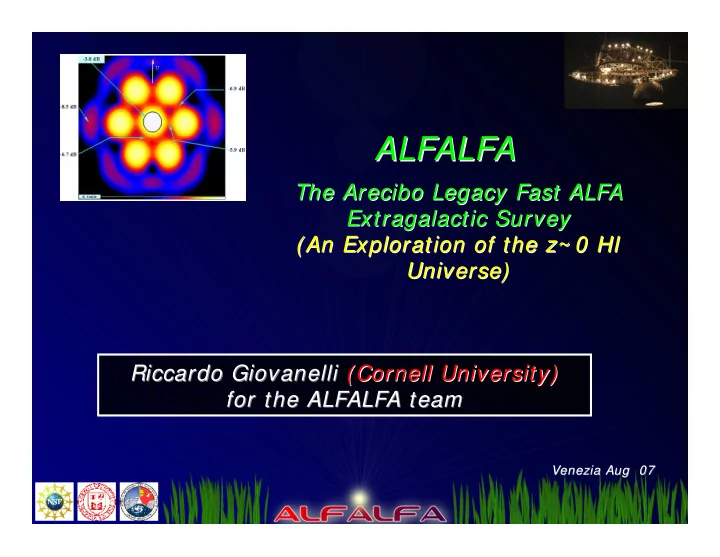
The The Arecibo Arecibo Legacy Fast ALFA Legacy Fast ALFA Extragalactic Survey Extragalactic Survey (An Exploration of the z~ 0 HI (An Exploration of the z~ 0 HI Universe) Universe) Riccardo Riccardo Giovanelli Giovanelli (Cornell University) (Cornell University) for the ALFALFA team for the ALFALFA team

ALFALFA ALFALFA

Venezia Venezia Aug 07 Aug 07

slide-2
SLIDE 2
  • An extragalactic spectral line survey
  • To cover 7000 sq deg of high galactic latitude sky
  • 1345-1435 MHz (-2000 to +17500 km/s for HI line)
  • 5 km/s resolution
  • 2-pass, drift mode (total int. time per beam ~ 40 sec)
  • ~2 mJy rms [MHI~105 in LG, ~107 at Virgo distance]
  • 4000 hrs of telescope time, 6-7 years
  • started Feb 2005; as of Feb 2007, 1/3 complete
  • One of several major surveys currently ongoing at

Arecibo, exploiting its multibeam capability

http://egg.astro.cornell.edu/alfalfa

ALFALFA, a Legacy Survey

slide-3
SLIDE 3

Who is ALFALFA?

ALFALFA is an open collaboration: anybody with a valid scientific interest can join. For participation guidelines, see: http://egg.astro.cornell.edu/alfalfa/joining.php Recommended guidelines for authorship can be found at: http://egg.astro.cornell.edu/alfalfa/projects/authorshipguidelines.php Project Guidelines: http://egg.astro.cornell.edu/alfalfa/projects/projectguidelines.php Projects (Team/PhD/undergrad): http://egg.astro.cornell.edu/alfalfa/projects/projects.php

slide-4
SLIDE 4

ALFALFA data products can be accessed through the web using robust, NVO-compatible software tools, developed by our students, thanks to an NSF/NVO development grant and the archival support

  • f the Cornell

Theory Center. ALFALFA is already an integral part of the NVO footprint http: / / arecibo.tc.cornell.edu/ hiarchive/ alfalfa/

slide-5
SLIDE 5

Science Goals to Be Addressed by ALFALFA: Science Goals to Be Addressed by ALFALFA:

1 Determination & environmental variation of the faint end of the HI Mass Function and the cosmic abundance of low mass halos 2 Global properties of HI-selected galaxy samples 3 The LSS of HI sources, the “void problem” & metallicity 4 Blind Survey for HI tidal remnants & “cold accretion” 5 HI Diameter Function 6 The low HI Column density environment of galaxies 7 The nature of HVC’s around the MW (and beyond?) 8 HI absorbers and the link to Lyman α absorbers 9 OH Megamasers at intermediate redshift

slide-6
SLIDE 6

ALFALFA: Prelim inary Results ALFALFA: Prelim inary Results from 2 strips through Virgo from 2 strips through Virgo

RA: 07: 40h to 16: 30h Dec: 12deg to 16deg and 08deg to 12deg Solid Angle: 1028 sq deg

(15% of survey)

slide-7
SLIDE 7

Over the ~ 1000 sq. deg. including the northern part of Virgo : Over the ~ 1000 sq. deg. including the northern part of Virgo :

  • ALFALFA detects 5200 sources, HIPASS 178 (several

ALFALFA detects 5200 sources, HIPASS 178 (several unconfirmed) unconfirmed)

  • While this region is perhaps the most intensively studied

While this region is perhaps the most intensively studied in the local Universe, at all wavelength bands (including in the local Universe, at all wavelength bands (including HI, using optically selected samples), HI, using optically selected samples),

  • 69% of ALFALFA detections are new

69% of ALFALFA detections are new (the conventional (the conventional wisdom on which optical targets would turn out to be wisdom on which optical targets would turn out to be HI HI -

  • rich appears to have been limited)

rich appears to have been limited)
slide-8
SLIDE 8

HIPASS Completeness Limit HIPASS Completeness Limit HIPASS Limit HIPASS Limit

slide-9
SLIDE 9

Source extraction and Source extraction and identification of identification of counterparts at other counterparts at other wavelength regimes can be wavelength regimes can be a painful experience a painful experience… … ...source ...source centroiding centroiding as as accurately as possible is accurately as possible is thus highly desirable thus highly desirable

slide-10
SLIDE 10

Suppose HIPASS detects a source Suppose HIPASS detects a source at S/ N~ 6 near 3000 km/ s in this at S/ N~ 6 near 3000 km/ s in this

  • field. The position error box will
  • field. The position error box will

have a radius of ~ 2.5 have a radius of ~ 2.5’ ’. . The opt counterpart could be gal The opt counterpart could be gal # 1, 2, 3, 4, 5 or 6. # 1, 2, 3, 4, 5 or 6. ALFALFA will detect the same ALFALFA will detect the same source with S/ N~ 50 source with S/ N~ 50 Centroiding Centroiding accuracy goes accuracy goes roughly as roughly as HPFW(PSF)/ (S/ N) HPFW(PSF)/ (S/ N) and the and the Arecibo Arecibo beam is beam is ¼ ¼ as as wide as the wide as the Parkes Parkes one

  • ne
  • The same source will have

The same source will have an ALFALFA position error an ALFALFA position error

  • f ~ 0.1
  • f ~ 0.1’

’ 1 1 2 2 3 3 4 4 5 5 6 6

slide-11
SLIDE 11

A quick look at the Virgo Cluster A quick look at the Virgo Cluster

slide-12
SLIDE 12
slide-13
SLIDE 13
slide-14
SLIDE 14
  • B. Kent Ph.D. Thesis
  • B. Kent Ph.D. Thesis
slide-15
SLIDE 15
  • B. Kent Ph.D. Thesis
  • B. Kent Ph.D. Thesis
slide-16
SLIDE 16
  • B. Kent Ph.D. Thesis
  • B. Kent Ph.D. Thesis
slide-17
SLIDE 17
  • B. Kent Ph.D. Thesis
  • B. Kent Ph.D. Thesis
slide-18
SLIDE 18
  • B. Kent Ph.D. Thesis
  • B. Kent Ph.D. Thesis
slide-19
SLIDE 19
  • B. Kent Ph.D. Thesis
  • B. Kent Ph.D. Thesis

Brown: Brown: Xray Xray Purple: Opt Purple: Opt Blue: HI Blue: HI

slide-20
SLIDE 20

What about What about “ “ dark galaxies dark galaxies” ” ? ?

slide-21
SLIDE 21
  • No optical counterpart

No optical counterpart

  • Evidence of rotation: V

Evidence of rotation: V rot

rot~ 1 3 km / s

~ 1 3 km / s

  • M

M HI

HI = 6 x1 0

= 6 x1 0 8

8

solar solar

  • M

M dyn

dyn( < 3

( < 3 ’ ’) ~ 7 x1 0 ) ~ 7 x1 0 8

8

solar solar

Giovanelli Giovanelli & Haynes 1989 & Haynes 1989 ApJ ApJ 346, L5 : 346, L5 : Arecibo Arecibo discovery discovery Chengalur Chengalur, , Giovanelli Giovanelli & Haynes 1995 AJ 109, 2415: VLA map & Haynes 1995 AJ 109, 2415: VLA map

HI 1 2 2 5 + 0 1 HI 1 2 2 5 + 0 1

M MHI

HI = 2x10

= 2x10 9

9 solar

solar M Mdyn

dyn~ 7x10

~ 7x10 9

9 solar

solar SF opt counterpart SF opt counterpart

But do such But do such

  • bjects exist
  • bjects exist

in isolation? in isolation?

slide-22
SLIDE 22

The Cardiff The Cardiff “ “ Dark Galaxy Dark Galaxy” ” VirgoHI VirgoHI -

  • 21

21

slide-23
SLIDE 23

10’ NGC 4254

45 kpc

DSS2 Blue

slide-24
SLIDE 24

Minchin et al 2007 (WSRT)

slide-25
SLIDE 25

Combined ALFALFA data around NGC 4254 cz = 2243 to 2557 km/s 10’

45 kpc

Haynes, Haynes, Giovanelli Giovanelli & Kent (2007 & Kent (2007 ApJL ApJL submitted) submitted) M MHI

HI

= 5x10 = 5x10 9

9 solar

solar

slide-26
SLIDE 26

10’

45 kpc

Combined ALFALFA data around VIRGOHI21 cz = 1946 to 2259 km/s

Haynes, Haynes, Giovanelli Giovanelli & Kent (2007 & Kent (2007 ApJL ApJL) ) Stream M Stream MHI

HI

= 5x10 = 5x10 8

8 solar

solar

Minchin et al 2007 (WSRT)

slide-27
SLIDE 27

Haynes, Haynes, Giovanelli Giovanelli & Kent 2007, & Kent 2007, ApJL ApJL

slide-28
SLIDE 28

Note the following: Note the following:

  • The prominent, anomalous m= 1 spiral structure of N4254 is

The prominent, anomalous m= 1 spiral structure of N4254 is visible in the gas and in the old stellar pop: visible in the gas and in the old stellar pop: gravity at w ork gravity at w ork

  • The HI mass in the stream is only 10% of HI mass in N4254:

The HI mass in the stream is only 10% of HI mass in N4254: albeit spectacular, disturbance of NGC 4254 is relatively mild albeit spectacular, disturbance of NGC 4254 is relatively mild

  • Velocity field of the stream shows the coupling of the tidal

Velocity field of the stream shows the coupling of the tidal force and rotation of NGC 4254, suggesting an interesting force and rotation of NGC 4254, suggesting an interesting timing argument: timing argument:

  • The stream exhibits memory of a full rotational cycle

The stream exhibits memory of a full rotational cycle

  • From the VLA map of N4254, we get the outer HI radius and

From the VLA map of N4254, we get the outer HI radius and Vrot Vrot at that radius at that radius rotation period ~ 800 rotation period ~ 800 Myr Myr

  • Hence the duration of the tidal encounter

Hence the duration of the tidal encounter ~ 800 ~ 800 Myr Myr, comparable with the cluster crossing time , comparable with the cluster crossing time

  • we

we’ ’re witnessing an event of mild harassment of NGC 4254 re witnessing an event of mild harassment of NGC 4254 in its high velocity transit through the periphery of the cluste in its high velocity transit through the periphery of the cluster r

slide-29
SLIDE 29

Duc Duc : simulation ALFALFA : simulation ALFALFA: data : data Credit: Credit: Duc Duc & & Bournaud Bournaud 2007 2007

slide-30
SLIDE 30

Haynes, Haynes, Giovanelli Giovanelli & Kent 2007, & Kent 2007, ApJL ApJL

Duc Duc’ ’s s simulation simulation P P-

  • V diagram

V diagram

slide-31
SLIDE 31

Does a cosmologically important population of optically faint but baryon rich low mass halos exist? Do such objects preferentially exist in regions of low cosmic density (“voids”), in which massive galaxies are known to be underrepresented? Does a significant population of optically “dark galaxies” exist? If they exist, are such objects primordial or the result of secular processes? Is there a cosmic density dependence of metallicity, i.e. do low mass systems in voids have preferentially lower heavy element abundances?

ALFALFA as a low z HI Cosmology Survey

slide-32
SLIDE 32
slide-33
SLIDE 33

Does a cosmologically important population of optically faint but baryon rich low mass halos exist? Do such objects preferentially exist in regions of low cosmic density (“voids”), in which massive galaxies are known to be underrepresented? Does a significant population of optically “dark galaxies” exist? If they exist, are such objects primordial or the result of secular processes? Is there a cosmic density dependence of metallicity, i.e. do low mass systems in voids have preferentially lower heavy element abundances?

ALFALFA as a low z HI Cosmology Survey

yes yes no; no; Saintonge Saintonge 2007 PhD thesis; Haynes 2007 PhD thesis; Haynes’ ’ talk talk Optically inert objects detected; see Kent et al. 2007 Optically inert objects detected; see Kent et al. 2007 ApJL ApJL the latter; Haynes et al. 2007 the latter; Haynes et al. 2007 ApJL ApJL Prob Prob no; no; Saintonge Saintonge 2007 2007 ( ( Basilakos Basilakos et al 2007) et al 2007)

slide-34
SLIDE 34

http://egg.astro.cornell.edu/alfalfa

For participation guidelines, see: http: / / egg.astro.cornell.edu/ alfalfa/ joining.php

http: / / arecibo.tc.cornell.edu/ hiarchive/ alfalfa/

Catalog access at: Catalog access at: