resilience all organisms are self-regulating systems equilibrium - - PowerPoint PPT Presentation

resilience
SMART_READER_LITE
LIVE PREVIEW

resilience all organisms are self-regulating systems equilibrium - - PowerPoint PPT Presentation

resilience all organisms are self-regulating systems equilibrium limits cycles Tallgrass National Preserve (US NPS photograph) resilience the ability of a system to maintain its self-organizing capacity equilibrium from Ruddiman, Earths


slide-1
SLIDE 1

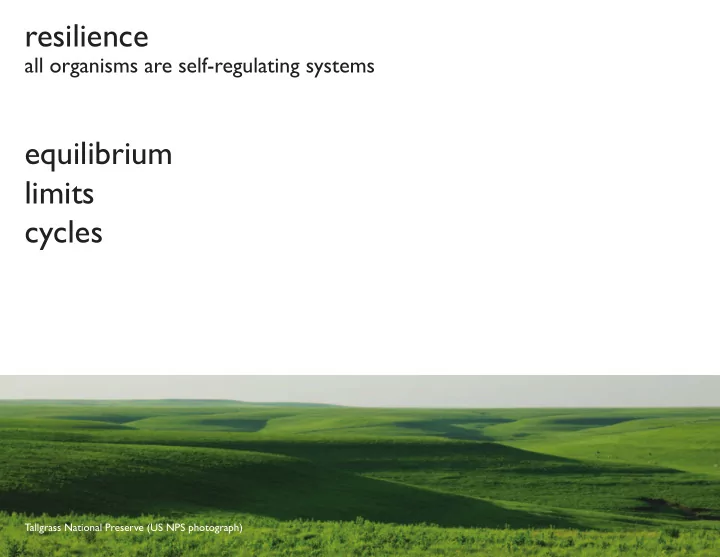
Tallgrass National Preserve (US NPS photograph)
resilience

all organisms are self-regulating systems

equilibrium limits cycles

slide-2
SLIDE 2

Tallgrass National Preserve (US NPS photograph) from Ruddiman, Earth’s Climate

resilience

the ability of a system to maintain its self-organizing capacity

equilibrium

slide-3
SLIDE 3

Tallgrass National Preserve (US NPS photograph)

This ball is at equilibrium. What happens if I push it?

resilience

the ability of a system to maintain its self-organizing capacity

equilibrium

slide-4
SLIDE 4

Tallgrass National Preserve (US NPS photograph)

This ball is at equilibrium. What happens if I push it?

resilience

the ability of a system to maintain its self-organizing capacity

equilibrium

slide-5
SLIDE 5

Tallgrass National Preserve (US NPS photograph)

This ball is stable for larger

  • displacements. It is more resilient.

This ball is stable only for small displacements.

resilience

the ability of a system to maintain its self-organizing capacity

equilibrium stability

slide-6
SLIDE 6

Tallgrass National Preserve (US NPS photograph)

Smaller range of experience. Less resilient than other ball. Larger range of experience.

resilience

the ability of a system to maintain its self-organizing capacity

equilibrium

the shape of the curve may be related to how much the ball moves around

slide-7
SLIDE 7

Tallgrass National Preserve (US NPS photograph)

resilience

To what degree must the pairie change before it is no longer a prairie?

Kansas (Flickr user powercat75)

slide-8
SLIDE 8

Tallgrass National Preserve (US NPS photograph)

resilience

concepts

slide-9
SLIDE 9

Tallgrass National Preserve (US NPS photograph)

time population pioneer bunny

resilience

concepts

population

depends on growth (α) and mortality (β) rates Δ bunnies = α x bunnies - β x bunnies Δ time

slide-10
SLIDE 10

Tallgrass National Preserve (US NPS photograph)

time population slow initial growth

resilience

concepts

population

depends on growth (α) and mortality (β) rates Δ bunnies = (α − β) x bunnies Δ time

slide-11
SLIDE 11

Tallgrass National Preserve (US NPS photograph)

time population rapid growth

resilience

concepts

population

depends on growth (α) and mortality (β) rates Δ bunnies = (α − β) x bunnies Δ time

slide-12
SLIDE 12

Tallgrass National Preserve (US NPS photograph)

time population rapid growth

resilience

concepts

population

growth, mortality, and competition γ Δ bunnies = (α − β) x bunnies Δ time (β + γ x bunnies) x bunnies

slide-13
SLIDE 13

Tallgrass National Preserve (US NPS photograph)

time population equilibrium

resilience

the ability of a system to maintain its self-organizing capacity

equilibrium

growth, mortality, and competition Δ bunnies = (α − (β + γ x bunnies)) x bunnies Δ time

slide-14
SLIDE 14

Tallgrass National Preserve (US NPS photograph)

time population pioneer bunny daisies

resilience

systems have many components

inter-dependence

bunny growth depends on daisies Δ b = (α x b x d) − (γ x b) Δ t competition daisies

slide-15
SLIDE 15

Tallgrass National Preserve (US NPS photograph)

time population pioneer bunny daisies

resilience

systems have many components

inter-dependence

we need an equation for daisies Δ b = (α x b x d) − (γ x b) Δ t Δ d = (φ x d) − (δ x d x b) Δ t eaten by bunnies

slide-16
SLIDE 16

Tallgrass National Preserve (US NPS photograph)

time population Is this the end for daisies?

resilience

systems have many components

inter-dependence

bunny predation on daisies

slide-17
SLIDE 17

Tallgrass National Preserve (US NPS photograph)

time population The bunny and daisy populations vary together.

resilience

ecosystems are biological systems of inter-related components

inter-dependence

Δ b = (α x b x d) − (γ x b) Δ t Δ d = (φ x d) − (δ x d x b) Δ t

slide-18
SLIDE 18

Tallgrass National Preserve (US NPS photograph)

time population The bunny and daisy populations vary together.

resilience

all organisms exist within systems of inter-dependent organisms

cycles

slide-19
SLIDE 19

Tallgrass National Preserve (US NPS photograph)

time population

resilience

all organisms exist within systems of inter-dependent organisms

cycles

  • rganism characteristics

number of organisms (external forcings)

slide-20
SLIDE 20

Tallgrass National Preserve (US NPS photograph)

time population

resiliency

The ability of a system to adjust its configuration and continue to function with disturbance.

slide-21
SLIDE 21

´

Tallgrass Prairie National Preserve National Park Service

Strong City, Kansas

U.S. Department of the Interior

Vegetation Classification

Ta Andropogon gerard llgrass Prairie, ii Herbaceous A (Sorghastrum nutans) lliance, CEGL 2201 Sch Rocky Mixed Prairie, izachyrium scoparium – Bouteloua curtipendula – B. gracilis Herbaceous Alliance, CEGL 2246 Bur Oak Woodland,Quercus macrocarpa, CEGL2053 Success Frax ional Forest, inus pennsylvanica – Ulmus americana – Celtis occidentalis Temporarily Flooded Forest Alliance, CEGL00218 Wet Ravine Vegetation, tina pectinata Spar Temporarily Flooded Herbaceous Alliance, CEGL 2223 Brome Grass, Sem Bromus inermis i-Natural Herbaceous Alliance, CEGL005264 Restored Prairie Weedy Ponds/Water Bodies Roadways Cropfields Developed Land

Boundaries

Preserve Boundary Mapping Buffer Boundary

1 2 Miles

Vegetation Mapping Project

resilience ecosystem

inter-dependent biotic and abiotic components connected via processes that regulate the flow

  • f nutrients and energy through

the system

slide-22
SLIDE 22

Tallgrass National Preserve (US NPS photograph)

resilience

To what degree must the pairie change before it is no longer a prairie?

Kansas (Flickr user powercat75)

slide-23
SLIDE 23

Tallgrass National Preserve (US NPS photograph)

time population

“There are no limits to the carrying capacity of Earth that are likely to bind any time in the forseeable future.” (Lawrence Summers, 1991) “Population blooms are always followed by crashes and die-offs. Always” (Heinberg, 2010)