Research Unit 2012 Cooperators Meeting 2011-2012 Metrics 21 - - PowerPoint PPT Presentation

research unit
SMART_READER_LITE
LIVE PREVIEW

Research Unit 2012 Cooperators Meeting 2011-2012 Metrics 21 - - PowerPoint PPT Presentation

Virginia Cooperative Fish and Wildlife Research Unit 2012 Cooperators Meeting 2011-2012 Metrics 21 peer-reviewed publications 10 technical reports 34 presentations or posters >$900,000 in funding (unit personnel)


slide-1
SLIDE 1

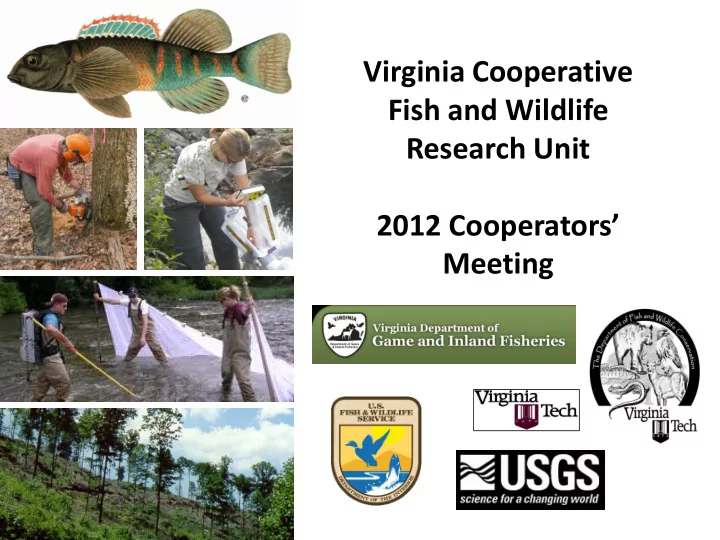
Virginia Cooperative Fish and Wildlife Research Unit 2012 Cooperators’ Meeting

slide-2
SLIDE 2

2011-2012 Metrics

  • 21 peer-reviewed publications
  • 10 technical reports
  • 34 presentations or posters
  • >$900,000 in funding (unit personnel)
  • >$500,000 in funding (faculty cooperators)
slide-3
SLIDE 3

Completed Projects

(Angermeier) Habitat suitability for Roanoke logperch near Philpott Reservior Assessing impacts of Roanoke River Flood Reduction Project on the endangered Roanoke Logperch Assessment of the distribution and abundance

  • f Roanoke logperch (Percina rex) in the Dan

River basin of Virginia

slide-4
SLIDE 4

Survey of the freshwater mollusk assemblages in the Little River, Virginia (Lead PI: Ostby)

slide-5
SLIDE 5

Status of the freshwater mussel fauna in the Powell River, Virginia and Tennessee (Lead PI: Henley)

slide-6
SLIDE 6

Evaluating potential effects of widening US highway 64 on red wolves, Washington, Tyrell, and Dare Counties, North Carolina (Vaughan and Kelly)

Final Results of research along 12 miles of US 64

– Barb wire bear hair samples collected: 851

  • 537 bear road crossing events - from at least 54 individual bears (42M:12F)

– Black bears captured: 116 (87M:29F)

  • 57 (30M:27F) GPS collared – Crossing the road an avg. of 2 times/100 days
  • 78% collared females and 50% collared males never crossed the roadway

– Recorded road kills

15 bears 8 WT deer 1 red wolf 3 bobcats 7 river otters 124 mid-size mammals 82 small mammals 1,153 birds 75 bats 4,014 reptiles 7,498 amphibians

– Photo-Captured wildlife crossings (at barb wire breaks)

260 black bears 177 red wolves 120 wild canids 170 WT deer 209 bobcats 208 raccoons

– Identified 6 Important Crossing locations where wildlife underpasses would be most effective in conserving wildlife and protecting motorist

slide-7
SLIDE 7

Evaluating potential effects of widening US highway 64 on the black bear population of Alligator River National Wildlife Refuge, Dare County, North Carolina (Kelly and Vaughan)

slide-8
SLIDE 8

Multigenerational, multi species test for endocrine disrupting chemical effects (Vaughan and Alexander)

slide-9
SLIDE 9

Noninvasive tracking of jaguars (Panthera onca) and co-

  • ccurring feline species in Belize by genotyping feces

and remote camera trapping (Kelly and Vaughan)

slide-10
SLIDE 10

Endangered fish surveys for the Virginia Department of Transportation

SPONSOR: Virginia Department of Transportation (Lead PI: Angermeier)

slide-11
SLIDE 11

Assessing post-construction impacts of the Roanoke River Flood Reduction Project on the endangered Roanoke logperch Habitat suitability for Roanoke logperch near Philpott Reservior

Sponsor: U.S. Army Corps of Engineers (Lead PI: Roberts)

Roanoke Pigg Smith Nottoway

slide-12
SLIDE 12

Population ecology of variegate darter in Virginia

SPONSOR: Virginia Department of Mines, Minerals, and Energy (Lead PI: Angermeier)

slide-13
SLIDE 13

Spatial analysis of relations among conservation practices, aquatic ecosystem services, and human well- being in the Albemarle-Pamlico basin

SPONSOR: U.S. Geological Survey (Lead PI: Angermeier)

slide-14
SLIDE 14

10 15 20 25 30 35 May Jun Jul Aug Sep Date (year = 2090) Projected Water Temperature (oC) Simultaneous Scenario Urbanization Only Climate Change Only Baseline Scenario

Development and Assessment of Tools for Evaluating Stream Fish Community Responses to Climate Change along Thermal Gradients SPONSOR: U.S. Forest Service (Lead PI: Angermeier)

slide-15
SLIDE 15

Sediment and Nitrogen Regulation

Regulating Services as Measures of Ecological Resilience

  • n DoD Lands

SPONSOR: U.S. Department of Defense, ESTCP (Lead PI: Angermeier)

slide-16
SLIDE 16

Comparison of habitat suitability among sites supporting strong, localized, and extirpated populations of candy darters (Etheostoma osburni)

SPONSOR: Virginia Department of Game and Inland Fisheries (Lead PI: Dunn)

slide-17
SLIDE 17

Bayesian population dynamics modeling to guide population restoration and recovery of endangered mussels in the Clinch and Powell Rivers, Tennessee and Virginia

SPONSOR: United States Geological Survey (Lead PI: Jiao)

slide-18
SLIDE 18

Biological monitoring and geomorphological characterization for the USGS Eastern Region Initiative on the Clinch An evaluation of freshwater mussel body burdens following in situ exposure to contaminants in Clinch River

SPONSOR: U.S.G.S. (Lead PI: Ostby)

Stream Surveys for Villosa perpurpurea and other native mussels in Beech Creek, Hawkins County, Tennessee

SPONSOR: U.S.F.W.S. (Lead PI: Ostby)

Semi-quantitative freshwater mussel surveys in the Wards Creek, Rocky Creek, Buck Mountain Creek,and Swift Run sub-watersheds of the Rivanna River

SPONSOR: T.N.C. (Lead PI: Ostby)

slide-19
SLIDE 19

sTr subhumid forest-654 cT humid forest-453 wT humid forest-553 sTr humid forest-653 cT and montane perhumid forest-452 Tr subhumid forest-754 B perhumid forest-342 cT humid forest-443 sP superhumid forest-241 B superhumid forest-351 cT perhumid forest-442 wT subhumid forest-543 sTr subhumid forest-644 cT superhumid rain forest-462

CURRENT

Evaluating Ecological Threats Under Climate Change (Army 6.2 –Ford)

sTr subhumid forest-654 cT humid forest-453 wT humid forest-553 sTr humid forest-653 cT and montane perhumid forest-452 Tr subhumid forest-754 cT humid forest-443 cT perhumid forest-442 wT subhumid forest-543 sTr subhumid forest-644 wT perhumid forest-562 Tr semiarid forest-745

A2 2085

slide-20
SLIDE 20

Effects of a hierarchal and spatially differential disruption of roosts and roost areas on non-random assorting (social) dynamic in bats using ephemeral forest conditions (Army 6.1 – Ford)

slide-21
SLIDE 21

Acoustical Sampling Following White-nose Syndrome at Fort Drum, New York: Pilot Test to Determine Efficacious Techniques to Address Surveillance Needs (Army Installation Command – Ford)

slide-22
SLIDE 22

Assessing occupancy and detection rates for the Carolina northern flying squirrel: examination of nest-box surveys in Program Mark and Program Presence and development of acoustical survey techniques (NC Wildlife Comm. and USFWS – Ford)

500 1,000 250 Feet 5 6 5400 5300 5 2 5700 5800 5 1 5 5 5700 5500 5600 5500 500 1,000 250 Feet 5 6 5400 5300 5 2 5700 5800 5 1 5 5 5700 5500 5600 5500

slide-23
SLIDE 23

White-tailed Deer Impact and Vegetative Response in the Blue Ridge, Ridge and Valley and Appalachian Plateau of Virginia in Relation to Landscape and Land Ownership Characteristics (VDGIF – Ford)

slide-24
SLIDE 24

Assessing the responses of breeding shorebirds to military jet

  • verflights of the Core MOA at Cape Lookout National Seashore

Sarah M. Karpanty and James D. Fraser

Objectives:

 To understand how a lowered floor for military

  • verflights affects the behavior and

demography of colonial waterbirds and Wilson’s Plovers.

 To maximize application of our data to the

varied management needs of the US Marine Corps, National Park Service, and other resource management agencies.

Field work and draft final reports completed; 2 M.S. students will be defending their theses in August 2012

Major Finding: No biologically-relevant alterations of behavior or demography due to military overflights at current use frequencies and altitudes.

Incubating Least Terns during U.S. Marine Corps

  • verflights at Cape Lookout National Seashore,

captured by Reconyx PC-90 cameras

slide-25
SLIDE 25

Missouri River Piping Plover Population Dynamics in relation to natural and Artificial Sandbars; Least tern and piping plover response to flooding on the Missouri River (Daniel Catlin, James Fraser, and Sarah Karpanty)

  • Post-flood research

(at least 3 years)

– Demography

  • Compare the

reaction to created habitats

– Food resources

  • Why has adult

survival declined?

– Cyclic vs. static

slide-26
SLIDE 26

Evaluation of the functional role of freshwater mussel beds in maintaining water quality and suitable habitat for fishes and endangered freshwater mussels (Benfield and Garst)

slide-27
SLIDE 27

Development of Demographic Metrics to Evaluate Success

  • f Mussel Reintroductions in the Upper Tennessee River

System (Jones)

Project Duration: September 2011 to February 2014.

  • Objective 1: Locate and characterize stream habitat patches in the Clinch,

Powell and Nolichucky rivers to use as potential reintroduction sites for each species

  • Objective 2: Estimate survival, recruitment, immigration rates and

fecundity for both species

  • Objective 3: Conduct population viability analysis (PVA) to compare
  • utcomes for alternative translocation and reintroduction strategies
slide-28
SLIDE 28

Restoration of freshwater mussel populations to high priority geographic areas in the upper Tennessee River system

Tagged endangered mussels cultured at FMCC Graduate student Tim Lane releasing mussels in the Powell River, TN in 2011. Project Goal: Establish viable populations of endangered mussels in Clinch, Powell and Nolichucky rivers. Project Duration: April 2011 to December 2013.

slide-29
SLIDE 29

Reintroduction Efforts

Releases in Upper Clinch River 2006-2011 Releases in Lower Nolichucky River 2007-2011 Releases in Lower Powell River 2008-2011 Efforts will continue in each reach in 2012 Translocated and Propagated mussels stocked in the three river reaches

Agencies Collaborating: VDGIF AWCC TWRA USFWS Virginia Tech FMCC

slide-30
SLIDE 30

FishTraits database redesigned for Virginia Tech Library hosting starting 9/2012 (Frimpong) Fish distribution modeling and field-testing of underway in the New River basin (VA, WV, & NC)

Sites being Sampled for Model validation New River Shiner distribution model with Maximum enthropy

slide-31
SLIDE 31

Restoration of Pine Flatwoods Wetlands on Eglin Air Force Base (Haas)

  • Wetland restoration treatments

have been applied.

  • Drift fences are in place to

monitor amphibian response.

Kelly Jones Kelly Jones Kelly Jones

Endangered Reticulated Flatwoods Salamander

slide-32
SLIDE 32

Histological Evaluations of Organ Tissues of Pheasantshells (Actinonaias pectorosa) from Horton Ford and Simones Island, Clinch River, Tennessee and Virginia (Henley) FKDCL As 0.64* Ba 0.74* B 0.64* Co 0.84*** Fe 0.74* Mn 0.73* Hg 0.75** Ni 0.63* Ag 0.85*** Sr 0.66* Correlations (Spearman’s rho) between tissue concentrations of trace elements and fractions of kidney diverticula cells containing lipofuscin (FKDCL) in mussels collected from Semones Island and Horton Ford (n=16), * p<0.01,

**p<0.001, ***p<0.0001.

slide-33
SLIDE 33

Angermeier Proposed Projects for 2012-13 1.Larval ecology of Roanoke logperch in the upper Roanoke River watershed 2.Population viability analysis for Roanoke logperch 3.Habitat suitability for Roanoke logperch near Philpott Reservoir 4.Evaluating air-water temperature linkages in Shenandoah National Park streams 5.Use of structured decision-making in the conservation of fishes and mussels in the upper Tennessee River basin 6.Survey for Roanoke logperch in Tinker Creek, Botetourt County, Virginia 7.Assessment of the distribution and degree of introgression of Roanoke bass populations in Virginia

slide-34
SLIDE 34

Ford Proposed Projects for 2012-13

  • 1. Micro-habitat characteristics of Virginia northern flying squirrel

(Glaucomys sabrinus fuscus) foragings sites: relating structure, composition and soils to habitat identification, conservation and restoration needs

  • 2. Development of a species action plan and workshop to aid in the

management of endangered Carolina northern flying squirrels at Blue Ridge Parkway and in Great Smoky Mountains National Park

  • 3. Cross-scale assessment of functional and structural ecological changes

from surface coal mining in Appalachia through development and application of an index of biological integrity.

  • 4. Cerulean warbler and associated species response to silvicultural

prescriptions in the central Appalachian region

  • 5. Bat response to desired forest conditions in southern bottomland

hardwoods in the Lower Mississippi Alluvial Valley: baseline needs for sustainable implementation of strategic habitat conservation

slide-35
SLIDE 35

“I will pause for a moment so you can let this information sink in.”