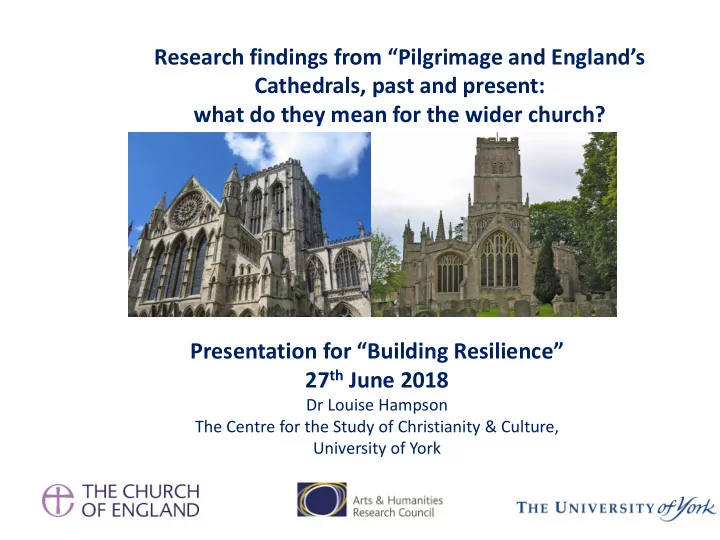
Research findings from Pilgrimage and Englands Cathedrals, past and - - PowerPoint PPT Presentation

research findings from pilgrimage and england s
SMART_READER_LITE
LIVE PREVIEW

Research findings from Pilgrimage and Englands Cathedrals, past and - - PowerPoint PPT Presentation

Research findings from Pilgrimage and Englands Cathedrals, past and present: what do they mean for the wider church? Presentation for Building Resilience 27 th June 2018 Dr Louise Hampson The Centre for the Study of Christianity


slide-1
SLIDE 1

Presentation for “Building Resilience” 27th June 2018

Dr Louise Hampson The Centre for the Study of Christianity & Culture, University of York

Research findings from “Pilgrimage and England’s Cathedrals, past and present: what do they mean for the wider church?

slide-2
SLIDE 2
  • 3 year interdisciplinary project in partnership with the Church of England
  • Considered ‘pilgrimage’ in its widest sense of openness to spiritual

engagement, whether planned or spontaneous

  • Aim was to allow the past to speak to the present and help shape the

future through:

  • detailed historical and theological research into the ways in which

medieval buildings were designed to shape and enhance learning and response

  • using the tools and insights of social science and religious studies to

provide in-depth analysis of the experience of visitors, pilgrims, ‘potential pilgrims’, staff, and volunteers today.

slide-3
SLIDE 3

INTERATING WITH SARED S

INTERACTING WITH SACRED SPACES IN THE PAST

slide-4
SLIDE 4
  • How can cathedrals/other churches combine being heritage

sites and civic resources with retaining their core role of offering worship and being places of spiritual encounter?

  • Churches are places of ‘spiritual heritage’. How can they explain

their meaning to visitors who may come from any faith or none, possibly with little or no Christian understanding?

  • Churches have worship, welcome and witness at their core, yet

are now welcoming audiences for whom both worship and witness may seem alien.

  • We often use the terms ‘pilgrim’ and ‘pilgrimage’ today but what
  • r who is a pilgrim?
  • Most churches now offer much less visual or tactile stimulus

than their medieval predecessors, yet human beings still learn and respond through their senses. What can we offer today to enhance learning, encounter and response?

slide-5
SLIDE 5

WHAT PEOPLE ARE DOING, SEEKING AND EXPERIENCING

slide-6
SLIDE 6

Free text quotations from the research

  • ‘Thought about my life; the significance of other people's contribution’
  • Walked around enjoying the PEACE, the mosaics and organ music’
  • ‘Wrote a card for the Christmas tree and prayed for Palestine’
  • ‘Sat to reflect on those most dear to me, dead and alive’
  • ‘Gazed at the Anthony Gormley figure – just amazing’
  • ‘Listened to the organ practice’
  • ‘Admired architecture’
  • ‘Took photos, sat in peace for a while’
  • ‘Looked at the beautiful building’
  • ‘Meditated’
  • ‘Spoke to someone about the meaning of life’
slide-7
SLIDE 7

0.00% 2.00% 4.00% 6.00% 8.00% 10.00% 12.00% 14.00% 16.00% 18.00% 20.00%

Q.10 - Which of the following experiences formed part of your visit to the Cathedral?

Canterbury Durham Westminster York

slide-8
SLIDE 8
  • Tight and loose spaces
  • The potency of adjacency
  • The importance of the invitation to engage
  • Using heritage as a route into exploration
  • The enduring appeal and importance of

leaving and taking away KEY OBSERVATIONS

slide-9
SLIDE 9

Lichfield Cathedral Touchscreen Explaining Biblical Themes

(Centre for the Study of Christianity & Culture)

ENCOURAGING SPIRITUAL EXPLORATION

slide-10
SLIDE 10
  • Pilgrim/tourist: not either/or - can be both/and with movement along a

continuum

  • Churches contain tight and loose spaces: Loose spaces can be significant
  • The significance of adjacencies and access: churches were designed to house

different activities, often simultaneously, within close proximity. Boundaries between activities may be fuzzy. Fuzziness can be potent!

  • Spaces of relationality: churches are often where people seek a connection with

their past, the past of their locality, or simply a sense of being part of a continuum.

  • Invitations to engage: People may need creative but unthreatening pathways

into engagement, and safe, welcoming spaces. An interest in the heritage can be the route into that broader engagement.

  • Taking away: Items bought at cathedrals and churches have significance.

Photographs both mark an individual’s presence at the place, and provide an

  • ngoing connection with it. The photo of a candle lit for somebody else can be a

powerful testimony and gift, creating a form of extended relationality, mediated by both candle and photo, especially in the era of social media. Stepping stones….