Research Data Services: New Roles for Academic Libraries? Carol - - PDF document

research data services new roles for academic libraries
SMART_READER_LITE
LIVE PREVIEW

Research Data Services: New Roles for Academic Libraries? Carol - - PDF document

18/04/13' Research Data Services: New Roles for Academic Libraries? Carol Tenopir University of Tennessee ctenopir@utk.edu Visiting Research Professor University of New South Wales (through April) Center for Information and Communication


slide-1
SLIDE 1

18/04/13' 1'

Center for Information and Communication Studies

Research Data Services: New Roles for Academic Libraries?

Carol Tenopir University of Tennessee ctenopir@utk.edu

Visiting Research Professor University of New South Wales (through April)

Center for Information and Communication Studies

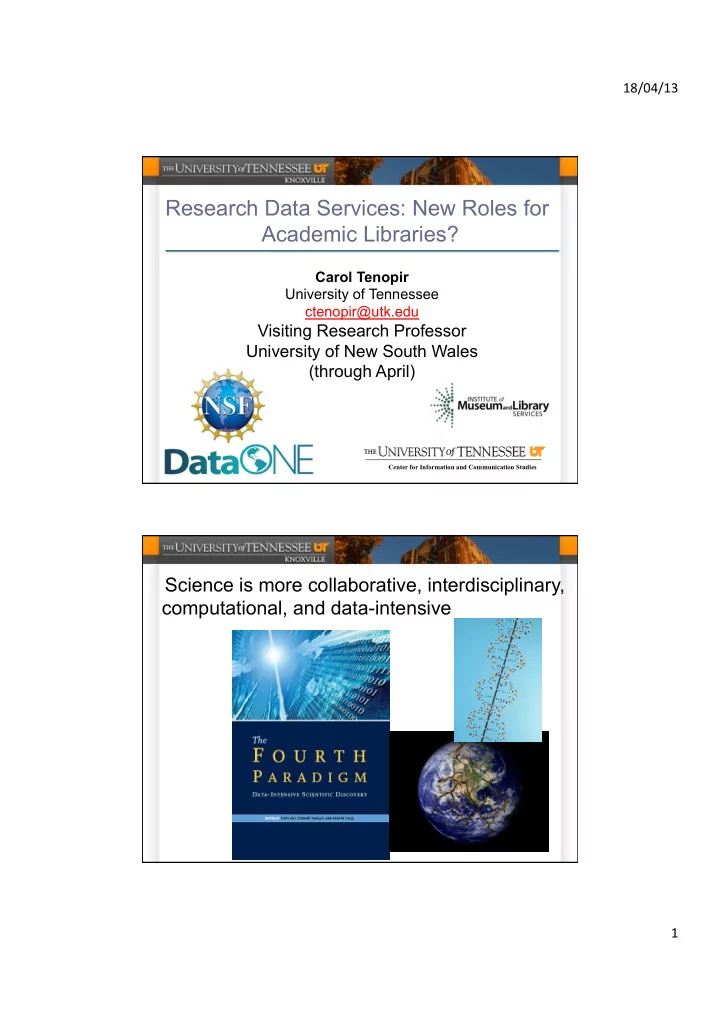
Science is more collaborative, interdisciplinary,

computational, and data-intensive

slide-2
SLIDE 2

18/04/13' 2'

Center for Information and Communication Studies

Open Science Movement…

…governments and funding agencies are requiring data management

U.K. Freedom of Information Act 2000, and the Freedom of Information (Scotland) Act 2002

U.S. Office of the the President

Center for Information and Communication Studies

Data loss

  • Natural disaster
  • Facilities infrastructure failure
  • Storage failure
  • Server hardware/software failure
  • Application software failure
  • External dependencies
  • Format obsolescence
  • Legal encumbrance
  • Human error
  • Malicious attack by human or

automated agents

  • Loss of staffing competencies
  • Loss of institutional commitment
  • Loss of financial stability
  • Changes in user expectations and

requirements

slide-3
SLIDE 3

18/04/13' 3'

Center for Information and Communication Studies

NSF Sustainable Digital Data Preservation and Access Network Partners (DataNet)

Will create exemplar partners to address “…one of the major challenges of this scientific generation: how to develop the new methods, management structures and technologies to manage the diversity, size, and complexity of current and future data sets and data streams”.

Center for Information and Communication Studies

Need new types of

  • rganizations that will…
  • integrate library and archival sciences,

cyberinfrastructure, computer & information sciences, and domain science expertise to:

– provide reliable digital preservation, access, integration, and analysis capabilities for science and/or engineering data over a decades-long timeline

slide-4
SLIDE 4

18/04/13' 4'

Center for Information and Communication Studies 8' 8'

The'DataONE'Vision'and'Approach:'

Providing)universal)access)to)data)about)life)on)earth)and)the) environment)that)sustains)it,)as)well)as)the)tools)needed)by)researchers'

1.''Building'community' 2.''Developing'sustainable' data'discovery'and' interoperability'soluFons' 3.'Enabling'science'through' tools'and'services'

Plan' Collect' Assure' Describe! Preserve' Discover' Integrate' Analyze'

slide-5
SLIDE 5

18/04/13' 5'

9' 9' 10' 10'

DataONE'is'Cyberinfrastructure'

Three'major'components'for'a' flexible,'scalable,'sustainable' network'

Coordina)ng!Nodes!

  • retain'complete'metadata'

catalog''

  • indexing'for'search'
  • networkUwide'services'
  • ensure'content'availability'

(preservaFon)'''

  • replicaFon'services'
slide-6
SLIDE 6

18/04/13' 6'

11' 11'

DataONE'is'Cyberinfrastructure'

Three'major'components'for'a' flexible,'scalable,'sustainable' network'

Coordina)ng!Nodes!

  • retain'complete'metadata'

catalog''

  • indexing'for'search'
  • networkUwide'services'
  • ensure'content'availability'

(preservaFon)'''

  • replicaFon'services'

Member!Nodes!

  • diverse'insFtuFons'
  • serve'local'community'
  • provide'resources'for'

managing'their'data'

  • retain'copies'of'data'

12' 12'

DataONE'is'Cyberinfrastructure'

Three'major'components'for'a' flexible,'scalable,'sustainable' network'

Coordina)ng!Nodes!

  • retain'complete'metadata'

catalog''

  • indexing'for'search'
  • networkUwide'services'
  • ensure'content'availability'

(preservaFon)'''

  • replicaFon'services'

Member!Nodes!

  • diverse'insFtuFons'
  • serve'local'community'
  • provide'resources'for'

managing'their'data'

  • retain'copies'of'data'

Inves)gator!Toolkit!

!

slide-7
SLIDE 7

18/04/13' 7'

13' 14' 14'

DataONE'Principles'

1.'Data'should'be'part'of'the'permanent'scholarly'record' and'requires'longUterm'stewardship.' ' 2.'Sharing'and'reuse'maximize'the'value'of'data'to' environmental'science.'' ' 3.'Science'is'best'served'by'an'open'and'inclusive'global' community.' ' 4.'The'data'environment'is'dynamic'and'requires'evidenceU based'decisionUmaking'about'pracFce'and'governance.''

slide-8
SLIDE 8

18/04/13' 8'

15' 15'

Alison'Specht,'ACEAS'Program'Manager,' Associate'Professor,'University'of'Queensland'

Australian!Centre!for!Ecological! Analysis!and!Synthesis!

Center for Information and Communication Studies

Libraries…

  • facilitate interdisciplinary work, data

access, and data knowledge through collections and services

  • Can take a leadership role in a variety
  • f research data services

Carol Tenopir

slide-9
SLIDE 9

18/04/13' 9'

Center for Information and Communication Studies

Research Data Services are…

  • …services that address the full data lifecycle,

including the data management plan, digital curation (selection, preservation, maintenance, and archiving), and metadata creation and conversion.

  • Services can be hands-on or consultative.

Center for Information and Communication Studies

Technical/Hands-On RDS

  • Providing tech support for RDS

systems/data repositories

  • Deselecting datasets for removal from

a repository

  • Preparing datasets for deposit
  • Creating or transforming metadata
  • Identifying datasets for deposit in

repositories

slide-10
SLIDE 10

18/04/13' 10'

Center for Information and Communication Studies

Informational/Consulting RDS

  • Consulting on Data Management Plans
  • Consulting on data and metadata

standards

  • Outreach/collaboration with other RDS

providers on campus

  • Reference for finding and citing data
  • Creating web guides and finding aids

for data

Center for Information and Communication Studies

More Informational/Consulting RDS

  • Directly participating with researchers
  • n a project
  • Discussing RDS with others on campus
  • n a (semi-) regular basis
  • Training co-workers on data issues
slide-11
SLIDE 11

18/04/13' 11'

Center for Information and Communication Studies

Plan Collect Assure Describe Preserve Discover Integrate Analyze

Data Lifecycle

Center for Information and Communication Studies

Collect Assure Deposit Preserve Discover Integrate Describe Analyze

Researchers might…

slide-12
SLIDE 12

18/04/13' 12'

23' 23'

Researcher'Challenges'

Plan' Collect' Assure' Describe! Preserve' Discover' Integrate' Analyze'

Metadata'' Standards'?' Data' Sharing'?' OrganizaFonal' Support'&' Services,' Training'?' Where?'

Center for Information and Communication Studies

Stewardship role (select & deselect)?

Librarian & Libraries

Plan Collect Assure Describe Preserve Discover Integrate Analyze

Are RDS priority? Role in partnering with researcher? Level of my knowledge & skills ? Is there an agency repository that accepts data? Level of participation with data? Role of librarian discovering data? Level of involvement with metadata? Role of the librarian to help preservation?

slide-13
SLIDE 13

18/04/13' 13'

Center for Information and Communication Studies

Assessment of Stakeholders

Scientists Data Managers Public Officials Citizen- scientists Libraries & Librarians Students & Teachers Publishers

Center for Information and Communication Studies

Results of scientists survey shows

  • pportunities for libraries…
slide-14
SLIDE 14

18/04/13' 14'

Center for Information and Communication Studies

What metadata do you currently use to describe your data?

DwC DC Open GIS FGDC ISO My Lab NONE

21 26 95 95 96 97 266 676

EML

12

DIF

Center for Information and Communication Studies

28 36% 41% 75% 78%

0% 10% 20% 30% 40% 50% 60% 70% 80% 90% 100%

Others can access my data easily Place all of my data into a central data repository I share my data Place at least some of my data into a central data repository

Gap'Between'Willingness'to'Share'and'Accessibility'

slide-15
SLIDE 15

18/04/13' 15'

Center for Information and Communication Studies

29

12% 12% 13% 15% 17% 20% 20% 34% 45%

0% 10% 20% 30% 40% 50% 60% 70% 80% 90% 100% Other reasons for data not available Should not be available Do not need data Sponsor does not require Lack of standards Do not have rights to make data… No place to put data Lack of funding Insufficient time

Reasons'for'Not'Making'Data' 'Electronically'Available'

Center for Information and Communication Studies

Academic Librarians

  • Unit of analysis = individual librarian
  • 302 librarians at 111 ARL libraries who

were most likely to be involved in RDS

  • Opinion about personal preparation and
  • pportunities for continuing education
slide-16
SLIDE 16

18/04/13' 16'

Center for Information and Communication Studies

Academic Libraries

  • Unit of analysis = library
  • 223 ACRL libraries
  • From stratified panel of directors from all

types of academic libraries

  • Current RDS and educational offerings
  • Plans for next 24 months

Center for Information and Communication Studies

librarians (in academic research libraries)…

slide-17
SLIDE 17

18/04/13' 17'

Center for Information and Communication Studies

Current Overall Engagement with RDS

10 20 30 40 50 60 70 80 90 100 Integral to job (27.9%) Occasionally (40.5%) No (31.5%) Frequency of Responses

Do you interact with faculty, students, or staff in support of their research data services (RDS) as part of your regular job responsibilities? (n = 223)

Center for Information and Communication Studies

ARL librarians strongly or somewhat agree…

  • RDS are as important as other services

(82% of integral; 68% of occasional; 32% of no)

  • RDS are a priority at my library (67%

integral; 40% of occasional; 19% of no)

slide-18
SLIDE 18

18/04/13' 18'

Center for Information and Communication Studies

I have the skills, knowledge, and training necessary to provide RDS. (n = 159)

Librarians’ Skills, Knowledge, and Training Necessary to Provide RDS

I have sufficient subject expertise to provide RDS to my patrons. (n = 159)

0%' 20%' 40%' 60%' 80%' 100%' No' Occasional' Integral' Agree'Strongly' Agree'Somewhat' Neither'Agree'Nor'Disagree'' Disagree'Somewhat' Disagree'Strongly' 0%' 20%' 40%' 60%' 80%' 100%' No' Occasional' Integral' Agree'Strongly' Agree'Somewhat' Neither'Agree'Nor'Disagree' Disagree'Somewhat' Disagree'Strongly'

Center for Information and Communication Studies

My library provides opportunities to develop skills related to RDS. (n = 159)

Librarians’ Skills, Knowledge, and Training Necessary to Provide RDS

0%' 20%' 40%' 60%' 80%' 100%' No' Occasional' Integral' Agree'Strongly' Agree'Somewhat' Neither'Agree'Nor'Disagree' Disagree'Somewhat' Disagree'Strongly' 0%' 20%' 40%' 60%' 80%' 100%' No' Occasional' Integral' Agree'Strongly' Agree'Somewhat' Neither'Agree'Nor'Disagree' Disagree'Somewhat' Disagree'Strongly' My library supports me to attend conferences/workshops on RDS. (n = 157)
slide-19
SLIDE 19

18/04/13' 19'

Center for Information and Communication Studies

For Those Not Currently Involved in RDS, Potential Motivations for Involvement

No (n = 160) Rank Motivation

#1

If my patrons request RDS

#2

If RDS became a responsibility in my job

#3

If my institution becomes more involved with RDS

#4

If my institution develops an IR that accepts data

#5

If external funding agencies require RDS

#6

If RDS becomes important to subject disciplines I support

#7

If I learn more about RDS

Center for Information and Communication Studies

Next libraries (in all types of academic libraries)…

slide-20
SLIDE 20

18/04/13' 20'

Center for Information and Communication Studies

Informational / Consulting RDS Currently Offered

  • r Planned

0% 10% 20% 30% 40% 50% 60% 70% 80% 90% 100% No, and no plans No, but > 24 months No, but 13-24 months No, but < 12 months Yes, currently offered

Center for Information and Communication Studies

Informational / Consulting RDS Currently Offered

  • r Planned

0% 20% 40% 60% 80% 100% Train co- workers Discuss regularly Project Participant Create guides No, and no plans No, but > 24 months No, but 13-24 months No, but < 12 months Yes, currently offered

slide-21
SLIDE 21

18/04/13' 21'

Center for Information and Communication Studies

Technical / Hands-On RDS Currently Offered or Planned

0% 10% 20% 30% 40% 50% 60% 70% 80% 90% 100% No, and no plans No, but > 24 months No, but 13-24 months No, but < 12 months Yes, currently offered

Center for Information and Communication Studies

Conclusions

  • Most respondents do not yet do RDS
  • Some have the knowledge, skills, and
  • pportunities to provide RDS
  • They believe RDS are important and

consistent with library mission and role

  • Libraries are at an early point in transition to

RDS—requiring resetting of priorities, realignment of responsibilities, and

  • pportunities to develop skills
slide-22
SLIDE 22

18/04/13' 22'

Center for Information and Communication Studies

Data Management services are part of transforming research libraries and librarians…

This is next-generation librarianship. The curation of research data is an activity that has gained traction in the wake of library and information science programs offering concentrations in data curation and institutes in digital curation, promising a cohort of librarians qualified to meet the challenges of managing data.

http://www.arl.org/rtl/eresearch/escien/nsf/leadershiproles.shtml Authors: Patricia Hswe and Ann Holt. Part of ARL’s transforming research libraries series.

Center for Information and Communication Studies

  • Academic Libraries And Research Data Services: Current

Practices and Plans for the Future, ACRLWhite Paper, 2012.

  • Academic Librarians and Research Data Services:

Preparation and Attitudes, IFLA Proceedings, 2012.

  • Data Sharing by Scientists: Practices and Perceptions,

PlosONE, 2011.