Research and Reflexology What is Research? Research is a process or - - PDF document

research and reflexology
SMART_READER_LITE
LIVE PREVIEW

Research and Reflexology What is Research? Research is a process or - - PDF document

Research and Reflexology What is Research? Research is a process or activity that leads to the development of knowledge and expertise. It encompasses a variety of activities that are used to expand knowledge. Research - like any other


slide-1
SLIDE 1

Research and Reflexology

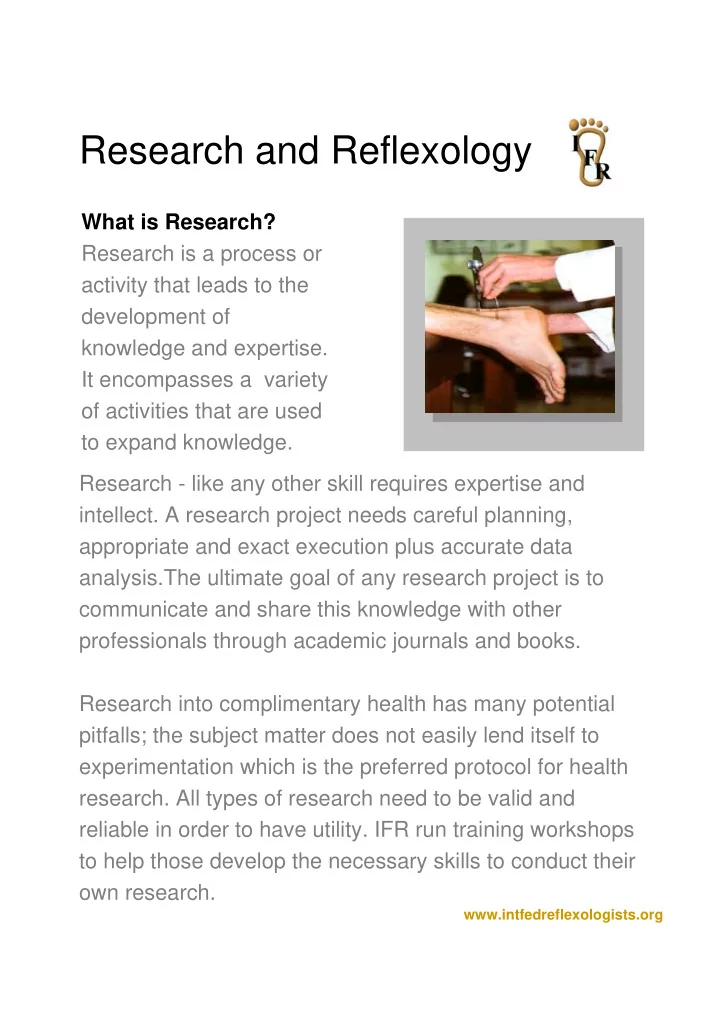
What is Research? Research is a process or activity that leads to the development of knowledge and expertise. It encompasses a variety

  • f activities that are used

to expand knowledge. Research - like any other skill requires expertise and

  • intellect. A research project needs careful planning,

appropriate and exact execution plus accurate data analysis.The ultimate goal of any research project is to communicate and share this knowledge with other professionals through academic journals and books. Research into complimentary health has many potential pitfalls; the subject matter does not easily lend itself to experimentation which is the preferred protocol for health

  • research. All types of research need to be valid and

reliable in order to have utility. IFR run training workshops to help those develop the necessary skills to conduct their

  • wn research.

www.intfedreflexologists.org

slide-2
SLIDE 2

The IFR is committed to research into reflexology and allied therapies. IFR have a research group of specialist scientists who are also qualified and experienced therapists, who advise the federation on various aspects of research and therapy. The research group is directed by Jarrod Hollis PhD, BSc (Hons) BOptom (Hons). Jarrod has published widely in scientific journals and has written a number of books and research papers. He has undergone specialist training in research centres

  • f academic excellence such as

Cambridge and Oxford University. Jarrod acts as advisor to the board. Other members of the research group include: Janis Holden-Metcalf BSc (Hons) and Mathias Schadlich BSc (Hons). Janis has a degree in Health and human sciences and specialises in medical anthropology. Mathias is a biological scientist with an active interest in wellbeing and health. Together these people provide a unique combination of skills that yield expert opinion into quantitative and qualitative methods.

  • Dr. Jarrod Hollis

PhD BSc (Hons) BOptom (Hons) Janis Holden-Metcalfe BSc (Hons) Mathias Schadlich BSc (Hons) www.intfedreflexologists.org

slide-3
SLIDE 3

Quantitative Methods

This research style aims to produce valid and reliable findings using procedures that are adopted from the natural sciences. Data is collected in a highly structured form. The findings are analysed using quantitative

  • techniques. The methods of data collection

include experimentation, case study and inventory.

Qualitative Methods

This research style aims to produce uses flexible methods of data collection and analysis, but which nevertheless aim to produce a coherent account of natural phenomena. Data is collected and analysed in many different forms. Although qualitative methods seem easy compared to more structured approaches, they require in-depth analysis and planning if the resulting findings are to have utility.

www.intfedreflexologists.org