
SLIDE 1
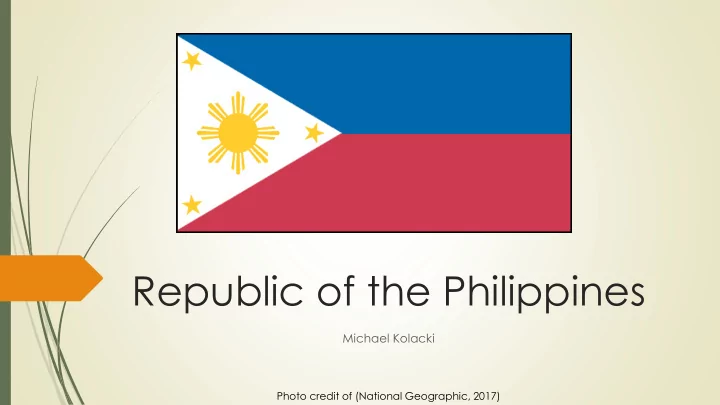
Republic of the Philippines
Michael Kolacki
Photo credit of (National Geographic, 2017)
Republic of the Philippines Michael Kolacki Photo credit of - - PowerPoint PPT Presentation
Republic of the Philippines Michael Kolacki Photo credit of (National Geographic, 2017) Geography Archipelago consisting of 7107 islands 1 East of Vietnam, South of Taiwan, North of Indonesia, Northwest of Malaysia, and Southeast of
Michael Kolacki
Photo credit of (National Geographic, 2017)
– Archipelago consisting of 7107 islands1 – East of Vietnam, South of Taiwan, North of Indonesia, Northwest of Malaysia, and Southeast of China – Nestled within the South China Sea (West), the Philippine Sea (East), the Sulu Sea (Southwest), and the Celebes Sea (South) – ~300,000 sq. km. total, with ~298,000 being land, and ~2,000 being water1,2 – ~36,289 km coastline2 – Terrain varies depending on the island, but most islands are mountainous with narrow to broad coastal lowlands2 – Highly volcanic region2
4° 40′ - 21° 10′ N, 116°40′ - 126°34′ E
– Capital
– Population
and southeastern regions of Luzon, as well as in the Visayan islands
– Natural Resources
– Land Usage
– 41% allocated for agriculture, 25.9% forested, 33.1% designated for alternative uses (2011)
– Declaration of independence:
– From Spain – June 12, 1898 – From US – July 4, 1946
– Form of Gorvenment:
– Presidential Republic – has each of the three familiar branches
– Executive:
– Elections every 6 years for president and vice president
– Elected independently via simple majority, popular vote
– President – Rodrigo Duterte – Vice President – Leni Robredo
– Legislative:
– Senate:
– 24 seats, with members serving 6 year terms – Directly elected, majority vote
– House of Representatives
– 297 seats and 3 year terms, appointed in 2 ways:
– 238 are directly elected by simple majority vote – 59 are proportionally elected by existing parties to represent political minorities
– Judicial:
– Supreme Court – 15 justices (one chief), each serving until the age of 70
– New justices appointed by president and special council
– Numerous lower level courts, including Sandiganbayan, the Court of Appeals, and sharia courts
– Numerous Political Parties2:
– Akbayon, Laban ng Demokratikong Pilipino (Struggle of Filipino Democrats) or LDP, Lakas ng EDSA-Christian Muslim Democrats or Lakas-CMD, Liberal Party or LP, Nacionalista Party or NP, Nationalist People's Coalition
(Force of the Philippine Masses) or PMP, United Nationalist Alliance or UNA – Most prominent parties:
– Liberal Party or LP, with 31.3% of seats in the senate, 41.7% of seats in the House, and the Vice President (35.1% of vote) – PDP-Laban, with the President (39% of vote)
– President Duterte – Very strong stance on illegal drug use5
– Believes that this in combination with crime and corruption have been the largest hindrances to lower income households2 – Pledged to reduce the high poverty rate by attacking these issues – Degree of enforcement of international concern5
– GDP (PPP)2 – $805.2 Billion USD with 6.8% growth rate (2016)
– Agriculture – 9.7%
– Tropical fruit/vegetables, rice, meats
– Industry – 30.8%
– Electronics and technology, food + beverage manufacturing, fuels and chemical products, textiles, minerals
– Services – 59.5%
– Education, tourism, transport and communications, hotels and restaurants, etc.6
– Labor Force2 – 43.19 million
– Agriculture – 26.9% – Industry – 17.5% – Services – 55.6%
– GDP Per Capita2 – $7,700 USD
– 21.6% below poverty line
– Unemployment Rate2 – 5.5%
– Imports
– Major 5 partners include
– China (17.3%), Japan (11.1%), US (8.4%), Thailand (7.3%), South Korea and Singapore (tie, 6.1%)
– Primary imported products include
– Electronics, fuel, plastic, grains, fabrics, machinery, iron/steel, chemicals
– Exports
– Major 5 partners include
– Japan (20.8%), US (15.5%), Hong Kong (11.7%), China (11%), Singapore (6.6%)
– Primary exported products include
– Semiconductors and other electronics, processed food and beverages, seafood, bananas and other fruits, garments, machinery, and chemicals
– Exchange Rate – 47.49 PHP / USD
– As of 20156…
– 79.5% Roman Catholic – 6.0% Islam – 2.6% Iglesia ni Cristo – 2.4% Evangelical – 9.4% Other
– Including alternate forms of Christianity, other religions altogether, a small, unspecified percentage, and those of no religious affiliation2
– Heavy majority of Christianity
– Derivative of the Spanish colonization in the 1500s, and Spanish rule until 18982
– Ethnic Groups
– Tagalog, Cebuano, Ilocano, Bisaya/Binisaya, Hiligaynon Ilonggo, Bikol, Waray, and many more2…
– Spoken Languages
– 187 listed languages – 2 official, 8 primary dialects8 – Official
– Filipino, English2,8
– Major Dialects
– Tagalog, Cebuano, Ilocano, Hiligaynon/Ilonggo, Bicol, Waray, Pampango, and Pangasinan2,8
– Very family and work centered culture9 – Food plays a central role in celebrations, festivities, and get-togethers9
– Fiestas!!9
– Ati-Atihan – Kalibo, Aklan – Dinagyang – Iloilo City – Sinulog – Cebu City
– Current weather:
– https://www.wunderground.com/cgi-bin/findweather/getForecast?query=Philippines&hdf=1 – https://weatherph.org/
– Archived Data
– https://www.meteoblue.com/en/weather/forecast/archive/republic-of-the- philippines_philippines_9035709 – https://www1.pagasa.dost.gov.ph/index.php/climate/climate-monitoring#temperature
– Considered to be one of the most disaster prone countries19 – Common weather and weather related disasters include:
– Floods – Droughts – Typhoons – Storm surges – Mudslides and landslides – Volcanoes – Earthquakes
– At least 60% of land area vulnerable to hazards, and 74% of the population20
– Typhoon season: June – December19 – Affected by approximately 20 annually, with 8 or 9 making landfall19 – High winds, heavy rainfall, and subsequent flooding cause massive amounts of damage – In 2009 alone19…
– ~$4B USD in damage from typhoons Ondoy and Pepeng alone – 736,000 people displaced and 36,728 hectares of rice fields and other valuable commercial crops destroyed in central Luzon by tropical storm Ketsana – Loss of crops led to large spike in local food prices – Combination of more expensive food and loss of housing for a nation with ~21.6% below poverty line… Not good
– Category 5 storms in 2012 and 2013 EACH with winds in excess of 250 kph (155 mph)20
– And then there was super typhoon Yolonda (Haiyan)
–
– Most powerful tropical cyclone to make landfall ever recorded – Sustained winds estimated at 315 kph (195 mph) –
(Katrina – 1833)
– Floods –
– Common with periods of prolonged rainfall, attributed to typhoons and tropical depressions – Excessive rainfall loosens soil, making it unstable on steep slopes – Unstable, loose soil lends way to mudslides and landslides capable of causing severe damage to those within the vicinity
– This is intensified due to logging on the very same slopes
– Droughts –
– Major droughts correlate with El Nino years, and can lead to crop failures, drying out of fishponds, forest fires, water shortages, soil degradation, and salinized drinking water – Also can impact agriculture and industry
– 6.6% drop in crop productivity and 9.5% drop in construction and construction related manufacturing during droughts of 1997-1998
– Big push to make citizens aware of weather and climatological hazards
– Difficult since not all citizens have ready access to internet, T.V., etc.
– Many of the weather websites/mobile applications also indicate current hazards to be aware of, based on location – While not all citizens have access to this technology…
– Developing Nation – Access to resources increasing – Strong communal and family ties, may be more pertinent to provide the information
– University Developed Tech to Warn (from the University of the Philippines)
– Nationwide Operational Assessment of Hazards (NOAH) – http://noah.dost.gov.ph/#/
– NDRRMC – National Disaster Risk Reduction and Management Council24
– Monitors and provides advisories for everything from volcanoes and earthquakes, to floods and tropical storms/typhoons – Sets in place regulations and practices for disaster response – Helps to determine how to appropriately allocate funding for disaster response, and of the studies focused on the causes and projected costs of natural disasters – Working group of civil and private sector organizations
– PeDRO25
– Philippine Disaster Relief Organization – Based in the Philippines, and focused on raising funds and helping those in need following disaster events – “PeDRO helps rebuild lives when disaster strikes.”
– Stronger typhoons?
– Warmer waters bring a potential intensification of tropical cyclones, and greater risk of damage from wind and rainfall/flooding → landslides19
– Sea level rise19
– Large percentage of population along coast (25 of the country’s major cites). May need to relocate – May also worsen the effects of storm surges, cause an increase in landslides, and impact coastal ecosystems
– Coral reefs
– Higher temperatures and increasingly acidic oceans have devastating effects on living coral19,26
– 15 – 20% of the country’s coral died in 1998, one of the warmest years on record in the Philippines19
– Climate model predictions on rainfall19:
– Heavier rainfall in the wetter seasons, during the southwest monsoon (June – November) – More frequent El Nino events – more droughts, potentially more cyclones
– High confidence in an increased risk of diseases such as dengue and malaria26 – Agriculture19
– Past events have shown that agriculture in the Philippines is relatively vulnerable to increased rainfall and droughts – Devastated crops have shown to lead to price fluctuations in food, making it less accessible in times of climatic stress
– Quote of IPCC (FAQ 24.3) – Who is most at risk from climate change in Asia?
– “People living in low-lying coastal zones and flood plains are probably most at risk from climate change impacts in Asia. Half of Asia’s urban population lives in these areas. Compounding the risk for coastal communities, Asia has more than 90% of the global population exposed to tropical cyclones. The impact of such storms, even if their frequency or severity remains the same, is magnified for low-lying and coastal zone communities because of rising sea level (medium confidence). Vulnerability of many island populations is also increasing due to climate change impacts. Settlements on unstable slopes or landslide-prone areas, common in some parts of Asia, face increased likelihood of rainfall-induced landslides. Asia is predominantly agrarian, with 58% of its population living in rural areas, of which 81% are dependent on agriculture for their livelihoods. Rural poverty in parts of Asia could be exacerbated due to negative impacts from climate change
Climate change will have widespread and diverse health impacts. More frequent and intense heat waves will increase mortality and morbidity in vulnerable groups in urban areas (high confidence). The transmission of infectious disease, such as cholera epidemics in coastal Bangladesh, and schistosomiasis in inland lakes in China, and diarrheal outbreaks in rural children will be affected as a result of warmer air and water temperatures and altered rain patterns and water flows (medium confidence). Outbreaks of vaccine-preventable Japanese encephalitis in the Himalayan region and malaria in India and Nepal have been linked to rainfall. Changes in the geographical distribution of vector-borne diseases, as vector species that carry and transmit diseases migrate to more hospitable environments, will occur (medium confidence). These effects will be most noted close to the edges of the current habitats of these species.”
– In a nutshell….
– Climate Change Commission (2009)27
– Mission: “To take the lead in the development and mainstreaming of evidence-based climate adaptation and mitigation policies through optimum coordination among key stakeholders towards achieving a climate-resilient and climate-smart Philippines with healthy, safe, prosperous, and self-reliant communities.” – http://www.climate.gov.ph/
– Presidential Task Force on Climate Change (2007)19
– Created to oversee and coordinate climate change policy
– Several ongoing projects with the purposes of research, adaptation, and information19 – IRRI – International Rice Research Institute19
– Introduced 3 new species of rice to help combat agricultural impacts
– Flood tolerant, drought tolerant, and salt-tolerant
1. National Geographic Kids, 2017, “Philippines”. Accessed September 30, 2017. [https://kids.nationalgeographic.com/explore/countries/philippines/#philippines-island.jpg] 2. Central Intelligence Agency, 2017, “The World Factbook – East and Southeast Asia :: Philippines”. Accessed October 1, 2017. [https://www.cia.gov/library/publications/the-world- factbook/geos/rp.html] 3. FloodMap, 2014, Image: “Philippines Elevation Map”. Accessed October 5, 2017. [http://www.floodmap.net/elevation/CountryElevationMap/?ct=PH] 4. Philippine Statistics Authority, 2016, Image: “Philippine Population Density (Based on the 2015 Census of Population)”. Accessed October 6, 2017. [http://psa.gov.ph/content/philippine-population-density-based-2015-census-population] 5. VICE News, 2016, Video: “Behind The Death Squads Of Duterte’s Brutal Drug War (HBO)”. Accessed October 15, 2017. [https://www.youtube.com/watch?v=k-MjEYs2n4U] 6. Philippine Statistics Authority, 2017, “Census of Population and Housing”. Accessed October 6, 2017. [https://psa.gov.ph/population-and-housing] 7. Wikipedia, 2017, Image: “Interior of the Basilica del Santo Niño”. Accessed October 13, 2017. [https://en.wikipedia.org/wiki/Basilica_del_Santo_Ni%C3%B1o#/media/File:Interior_of_the_Basilica_del_Santo_Ni%C3%B1o.jpg] 8. Simons, Gary F. and Charles D. Fennig (eds.), 2017, Ethnologue: Languages of the World, Twentieth edition. Accessed October 13, 2017. [https://www.ethnologue.com/country/PH] 9. Global Affairs Canada, 2017, “Cultural Information – Philippines”. Accessed October 14, 2017. [https://www.international.gc.ca/cil-cai/country_insights-apercus_pays/ci- ic_ph.aspx?lang=eng#cn-13] 10. Javines, Beth: Philippine Primer, 2015, Image: “Ati-Atihan”. Accessed October 15, 2017. [http://primer.com.ph/tips-guides/2015/01/18/ati-atihan-2015/] 11. Hechanova, Myrell P.: CNN Philippines, 2016, Image: “PHOTOS: Dinagyang Festival 2016”. Accessed October 15, 2017. [http://cnnphilippines.com/lifestyle/2016/01/25/PHOTOS- Dinagyang-Festival-2016.html] 12. PhilStar, 2015, Image: “SINULOG 2015 Schedule of Activities”. Accessed October 15, 2017. [http://www.philstar.com/travel-and-leisure/festivals/sinulog- 2015/schedule/2015/01/07/1410419/sinulog-2015-schedule-activities] 13. Weather Underground, 2017, “Weather for Philippines”. Accessed October 20, 2017. [https://www.wunderground.com/cgi- bin/findweather/getForecast?query=Philippines&hdf=1] 14. Weather Philippines, 2017, “A #WeatherWiser Nation”. Accessed October 20, 2017. [https://weatherph.org/]
15. Meteoblue, 2017, “Weather archive Republic of the Philippines”. Accessed October 20, 2017. [https://www.meteoblue.com/en/weather/forecast/archive/republic-of-the- philippines_philippines_9035709] 16. Philippine Atmospheric, Geophysical and Astronomical Services Administration, 2017, “Daily Rainfall and Temperature”. Accessed October 20, 2017. [https://www1.pagasa.dost.gov.ph/index.php/climate/climate-monitoring#temperature] 17. Cabacungan, Paul & Tangonan, Gregory & Joseph C. Libatique, Nathaniel & Calasanz, Tristan, 2009, CLEAN WATER SYSTEMS USING SOLAR POWER FOR OFF-GRID COMMUNITIES. Accessed October 21, 2017. [https://www.researchgate.net/publication/263618685_CLEAN_WATER_SYSTEMS_USING_SOLAR_POWER_FOR_OFF-GRID_COMMUNITIES] 18. Panahon TV, 2014, Image: “Top 3 Things You Should Know about October Weather”. Accessed October 21, 2017. [http://www.panahon.tv/blog/2014/09/top-3-things-you-should- know-about-october-weather-2/] 19. The World Bank, 2011, “ Vulnerablility, Risk Reduction, and Adaptation to Climate Change – Philippines”. Accessed October 21, 2017. [http://sdwebx.worldbank.org/climateportalb/doc/GFDRRCountryProfiles/wb_gfdrr_climate_change_country_profile_for_PHL.pdf] 20. Global Facility for Disaster Reduction and Recovery, 2016, “Country Profile: The Philippines”. Accessed October 22, 2017. [https://www.gfdrr.org/sites/default/files/publication/PHILIPPINES2016.pdf] 21. National Aeronautics and Space Administration, 2013, “NASA – Generated Damage Map to Assist With Typhoon Haiyan Disaster Response”. Accessed October 23, 2017. [https://www.nasa.gov/content/goddard/haiyan-northwestern-pacific-ocean/] 22. National Oceanic and Atmospheric Administration, 2013, GIF: “Images of Super Typhoon Haiyan”. Accessed October 23, 2017. [http://www.ospo.noaa.gov/Organization/History/imagery/Haiyan/index.html] 23. Nationwide Operational Assessment of Hazards, 2017, Interactive Map. Accessed October 23, 2017. [http://noah.dost.gov.ph/#/] 24. National Disaster Risk Reduction and Management Council, 2017, NDRRMC Advisory. Accessed October 24, 2017. [http://www.ndrrmc.gov.ph/] 25. Philippine Disaster Relief Organization, 2017, “PeDRO’s Mission”. Accessed October 24, 2017. [http://www.gopedro.org/home.html] 26. Intergovernmental Panel on Climate Change, 2014, Chapter 24: Asia (Pages 1330,1331, and 1347, in order of reference). Accessed October 24, 2017. [https://www.ipcc.ch/pdf/assessment-report/ar5/wg2/WGIIAR5-Chap24_FINAL.pdf] 27. Climate Change Commission, 2017, “Climate Change Commission – Mission”. Accessed October 24, 2017. [http://www.climate.gov.ph/about-ccc]