
SLIDE 1
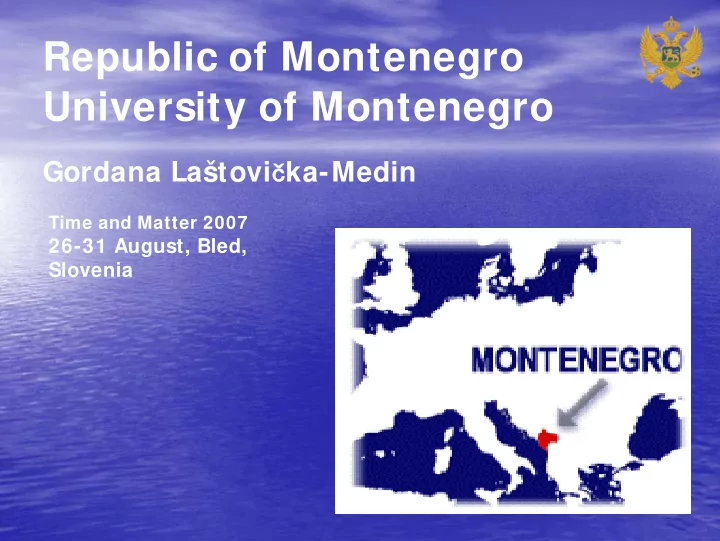
Republic of Montenegro University of Montenegro
Gordana Laštovička-Medin
Time and Matter 2007
26-31 August, Bled, Slovenia
Republic of Montenegro University of Montenegro Gordana Latovi - - PowerPoint PPT Presentation
Republic of Montenegro University of Montenegro Gordana Latovi ka-Medin Time and Matter 2007 26-31 August, Bled, Slovenia Montenegro history Montenegro history Name: reflects an adoption of the Name: reflects an adoption of the
Time and Matter 2007
26-31 August, Bled, Slovenia
Gordana La Gordana Laš štovi tovič čka ka-
Medin 2 2
Lord Byron wrote: “At the moment of the creation of our planet, the most beautiful merging of land and sea occurred at the Montenegrin seaside... when the pearls of nature were sworn, an abundance of them were strewn all over this area…”
Gordana La Gordana Laš štovi tovič čka ka-
Medin 3 3
Gordana La Gordana Laš štovi tovič čka ka-
Medin 4 4
Situated in the Mediterranean,
■ Its surface area is 13,812
square kilometers (Sicily is 25,460 square kilometers, Cyprus is 9,251 square kilometers);
■ The capital is Podgorica
(formerly Titograd) with approximately 200,000 inhabitants;
■ By its geographical position,
Montenegro belongs to the central Mediterranean that is Southern Europe.
Luštica Landscape, Skadar Lake
Gordana La Gordana Laš štovi tovič čka ka-
Medin 5 5
The two furthermost points of the country are only 190 km apart from each other in a straight line, but between them the northbound air streams of Africa meet the southbound from the Polar circle.
■ The distance between the
Montenegrin capital Podgorica and Rome is around 500 km by air, from Paris and Berlin it is around 1,500 km, from Moscow almost 2,000 km, and 7,500 km from New York.
Rivers Moraca and Ribnica , Podgorica Highest peak, Durmitor Mount
Gordana La Gordana Laš štovi tovič čka ka-
Medin 6 6
Montenegro has a diverse Climate. The South part is characterized by Mediterranean climate with long, hot and dry summers, and gentle rainy winters. The Central and northern part is characterized by mountain Climate. The North part is characterized by continental climate, with small, considerably equilibrated quantities of rainfalls, and great daily and yearly amplitudes of temperature.
■ Average temperature of the air is
27.4°C in the summer and 13.4°C in the winter.
■ 180 average sunny days per
Landscape, Durmitor Mount Mamula I sland
Gordana La Gordana Laš štovi tovič čka ka-
Medin 7 7
■ Although small in area, nature
has produced here unique contrasts - the quality and diversity of its natural and anthropological values, makes it
regions in the Mediterranean.
■ Captain Jacque Cousteau, who
investigated the pollution in the Mediterranean with his scientific team, described the Montenegrin coast the cleanest in the Mediterranean – no industrial polluters along the coast of Montenegro.
Sveti Stefan
Gordana La Gordana Laš štovi tovič čka ka-
Medin 8 8
Over a span of only 100 km in a straight line, three natural environments are distinguishable: the seaside, the karstic field zone and the high mountain region - the tourist has the possibility of taking a swim in the lakes or in the sea, rafting down the river and skiing on the mountain slopes - all in a day;
■ The Parliament of Montenegro,
in 1991, adopted the Declaration whereby Montenegro got proclaimed the first ecological state in the worl
Rijeka Crnojevica
Gordana La Gordana Laš štovi tovič čka ka-
Medin 9 9
A most attractive resource is the more than 290 km long coastline, with a multitude of beaches and inlets.
quality and many of them have been classified with the highest of grade and among the most beautiful in the Mediterranean;
■ The seaside is a very narrow
strip of land (2-10 km wide), separated from the inland by high and steep limestone mountains of Rumija, Sutorman, Orjen, and Lovcen.
Skadar Lake
Gordana La Gordana Laš štovi tovič čka ka-
Medin 10 10
The width of the Adriatic Sea is greatest between Montenegro and Southern Italy (around 200 km), and that part of the Adriatic is at the same time the deepest (greatest depth is 1.330 m at the point 120 km south-west of the Bay of Kotor).
■ An abundance of underwater
caves, shipwrecks, cliffs and rich marine life (some of it rare) make Montenegro a scuba diving heaven.
■ There are 40 lakes in
Montenegro and its rivers have still remained the purest of Europe's.
Perast (Bay of Kotor)
Gordana La Gordana Laš štovi tovič čka ka-
Medin 11 11
Tara is the longest Mountain river in Montenegro (150 km). The canyon of the river is about 80 km long cut between the mountains of Sinjajevina and Durmitor, the average depth is about 1.000m, near the town
which makes it the deepest and longest canyon of the world after the Grand Canyon of Colorado.
■ Eighty percent of the territory
is comprised of forests, natural pasturelands and meadows
Tara Canyon
Gordana La Gordana Laš štovi tovič čka ka-
Medin 12 12
A total of 2.833 plant species, many of them unique, grow here which makes up nearly a quarter
that in a mere 0.14% of the continents territory.
■ The entire northern part of
Montenegro is literally an oasis
waiting to be explored.
■ There is maybe no other country
in Europe where the nature lover can enjoy so many activities at a most diverse morphological environment, i.e. rafting, fishing, climbing, hunting, hiking, canoeing, skiing, etc.
Skadar Lake Black Lake
Gordana La Gordana Laš štovi tovič čka ka-
Medin 13 13
Four national parks and a number of other places of flora and fauna, many of which are protected by UNESCO, cover almost 1/3
■ In only the Biogradska Gora
National Park there are 86 kinds of trees and probably the only virgin forest in Europe – with trees over 500 years old.
Biogradska Gora
Gordana La Gordana Laš štovi tovič čka ka-
Medin 14 14
The population of Montenegro is 620,000 (2003).
■ The language spoken is Serbian
although with its own Montenegrin dialect.
■
It is a multi-ethnic and multi- confessional Community (majority Christian orthodox, the rest are Islamic, Roman Catholic, Jewish, Protestant and other).
■ Montenegro's traditional culture
revolves around clans, groups of patriarchal related families that at one time maintained tribal identities on their own traditional territories.
Montenegrins in ethnic costumes
Gordana La Gordana Laš štovi tovič čka ka-
Medin 15 15
Habits, customs, values and morality form a unique life philosophy – family brotherhood, tribe and the whole state upheld the military/proud spirit of the time.
■ Renowned about their bravery
forced Giuseppe Garibaldi to state: "Montenegro undoubtedly takes one of the first places; the legendary heroism of its people brings honor to mankind“.
A "gusle" player
Gordana La Gordana Laš štovi tovič čka ka-
Medin 16 16
Montenegrins have accumulated a rich cultural and historical heritage, which dates from the pre-Romanesque, Gothic and Baroque periods.
■ Montenegro has been
influenced by both eastern and western civilizations – whether these were Greeks, Illyrians, or Romans, Byzantines, Venetian, Slavs, Austro-Hungarians or Ottomans, they all left their mark forming a most interesting multicultural society.
Stećak
Gordana La Gordana Laš štovi tovič čka ka-
Medin 17 17
The historical roots of
Montenegro lie in the arrival of the Slavs in the Balkans in the 7th century AD.
■ Earlier, during the period of the
Roman Empire the area of present Montenegro greatly
Prevalitana; later called Duklia established by the Byzantines.
■ From the 11th century on, it
was called "Zeta", which was first ruled by the Balšić dynasty and later by the Crnoiević
Church door in Kotor Old Town Church door in Kotor Old Town
Gordana La Gordana Laš štovi tovič čka ka-
Medin 18 18
The Byzantine influence in architecture and art is especially felt in continental part of
monasteries are decorated with thousands
■ The Montenegrin coastal region is
especially known for its cultural monuments, such as the Cathedral of St. Tryphon, the basilica of St. Luke (over 800 years), Our Lady of the Rock (Scrpjelo), the Savina Monasteryand many others.
Fresco at Moraca monastery
Gordana La Gordana Laš štovi tovič čka ka-
Medin 19 19
The name "Montenegro" meaning Black Mountain was first mentioned in the 13th
centuries Montenegro enjoyed the status of being an independent principality ruled under the Crnojević and Petrović Dynasties.
■ Montenegro's resistance to
Ottoman attacks, which in the end resulted in strengthening its statehood, marks this time period.
Mausoleum on Lovćen
Herceg Novi, Western Montenegro
Gordana La Gordana Laš štovi tovič čka ka-
Medin 20 20
In the 15th century it remained the only unconquered and free
powerful Ottoman empire and the Venetians.
■ The printed word in Montenegro
goes way back in history. Thirty eight years after the Gutenberg's Bible, in 1493, the first printing shop in the Balkans started its
book was printed - Oktoih (from Greek οκτόηχος), a precondition for the future development of literature in Montenegro.
First book published in the Balkans A Cave next to Ostrog Monastery
Gordana La Gordana Laš štovi tovič čka ka-
Medin 21 21
Montenegro was internationally recognized as a state in 1878, after having been an independent Principality for almost five centuries. Its capital at the time was Cetinje.
■ Montenegro was declared
kingdom on August 1, 1910 during the reign of King Nikola I
■ From 1918 to 1941 it was part of
the Kingdom of Yugoslavia.
■ After the II World War, it became
Socialist Federal Republic of Yugoslavia.
King Nikola I Cetinje Monastery
Gordana La Gordana Laš štovi tovič čka ka-
Medin 22 22
In 1992, after the breakup of Communist Yugoslavia and the introduction of a multi-party political system, it became part
Yugoslavia (FRY).
■ In 2003 the FRY was renamed
to Serbia and Montenegro and
loose commonwealth.
■ A new referendum on
independence or union was in 2006, and Montenegro become independent country.
Gordana La Gordana Laš štovi tovič čka ka-
Medin 23 23
Montenegro is the only state
that uses the Euro as its currency.
The Yugoslav Dinar was abandoned in November 1999 when the German Deutsch Mark was adopted.
Pešića Lake, Bjelasica Mount
■ The real GDP growth in 2004 was
estimated to be a low 2.7% .
■
Transition is proceeding, with good results in privatization of enterprises and banks, but the administrative capacity
to implement reforms remains weak and the entrepreneurial culture needs further development.
Tara River
Gordana La Gordana Laš štovi tovič čka ka-
Medin 24 24
Over the last 50 years, industry has been the chief carrier of the economic development of Montenegro.
■ In that period, the growth of the
power industry, metallurgy (steel and aluminum), and transport infrastructure were making the basis for the overall development.
■ The industrial facilities had been
sized to the needs of the previous Yugoslavia so that 90%
was marketed outside the Republic.
Shipyard Bijela, Kotor fiord
Gordana La Gordana Laš štovi tovič čka ka-
Medin 25 25
As a result, Montenegro presently has at its disposal the facilities for producing/treating,
400,000 tons of crude steel; 1,000,000 tons of bauxite; 280,000 tones of alumna; 100,000 tons of aluminum; 75,000 tons of sea salt; 2,700,000 tons of coal. ■
The power plants (hydro-electric power plants of Perućica and Piva, and the thermoelectric power plant of Pljevlja) produce around 3 bn KWh per year.
■
Supplemented with a variety of industries, i.e. metal-works, timber, textile, chemical, Barrage , Piva river household appliances.
Barrage , Piva river
Gordana La Gordana Laš štovi tovič čka ka-
Medin 26 26
MREN – Montenegro Research and Education Network
European Commission through SEEREN2 project (FP6) and the Ministry of education and Science.
Gordana La Gordana Laš štovi tovič čka ka-
Medin 27 27
♦ Montenegrin Academy of Sciences and Arts
Gordana La Gordana Laš štovi tovič čka ka-
Medin 28 28
Faculty of Economics, of Engineering and Faculty of Economics, of Engineering and the Faculty of Law from Titograd, two the Faculty of Law from Titograd, two colleges: Teaching College from colleges: Teaching College from Nik Nikš ši ić
ć and
and Maritime Studies College from Kotor and Maritime Studies College from Kotor and three independent scientific institutes: for three independent scientific institutes: for History, for Agriculture and for Biological History, for Agriculture and for Biological and Medical Research from Titograd, and Medical Research from Titograd, signed an Agreement on Association into signed an Agreement on Association into the University in Titograd the University in Titograd.
Gordana La Gordana Laš štovi tovič čka ka-
Medin 29 29
Gordana La Gordana Laš štovi tovič čka ka-
Medin 30 30
Gordana La Gordana Laš štovi tovič čka ka-
Medin 31 31
Gordana La Gordana Laš štovi tovič čka ka-
Medin 32 32
Gordana La Gordana Laš štovi tovič čka ka-
Medin 33 33
– Education of Physicists in Montenegro begins at Department of Education of Physicists in Montenegro begins at Department of Physics at Institute for Mathematics and Physics Physics at Institute for Mathematics and Physics
– Department of Physics at Faculty of Science Department of Physics at Faculty of Science Since 1979 Since 1979 -
16 assistants from the Department of Physics got PhD 8 of those 16 PhDs were done in HEP. 8 of those 16 PhDs were done in HEP. In general, HEP is attractive and popular among young physicists In general, HEP is attractive and popular among young physicists from Department of Physics. from Department of Physics.
BUT BUT, Physicist at Department of physics are teaching stuff
, Physicist at Department of physics are teaching stuff
Departments need various profiles of Physics education
young
young people who want to do PhD in HEP can hardly expect employment people who want to do PhD in HEP can hardly expect employment at the Department at the Department
thus young people are going abroad for PhD
thus young people are going abroad for PhD study. study.
Gordana La Gordana Laš štovi tovič čka ka-
Medin 34 34
JI NR – – Dubna Dubna: was the only gate abroad for our physicists during
: was the only gate abroad for our physicists during the sanctions against Serbia and Montenegro the sanctions against Serbia and Montenegro
Propane Bubble Chamber experiment (DUBNA)
CERES/NA45 experiment (CERN)
ATLAS Project (CERN)
University of Oxford
International Linear Collider (LCFI group)
Physics I nstitute, University of Heidelberg
CERES/NA45/NxA60 experiment (CERN)
MPI Munich
H1 experiment (DESY)
ATLAS project (CERN)
Gordana La Gordana Laš štovi tovič čka ka-
Medin 35 35
NOTE: Physics from Montenegro were participating to HEP collaborations mostly (except H1 and ILC) only via other Institutes (no official membership
Gordana La Gordana Laš štovi tovič čka ka-
Medin 36 36
Gordana La Gordana Laš štovi tovič čka ka-
Medin 37 37
6 physicists from University of Montenegro involved H1 6 physicists from University of Montenegro involved H1 (5 of them are woman!)
(5 of them are woman!)
Detector performance studies Study of performances of Liquid-Argon trigger for HERA II data; Study of the FST performances and precision for HERA II data using
γ → e+ e- and K0 → π+ π – decay
channels; New hardware component - Jet Trigger - software development and implementation.
Main activities on H1 of physicists from University of Montenegro
Gordana La Gordana Laš štovi tovič čka ka-
Medin 38 38
Physics Analysis Physics Analysis
Measurement of e e+
+ p
p neutral current (DIS) neutral current (DIS) D
Deep
eep I
I nelastic
nelastic S
Scattering
cattering (e + p (e + p →
→ e + X with high momentum transfer
e + X with high momentum transfer – – Q Q2
2) cross section and the
) cross section and the structure functions (results for HERA I data obtained and p structure functions (results for HERA I data obtained and published); ublished);
Measurement of e e+
+ p
p DIS cross section and the structure functions at low DIS cross section and the structure functions at low Q Q2
2 from data collected on H1 during 1999/2000 (preliminary result e
from data collected on H1 during 1999/2000 (preliminary result exists, xists, but still work to be done; precision of measurement of F2 struct but still work to be done; precision of measurement of F2 structure function ure function expected to be on the level of 1% ); expected to be on the level of 1% );
Study of electron-
proton charged current DIS processes (e + p →
→ ν ν + X)
+ X) from HERA II data; from HERA II data;
Xi analysis and searches for Xi--
pentquark. .
Gordana La Gordana Laš štovi tovič čka ka-
Medin 39 39
The main technology being developed by LCFI is the by LCFI is the Column Parallel Charge Column Parallel Charge Coupled Device Coupled Device (CPCCD). (CPCCD).
These are composed of tiny pixels which accumulate charge when which accumulate charge when particles pass through. particles pass through.
Similar to the CCDs CCDs in digital cameras, in digital cameras, but with a but with a much faster readout much faster readout
(~ 50MHz required). (~ 50MHz required).
Montenegro HEP group engagement Jet tagging algorithms (e.g. Neural Networks) SUSY - search for Sbottom in soft b-jets, (cosmology motivated scenario).
Gordana La Gordana Laš štovi tovič čka ka-
Medin 40 40
Montenegro is country with a lot to offer. to offer.
International scientific collaboration is significantly collaboration is significantly increasing. increasing.
We would like to invite you to
the next Time and Matter Conference in Montenegro. Conference in Montenegro.
It would be our pleasure and honor It would be our pleasure and honor for University of Montenegro as well as for University of Montenegro as well as a step forward in establishing and a step forward in establishing and developing science on international developing science on international level in Montenegro. level in Montenegro.
Thank you for your attention. Thank you for your attention.
Gordana La Gordana Laš štovi tovič čka ka-
Medin 41 41
There are several hundred planes that land at the that land at the Podgorica
Podgorica and
and
Tivat Tivat airports every day during
airports every day during the high season, with visitors from the high season, with visitors from around the world. A large number around the world. A large number
port of port of Bar
Bar and the many marinas
and the many marinas along the whole coastal zone are along the whole coastal zone are ready to welcome small and ready to welcome small and medium size yachts. medium size yachts.