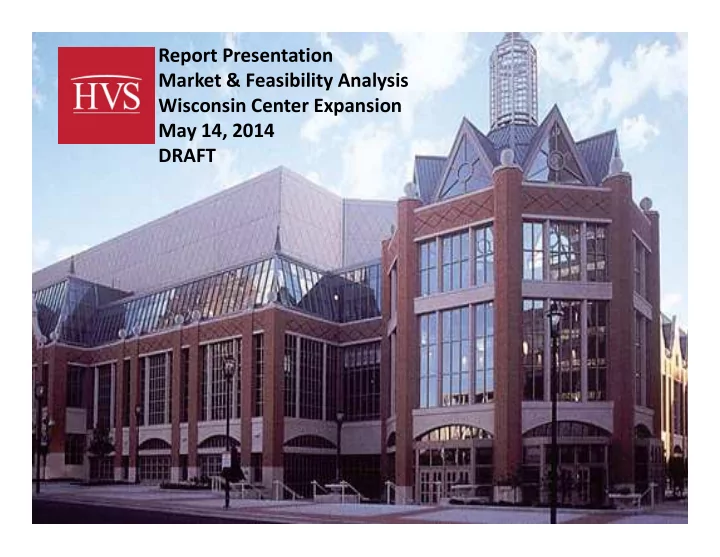
Report Presentation Market & Feasibility Analysis Wisconsin - - PowerPoint PPT Presentation

report presentation market feasibility analysis wisconsin
SMART_READER_LITE
LIVE PREVIEW

Report Presentation Market & Feasibility Analysis Wisconsin - - PowerPoint PPT Presentation

Report Presentation Market & Feasibility Analysis Wisconsin Center Expansion May 14, 2014 DRAFT Wisconsin Center Expansion Study Process The Wisconsin Center District and Visit Milwaukee engaged HVS Convention, Sports & Entertainment


slide-1
SLIDE 1

Report Presentation Market & Feasibility Analysis Wisconsin Center Expansion May 14, 2014 DRAFT

slide-2
SLIDE 2

Wisconsin Center Expansion Study Process The Wisconsin Center District and Visit Milwaukee engaged HVS Convention, Sports & Entertainment Facilities Consulting (“HVS”) and tvsdesign to conduct expansion analysis of the Wisconsin Center in Milwaukee, Wisconsin. The proposed Wisconsin Center expansion could enhance the demand potential of the meetings market in Milwaukee, and allow Milwaukee to compete more effectively for group meetings business against national, regional, and state competitors. If the expansion were part

  • f a larger mixed-use sports and entertainment complex, the Wisconsin Center

expansion could play a vital role in the redevelopment of downtown Milwaukee. The HVS analysis included:

  • - Assessment of the market’s strengths and weaknesses
  • - A detailed survey of event planners
  • - Comparative analysis with other venues and destinations
  • - Building program recommendations
  • - A concept plan for the recommended program
  • - Demand and financial forecasts
  • - An economic impact analysis

The graphic on the following page illustrates the study process.

5/14/2014 DRAFT Page 2 HVS Convention, Sports & Entertainment

slide-3
SLIDE 3

Demand Projections

Market Analysis

Preliminary Building Program

User Survey & Interviews Competitive and Comparable Venue Analysis Analysis of Financial Operations Financing Plan Sources and Use Identify Financing Sources Conceptual Plan & Cost Estimates Final Report

SITE VISIT IN MILWAUKEE AND INFORMATION GATHERING PRESENTATION OF FINDINGS AND DRAFT INTERIM REPORT FINAL PRESENTATION

Week 1 Week 2 Week 3 Week 4 Week 5 Week 6 Week 7 Week 8 Week 9 Week 10 Week 11 Week 12 Week 13 Week 14 Week 15 Week 16

Wisconsin Center Expansion Study Process

Analysis of Economic & Fiscal Impacts Hotel Supply and Demand

slide-4
SLIDE 4

Milwaukee Market Area Analysis

Page 4 HVS Convention, Sports & Entertainment

The Milwaukee market benefits from a well-diversified employment base, which has slowly improved since the 2008

  • recession. A significant number of major companies across a

broad range of business sectors provide a strong and stable corporate presence and serve as potential sources of demand for convention center spaces. Healthcare and financial services remain the cornerstones of the market and potential sources from convention, trade show, and meeting demand. The economic outlook for the area is generally positive with employment growth anticipated in most sectors.

MAJOR EMPLOYERS Firm Number of Employees Aurora Health Care 21,100 Wheaton Franciscan Healthcare 12,000 Froedtert Health 8,600 Kohl's Corporation 7,700 Roundy's Supermarkets, Inc. 6,800 GE Healthcare 6,000 Quad/Graphics, Inc. 5,600 Columbia St. Mary's 5,400 Medical College of Wisconsin 5,200 ProHealth Care, Inc. 5,000 Northwestern Mutual 5,000 Wisconsin Energy Corp. 4,700 BMO Harris Bank 4,500 Children's Hospital & Health System 4,400 Rockwell Automation 4,300 AT&T Wisconsin 3,700 Wells Fargo 3,500 US Bank 3,300 FIS 3,100 Harley Davidson Inc. 2,800 Johnson Controls 2,800 Marquette University 2,800 Potawatomi Casino 2,500 Bon-Ton Department Stores 2,500 Briggs & Stratton Corp. 2,300 0% 2% 4% 6% 8% 10% 12% 2003 2004 2005 2006 2007 2008 2009 2010 2011 2012

UNEMPLOYMENT STATISTICS

Milwaukee MSA Wisconsin 5/14/2014 DRAFT

slide-5
SLIDE 5

Milwaukee Market Area Analysis

Page 5 HVS Convention, Sports & Entertainment

Milwaukee experienced recent declines in passenger air service, which is a concern to national event planners who prefer direct air access to the destinations they choose. The manufacturing sector of the Milwaukee economy has been in decline since 1990 but overall economic growth is expected as healthcare and other service industries offset the decline in

  • manufacturing. The types of events that occur at the Wisconsin

Center are likely to reflect this economic change. The practical effect on the Wisconsin Center will be less demand for exhibit space as required by manufacturing trade shows and more demand for meeting and banquet space as required by service industry events.

HISTORICAL AND PROJECTED EMPLOYMENT (000S)

Sector/Geographic Area Beginning Amount (thousands) 1990 2002 2012 2017 Ending Amount (thousands) Milwaukee County Health Care And Social Assistance 86 151 Manufacturing 166 111 Retail Trade 103 98 State And Local Government 73 86 Accommodation And Food Services 50 66 Administrative And Waste Services 40 61 Professional And Technical Services 41 59 Finance And Insurance 54 59 Other Services, Except Public Administration 44 57 Wholesale Trade 44 42 Other 179 242 Total Milwaukee County 881 1,032 U.S. 138,331 191,297

Source: Woods & Poole Economics, Inc.

Highway access is excellent for a large majority of the population

  • f Wisconsin, which will allow the Wisconsin Center to continue

to attract state association and corporate business.

0.0 1.0 2.0 3.0 4.0 5.0 6.0 7.0 8.0 9.0 10.0 2003 2004 2005 2006 2007 2008 2009 2010 2011 2012 2013

Millions

GENERAL MITCHELL AIRPORT PASSENGER VOLUME

5/14/2014 DRAFT

slide-6
SLIDE 6

COMPARABLE VENUES Name of Venue Location State Competitors Wisconsin Center Milwaukee WI 265,841 Wisconsin Expo Center Milwaukee WI 202,727 Alliant Energy Center Madison WI 119,360 Monona Terrace Community and Convention Center Madison WI 68,370 La Crosse Center La Crosse WI 68,012 Kalahari Resorts Wisconsin Dells WI 61,342 Grand Geneva Resort & Spa Lake Geneva WI 48,166 KI Convention Center Green Bay WI 41,801 National Competitors Indiana Convention Center Indianapolis IN 737,500 Americas Center

  • St. Louis

MO 644,582 Greater Columbus Convention Center Columbus OH 634,640 Minneapolis Convention Center Minneapolis MN 597,980 Kansas City Convention Center Kansas City MO 552,954 Music City Center Nashville TN 500,593 David L. Lawrence Convention Center Pittsburgh PA 423,046 Cleveland Convention Center Cleveland OH 319,099 Duke Energy Convention Center Cincinnati OH 296,972 Kentucky International Convention Center Louisville KY 288,093 Wisconsin Center Milwaukee WI 265,841 CenturyLink Convention Center Omaha NE 258,226 DeVos Place Grand Rapids MI 234,000

Sources: Respective Venues

Total Function Space (square feet)

Comparable Venue Function Space Analysis

Page 6 HVS Convention, Sports & Entertainment

HVS compared the Wisconsin Center to seven competing state venues and to 12 comparable national venues, with respect to the amount of their function space (exhibit ballroom and meeting space). The Wisconsin Center ranks first among state venues, but is smaller than all but two national venues. The two smaller venues are in cities with smaller populations and economies than Milwaukee. The relatively small size

  • f

the Wisconsin Center limits its demand potential in two ways: 1) the venue cannot accommodate larger events, and 2) it cannot accommodate as many simultaneous events as the larger

  • competitors. As seen later in this

analysis, the lack of adequate amounts

  • f function space and date conflicts are

two reasons event planners have not used the Wisconsin Center.

5/14/2014 DRAFT

slide-7
SLIDE 7

National Competitors sf Indiana Convention Center 566,600 Americas Center 485,000 Minneapolis Convention Center 475,000 Greater Columbus Convention Center 413,640 Kansas City Convention Center 388,800 Cleveland Convention Center 375,000 Music City Center 353,143 David L. Lawrence Convention Center 313,106 Duke Energy Convention Center 195,320 CenturyLink Convention Center 194,300 Kentucky International Convention Center 191,000 Wisconsin Center 188,695 DeVos Place 162,000 Average 330,893 National Competitors sf Greater Columbus Convention Center 114,000 Kansas City Convention Center 70,394 Music City Center 65,400 Indiana Convention Center 62,173 Duke Energy Convention Center 57,311 CenturyLink Convention Center 41,876 DeVos Place 40,000 Wisconsin Center 37,506 David L. Lawrence Convention Center 33,058 Kentucky International Convention Center 30,000 Americas Center 28,416 Minneapolis Convention Center 27,522 Cleveland Convention Center Average 50,638 National Competitors sf Americas Center 131,166 Indiana Convention Center 113,302 Greater Columbus Convention Center 107,000 Minneapolis Convention Center 95,458 Kansas City Convention Center 93,760 Music City Center 82,050 David L. Lawrence Convention Center 76,882 Kentucky International Convention Center 67,093 Duke Energy Convention Center 44,341 Wisconsin Center 39,640 DeVos Place 32,000 CenturyLink Convention Center 22,050 Cleveland Convention Center Average 75,395

EXHIBIT HALL BALLROOM MEETING ROOMS

Exhibit, Ballroom, and Meeting Space Comparisons

Page 7 HVS Convention, Sports & Entertainment

HVS compared the Wisconsin Center to comparable national venues by type of functions space: exhibit, ballroom, and meeting rooms. The Wisconsin Center ranks at the bottom with respect to the available floor area of exhibit space, but near the middle of the comparable venues in the amount of ballroom space. Meeting space also appears to be deficient as the Wisconsin Center ranks third last. While this comparison illustrates the need for the increase in all types of space, exhibit and meeting space should increase more than ballroom space in

  • rder to maintain a good proportion of function spaces.

5/14/2014 DRAFT

slide-8
SLIDE 8

Ranking of Milwaukee’s National Competitors

Page 8 HVS Convention, Sports & Entertainment

To assess Milwaukee’s competitiveness as a national convention and meetings destination, HVS ranked Milwaukee and 12 comparable cities on eight criteria that indicate attractiveness as a destination. Amounts of function space, hotel capacity, air access, and cost of travel are of immediate concern to event planners. The level of population, median income, and corporate presences indicate the quality of the destination and its ability to generate local demand of the convention center. On these criteria, Milwaukee ranks nine of 13 overall. Strong rankings in adjacent hotel capacity (2) and travel costs (2) are offset by low rankings in amounts of function space (11), total hotel rooms (10), supporting population (10), median income (8), and the number of businesses (10). The previously discussed air capacity limitations place Milwaukee in the seventh rank with respect to air service.

Venue Total Function Space Adjacent Hotel Capacity Airport Passengers MSA Pop MSA Median Inc Number Bus > 500 Total Hotel Rooms Cost Index* Overall Rank Americas Center 2 3 2 2 4 2 4 6 1 Minneapolis Convention Center 4 2 1 1 1 1 7 13 2 Indiana Convention Center 1 1 8 7 5 8 2 1 3 Music City Center 6 7 3 9 9 9 1 4 4 Kansas City Convention Center 5 13 4 6 2 5 12 4 5 Greater Columbus Convention Center 3 9 9 8 7 7 3 8 6 David L. Lawrence Convention Center 7 10 6 3 10 3 6 12 7 Duke Energy Convention Center 9 6 10 4 6 4 9 10 8 Wisconsin Center 11 4 7 10 8 10 10 2 9 Cleveland Convention Center 8 12 5 5 11 6 12 11 10 CenturyLink Convention Center 12 11 11 12 3 12 8 3 11 Kentucky International Convention Center 10 5 12 11 13 11 5 7 12 DeVos Place 13 8 13 13 12 13 11 9 13

* Source: Corporate Travel Index 5/14/2014 DRAFT

slide-9
SLIDE 9

Event Planners Who Place Events in the Wisconsin Center are Highly Satisfied

Page 9 HVS Convention, Sports & Entertainment

The HVS survey asked event planners whether they used the Wisconsin Center. Of those who placed events in the Wisconsin Center, HVS asked about their level of satisfaction with various aspects of the venue and its operation. Event planners rated the Wisconsin Center on a scale of one to five with five being highly satisfied and one being highly unsatisfied. Existing users are satisfied with the amounts and quality of available spaces and with overall customer service. Food service costs and quality ranks received lower rankings indicating that price and service adjustments could improve customer satisfaction. Satisfaction is the primary indicator of the ability to generate repeat business.

4.23 4.12 4.11 4.09 3.95 3.92 3.69 3.41 3.37 3.33 2.95 Exhibit hall size Pre-event support and communication Overall customer service Ballroom size Quality of meeting space Number of breakout meeting rooms Audio/visual technology Overall food service Food & beverage quality Price of meeting space Food & beverage cost

PLANNER SATISFACTION WITH WISCONSIN CENTER

5/14/2014 DRAFT

slide-10
SLIDE 10

Page 10 HVS Convention, Sports & Entertainment

HVS designed and conducted a survey of event planners to provide a basis for assessing the potential demand for a proposed expansion of the Wisconsin

  • Center. HVS collected contact information for 597

event planners from Visit Milwaukee via email. HVS introduced the purpose of the survey and provided a link to the web-based survey. 204 respondents took the web-based survey – a 40 percent response rate. Respondents included professionals from

  • rganizations representing national, regional, state,

and local associations, government entities, corporate and

  • ther
  • rganizations.

This survey gathered information from professional event planners about their event needs and event destination preferences. In unaided questions, event planners were asked to list what they perceived to be the strengths and weaknesses

  • f

Milwaukee as a convention

  • destination. HVS categorized these responses. The

figures

  • n

the right show the percentage

  • f

respondents listing strengths or weaknesses in each

  • category. The results show that downtown Milwaukee

and its festivals are an attraction. But, the lack of capacity in existing venues and limited hotel room availability emerge as concerns for many event planners.

Event Planners Perceptions of Strengths and Weaknesses

28% 27% 26% 24% 23% 21% 18% 17% 17% 13% Downtown location, ease of local transportation Overall tourism appeal, festivals, attractions Hotel package Customer service, friendly people Low cost, good value, non-union Geography, easy access Downtown dining, retail & entertaiment options Venues Air service City size, population base

MARKET STRENGTHS

22% 21% 21% 21% 17% 15% 14% 13% 9% 6% 6% 6% 5% Insufficient venues, WC too small Insufficient hotel rooms Lack of air lift Weather Poor local transportation, no airport shuttles Poor draw for attendees, no client interest High costs Lack of destination appeal, amenities Geographic location Insufficient population base Poor customer service, lack of single contact Lack of dining, retail & entertainment options Big city issues, lack of safety, cleanliness

MARKET WEAKNESSES

5/14/2014 DRAFT

slide-11
SLIDE 11

Reasons Event Planners Have Not Placed Events at the Wisconsin Center

Page 11 HVS Convention, Sports & Entertainment

Event planners that have not placed events at the Wisconsin Center fall into two categories: those who have considered Milwaukee but chose not to come and those who never considered Milwaukee. HVS asked the latter group why they never considered

  • Milwaukee. Their lack of interest centers around

issues of destination appeal. Roughly a third of the event planners will not consider Milwaukee because it is not in their geographic rotation and little can be done to attract them to Milwaukee. Another third of event planners expressed concern about Milwaukee’s ability to attract attendees and these event planners would be more disposed to place their events in Milwaukee if steps were taken to improve its downtown destination appeal. Better destination appeal may also influence decision makers to consider Milwaukee for the first time. 56% 44%

PLANNERS CONSIDERATION OF MILWAUKEE

I have considered Milwaukee but never booked an event there. I have never considered Milwaukee as an event destination. 47% 34% 34% 28% 16% 28% Board/Selection committee has never expressed interest in Milwaukee Geography/Milwaukee is not in our rotation Concerned that attendance may be low Concerned about weather issues We have no local membership in Milwaukee Other

REASONS FOR NOT CONSIDERING MILWAUKEE

5/14/2014 DRAFT

slide-12
SLIDE 12

35% 15% 29% 21%

REASONS FOR NOT BOOKING Insufficient function space Insufficient hotel package Dates unavailable at venue Other

Event Planners that Considered Milwaukee but Did Not Come

HAVE YOU WANTED TO BOOK AN EVENT IN MILWAUKEE AND BEEN UNABLE TO DO SO?

Page 12 HVS Convention, Sports & Entertainment

27 percent of event planners wanted to place an event in Milwaukee but were unable to do so. HVS asked them why they did not

  • come. The lack of available function space and date conflicts are the leading sources of their reluctance. While banquet space

availability is not an issue, meeting and exhibition spaces are insufficient. Although Milwaukee has a favorable number of proximate hotel rooms, 57 percent of event planners indicate that they could not reserve an adequate room block.

27% 73% Yes No

47% 24% 6% 65% Exhibit space Seating capacity Banquet space Meeting room space

SPECIFIC EVENT FUNCTION SPACE THAT WAS INSUFFICIENT

57% 14% 29% 29% Available hotel room block too small Hotel room rates too high Hotel room block spread over too many properties Hotel rooms not proximate to event space

SPECIFICREASON WHYHOTEL PACKAGE WAS INSUFFICIENT

5/14/2014 DRAFT

slide-13
SLIDE 13

Frequency of Event Bookings

HVS Convention, Sports & Entertainment

HVS asked event planners to indicate their likelihood of booking an event at the Wisconsin Center if the expanded building would meet their event

  • needs. 51 percent indicated that they would be somewhat or highly likely to

book an event. HVS asked how often event planners would book events at the Wisconsin Center. Only 17 percent said never and one fourth of event planners would book at least once per year. 34% 17% 34% 6% 10% Very likely Somewhat Likely Neutral Somewhat Unlikely Very Unlikely

LIKELIHOOD OF BOOKING EVENT

7% 18% 20% 13% 26% 17% More often than once per year Once every year Every two to three years Every four

  • r five years

Less often than every five years Never

FREQUENCY OF EVENTS

Page 13 5/14/2014 DRAFT

slide-14
SLIDE 14

Page 14 HVS Convention, Sports & Entertainment

HVS Building Program Recommendations

HVS based its program recommendation on the previously discussed market, comparable venue, and event planner survey analyses. HVS program recommendations would place the proposed Wisconsin Center expansion in a position to attract new national, regional, and state conventions and tradeshows to the Milwaukee market. The venue could also serve the customer base, which faces venue size restrictions to grow. The proposed Wisconsin Center expansion would continue to accommodate local demand for conferences, meetings, banquets, and civic events. The figure below shows the amounts of existing and proposed function spaces. The figures to the right compare existing and proposed Wisconsin Center capacities to the amounts of space needed by event planners who responded to the HVS survey.

50 100 150 200 250 300

Exhibit Space Ballroom Space Meeting Space

Thousands of Square Feet

RecommendedBuilding Program

Existing Space Recommended Expansion

100,000 200,000 300,000 400,000 Exhibit SpaceRequired (SF) Events Distributed by Exhibit SpaceRequired

EXHIBITSPACE REQUIREMENTS FOR EXHIBIT EVENTS

Event planner needs Capacity before expansion Capacity after expansion 1,000 2,000 3,000 4,000 5,000 Number of Banquet Seats Required Events Distributed by BanquetSeats Required

BANQUETSEATING REQUIREMENTS FOR ALL EVENTS

Event planner needs Capacity before expansion Capacity after expansion 10 20 30 40 50 60 Number of Meeting Rooms Required Events Distributed by Meeting Rooms Required

MEETING ROOM REQUIREMENTS FORALL EVENTS

Event planner needs Capacity after expansion Capacity before expansion

5/14/2014 DRAFT

slide-15
SLIDE 15

Page 15 HVS Convention, Sports & Entertainment

Building Concept Plans

A leading architectural firm in the planning and design of convention centers—tvsdesign, translated the HVS program recommendations into a concept plan that shows how the recommendations could be implemented on the Wisconsin Center expansion site. In addition to programming the recommended function spaces, tvsdesign considered all the necessary support spaces including: pre-function areas, pedestrian horizontal and vertical circulation, service areas, mechanical and electrical spaces, vehicular access, drop-off areas, truck loading access, and parking. The concept plan provides for a seamless continuation of the existing building with the exhibition hall on the third level, meeting rooms on the second level, and new banquet and meeting space on the first level. With new drop-off areas on Kilbourn Avenue, the new space could

  • perate

in combination with existing space or independently from the rest of the building and thereby enhance the Wisconsin Center’s ability to host larger events that use the entire building or smaller events that could simultaneously use separate parts of the building. The figures on the following three pages illustrate each level

  • f the proposed expansion plan.

Expansion Site

5/14/2014 DRAFT

slide-16
SLIDE 16

Level One Expansion Conceptual Plan (by tvsdesign)

Page 16 HVS Convention, Sports & Entertainment 5/14/2014 DRAFT

slide-17
SLIDE 17

Level Two Expansion Conceptual Plan (by tvsdesign)

Page 17 HVS Convention, Sports & Entertainment 5/14/2014 DRAFT

slide-18
SLIDE 18

Level Three Expansion Conceptual Plan (by tvsdesign)

Page 18 HVS Convention, Sports & Entertainment 5/14/2014 DRAFT

slide-19
SLIDE 19

Downtown Entertainment District Development

Page 19 HVS Convention, Sports & Entertainment

Destination appeal is a critical factor in event planner choice. In a highly competitive convention center industry in which most cities offer convention center comparable venues, facility improvement alone does not create a competitive

  • advantage. The previously discussed survey demonstrates

that event planners are highly motivated to maximize attendance and choose destinations with this goal in mind. The vitality of the neighborhood surrounding a convention center creates destination appeal. San Antonio, Nashville, and Indianapolis are examples of cities that have successfully created attractive downtown environments and, as a result, experience a high degree of success in the convention

  • industry. These downtown neighborhoods also serve as a hub
  • f sports and entertainment activities for local area residents.

The Wisconsin Center and a new events center, which would replace the Bradley Center, could serve as anchors to a mixed-use entertainment district in downtown Milwaukee. This district could attract private investment with the inclusion of residential, commercial, and retail development. This mixed-use district could become a hub for entertainment activity in Milwaukee used by residents and visitors alike. The figures on the right show examples of downtown entertainment districts in other cities. The figure on the following page shows a preliminary master plan idea for a convention and entertainment district in Milwaukee. Top: The American Airlines Arena at Victory Plaza in

  • Dallas. Middle: Indiana

Convention Center and Lucan Oil Stadium. Bottom: San Antonio River Walk adjacent to the Henry B. Gonzalez Convention Center

5/14/2014 DRAFT

slide-20
SLIDE 20

Master Plan of Convention Center District (by tvsdesign)

Page 20 HVS Convention, Sports & Entertainment 5/14/2014 DRAFT

slide-21
SLIDE 21

289 275 277 296 269 271 247 209 222 217 194 195 2001 2002 2003 2004 2005 2006 2007 2008 2009 2010 2011 2012

WISCONSIN CENTER HISTORICAL EVENTS

Number of events 924 1,046 997 838 771 722 617 774 707 621 649 611 2001 2002 2003 2004 2005 2006 2007 2008 2009 2010 2011 2012

WISCONSIN CENTER HISTORICAL ATTENDANCE

Attendance (thousands)

Wisconsin Center Historical Demand

Page 21 HVS Convention, Sports & Entertainment

HVS analyzed historical trends in events and attendance at the Wisconsin Center. The Wisconsin Center District provided HVS with a summary of the Wisconsin Center’s historical demand for calendar years 2001 through 2012. The figures on the right present the total event and attendance history at the Wisconsin Center for this period. Both the number of events and the total attendance at the Wisconsin Center have declined over the past decade. Once peaking at over 300 events and one million annual attendees, the venue currently hosts approximately 200 events and 600,000 attendees each year. This decline is related to weak demand during the Great Recession and stronger competitive supply as cities such as Indianapolis, Nashville, and others have improved their venues and destinations.

5/14/2014 DRAFT

slide-22
SLIDE 22

Wisconsin Center Projected Demand

Page 22 HVS Convention, Sports & Entertainment

Based on the event information provided by the Wisconsin Center District, HVS classified event types into standard event categories to allow comparisons with other venues. The following figures provide detailed event and attendance data for the three most recent years of operation. The Wisconsin Center’s demand profile consists of a variety of exhibit-based events, meetings, and banquets. These events, which primarily use the Wisconsin Center’s exhibit, banquet, and meeting space, make up approximately 60 percent of events and 50 percent of annual attendees. Sports, entertainment, and assembly events, which primarily use the U.S. Cellular Arena and Milwaukee Theater, make up the remaining 40 percent of events and 50 percent of annual attendees. HVS estimated future performance under expansion and “do- nothing” scenarios. Under the no expansion scenario, the Wisconsin Center’s participation in the national convention market would continue to decline. Under the expansion scenario the Wisconsin Center would expand the number of trade shows, conventions, and other group business from national corporations and associations. Likewise, demand from state associations, local corporations, and other groups would grow through more simultaneous use of the building. The figure on the right compares demand under the expansion and do-nothing scenarios during a stabilized year

  • f future operations.

DEMAND PROJECTION IN A STABILIZED YEAR

No Expansion Expansion Change Events Conventions 12 18 6 Tradeshows 9 13 4 Consumer Shows/Fairs 7 12 5 Conferences 23 35 12 Meetings 19 28 9 Banquets 14 22 8 Assemblies 25 25

  • Exhibit Hall Sports

8 12 4 Concerts & Entertainment 25 25

  • Arena Sports

28 28

  • Other

2 2

  • Total

172 220 48 Total Attendance Conventions 26,000 41,000 15,000 Tradeshows 16,000 24,000 8,000 Consumer Shows/Fairs 111,000 191,000 80,000 Conferences 20,000 35,000 15,000 Meetings 9,000 13,000 4,000 Banquets 14,000 22,000 8,000 Assemblies 92,000 92,000

  • Exhibit Hall Sports

27,000 42,000 15,000 Concerts & Entertainment 156,000 156,000

  • Arena Sports

79,000 79,000

  • Other

6,000 6,000

  • Total

556,000 701,000 145,000 5/14/2014 DRAFT

slide-23
SLIDE 23

New Room Night Generation

Page 23 HVS Convention, Sports & Entertainment

The expanded Wisconsin Center would result in a greater number of higher impact conventions and trade shows in Milwaukee. Larger conventions and trade shows would bring a greater number of out-of-town visitors who require lodging. Meetings, conferences, and sporting events would similarly bring a greater percentage of attendees from outside the local market. The following figure compares projected room nights for a stabilized year of demand expansion to the projected room nights for this same year with no expansion to the Wisconsin Center.

ROOM NIGHT PROJECTIONS IN A STABILIZED YEAR

No Expansion Expansion Change Events Conventions 36,000 63,000 27,000 Tradeshows 13,000 23,500 10,500 Consumer Shows/Fairs 4,000 6,400 2,400 Conferences 19,000 37,100 18,100 Meetings 4,000 6,900 2,900 Banquets

  • 600

600 Assemblies 5,000 4,600 (400) Exhibit Hall Sports 8,000 12,000 4,000 Concerts & Entertainment 2,000 2,300 300 Arena Sports 2,000 2,300 300 Total 93,000 158,700 65,700 5/14/2014 DRAFT

slide-24
SLIDE 24

WISCONSIN CENTER EXPANSION SCENARIO “DO-NOTHING” SCENARIO

Estimated Financial Operations ($ millions in a stabilized year - 2022)

The expanded Wisconsin Center would increase food and beverage and rental revenues as the venue could attract more and larger events. As cost would increase along with the new activity in the building, the venue would continue to operate at roughly the same level of subsidy. Without expansion of the Wisconsin Center, HVS projects that demand and attendance would continue to decline due to increased competition from competing markets across the U.S. Falling rental and food and beverage revenues would lead to a greater subsidy to maintain the venue’s current operation.

Page 24 HVS Convention, Sports & Entertainment OPERATING REVENUE Facility Rental $5.4 Event Services (Gross) 5.0 Food & Beverage (Net) 4.4 Parking (Net) 0.9 Adverstising & Sponsorships 2.1 Box Office 0.7 Other Revenue 1.4 OPERATING EXPENSES Salaries & Benefits ($11.9) Event Services Costs (1.8) Contractual Services (0.2) Repair & Maintenance (2.0) Administrative & General (0.2) Marketing & Sales (0.2) Insurance (0.8) Utilities (3.2) Other Expense (1.7) OPERATING INCOME (LOSS) ($2.2)

OPERATING PRO FORMA - EXPANSION SCENARIO

OPERATING REVENUE Facility Rental $3.4 Event Services (Gross) 3.1 Food & Beverage (Net) 3.0 Parking (Net) 0.7 Adverstising & Sponsorships 2.1 Box Office 0.7 Other Revenue 1.4 OPERATING EXPENSES Salaries & Benefits ($11.4) Event Services Costs (1.1) Contractual Services (0.1) Repair & Maintenance (1.6) Administrative & General (0.2) Marketing & Sales (0.2) Insurance (0.7) Utilities (2.4) Other Expense (1.4) OPERATING INCOME (LOSS) ($4.9)

OPERATING PRO FORMA - "DO NOTHING" SCENARIO

5/14/2014 DRAFT

slide-25
SLIDE 25

Economic and Fiscal Impact Analysis Process

The Wisconsin Center generates economic impact by attracting new visitors and importing their spending or new income into the local

  • economy. Public investment in the expansion project would increase the Wisconsin Center’s economic impact by increasing use of the

venue and attracting visitors that would not otherwise come to Milwaukee. To measure this impact HVS calculated net new demand— the difference between event and attendance in the do-nothing and expansion scenarios. See the figure below.

Gross Direct Spending Net Direct Spending Indirect Spending Induced Spending Job Impacts Spending Net Tax Impacts Net New Demand

Multiplying the new demand by the amounts of spending per visitor or attendee generated gross direct spending estimates. Gross direct spending provides the inputs into the IMPLAN model of the local area economics. IMPLAN then generates estimates of total net

  • spending. Spending falls into three categories: net direct spending, indirect spending, and induced spending. Many refer to indirect and

induced impacts as multiplier effects. The sum of direct, indirect, and induced spending estimates make up the total estimated spending impact of Wisconsin Center’s operations. HVS used the IMPLAN model to estimate the increase in employment associated with the total net spending.

HVS Convention, Sports & Entertainment Page 25 5/14/2014 DRAFT

slide-26
SLIDE 26

ANNUAL RECURRING ECONOMIC IMPACT (IN 2014 DOLLARS)

HVS estimated gross direct spending from five sources: 1) overnight visitors, 2) day-trip visitors, 3) exhibitors, 4) event organizers, and 5) new spending at the proposed venue. Spending parameters are based on a national survey of convention related spending adjusted for inflation and the relative travel costs in Milwaukee. Gross direct spending provides the input into an economic model that generates estimates of net direct, indirect, and induced spending. HSV projected impacts and jobs for four geographic market areas: 1) the City of Milwaukee, 2) Milwaukee County, 3) the Milwaukee SMSA, and 4) the State of Wisconsin.

IMPLAN

HVS also used the IMPLAN model to calculate the number of permanent full-time equivalent jobs the project would create.

Page 26 HVS Convention, Sports & Entertainment Impact ($ millions) City of Milwaukee Milwaukee County Milwaukee SMSA State of Wisconsin Spending Estimates Net Direct $42.0 $38.0 $34.2 $16.8 Indirect 10.6 9.6 $12.7 $6.3 Induced 10.9 10.5 $13.6 $6.1 Total $63.5 $58.1 $60.4 $29.2 Total Permanent Jobs 644 595 577 286 Gross Direct Spending City of Milwaukee $46.7 million Milwaukee County $42.7 million Milwaukee SMSA $36.7 million State of Wisconsin $18.1 million

PRESENT VALUE OF NET SPENDING*

$ Millions City of Milwaukee $747 Milwaukee County $684 Milwaukee SMSA $608 State of Wisconsin $344

*Stated in constant 2014 dollars.

The proposed capital investment in the renovation and expansion of the Wisconsin Center would most likely be repaid over a 20- to 30-year period that coincides with the useful life of the asset. As a point of comparison with the capital investment, HVS calculated the present value of the net spending that it would generate over a 20-year period. We assumed a five percent discount rate that approximates weighted cost of public sector capital. The figure below shows the present value of spending for the City of Milwaukee and Milwaukee County.

5/14/2014 DRAFT

slide-27
SLIDE 27

EXISTING DISTRICT TAXES

During the recession in 2008 and 2009, revenues fell dramatically. In response, the WCD raised certain tax rates. The Food and Beverage Tax rate increased from 0.25% to 0.50% in 2010. The Basic Room Tax rate increased from 2.0% to 2.5% in 2011 and its maximum rate is 3.0%. The Car Rental Tax maximum rate is 4.0%. Food and Beverage Tax and the Additional Room Tax are at their maximum rate.

Page 27 HVS Convention, Sports & Entertainment

$0 $10 $20 $30 $40 Millions Car Rental (3.0% in Milwaukee County) Food and Beverage (0.5% in Milwaukee County) Additional Room (7.0% in the City of Milwaukee) Basic Room (2.5% in Milwaukee County) The Wisconsin Center District (WCD) currently collects revenue from four taxes: 1) a Basic Room Tax of 2.5% in Milwaukee County, 2) an Additional Room Tax of 7.0% in the City of Milwaukee, 3) a 0.5% Food and Beverage tax in Milwaukee County (for food consumed on premise), and 4) a 3.0% Car Rental Tax in Milwaukee County. The revenue from these taxes are pledged to debt service. The amount remaining after the payment is used to fund the marketing efforts of Visit Milwaukee and the net operating loss from WCD operations. The figure below shows the history of WCD gross tax collections from 1998 through 2013 from which the state takes a 2.55% administrative fee for collection of the taxes.

5/14/2014 DRAFT

slide-28
SLIDE 28

Financing the Project

$0 $5 $10 $15 $20 $25 $30 $35 $40 $45

M illions

AggregateDebt Service Visit Milwaukee Operating Deficit Capital Maintenance Available District Revenue Net Tax Revenue

Future Expenses and Debt Service vs. Estimated Revenues

Page 28 HVS Convention, Sports & Entertainment

As shown in the figure below, debt service, payments to Visit Milwaukee for marketing and sales, and the Wisconsin Center

  • perating deficit use nearly all available tax revenue. The WCD does not have sufficient excess capacity to additional debt
  • services. Clearly, new sources of revenue will be necessary to finance the proposed expansion.

5/14/2014 DRAFT

slide-29
SLIDE 29

Contact Information: Thomas Hazinski Managing Director HVS Convention, Sports & Entertainment 312-587-9900 Ext. 11 thazinski@hvs.com