
SLIDE 1
MINISTRY ¡OF ¡EDUCATION ¡ CURRICULUM ¡REFORMS ¡
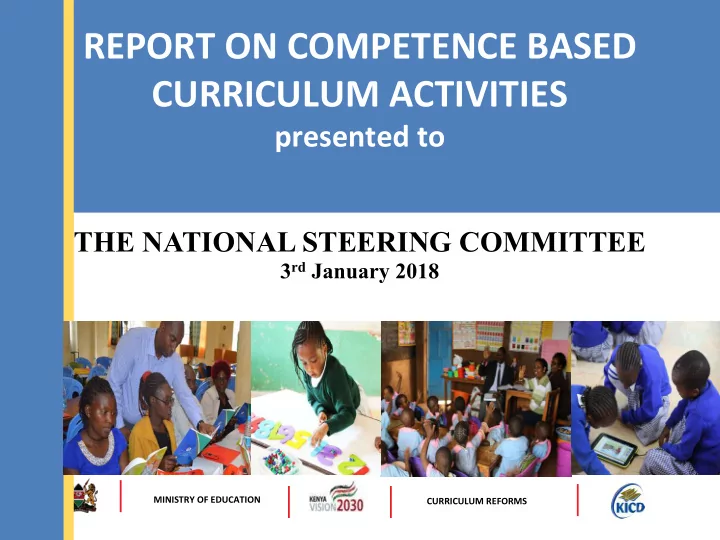
REPORT ¡ON ¡COMPETENCE ¡BASED ¡ ¡ ¡ CURRICULUM ¡ACTIVITIES ¡
presented ¡to ¡
THE NATIONAL STEERING COMMITTEE
3rd January 2018
REPORT ON COMPETENCE BASED CURRICULUM ACTIVITIES - - PowerPoint PPT Presentation
REPORT ON COMPETENCE BASED CURRICULUM ACTIVITIES presented to THE NATIONAL STEERING COMMITTEE 3 rd January 2018 MINISTRY OF EDUCATION CURRICULUM REFORMS MINISTRY OF
MINISTRY ¡OF ¡EDUCATION ¡ CURRICULUM ¡REFORMS ¡
3rd January 2018
MINISTRY ¡OF ¡EDUCATION ¡ CURRICULUM ¡REFORMS ¡
Figure ¡1: ¡Curriculum ¡Development ¡Cycle ¡
MINISTRY ¡OF ¡EDUCATION ¡ CURRICULUM ¡REFORMS ¡
Figure ¡2: ¡Basic ¡EducaHon ¡Structure ¡for ¡EYE ¡
¡ ¡
Kenyan Sign Language (KSL)
Activities
activities (CRE, IRE, HRE and PPI)
for learners who are deaf
and PPI) Activities
(Art, Craft, Music and Physical Ed.
¡ ¡
PRE-PRIMARY 1 and 2 LOWER PRIMARY Grade 1-3
*Learning ¡areas ¡have ¡been ¡adapted ¡to ¡suit ¡learners ¡with ¡special ¡needs ¡educaHon. ¡
¡
CONTENT ¡
Figure ¡3: ¡ObjecHve ¡based ¡curriculum ¡design ¡
Topic/ ¡ Theme ¡ Sub-‑ topic ¡ ObjecHves ¡ Content ¡ Teaching ¡ and ¡ learning ¡ experiences ¡ Teaching ¡ and ¡ learning ¡ resources ¡ Assessment ¡ Time ¡ AllocaHon ¡
THEME: LIVING TOGETHER IN OUR HOME AND SCHOOL 1.0 OUR HOME 1.1 Specific Objectives By the end of this topic, the learner should be able to:- a) state the meaning of a home b) name different types of houses c) identify materials used in building houses 1.2 Content
Specific Learning Outcomes Link to Other Subject Specific Learning Experiences Key Inquiry Questions Core Competences Link to PCIs CSL Assessment
Figure ¡4: ¡CBC ¡design ¡
STRAND ¡ Sub- strand ¡ Specific learning outcomes ¡ Suggested learning experiences ¡ Key inquiry questions ¡
Loco- motor Activities ¡ Jumping ¡
(K)
jumping vertically and horizontally (S)
jumping forward, backwards and sideways (S)
jumping activities with others (A) Learners could be guided to jump on or over various apparatus (ropes, benches mats) ¡ Learners explore different forms of jumping in fun games ¡ Learners to participate in jumping activities in pairs and in groups ¡ What do you need to do to jump high? ¡ Can you jump on
How did you feel jumping on or over the apparatus? ¡ How high/far can you jump? ¡ Core competences to be developed: ¡
Link to PCIs and Values: ¡ Life Skills: self-awareness, self-esteem, interpersonal relations, cooperation ¡ Link to other subjects: ¡
concept of height and distance
Table ¡1: ¡Sample ¡of ¡CBC ¡Design ¡
Community Service Learning: ¡ Learners can practice jumping activities and discuss their experiences during their leisure time. They may also observe related sports activities undertaken in their communities and in the media. ¡ Assessment Rubrics: ¡ Exceeds expectation ¡
Meets expectation ¡ Approaching expectation ¡ Below expectation ¡ Learner can jump for height, distance and direction correctly in different expressive ways. ¡ Learner can jump for height, distance and direction
Learner can jump with ease in any two forms- height, distance or
Learner can jump with ease in only one form – height, distance or direction. ¡
1. Establish the appropriateness of the curriculum designs in promoting attainment of core competencies among learning in early years education 2. Assess the ability of teachers to use the inquiry based learning approach in promoting achievement of core competencies among learners 3. Assess the adequacy of allocated time for various learning areas 4. Establish the relevance of the instructional materials in promoting achievement of core competencies among learners 5. Identify effective parental engagement strategies for the early years education level.
0.0% 10.0% 20.0% 30.0% 40.0% 50.0% 60.0% 70.0% 80.0% 90.0%
Compute ters Lapto tops Tablets ts TV TV Sc Scho hool Radio
26.3% 19.0% 23.9% 27.2% 16.5% 73.7% 81.0% 76.1% 72.8% 83.5%
Percentage Responses
ICT Devices
NO YES
Figure ¡5: ¡Availability ¡of ¡ICT ¡devices ¡in ¡the ¡schools ¡
There ¡is ¡need ¡ to ¡ensure ¡that ¡ there ¡is ¡ provision ¡of ¡ various ¡ICT ¡ devices ¡for ¡
Yes (34.5%) No (60.6%) NR
(4.9%)
Figure ¡6: ¡Teachers ¡Trained ¡on ¡ICT ¡Integra;on ¡
*NR-‑ ¡No ¡Response ¡
Yes (75.8%)
No (23.0%)
NR (1.2%) Figure ¡7: ¡Adequacy ¡of ¡space ¡in ¡the ¡classroom ¡ *NR-‑ ¡No ¡Response ¡
Yes (85.4%) No ¡ (6.6%) ¡ NR ¡ (8.0%) ¡
Figure ¡8: ¡Teachers ¡Ability ¡to ¡ derive ¡content ¡from ¡the ¡designs. ¡
[CATEGORY NAME], [VALUE] [CATEGORY NAME], [VALUE] [CATEGORY NAME], [VALUE] [CATEGORY NAME], [VALUE]
¡ ¡ ¡
[CATEGO RY NAME], [VALUE]
Percentage ¡Responses ¡ RaHngs ¡
Figure ¡9: ¡Appropriateness ¡of ¡Curriculum ¡Designs ¡in ¡ development ¡of ¡core ¡competencies. ¡
[CATEGORY NAME], [VALUE] Some Extent, [VALUE] Great Extent, [VALUE] [CATEGORY NAME], [VALUE]
Percentage ¡Responses ¡ RaHngs ¡
Figure ¡10: ¡Teachers ¡Ability ¡to ¡use ¡Inquiry ¡Based ¡learning ¡Approach ¡ ¡
Over ¡half ¡of ¡the ¡ respondents ¡ expressed ¡that ¡ they ¡were ¡able ¡ to ¡use ¡inquiry ¡ based ¡learning ¡
is ¡need ¡for ¡ adequate ¡ teacher ¡training ¡
ideal ¡for ¡CBC. ¡
Figure ¡11: ¡Relevance ¡of ¡the ¡instrucHonal ¡support ¡materials ¡
70.4% ¡of ¡the ¡ respondents ¡ found ¡the ¡ instrucFonal ¡ support ¡ materials ¡ relevant ¡for ¡CBC ¡ implementaFon ¡ as ¡they ¡were ¡ acFvity ¡based. ¡
Figure ¡12: ¡Challenges ¡in ¡implementaHon ¡of ¡CBC ¡ ¡
Fig ¡13: ¡Head ¡teachers ¡ability ¡to ¡mentor ¡and ¡support ¡teachers ¡to ¡implement ¡CBC ¡ ¡ ¡
Majority ¡of ¡head ¡ teachers ¡indicated ¡ that ¡they ¡were ¡ able ¡to ¡mentor ¡ and ¡support ¡ teachers ¡ implement ¡CBC. ¡
Fig ¡14: ¡Teachers ¡Ra;ng ¡of ¡support ¡from ¡CSOs ¡ Adequate ¡ 66.9% ¡ Not ¡ Adequate ¡ 33.1% ¡
0.0% ¡ 10.0% ¡ 20.0% ¡ 30.0% ¡ 40.0% ¡ 50.0% ¡ 60.0% ¡
Very ¡Low ¡Extent ¡ Low ¡Extent ¡ Not ¡Sure ¡ Some ¡Extent ¡ Great ¡Extent ¡
0.7% ¡ 1.4% ¡ 3.1% ¡ 52.6% ¡ 42.2% ¡ 0.3% ¡ 1.5% ¡ 2.4% ¡ 55.7% ¡ 40.1% ¡
% ¡responses ¡
success rate
Htr ¡% ¡ Trs ¡ ¡ ¡ ¡ ¡ ¡ ¡ ¡ % ¡ Fig ¡15: ¡Respondents’ ¡RaHng ¡on ¡Success ¡of ¡the ¡Pilot ¡of ¡CBC ¡in ¡their ¡Schools ¡
MINISTRY ¡OF ¡EDUCATION ¡ CURRICULUM ¡REFORMS ¡
ACTIVITY TIMEFRAME Submission of proposals Opening of bids 10th November 2017- 12.00 pm 10th November 2017 – 3.00 pm Completion of evaluation of submissions 8th December 2017 Formal approval by MTVC 19th December 2017 Release of evaluation results 21th December 2017 Publishers undertake corrections and resubmit for correction 22nd Dec 2017 – 8th January 2018 Development of English Mathematics and Kiswahili Grade 3 books Completed and under production
Table ¡2: ¡PreparaHon ¡of ¡curriculum ¡support ¡materials ¡
MINISTRY ¡OF ¡EDUCATION ¡ CURRICULUM ¡REFORMS ¡
Master Trainers TOTs training Orientation of CSOs and Champion Teachers Orientation of Head Teachers and Teachers Mentorship and support
Fig ¡16: ¡CBC ¡Teacher ¡OrientaHon ¡Cascade ¡Model ¡
Activity Time line and Suggested Venue Key Players MASTER 24 Master Trainers for primary & 47 for Pre Primary 27th Nov. – 2nd Dec. 2017 18th – 19th Dec 2017 KICD, MOE, TSC, KEMI, KISE, RTI, CEMASTEA, KNEC, CoGs TOTs 180 Trainer of Trainers (TOTS) for primary & 327 sub county ECD coordinators 4th – 9th December 2017 KICD, MOE, TSC, KEMI, KISE, RTI, CEMASTEA, KNEC, CoGs REGIONAL 3360 CSO’s & Champion Teachers training 11th – 16th December 2017 (At county level in 43 Venues) KICD, MOE, TSC, KEMI, KISE, RTI, CEMASTEA, KNEC, CSOS and Champion Teachers ZONAL 168,000 Head teachers and Teachers targeted for EYE Training December 2017 – January 2018 Training at Zonal level KICD, MOE, TSC, KEMI, KISE, RTI, CEMASTEA, KNEC, CSOS, Champion Teacher, EYE Teachers and their Head teachers
Note: KICD partnered with the Private Schools and the Counties to train their teachers at the zonal level. KICD provided the trainers. Private schools and counties catered for transport and meals for teachers.
Table ¡3: ¡Training ¡Workshops ¡Undertaken ¡
¡ ¡ ¡ ¡ ¡ ¡ ¡ ¡ ¡ ¡ ¡ ¡ ¡ ¡ ¡ ¡ ¡ ¡
¡Std.4 ¡
¡ ¡ ¡ ¡ ¡ ¡ ¡ ¡ ¡ ¡ ¡ ¡ ¡ ¡ ¡ ¡
¡ ¡
¡ ¡ ¡ ¡ ¡ ¡ ¡ ¡ ¡ ¡ ¡ ¡ ¡ ¡
¡ ¡
¡ ¡
¡ ¡
¡ ¡
¡ ¡
¡ ¡
¡ ¡
Key: ¡ ¡ ¡ ¡ ¡ ¡ ¡ ¡ ¡Phase ¡2 ¡Pilot ¡ ¡ ¡ ¡ ¡ ¡ ¡CBC ¡rollout ¡ ¡ ¡ ¡ ¡ ¡ ¡ ¡ ¡ ¡ ¡ ¡ ¡ ¡ ¡ ¡8-‑4-‑4 ¡
MINISTRY ¡OF ¡EDUCATION ¡ CURRICULUM ¡REFORMS ¡
2018 – Phase 2 National Pilot of CBC in PP1, PP2, G1, G2 in all schools
2019 – Roll out in PP1 - G4 (Last cohort of 8-4-4 will be the Standard 4) 2020 – Roll out in G5 2021 – 2027 – Yearly Roll out of G6 – 12 2024 – The first cohort of CBC join G9 (There is need to confirm where this level will be domiciled) 2025 – The first cohort in the CBC will join G10 and will be segregated according to the three pathways. By this time the required number of schools, infrastructure, facilities and human resource required for the pathways should be in place. 2027 – first cohort of CBC complete Basic Education
MINISTRY ¡OF ¡EDUCATION ¡ CURRICULUM ¡REFORMS ¡
Development of Standards for Online Curation
Supplementary, OERs, Education Apps and
to March 2016 Launched on 10th March 2016 Content Curation Nov. 2016 to March 2017 Review of digital content standards to CBC. Call for content submission Content quality assurance 15th Jan. to 30th Jan. 2018 Work plan developed On-Premise Cloud developed Public Cloud Operationalization on going
to Feb. 2018 On schedule
MINISTRY ¡OF ¡EDUCATION ¡ CURRICULUM ¡REFORMS ¡
Develop online orientation course on implementation of CBC for primary school teachers
March 2018 Work plan developed Operationalize & upgrade: (kec.ac.ke) Curriculum management portal Content dissemination and leaner resource portal CBC implementation analytics portal
April 2018 On schedule Continuous digital content submission Content quality assurance (cms.kec.ac.ke)
April 2018 Work plan developed
MINISTRY ¡OF ¡EDUCATION ¡ CURRICULUM ¡REFORMS ¡
Finalization of Curriculum designs G1 to G3 – Vol. I to Vol. VI PP1 & PP2 – Vol. I & Vol. II BECF – One Vol. 2nd to 22nd Dec. 2017 Completed Production of printed copies and dissemination to schools, COG, KICD &
27th Dec. 2017 to 26th Jan. 2018 Work plan developed On line hosting final copy of Curriculum Designs and BECF 15th Jan. 2018 Work plan developed
MINISTRY ¡OF ¡EDUCATION ¡ CURRICULUM ¡REFORMS ¡
ACTIVITY TIMEFRAME OUTPUT Completion of Sessional Paper and Curriculum Policy Quarter One, 2018 Finalized Sessional Paper and Curriculum Policy Parliamentary brief on curriculum reform Quarter One, 2018 Legal framework for Curriculum Reform Engagement with Council of Governors on anchoring of Pre-Primary Education Quarter One, 2018 Framework of engagement between national and county governments on management of pre-primary education Evaluation of the CBC to inform the roll out Quarter Two 2018 National Conference on rollout
Quarter Three 2018 Adoption of the rollout plan Full Roll out of Competence Based Curriculum January 2019 Implementation framework for CBC
MINISTRY ¡OF ¡EDUCATION ¡ CURRICULUM ¡REFORMS ¡
Kenya Institute of Curriculum Development