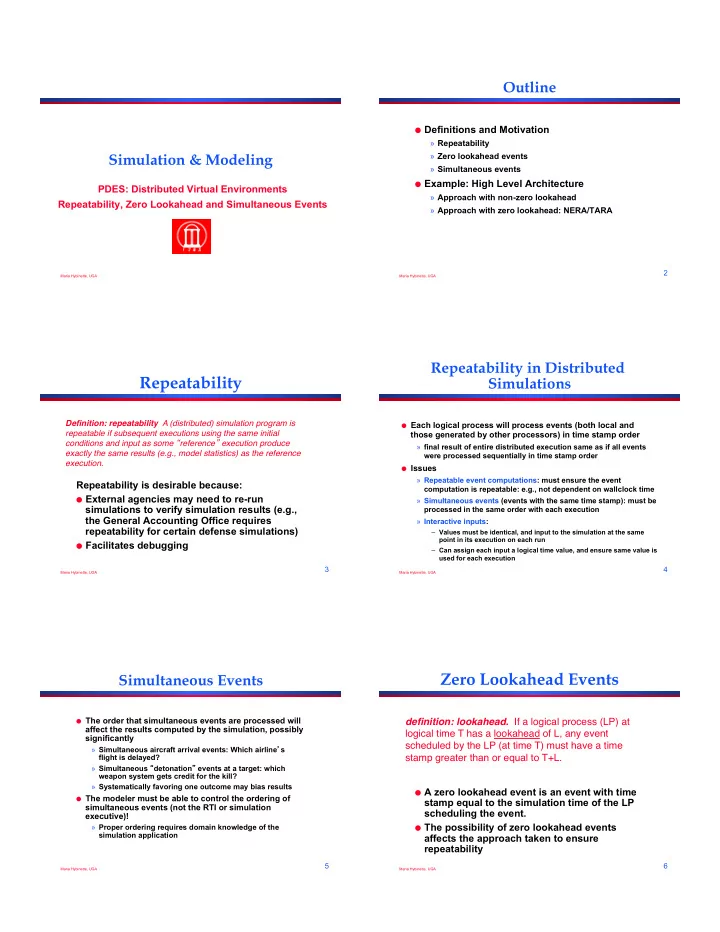
Repeatability Simulations Definition: repeatability A (distributed) - - PDF document

repeatability
SMART_READER_LITE
LIVE PREVIEW

Repeatability Simulations Definition: repeatability A (distributed) - - PDF document

Outline Definitions and Motivation Repeatability Simulation & Modeling Zero lookahead events Simultaneous events Example: High Level Architecture PDES: Distributed Virtual Environments Approach with non-zero lookahead


slide-1
SLIDE 1

Maria Hybinette, UGA

Simulation & Modeling

PDES: Distributed Virtual Environments Repeatability, Zero Lookahead and Simultaneous Events

Maria Hybinette, UGA

2

Outline

 Definitions and Motivation

» Repeatability » Zero lookahead events » Simultaneous events

 Example: High Level Architecture

» Approach with non-zero lookahead » Approach with zero lookahead: NERA/TARA

Maria Hybinette, UGA

3

Repeatability

Repeatability is desirable because:

 External agencies may need to re-run

simulations to verify simulation results (e.g., the General Accounting Office requires repeatability for certain defense simulations)

 Facilitates debugging

Definition: repeatability A (distributed) simulation program is repeatable if subsequent executions using the same initial conditions and input as some reference execution produce exactly the same results (e.g., model statistics) as the reference execution.!

Maria Hybinette, UGA

4

Repeatability in Distributed Simulations

 Each logical process will process events (both local and

those generated by other processors) in time stamp order

» final result of entire distributed execution same as if all events were processed sequentially in time stamp order

 Issues

» Repeatable event computations: must ensure the event computation is repeatable: e.g., not dependent on wallclock time » Simultaneous events (events with the same time stamp): must be processed in the same order with each execution » Interactive inputs:

– Values must be identical, and input to the simulation at the same point in its execution on each run – Can assign each input a logical time value, and ensure same value is used for each execution

Maria Hybinette, UGA

5

Simultaneous Events

 The order that simultaneous events are processed will

affect the results computed by the simulation, possibly significantly

» Simultaneous aircraft arrival events: Which airlines flight is delayed? » Simultaneous detonation events at a target: which weapon system gets credit for the kill? » Systematically favoring one outcome may bias results

 The modeler must be able to control the ordering of

simultaneous events (not the RTI or simulation executive)!

» Proper ordering requires domain knowledge of the simulation application

Maria Hybinette, UGA

6

Zero Lookahead Events

 A zero lookahead event is an event with time

stamp equal to the simulation time of the LP scheduling the event.

 The possibility of zero lookahead events

affects the approach taken to ensure repeatability definition: lookahead. If a logical process (LP) at logical time T has a lookahead of L, any event scheduled by the LP (at time T) must have a time stamp greater than or equal to T+L.

slide-2
SLIDE 2

Maria Hybinette, UGA

7

Example: High Level Architecture

 Next Event Request / Time Advance Request: If the RTI

issues a Time Advance Grant (TAG) to T, it guarantees no event will later be delivered to the federate with time stamp T (or less)

 A simple approach to ensure repeatability

» Federate invokes NER/TAR, gets a TAG to simulation time T » All simultaneous events (with time stamp T or less) have been delivered to the federate » Federate orders simultaneous events in a repeatable fashion, and processes events in this order

 What about zero lookahead events? RTI" Federate network" sort events

TSO queue"

process" events"

Maria Hybinette, UGA

8

Zero Lookahead

 Observation: If zero lookahead is allowed, a Time Advance Grant

to time T cannot guarantee delivery of all events with time stamp equal to T

Federate A RTI

  • 1. RTI issues Time

Advance Grant to time T

  • 2. Federate A sends a zero lookahead

message (time stamp T) requesting information from another federate

  • 3. Federate B sends reply message

with time stamp T (zero lookahead) to Federate A. Federate B  Because a federate cannot be guaranteed delivery of all events

with time stamp equal to T, it cannot sort them to ensure a repeatable execution.

Maria Hybinette, UGA

9

Idea: Allow Zero Lookahead

1) Allow zero lookahead federates, but 2) Provide a separate mechanism where a federate wishing to receive all events at time T can do so, but at the cost that it must temporarily have a non-zero lookahead in order to allow such a mechanism to be implemented

Maria Hybinette, UGA

10

Zero Lookahead in the HLA

 Next Event Request / Time Advance Request

» The resulting Time Advance Grant to time T guarantees all messages w/ time stamp T or less have been delivered » A federate that advanced to its current simulation time via NER/TAR cannot send zero lookahead messages (even if it has declared to the RTI its lookahead is zero)

 Two new services:

» NER Available (NERA) and TAR Available (TARA), same as NER and TAR, except grant to time T does not guarantee delivery of all events with time stamp T » Federate may send zero lookahead messages after receiving the resulting Time Advance Grant

 Note: Simultaneous events may not be delivered in the

same order on subsequent executions

Maria Hybinette, UGA

11 Next Event Request (T) Next Event Available (T’’)

Zero Lookahead allowed

Time Advance Grant (T)

Zero Lookahead allowed T

Time Advance Request(T’’)

Maria Hybinette, UGA

12

Another Approach: Wide Virtual Time

Basic idea

 Ensure there are no simultaneous events by appending

hidden bits to least significant end of time values to

  • rder events with same time value

» RTI uses hidden bits to order simultaneous events » Application ignores hidden bits when computing time values

 Use federate id and a per-federate counter to ensure

unique time stamps

» Zero lookahead events: time stamp (including hidden bits) must be greater than current time of federate

 Use application defined priority field (in hidden bits) to

control ordering of simultaneous events

slide-3
SLIDE 3

Maria Hybinette, UGA

13

Summary

 Repeatability is important for many applications  Ordering of simultaneous event can be important

» Application must have control over the ordering of simultaneous events

 Repeatable, application controlled ordering of

simultaneous events is straightforward if no zero lookahead events are allowed

» Example: HLA NER and TAR services

 Another approach is to use hidden time stamps in

fields to eliminate possibility of simultaneous events