REMS and Pharmacy pharmacist to every patient receiving the drug. - - PDF document

rems and pharmacy
SMART_READER_LITE
LIVE PREVIEW

REMS and Pharmacy pharmacist to every patient receiving the drug. - - PDF document

REMS Elements & Pharmacy MEDICATION GUIDE Document written for patients highlighting important safety information about the drug; this document must be distributed by the REMS and Pharmacy pharmacist to every patient receiving the drug.


slide-1
SLIDE 1

REMS and Pharmacy Continuing Education

Peter H. Vlasses, PharmD, DSc (Hon.), BCPS Executive Director

Food and Drug Administration Center for Drug Evaluation and Research Joint Meeting of the Anesthetic and Life Support Drugs Advisory Committee & Drug Safety and Risk Management Advisory Committee UMUC Conference Center at the Marriot, Adelphi, MD July 22, 2010, 3 pm

REMS Elements & Pharmacy

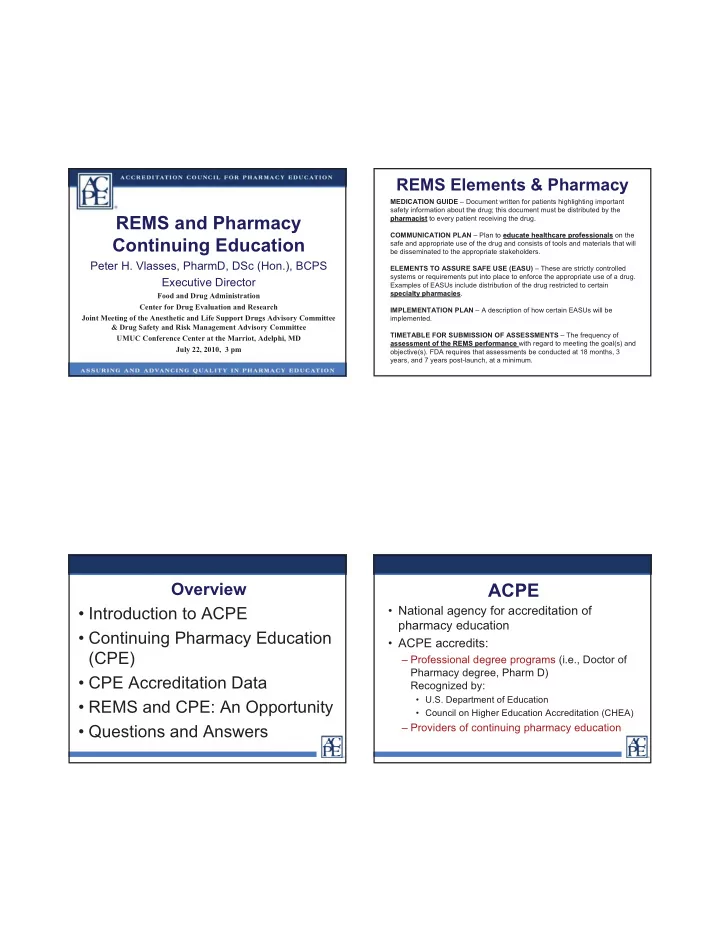
MEDICATION GUIDE – Document written for patients highlighting important safety information about the drug; this document must be distributed by the pharmacist pharmacist to every patient receiving the drug. COMMUNICATION PLAN – Plan to educate healthcare professionals educate healthcare professionals on the safe and appropriate use of the drug and consists of tools and materials that will be disseminated to the appropriate stakeholders. ELEMENTS TO ASSURE SAFE USE (EASU) – These are strictly controlled systems or requirements put into place to enforce the appropriate use of a drug. Examples of EASUs include distribution of the drug restricted to certain specialty pharmacies specialty pharmacies. IMPLEMENTATION PLAN – A description of how certain EASUs will be implemented. TIMETABLE FOR SUBMISSION OF ASSESSMENTS – The frequency of assessment of the REMS performance assessment of the REMS performance with regard to meeting the goal(s) and

  • bjective(s). FDA requires that assessments be conducted at 18 months, 3

years, and 7 years post-launch, at a minimum.

Overview

  • Introduction to ACPE
  • Continuing Pharmacy Education

(CPE)

  • CPE Accreditation Data
  • REMS and CPE: An Opportunity
  • Questions and Answers

ACPE

  • National agency for accreditation of

pharmacy education

  • ACPE accredits:

– Professional degree programs (i.e., Doctor of Pharmacy degree, Pharm D) Recognized by:

  • U.S. Department of Education
  • Council on Higher Education Accreditation (CHEA)

– Providers of continuing pharmacy education

slide-2
SLIDE 2

ACPE

  • Founded in 1932 for accreditation of professional

programs, by:

– National Association of Boards of Pharmacy (NABP) (regulators) – American Association of Colleges of Pharmacy (AACP) (educators), and – American Pharmacists Association (APhA) (practitioners)

  • Accreditation of CE Providers added in 1975;

accreditation of Certificate Programs (1999-2008)

  • ACPE is an autonomous, independent, not-for-

profit agency with headquarters in Chicago, IL

Joint Commission of Pharmacy Practitioners (JCPP) Vision

Pharmacy education and continuing education will prepare pharmacists to: 1.provide patient-centered and population-based care that optimizes medication therapy 2.manage health care system resources to improve therapeutic outcomes 3.promote health improvement, wellness, and disease prevention JCPP Vision forms basis of ACPE standards for JCPP Vision forms basis of ACPE standards for degree programs and CPE providers degree programs and CPE providers

  • +/- 280,000 licensed pharmacists in U.S.
  • All state or territory pharmacy boards require

CPE for pharmacist relicensure

  • Avg. of 15 CPE hours per year required
  • Close to 400 ACPE-accredited CPE providers
  • CPE from an ACPE-accredited provider is:

– accepted for mandatory licensure requirements by state boards of pharmacy – accepted between state boards for license transfer, or multiple licenses

CPE and Pharmacist Relicensure

ACPE Accredited CPE Provider Demographics

Group (Total n = 396) Percentage Colleges or schools 21% Educational companies 23% Hospitals, Health Care Networks 15% Local, State or National Associations 21% Publishers, Government Agencies, etc. 20%

slide-3
SLIDE 3

www.acpeaccredit.org:ACPECPEActivityDatabase

Definition of CE for the Profession of Pharmacy

Universal Activity Number 197 – 000 – 07 – 001 – L 05-T

Provider ID (001-998) Cosponsor Designator (000, 999) Topic Designator 01: Disease State/Drug therapy 02: AIDS therapy 03: Law (related to pharmacy practice) 04: General Pharmacy 05: Patient Safety (as defined by NPSF) Development/ Release Year Sequential Number Format Designator L: Live activity H: Home study C: Combined Intended Audience P: Pharmacist T: Pharmacy technician

ACPE CPE Enterprise Academic Yr 2008-2009; n = 396 providers

Participant Type Activities Participant # PHARMACISTS

25,513 3,062,909

PHARMACY TECHNICIANS

5,231 1,816,089

Changes in ACPE CE Enterprise

Academic Year 2001-2002 2008-2009

# CPE Providers 392 396 # CPE Activities 15,729 30,744 Participants (RPh and PT) 1,794,928 4,878,998 Live CPE 701,564 843,824 (39%) (17%) Homestudy CPE 1,086,230 4,031,547 (60%) (83%) Combined CPE 7,134 3,627 (1%) (<1%)

slide-4
SLIDE 4

ACPE CPE Enterprise n = 396 providers

2008-2009 Number of Activities Number of Participants REMS-relevant Activities

1,225 229,588

All Activities

30,744 4,878,998

ACPE CPE Enterprise Academic Yr 2008-2009; n = 396 providers Keyword Activities Participants

PainManagement 759 159,177 Opioids/Opiates 266 38,525 Addiction 221 28,450 SubstanceAbuse 144 23,644 Narcotics 108 35,992 DrugDiversion 95 11,711

Standards for Continuing Pharmacy Education: CPE Activities

Activity Activity Purpose Learning Assessment Assessment Feedback

Knowledge 0.25 hr Transmit knowledge Questions/recall

  • f facts

Must be provided to all participants Application 1.0 hr Apply information Case studies/ application of principles Practice 15 hr Instill knowledge, skills, attitudes Hands-on, workplace

CPE Tracker: In Development…

  • Collaboration with National

Association of Boards of Pharmacy (NABP)

  • Capture individual pharmacist CPE

activities (title, format, date, etc.)

  • Stored in secure electronic data base
  • f pharmacists’ profiles at NABP
  • Could develop REMS specific tracking

system

slide-5
SLIDE 5

StandardsforContinuingPharmacy Education:Evaluation

Standard11:EvaluationofCPEActivities Standard12:EvaluationofAchievementandImpactof CPEMissionandGoals

  • Participation
  • Satisfaction
  • Learning
  • Performance
  • PatientHealth
  • PopulationHealth

Application-based CPE Activity Knowledge-based CPE Activity Practice-based CPE Activity Practice-based CPE Activity, if applicable

Standards for Commercial Support

  • ACPE has formally adopted ACCME

Standards for Commercial Support as part

  • f CPE accreditation standards
  • Definition

– A ‘commercial interest’ is any entity producing, marketing, reselling, or distributing health care goods or services consumed by, or used on,

  • patients. Providers of clinical service directly to

patients are not ‘commercial interests’

As with CME Providers, CPE Providers, If Asked Can:

  • Produce specific CPE to support

proper use of drugs under REMS

  • Evaluate, or measure, effectiveness
  • f REMS educational activities
  • Facilitate change and data,

including individual pharmacist CPE documentation