REMBRANDT: The Late Works Thoughts on an Exhibition CODART 19 - - PowerPoint PPT Presentation

rembrandt
SMART_READER_LITE
LIVE PREVIEW

REMBRANDT: The Late Works Thoughts on an Exhibition CODART 19 - - PowerPoint PPT Presentation

REMBRANDT: The Late Works Thoughts on an Exhibition CODART 19 January 2015 Betsy Wieseman Curator of Dutch and Flemish Paintings, The National Gallery Rembrandt: The Late Works How did the idea for the exhibition come about? What were
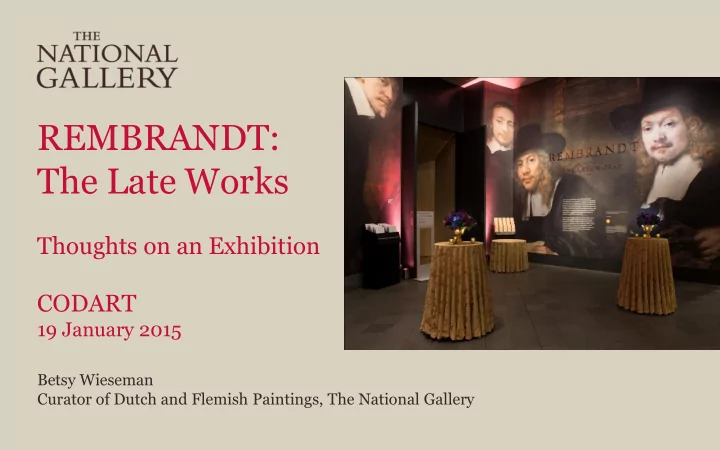

slide-1
SLIDE 1

REMBRANDT: The Late Works

Thoughts on an Exhibition CODART

19 January 2015

Betsy Wieseman Curator of Dutch and Flemish Paintings, The National Gallery

slide-2
SLIDE 2
slide-3
SLIDE 3

Rembrandt: The Late Works

  • How did the idea for the exhibition come about?
  • What were the key questions the exhibition hoped to address?
  • How is the catalogue organized? How is this reflected in the exhibition

layout?

  • Internal discussions and interpretive strategies
  • Exhibition design
  • What has been the response from press, colleagues and general public?
  • Differences between National Gallery and Rijksmuseum presentations
  • What am I proudest of / most satisfied with?
  • What would I do differently if I had to make this show again?
  • Things I have learned
  • Has my view of Rembrandt changed?
slide-4
SLIDE 4

Rembrandt: The Late Works

  • How did the idea for the exhibition come about?
slide-5
SLIDE 5
slide-6
SLIDE 6
slide-7
SLIDE 7

Rembrandt: The Late Works

  • How did the idea for the exhibition come about?
  • What were the key questions the exhibition hoped to address?
slide-8
SLIDE 8

Rembrandt: The Late Works

  • How did the idea for the exhibition come about?
  • What were the key questions the exhibition hoped to address?
  • what defines a ‘late’ Rembrandt, in terms of formal/stylistic or

iconographic characteristics?

slide-9
SLIDE 9

Rembrandt: The Late Works

  • How did the idea for the exhibition come about?
  • What were the key questions the exhibition hoped to address?
  • what defines a ‘late’ Rembrandt, in terms of formal/stylistic or

iconographic characteristics?

  • when does ‘late’ Rembrandt begin? (on stylistic grounds, settled on

1652 for works on paper, 1654 for paintings)

slide-10
SLIDE 10

Rembrandt: The Late Works

  • How did the idea for the exhibition come about?
  • What were the key questions the exhibition hoped to address?
  • How is the catalogue organized? How is this reflected in the exhibition

layout?

slide-11
SLIDE 11

Rembrandt: The Late Works

Self-scrutiny Formal concerns

  • Observation of everyday life
  • Emulation (engagement with the work of earlier masters)
  • Artistic conventions
  • Experimental technique
  • Light

Iconographic concerns

  • Intimacy
  • Contemplation
  • Inner Conflict
  • Reconciliation
slide-12
SLIDE 12
slide-13
SLIDE 13
slide-14
SLIDE 14

Rembrandt: The Late Works

  • How did the idea for the exhibition come about?
  • What were the key questions the exhibition hoped to address?
  • How is the catalogue organized? How is this reflected in the exhibition

layout?

  • Internal discussions and interpretive strategies
slide-15
SLIDE 15

Rembrandt: The Late Works

  • How did the idea for the exhibition come about?
  • What were the key questions the exhibition hoped to address?
  • How is the catalogue organized? How is this reflected in the exhibition

layout?

  • Internal discussions and interpretive strategies
  • Exhibition design
slide-16
SLIDE 16
slide-17
SLIDE 17
slide-18
SLIDE 18
slide-19
SLIDE 19
slide-20
SLIDE 20
slide-21
SLIDE 21

Rembrandt: The Late Works

  • How did the idea for the exhibition come about?
  • What were the key questions the exhibition hoped to address?
  • How is the catalogue organized? How is this reflected in the exhibition

layout?

  • Internal discussions and interpretive strategies
  • Exhibition design
  • What has been the response from press, colleagues and general public?
slide-22
SLIDE 22

Rembrandt: The Late Works

  • How did the idea for the exhibition come about?
  • What were the key questions the exhibition hoped to address?
  • How is the catalogue organized? How is this reflected in the exhibition

layout?

  • Internal discussions and interpretive strategies
  • Exhibition design
  • What has been the response from press, colleagues and general public?
  • Differences between National Gallery and Rijksmuseum presentations
slide-23
SLIDE 23
slide-24
SLIDE 24

Rembrandt: The Late Works

  • How did the idea for the exhibition come about?
  • What were the key questions the exhibition hoped to address?
  • How is the catalogue organized? How is this reflected in the exhibition

layout?

  • Internal discussions and interpretive strategies
  • Exhibition design
  • What has been the response from press, colleagues and general public?
  • Differences between National Gallery and Rijksmuseum presentations
  • What am I proudest of / most satisfied with?
slide-25
SLIDE 25

Rembrandt: The Late Works

  • How did the idea for the exhibition come about?
  • What were the key questions the exhibition hoped to address?
  • How is the catalogue organized? How is this reflected in the exhibition

layout?

  • Internal discussions and interpretive strategies
  • Exhibition design
  • What has been the response from press, colleagues and general public?
  • Differences between National Gallery and Rijksmuseum presentations
  • What am I proudest of / most satisfied with?
  • What would I do differently if I had to make this show again?
slide-26
SLIDE 26

Rembrandt: The Late Works

  • How did the idea for the exhibition come about?
  • What were the key questions the exhibition hoped to address?
  • How is the catalogue organized? How is this reflected in the exhibition

layout?

  • Internal discussions and interpretive strategies
  • Exhibition design
  • What has been the response from press, colleagues and general public?
  • Differences between National Gallery and Rijksmuseum presentations
  • What am I proudest of / most satisfied with?
  • What would I do differently if I had to make this show again?
  • Things I have learned
slide-27
SLIDE 27
slide-28
SLIDE 28
slide-29
SLIDE 29
slide-30
SLIDE 30

Rembrandt: The Late Works

  • How did the idea for the exhibition come about?
  • What were the key questions the exhibition hoped to address?
  • How is the catalogue organized? How is this reflected in the exhibition

layout?

  • Internal discussions and interpretive strategies
  • Exhibition design
  • What has been the response from press, colleagues and general public?
  • Differences between National Gallery and Rijksmuseum presentations
  • What am I proudest of / most satisfied with?
  • What would I do differently if I had to make this show again?
  • Things I have learned
  • Has my view of Rembrandt changed?
slide-31
SLIDE 31
slide-32
SLIDE 32

Postcard top ten