Remarks on Scheepers Theorem on the cardinality of Lindel of spaces - - PowerPoint PPT Presentation

remarks on scheepers theorem on the cardinality of lindel
SMART_READER_LITE
LIVE PREVIEW

Remarks on Scheepers Theorem on the cardinality of Lindel of spaces - - PowerPoint PPT Presentation

Remarks on Scheepers Theorem on the cardinality of Lindel of spaces Masaru Kada (Osaka Prefecture University, Japan) RIMS conference Interplay between large cardinals and small cardinals Kyoto,


slide-1
SLIDE 1

Remarks on Scheepers’ Theorem

  • n the cardinality of Lindel¨
  • f spaces

Masaru Kada

(Osaka Prefecture University, Japan)

嘉田 勝

(大阪府立大学)
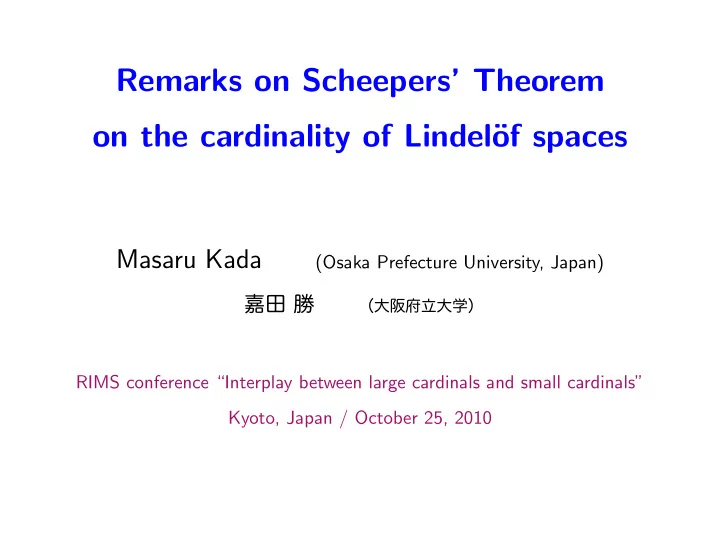
RIMS conference “Interplay between large cardinals and small cardinals” Kyoto, Japan / October 25, 2010

slide-2
SLIDE 2

Summary

Theorem (Scheepers, 2010) CON(∃ measurable) ⇒ CON(every points-Gδ indestructibly Lindel¨

  • f space has size ≤ 2ℵ0)

This exhibits an interplay between large cardinals and small cardinals! We will briefly review the role of – a measurable cardinal and – combinatorial (game-theoretic?) properties of precipitous ideals in the proof of the above theorem.

slide-3
SLIDE 3

Background: The cardinality of Lindel¨

  • f spaces

Theorem (Arhangel’ski˘ ı, 1969) First-countable T2 Lindel¨

  • f spaces have cardinality ≤ 2ℵ0.

Question: What about points-Gδ T2 Lindel¨

  • f spaces?

(Remark: points-Gδ spaces are T1, but not necessarily T2)

slide-4
SLIDE 4

Background: The cardinality of Lindel¨

  • f spaces

Theorem (Arhangel’ski˘ ı, 1969) First-countable T2 Lindel¨

  • f spaces have cardinality ≤ 2ℵ0.

Question: What about points-Gδ T2 Lindel¨

  • f spaces?

Consistent negative answer: Theorem (Shelah, 1996)(Gorelic, 1993) CON ( ZFC + CH + ∃ 0-dim. points-Gδ Lindel¨

  • f space of size 2ℵ1)

The consistency of a positive answer is open.

slide-5
SLIDE 5

Background: The cardinality of Lindel¨

  • f spaces

Theorem (Arhangel’ski˘ ı, 1969) First-countable T2 Lindel¨

  • f spaces have cardinality ≤ 2ℵ0.

Question: What about points-Gδ T2 Lindel¨

  • f spaces?

A known ZFC-provable upper bound for T1 spaces: Theorem (Arhangel’ski˘ ı) Points-Gδ Lindel¨

  • f spaces have cardinality < the least measurable.

Theorem (Juh´ asz) There are points-Gδ (but not T2) Lindel¨

  • f spaces of arbitrarily large cardi-

nality below the least measurable.

slide-6
SLIDE 6

Indestructible Lindel¨

  • fness

Definition (Tall) A Lindel¨

  • f space (X, τ) is indestructibly Lindel¨
  • f if its Lindel¨
  • fness is

preserved by any <ω1-closed forcing notion.

slide-7
SLIDE 7

Indestructible Lindel¨

  • fness

Definition (Tall) A Lindel¨

  • f space (X, τ) is indestructibly Lindel¨
  • f if its Lindel¨
  • fness is

preserved by any <ω1-closed forcing notion. Terminology For a Lindel¨

  • f space (X, τ),

P preserves Lindel¨

  • fness of (X, τ) if ( ˇ

X, τ P) is forced to be Lindel¨

  • f in

VP, where τ P is a P-name for the topology generated by ˇ τ.

slide-8
SLIDE 8

Indestructible Lindel¨

  • fness

Definition (Tall) A Lindel¨

  • f space (X, τ) is indestructibly Lindel¨
  • f if its Lindel¨
  • fness is

preserved by any <ω1-closed forcing notion. Example

  • Hereditarily Lindel¨
  • f spaces are indestructible. Consequently, any

subspace of a Euclidean space Rn is indestructibly Lindel¨

  • f.
  • The Lindel¨
  • fness of 2ω1 is destroyed by adding a Cohen subset of

ω1 with countable conditions (forcing with Fn(ω1, 2, ω1)).

slide-9
SLIDE 9

Games on topological spaces of transfinite length

Game G<ω1

1

(O, O) on (X, τ): One U0 U1 U2 · · · Uξ · · · Two O0 O1 O2 · · · Oξ · · · For each ξ < ω1, Uξ is an open cover of (X, τ); Oξ ∈ Uξ. Two wins if ∃γ < ω1 [ ∪{Oξ : ξ < γ} = X ] .

Remark ∪{Oξ : ξ < ω1} = X is not enough for Two to win!

slide-10
SLIDE 10

Games on topological spaces of transfinite length

Game G<ω1

1

(O, O) on (X, τ): One U0 U1 U2 · · · Uξ · · · Two O0 O1 O2 · · · Oξ · · · For each ξ < ω1, Uξ is an open cover of (X, τ); Oξ ∈ Uξ. Two wins if ∃γ < ω1 [ ∪{Oξ : ξ < γ} = X ] . Theorem (Scheepers–Tall) (X, τ) is indestructibly Lindel¨

  • f

⇐ ⇒ One does not have a winning strategy in G<ω1

1

(O, O) on (X, τ)

slide-11
SLIDE 11

Cardinality of indestructibly Lindel¨

  • f spaces

Question Is there a smaller upper bound for the cardinality of points-Gδ indestructibly Lindel¨

  • f spaces than the least measurable?

Recall: Theorem (Arhangel’ski˘ ı) Points-Gδ Lindel¨

  • f spaces have cardinality < the least measurable.

Theorem (Juh´ asz) There are points-Gδ (but not T2) Lindel¨

  • f spaces of arbitrarily large cardinality below the

least measurable.

slide-12
SLIDE 12

Cardinality of indestructibly Lindel¨

  • f spaces

Question Is there a smaller upper bound for the cardinality of points-Gδ indestructibly Lindel¨

  • f spaces than the least measurable?

Theorem (Tall, 1995) CON (∃ supercompact) ⇒ CON (CH + every points-Gδ indestructibly Lindel¨

  • f space has size ≤ ℵ1)
slide-13
SLIDE 13

Cardinality of indestructibly Lindel¨

  • f spaces

Question Is there a smaller upper bound for the cardinality of points-Gδ indestructibly Lindel¨

  • f spaces than the least measurable?

Theorem (Tall, 1995) CON (∃ supercompact) ⇒ CON (CH + every points-Gδ indestructibly Lindel¨

  • f space has size ≤ ℵ1)

Theorem (Scheepers, 2010) CON (∃ measurable) ⇒ CON ( every points-Gδ indestructibly Lindel¨

  • f space has size ≤ 2ℵ0)

(Scheepers’ method allows us some flexibility of the value of 2ℵ0.)

slide-14
SLIDE 14

Games related to precipitous ideals

I: a nonprincipal ℵ1-complete (not necessarily κ-complete) ideal on κ Game G(I): One O0 O1 O2 · · · On · · · Two T0 T1 T2 · · · Tn · · · On’s, Tn’s are all from I+, O0 ⊇ T0 ⊇ O1 ⊇ · · · ⊇ On ⊇ Tn ⊇ · · · . Two wins ⇐ ⇒ ∩

n<ω Tn ̸= ∅

Definition I is weakly precipitous ⇐ ⇒ One does not have a w.s. in G(I)

(Note: I is precipitous ⇐ ⇒ I is κ-complete and weakly precipitous)

slide-15
SLIDE 15

Games related to precipitous ideals (cont’d)

I: a nonprincipal ℵ1-complete (not necessarily κ-complete) ideal on κ Game DGω(I+, ⊆): One O0 O1 O2 · · · On · · · Two T0 T1 T2 · · · Tn · · · On’s, Tn’s are all from I+, O0 ⊇ T0 ⊇ O1 ⊇ · · · ⊇ On ⊇ Tn ⊇ · · · . Two wins ⇐ ⇒ ∩

n<ω Tn ∈ I+

(A descending chain (Banach–Mazur) game on a poset (I+, ⊆))

slide-16
SLIDE 16

Descending chain games of transfinite length

I: a nonprincipal ℵ1-complete (not necessarily κ-complete) ideal on κ Game DG<ω1

Two(I+, ⊆):

One O0 O1 · · ·

(pass)

Oω+1 · · · Oξ · · · Two T0 T1 · · · Tω Tω+1 · · · Tξ · · · Oξ’s, Tξ’s (ξ < ω1) are all from I+. In each limit inning Two has the initiative. O0 ⊇ T0 ⊇ O1 ⊇ · · · ⊇ Tω ⊇ Oω+1 ⊇ Tω+1 ⊇ · · · ⊇ Oξ ⊇ Tξ ⊇ · · · . Two wins ⇐ ⇒ the play is sustained all over ω1 innings

(A descending chain (Banach–Mazur) game on a poset (I+, ⊆) of transfinite length)

slide-17
SLIDE 17

Descending chain games of transfinite length (cont’d)

Theorem (Foreman)(Veliˇ ckovi´ c) For a poset (P, ≤), Two has a w.s. in DGω(P, ≤) ⇐ ⇒ Two has a w.s. in DG<ω1

Two(P, ≤)

In particular, Two has a w.s. in DGω(I+, ⊆) ⇐ ⇒ Two has a w.s. in DG<ω1

Two(I+, ⊆)

slide-18
SLIDE 18

Diagram

For a nonprincipal <ℵ1-complete ideal I on κ: I: dual of measure u.f. − − − − − → I is precipitous ? ? y ? ? y Two ↑tactic DGω(I+, ⊆) ↓ ? ? y ? ? y Two ↑ DG<ω1

Two (I+, ⊆)

Two ↑ DGω(I+, ⊆) ↓ ? ? y ? ? y ? ? y One ̸↑ DG<ω1

Two (I+, ⊆) −

− − − − → One ̸↑ DGω(I+, ⊆) ↓ ? ? y ? ? y One ̸↑ G(I) I is weakly precipitous

slide-19
SLIDE 19

Diagram

κ is measurable κ > 2ℵ0 κ may be ℵ1 I: dual of measure u.f. − − − − − → I is precipitous ? ? y ? ? y Two ↑tactic DGω(I+, ⊆) ↓ ? ? y ? ? y Two ↑ DG<ω1

Two (I+, ⊆)

Two ↑ DGω(I+, ⊆) ↓ ? ? y ? ? y ? ? y One ̸↑ DG<ω1

Two (I+, ⊆) −

− − − − → One ̸↑ DGω(I+, ⊆) ↓ ? ? y ? ? y One ̸↑ G(I) I is weakly precipitous

slide-20
SLIDE 20

Diagram

After collapsing a measurable κ to ℵ1, I (the dual of the measure u.f.) satisfies: I: dual of measure u.f. − − − − − → I is precipitous ? ? y ? ? y Two ↑tactic DGω(I+, ⊆) ↓ ? ? y ? ? y Two ↑ DG<ω1

Two (I+, ⊆)

Two ↑ DGω(I+, ⊆) ↓ ? ? y ? ? y ? ? y One ̸↑ DG<ω1

Two (I+, ⊆) −

− − − − → One ̸↑ DGω(I+, ⊆) ↓ ? ? y ? ? y One ̸↑ G(I) I is weakly precipitous

slide-21
SLIDE 21

Diagram

After collapsing a measurable κ to ℵ2, I (the dual of the measure u.f.) satisfies: I: dual of measure u.f. − − − − − → I is precipitous ? ? y ? ? y Two ↑tactic DGω(I+, ⊆) ↓ ? ? y ? ? y Two ↑ DG<ω1

Two (I+, ⊆)

Two ↑ DGω(I+, ⊆) ↓ ? ? y ? ? y ? ? y One ̸↑ DG<ω1

Two (I+, ⊆) −

− − − − → One ̸↑ DGω(I+, ⊆) ↓ ? ? y ? ? y One ̸↑ G(I) I is weakly precipitous

slide-22
SLIDE 22

The main theorem

Theorem (Scheepers) If there is a nonprincipal ℵ1-complete ideal I on κ such that Two has a winning tactic in DGω(I+, ⊆), then every points-Gδ indestructibly Lindel¨

  • f space has cardinality < κ.
slide-23
SLIDE 23

The main theorem

Theorem (Scheepers) If there is a nonprincipal ℵ1-complete ideal I on κ such that Two has a winning tactic in DGω(I+, ⊆), then every points-Gδ indestructibly Lindel¨

  • f space has cardinality < κ.

Now, by collapsing a measurable cardinal κ to ℵ2, we obtain a model where every points-Gδ indestructibly Lindel¨

  • f space

has cardinality ≤ ℵ1 = 2ℵ0.

Raising 2ℵ0 with λ+ random reals and then collapsing κ to λ++ allows us to force “every points-Gδ indestructibly Lindel¨

  • f space has cardinality ≤ λ+ = 2ℵ0.”
slide-24
SLIDE 24

The main theorem

Theorem (Scheepers) If there is a nonprincipal ℵ1-complete ideal I on κ such that Two has a winning tactic in DGω(I+, ⊆), then every points-Gδ indestructibly Lindel¨

  • f space has cardinality < κ.

Actually the above theorem can be slightly improved as follows:

Theorem If there is a nonprincipal ℵ1-complete ideal I on κ such that Two has a winning stragety in DGω(I+, ⊆), then every points-Gδ indestructibly Lindel¨

  • f space has cardinality < κ.
slide-25
SLIDE 25

How games work

What we actually prove is the following statement:

If there is a nonprincipal ℵ1-complete ideal I on κ such that Two has a winning stragety in DG<ω1

Two(I+, ⊆),

then, for any points-Gδ space (X, τ) with |X| ≥ κ, One has a winning strategy in G<ω1

1

(O, O) on (X, τ). The proof goes along the plays of two games, DG<ω1

Two(I+, ⊆)

and G<ω1

1

(O, O) on (X, τ), which are simultaneously played.

slide-26
SLIDE 26

How games work (cont’d)

A (very rough) sketch of the proof: Lemma Let I be a nonprincipal ℵ1-complete ideal on κ, X a points-Gδ space with X ⊇ κ. Then for each x ∈ X, B ∈ I+ and 〈Un : n < ω〉: a sequence of open neighborhoods of x such that S

n<ω Un = {x}, there is a C ∈ I+ such that C ⊆ B and Un ∩ C ∈ I for all n.

Using the above lemma, we find out a winning strategy for One in G<ω1

1

(O, O) on X. For each x ∈ X fix a ⊆-decreasing sequence 〈Ux,n : n < ω〉 of neighborhoods of x whose intersection is {x}. In each α-th inning One will play an open cover of X of the form {Ux,fα(x,n) : x ∈ X} for some fα : X → ω. We shall manipulate fα’s to lead One to win the game. The winning strategy for Two in another game DG<ω1

Two (I+, ⊆) and the above

lemma help us defend an I-positive “off-limits area” against Two’s attempt to complete a cover of X.

slide-27
SLIDE 27

Conclusion

We have reviewed how the following theorem is proved: Theorem (Scheepers, 2010) CON(∃ measurable) ⇒ CON(every points-Gδ indestructibly Lindel¨

  • f space has size ≤ 2ℵ0)

and ...

slide-28
SLIDE 28

Conclusion

We have reviewed how the following theorem is proved: Theorem (Scheepers, 2010) CON(∃ measurable) ⇒ CON(every points-Gδ indestructibly Lindel¨

  • f space has size ≤ 2ℵ0)

and (hopefully) examined how large cardinals and small cardinals interplay! Thank you for your attention!

Remarks on Scheepers’ Theorem on the cardinality of Lindel¨

  • f spaces

Masaru Kada (Osaka Prefecture University, Japan)