Relationship-Centered interactions in your career? Care leads to - - PDF document

relationship centered
SMART_READER_LITE
LIVE PREVIEW

Relationship-Centered interactions in your career? Care leads to - - PDF document

Relationship-Centered Communication 2014 Disclosures Relationship-Centered Communication All proceeds from I M P R O V I N G P A T I E N T A N D C L I N I C I A N sales go directly to E X P E R I E N C E S the Academy of C A L V I N C


slide-1
SLIDE 1

Relationship-Centered Communication 2014 AACH 1

I M P R O V I N G P A T I E N T A N D C L I N I C I A N E X P E R I E N C E S C A L V I N C H O U , M D , P H D P R O F E S S O R O F C L I N I C A L M E D I C I N E U C S F

Relationship-Centered Communication

Disclosures

All proceeds from sales go directly to the Academy of Communication in Healthcare

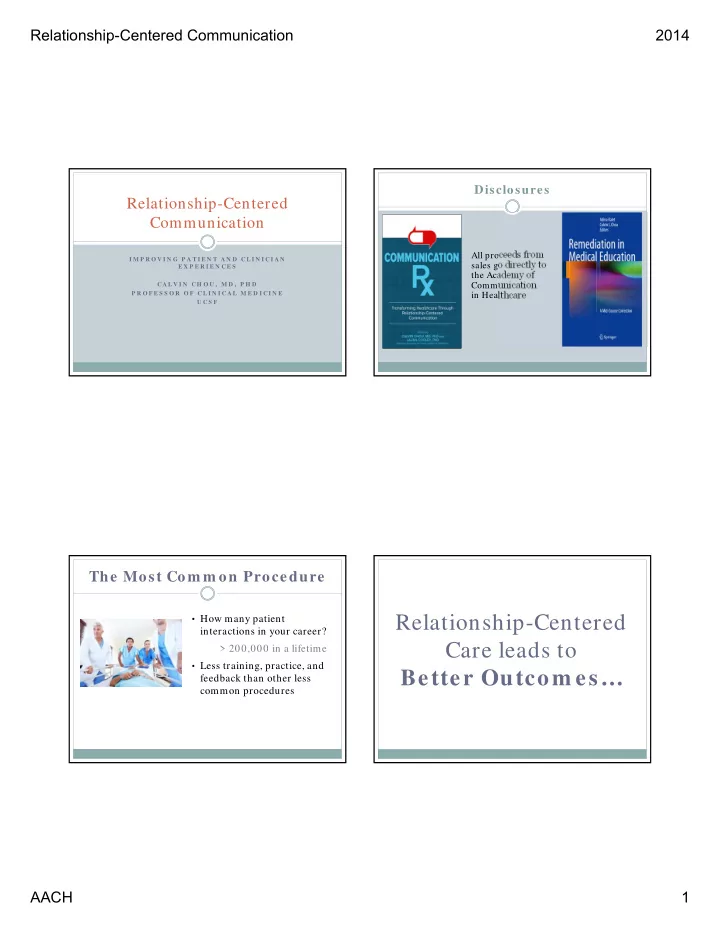
The Most Com m on Procedure

  • How many patient

interactions in your career? > 200,000 in a lifetime

  • Less training, practice, and

feedback than other less common procedures

Relationship-Centered Care leads to Better Outcom es…

slide-2
SLIDE 2

Relationship-Centered Communication 2014 AACH 2 For Patients

 Diabetes  Pain management  Adherence to

medications

 Satisfaction with

care experiences

Safran et al, J Fam Pract 1998; Stewart et al, J Fam Pract 2000; Levinson et al, Health Affairs 2010; Dwam ena et al, Cochrane Database Syst Rev 2012; Hojat et al, Acad Med 2013; Kennedy et al, Pat Experience J 2014

For Clinicians & Team s

Engagement

Satisfaction

Workload stress

Medical malpractice

Levinson et al, JAMA 1997; Krasner et al, JAMA 2009

For Institutions

 H/ CG-CAHPS  Work Environment  Job Satisfaction

Like any procedure…

 Skills can be learned and

taught

 Mastery requires

deliberate practice and feedback

Ericsson, Acad Med 2004; Tulsky, J Pall Med 2005; Dwam ena et al, Cochrane Database Syst Rev 2012; Archer, Med Educ, 2010

slide-3
SLIDE 3

Relationship-Centered Communication 2014 AACH 3

Specific Skills to Adopt

 Collaborative agenda-

setting

 Empathic statements  Teach-back

Collaborative Agenda-Setting

 Elicit a LIST of all items  Set a specific agenda:

state your goals and ask the patient to prioritize

 Great for

 Patients: more concerns

voiced; better physical and behavioral health outcomes

 Providers: decreased door-

knob questions; higher patient ratings

Alam o, 2002; Brock 2011; Heritage, 2007; Mauksch, 2001; Kaplan 1989

Em pathic Statem ents Em pathic Statem ents

 Partnership  Empathy  Appreciation  Respect  Legitimization  Support

Chou and Cooley 2018; Epstein 2017; Hart 2006; Kinsm an 2010; Riess 2012; Roter 1995

slide-4
SLIDE 4

Relationship-Centered Communication 2014 AACH 4

Em pathy Saves Tim e

Addressed em otional cues Didn’t address em otional cues Internists 17.6 min visits 20.1 min visits Surgeons 12.5 min visits 14 min visits

Levinson et al, JAMA 2000; Hojat et al, Acad Med 2011

The ART of Teach-back

 ASK the patient to

summarize

 REFLECT or reinforce

what the patient says

 TELL any additional

necessary material

Schillinger et al, 2003; Schenker et al, 2011

Where to hone these skills

 UCSF: Center for

Enhancement of Communication in Healthcare (CECH)

 ZSFG: Improving Patient

Experiences Through Communication

 Perhaps your own

institution

 National courses through

the Academy of Communication in Healthcare

Recap

 Collaborative

agenda-setting

 Empathic

statements

 Teach-back  Great for patients

and for us

 Can be taught and

practiced